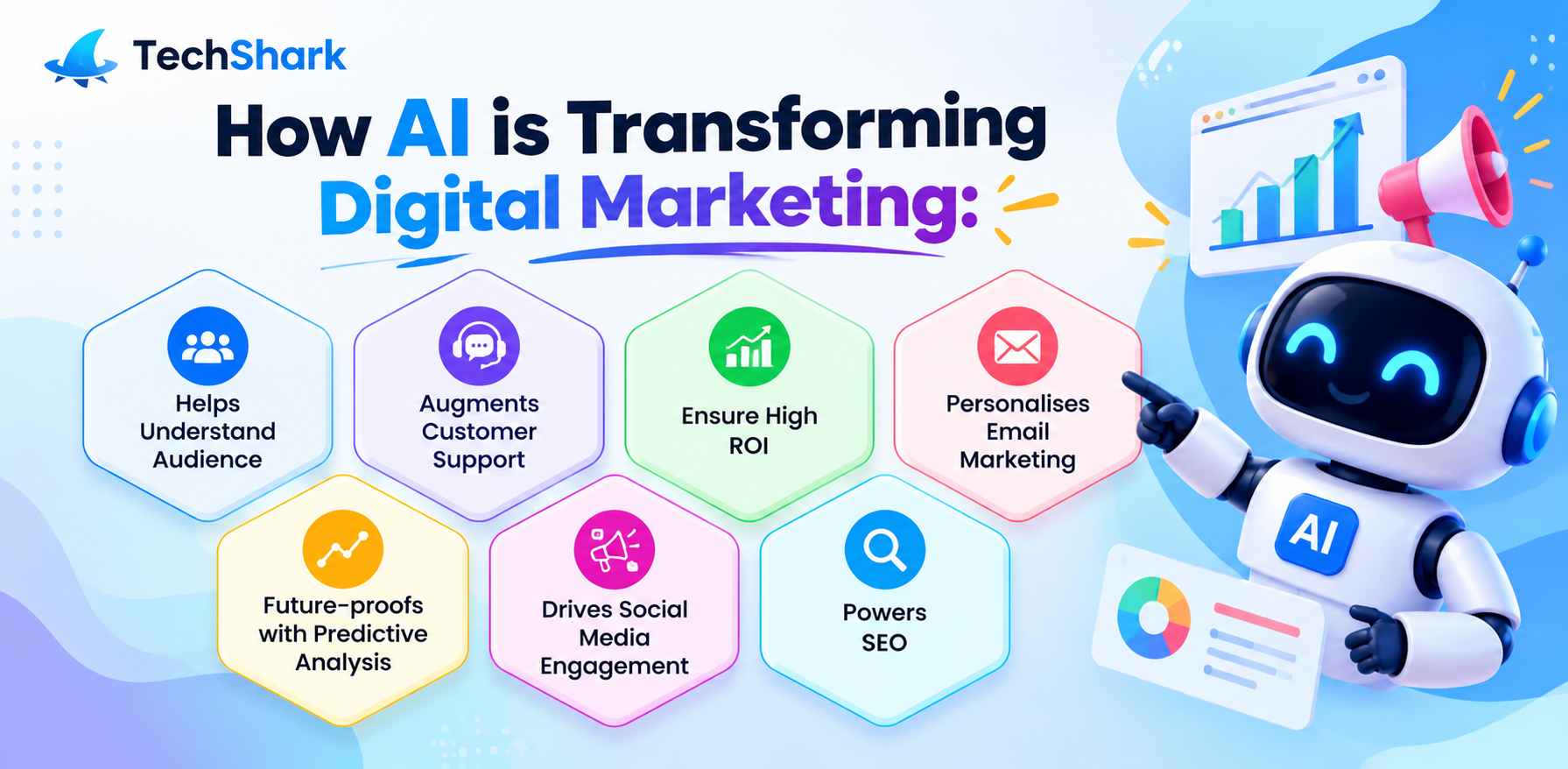
How AI is Transforming Digital Marketing in 2026
Discover how AI is transforming digital marketing in 2026, with key statistics, tools, SEO and AEO strategies, benefits, use cases, and expert tips.
Explore moreAI is transforming digital marketing by automating repetitive tasks, analyzing customer data, personalizing campaigns, improving advertising optimization, assisting content creation, supporting predictive analytics, and helping brands become more visible in AI-powered search experiences. Instead of relying entirely on manual research and fixed marketing campaigns, businesses can use AI to identify patterns, respond to customer behavior, test creative variations, and make data-informed decisions more quickly. Human marketers remain essential for strategy, originality, fact-checking, ethical judgment, and building customer relationships.
Artificial intelligence is changing how businesses attract customers, create content, run advertising campaigns, and measure marketing performance. Tasks that once required hours of manual research and analysis can now be supported by AI tools that process data, identify patterns, generate ideas, and help teams make faster decisions. But the biggest change is not simply that marketers can produce more content. AI is helping businesses understand customer intent, personalize experiences, automate repetitive work, improve campaign targeting, and adapt to a search environment where people increasingly use AI-powered answers to discover products and services. For small businesses, startups, agencies, and enterprise marketing teams, the opportunity is significant. The challenge is learning where AI adds genuine value without sacrificing accuracy, creativity, privacy, or customer trust.
In this guide, we explore how AI is transforming digital marketing, the latest industry statistics, the most important applications, the benefits and risks, and practical ways businesses can implement AI in their marketing strategies.
Key Takeaways
- Content creation: AI helps marketers research topics, generate first drafts, develop creative ideas, and repurpose existing content.
- Personalization: Machine learning helps tailor messages, recommendations, and offers to customer interests and behavior.
- Advertising: AI supports bidding, audience discovery, creative testing, and campaign optimization.
- SEO and AI search: Marketers need useful, trustworthy content that works for traditional search engines and AI-generated answers.
- Marketing analytics: AI can identify patterns and opportunities in campaign data, but results still depend on data quality.
- Customer experience: AI chatbots and assistants can provide faster responses and help customers navigate products and services.
- Human oversight: AI works best as part of a well-designed workflow, not as a replacement for expertise and accountability.
AI in Digital Marketing: Key Facts and Statistics
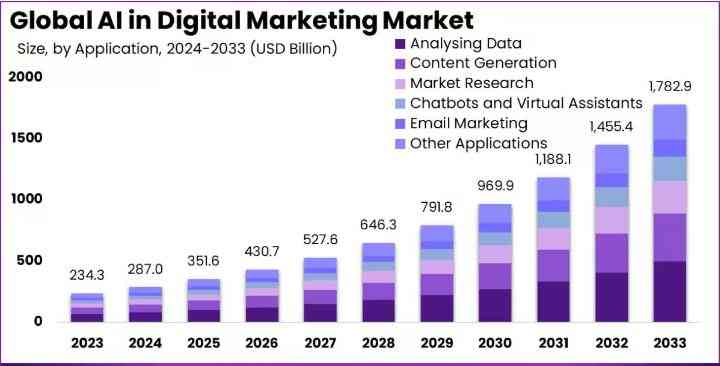
Recent industry research shows that AI has moved beyond experimentation and is becoming part of everyday marketing operations. However, adoption does not automatically mean that every organization is using AI effectively.
Here are several important findings from published industry research.
- AI adoption is becoming widespread: According to HubSpot's 2026 State of AI in Marketing report, 98% of surveyed marketing teams use AI in some form. The report also states that 71% of marketers say AI makes it easier to meet marketing-qualified lead (MQL) targets.
- Marketers are investing in AI, but personalization remains a challenge: Salesforce's 2026 State of Marketing research surveyed nearly 4,500 marketing decision-makers. It reported that 75% of marketers had adopted AI, while 84% said they were still running generic campaigns. The findings suggest that adopting AI tools is not enough; businesses also need relevant customer data and effective campaign workflows.
- AI is influencing SEO and content discovery: In the same Salesforce research, 85% of surveyed marketers said AI was reshaping their SEO strategy, and 88% said they had begun optimizing for AI-generated responses, including experiences such as ChatGPT and Google's AI Overviews. These figures describe the marketers surveyed, not every business worldwide. They nevertheless highlight why brands are paying more attention to answer-focused content and visibility in AI-powered search.
- AI-powered advertising can improve campaign performance: Google reports that eligible Search campaigns using AI Max can see an average of 7% more conversions or conversion value at a similar cost per acquisition or return on ad spend when enabling text customization and final URL expansion. This is a Google-reported result for the specified campaign setup, not a guaranteed improvement for every advertiser.
What these statistics mean: AI adoption is growing, but the strongest opportunity is not simply generating more marketing material. Businesses need to connect AI with customer insights, campaign objectives, high-quality data, and reliable measurement.
What Is AI in Digital Marketing?
AI in digital marketing refers to the use of artificial intelligence technologies to plan, execute, personalize, analyze, and improve online marketing activities. These technologies include machine learning, natural language processing, predictive analytics, computer vision, generative AI, and AI agents. For example, a marketing team can use AI to summarize customer feedback, identify common questions in search data, draft an email campaign, analyze ad performance, or suggest topics for a content calendar. A more advanced workflow might combine several tools to monitor performance, recommend changes, and prepare campaign updates for human approval.
AI does not understand every customer or business situation perfectly. Its output depends on the information it receives, the quality of its models, and the instructions and controls surrounding it.
AI vs. traditional digital marketing
Traditional digital marketing often relies on predefined rules, manual analysis, and fixed campaign schedules. AI-supported marketing can analyze more signals, identify patterns, and adapt certain actions based on new information.
| Marketing activity | Traditional approach | AI-supported approach |
|---|---|---|
| Content research | Manual keyword and competitor research | AI-assisted topic clustering and search-intent analysis |
| Email marketing | Broad audience segments and scheduled campaigns | Behavior-based segmentation and send-time recommendations |
| Advertising | Manual bid and creative adjustments | Automated bidding, targeting signals, and creative variations |
| Customer support | Human agents handle every inquiry | AI handles routine questions and escalates complex cases |
| Analytics | Marketers manually review reports | AI helps identify patterns, anomalies, and potential opportunities |
| SEO and AEO | Focus on rankings and conventional search results | Focus on search visibility, useful answers, brand mentions, and AI citations |
| Lead generation | Fixed scoring rules and manual qualification | Predictive lead scoring based on relevant behavioral and business signals |
AI does not eliminate the need for traditional marketing fundamentals. It can make those fundamentals easier to apply at scale.
10 Ways AI Is Transforming Digital Marketing
1. AI Is Changing Content Creation and Content Marketing
Content creation is one of the most visible uses of AI in digital marketing. Generative AI tools can help marketers brainstorm ideas, create outlines, draft copy, summarize research, develop social media posts, and repurpose existing content for different channels. For example, a single webinar could become a blog article, LinkedIn posts, an email newsletter, short-video scripts, and a frequently asked questions section. AI can help with the first drafts, while editors ensure that each format suits its audience and platform.
AI can also help marketers identify gaps in existing content. By analyzing customer questions, search queries, competitor coverage, and internal website data, teams can discover topics that deserve more detailed explanations. However, producing content quickly does not guarantee that it is useful or accurate. AI-generated material can contain outdated information, unsupported claims, repetitive language, or fabricated references.
How businesses can use AI for content marketing:
- Generate topic ideas based on customer problems and search intent.
- Build content briefs and article outlines.
- Repurpose existing articles into social posts and email campaigns.
- Summarize customer interviews and feedback.
- Identify missing sections in existing content.
- Improve readability and adapt tone for different audiences.
- Create initial drafts that subject-matter experts can review.
Best practice: Use AI to improve research, structure, and efficiency, then add original examples, expert insight, verified facts, and human editing. Avoid publishing large volumes of near-identical pages simply to target more keywords.
Resource: Google Search Central – Guidance on Generative AI Content
2. AI Is Making SEO More Intent-Focused
Search engine optimization is evolving as search engines become better at interpreting language, context, and the intent behind a query. AI can help SEO teams analyze search terms, group related keywords, identify content gaps, and understand the questions people ask before making a purchase. For example, a company targeting the keyword "best CRM software" might discover several related needs: CRM software for small businesses, CRM pricing, free CRM tools, CRM comparisons, and CRM implementation. AI can help organize these queries into a content plan that addresses different stages of the buying journey.
AI can also support technical SEO workflows by helping analyze crawl exports, summarize broken-link reports, categorize redirect issues, and prioritize pages for review. The underlying data still needs to be collected correctly, and technical recommendations should be validated before implementation.
Importantly, AI-generated content does not receive a special ranking advantage simply because AI created it. Google emphasizes helpful, original, reliable content created primarily for people. Using automation to generate many pages without adding value can violate its scaled-content-abuse policy.
How to use AI for SEO:
- Research primary, secondary, and long-tail keywords.
- Group queries by search intent and topic.
- Identify content gaps using competitor and search-performance data.
- Draft helpful page structures and concise answers.
- Audit titles, descriptions, headings, internal links, and content overlap.
- Review search performance and update pages based on evidence.
- Validate technical recommendations before making website changes.
Resource: Google Search Central – Creating Helpful, Reliable, People-First Content
3. AI Is Expanding AEO, GEO, and LLM Visibility
People increasingly use conversational AI systems to ask questions, compare products, summarize research, and explore purchasing options. This creates a broader discovery environment for brands beyond conventional search-result listings.
Three related disciplines are receiving growing attention:
- AEO (Answer Engine Optimization): Structuring content so it can answer users' questions clearly and directly.
- GEO (Generative Engine Optimization): Improving the likelihood that a brand's content is understood, represented, mentioned, or cited in generative AI experiences.
- LLM visibility optimization: Making a brand's expertise, products, facts, and useful resources easier for large language models and AI-powered discovery systems to interpret and reference.
These terms overlap, and the industry does not have one universally accepted definition for every practice. They should be treated as complementary approaches rather than guaranteed ranking systems.
For example, a software company could publish a detailed comparison page that explains its product's use cases, pricing model, limitations, alternatives, and ideal customer profile. A clear structure, accurate information, identifiable authorship, and credible supporting sources make the page more useful to people and easier for systems to interpret.
Practical ways to improve AEO, GEO, and LLM visibility:
- Answer the main question early in each article.
- Use descriptive headings that reflect real customer questions.
- Include original research, examples, and first-hand product experience where possible.
- Explain product capabilities, pricing, limitations, and target audiences precisely.
- Support factual claims with reliable sources.
- Keep key product and company information consistent across the website.
- Use relevant internal links and descriptive anchor text.
- Make important pages accessible to search engines and users.
- Monitor AI referrals, citations, brand mentions, and conversions where measurement is available.
No technique guarantees that a particular AI system will cite a page. The goal is to publish accurate, useful information and make the brand's expertise easy to discover and verify.
4. AI Is Improving Personalization
Customers expect brands to understand their needs, but generic messages often fail to connect. AI can help businesses use permitted customer data, browsing behavior, purchase history, and engagement signals to deliver more relevant experiences. An e-commerce business might recommend products based on a shopper's previous purchases. A B2B company could tailor email content according to a lead's industry, role, and interactions with product pages. A media website could recommend relevant articles based on reading patterns.
Personalization can make marketing more useful, but it should not become intrusive. Businesses need to respect consent, data protection requirements, customer preferences, and the limits of the information they hold.
Examples of AI-powered personalization:
- Product recommendations based on relevant browsing or purchase history.
- Email content tailored to customer interests.
- Website experiences adapted to a visitor's needs.
- Lead nurturing based on meaningful engagement signals.
- Customer segments based on behavior rather than broad assumptions.
Important consideration: Personalization depends on data quality. If customer records are incomplete, outdated, or incorrectly linked, AI can make irrelevant recommendations at scale.
5. AI Is Changing Paid Advertising and Campaign Optimization
Paid advertising platforms already use machine learning to support bidding, audience discovery, delivery, and campaign optimization. Generative AI is also helping marketers create variations of headlines, descriptions, images, and other creative assets. These capabilities can reduce repetitive work and help teams test more options. Instead of manually adjusting every campaign element, marketers can set objectives, provide relevant creative assets, define constraints, and monitor performance.
Google's AI Max for Search campaigns, for example, combines AI-driven search-term matching with creative and landing-page enhancements. Its reported performance results apply to eligible setups and should not be interpreted as a universal guarantee.
Ways AI supports advertising:
- Generating ad-copy variations for testing.
- Identifying patterns in campaign performance.
- Supporting automated bidding and budget allocation.
- Finding relevant search queries and audience signals.
- Helping match creative messages with landing pages.
- Summarizing results and highlighting unusual changes.
AI can also make mistakes. Generated copy may contain unsupported claims, creative assets may misrepresent a product, and automated targeting can spend money on low-quality traffic if conversion signals are poor. Marketers should monitor cost per acquisition, conversion rate, return on ad spend, lead quality, and revenue—not just impressions or clicks.
Resource: Google – AI Max for Search Campaigns
6. AI Is Automating Email Marketing
Email marketing involves many repetitive tasks, including segmenting audiences, drafting subject lines, planning follow-ups, testing content, and reviewing performance. AI can support these activities and help marketers respond more quickly to customer behavior. For example, an online store could trigger a reminder when a customer leaves items in a cart. A B2B company could send educational content after a prospect downloads a guide. AI can help draft different versions of these messages, while marketing automation software manages timing and delivery.
Useful applications include:
- Drafting subject lines and email copy.
- Creating variations for A/B tests.
- Recommending audience segments.
- Supporting behavior-based email journeys.
- Summarizing campaign performance.
- Identifying engagement patterns that deserve investigation.
The goal is not to send more emails. It is to send useful messages at appropriate times. Excessive automation can create fatigue, damage trust, and increase unsubscribes.
7. AI Is Transforming Social Media Marketing
Social media teams must balance content planning, publishing, community management, trend monitoring, creative development, and performance analysis. AI can assist with each of these tasks. It can turn a long article into several post concepts, summarize comments, identify recurring audience questions, or help a team develop a content calendar. Image and video tools can also support early-stage creative production. For example, a digital marketing agency could transform a case study into a short video script, a carousel outline, several LinkedIn posts, and an email summary. Each version should be adapted to the platform rather than copied and pasted everywhere.
AI use cases in social media marketing:
- Content ideation and calendar planning.
- Caption and post drafting.
- Short-form video scripts.
- Comment and sentiment analysis.
- Social listening and topic monitoring.
- Creative variations for testing.
- Reporting on engagement and audience growth.
Human review remains important, especially when responding to sensitive issues, handling complaints, or discussing current events. AI-generated images and videos should not mislead audiences about real people, products, or events.
8. AI Is Improving Customer Support and Conversational Marketing
AI chatbots and conversational assistants can help visitors find information, understand product features, explore documentation, and resolve routine questions without waiting for a human response. A well-designed chatbot might answer questions about shipping, pricing, product compatibility, or account setup. It can also guide a visitor toward a relevant resource or collect information before handing the conversation to a sales representative. More advanced AI agents can perform multi-step tasks within defined permissions, such as retrieving information from approved systems or preparing a response for review. Their capabilities vary considerably by platform and integration.
Benefits of AI-powered customer support include:
- Faster responses to common questions.
- Support outside normal business hours.
- More consistent access to approved information.
- Reduced repetitive workload for human agents.
- Better routing of complex inquiries.
- Potential insights into customer pain points.
AI support should make it easy to reach a person. Businesses should test the assistant against real customer questions, restrict access to sensitive information, and provide a clear escalation path when the system is uncertain.
9. AI Is Making Marketing Analytics More Actionable
Marketing teams collect information from websites, advertising platforms, email campaigns, social media, customer relationship management systems, and sales pipelines. The challenge is turning this data into decisions. AI can help summarize reports, detect unusual changes, group customer feedback, explore relationships between metrics, and suggest questions for further analysis. Predictive models can also estimate outcomes such as lead conversion or customer churn when suitable historical data is available.
For example, if a campaign generates many leads but few qualified opportunities, AI-assisted analysis could help identify differences in traffic sources, landing pages, audience segments, or lead behavior. The findings should be checked against the underlying data before changing budgets.
Key marketing metrics to monitor:
- Organic traffic and qualified organic conversions.
- Click-through rate and conversion rate.
- Cost per lead and cost per acquisition.
- Customer acquisition cost (CAC).
- Customer lifetime value (CLV).
- Return on ad spend (ROAS).
- Email engagement and unsubscribe rates.
- Lead-to-opportunity and opportunity-to-customer rates.
- AI referral traffic and attributable conversions, where available.
AI can support analysis, but it cannot fix inaccurate tracking or automatically prove that a campaign caused a result. Correct event setup, attribution rules, and clear definitions are essential.
Resource: Google Analytics – Guides for Marketers and Digital Analysts
10. AI Is Enabling Predictive Marketing and AI Agents
Predictive marketing uses historical and current data to estimate likely future outcomes. Examples include predicting which leads are more likely to convert, which customers may stop purchasing, or which products a customer might need next. AI agents take this further by helping execute a sequence of tasks toward a defined goal. Depending on the system, an agent may research information, analyze campaign data, prepare recommendations, or interact with connected software under specified permissions.
For example, a marketing workflow might:
- Review campaign performance data.
- Flag an unexpected increase in cost per lead.
- Identify the campaigns and audience segments affected.
- Recommend possible causes.
- Prepare suggested changes for a marketer to approve.
The distinction matters: an AI assistant generally responds to requests, while an AI agent may carry out multi-step actions. Not every tool marketed as an “AI agent” has the same level of autonomy. For sensitive or expensive actions—such as changing large advertising budgets, publishing public statements, or emailing thousands of customers—human approval and clear operating limits remain important.
Key Benefits of AI in Digital Marketing
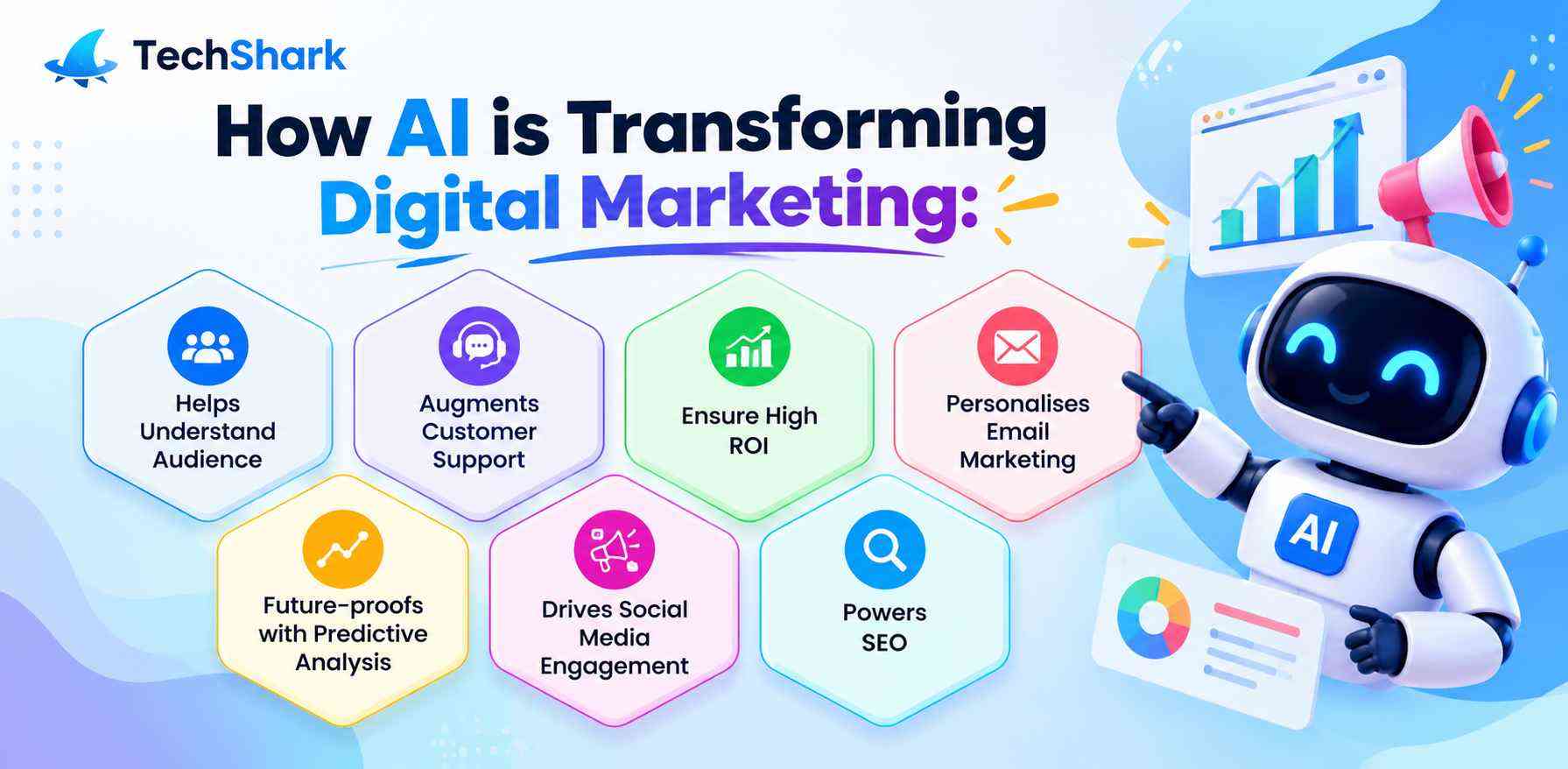
AI can create value across the marketing lifecycle when it is applied to well-defined problems.
| Benefit | How it helps | Example |
|---|---|---|
| Productivity | Reduces repetitive work | Drafting campaign variations or summarizing reports |
| Personalization | Makes messages more relevant | Tailoring email content to customer interests |
| Faster analysis | Helps identify patterns in large datasets | Reviewing campaign performance across channels |
| Content scalability | Supports repurposing and structured production | Turning a webinar into multiple content formats |
| Campaign optimization | Supports testing and automated adjustments | Comparing ad variations and monitoring conversions |
| Customer experience | Helps answer routine questions quickly | Providing a product FAQ chatbot |
| Decision support | Surfaces insights for review | Identifying a decline in qualified leads |
| Discovery and visibility | Helps structure content around questions and entities | Building clear, sourced comparison pages |
These benefits are not automatic. Results depend on the use case, implementation, data, user experience, and the quality of human oversight.
AI Digital Marketing Tools: Categories and Examples
Businesses do not need to buy every available AI product. It is better to start with the marketing problem and select tools that fit the existing workflow.
| Tool category | Common uses | Example tools |
|---|---|---|
| General-purpose AI assistants | Research, brainstorming, drafting, summarization | ChatGPT, Google Gemini, Claude |
| SEO and content research | Keyword research, content audits, competitive analysis | Semrush, Ahrefs, Surfer |
| Marketing automation and CRM | Lead management, segmentation, campaign workflows | HubSpot, Salesforce |
| Email marketing | Campaign creation, segmentation, optimization | Mailchimp, HubSpot |
| Paid advertising | Automated bidding, targeting, creative optimization | Google Ads, Meta Ads tools |
| Analytics | Reporting, conversion analysis, data exploration | Google Analytics, reporting and BI platforms |
| Design and creative production | Images, layouts, video, and creative variations | Canva, Adobe tools |
| Customer support | Chatbots, help-center search, ticket assistance | Intercom and other support platforms |
Features, pricing, availability, and integrations change over time. Confirm current capabilities on each provider's official website before choosing a tool. Some platforms use AI internally, while others offer AI features that marketers can control directly.
For more options, explore TechShark's relevant categories for AI marketing tools, AI writing tools, AI SEO tools, AI chatbots, and AI automation tools.
How to Implement AI in Your Digital Marketing Strategy
Adopting AI successfully is less about using the largest number of tools and more about solving a measurable business problem.
Step 1: Identify a specific problem
Start with one time-consuming or underperforming activity. Examples include slow content production, repetitive reporting, poor lead follow-up, inconsistent email segmentation, or difficulty analyzing customer feedback. Define the current baseline before introducing a new workflow.
Step 2: Choose the right AI tool
Compare tools based on the task they perform, data requirements, integration options, security, ease of use, cost, and human review controls. A general-purpose AI assistant may be enough for brainstorming and summarization. A CRM-integrated tool may be more appropriate for lead management, while advertising platforms already provide AI features for campaign delivery.
Step 3: Prepare your data and guidelines
Give the tool accurate information, clear instructions, approved brand language, and examples of acceptable output. Avoid entering confidential customer details or sensitive business information into tools that have not been approved for that use. Create rules for fact-checking, disclosure, permissions, and escalation.
Step 4: Run a controlled pilot
Test the workflow on a limited number of campaigns, pages, or customer interactions. Compare its performance with your existing process. For instance, test AI-assisted email drafting on a small audience segment before expanding it to a full database.
Step 5: Measure business outcomes
Track both efficiency and quality. Useful measures may include time saved per task, content corrections required, conversion rate, cost per qualified lead, customer satisfaction, and revenue contribution. Do not assume that producing more content or generating more clicks automatically improves business performance.
Step 6: Review and improve
Collect feedback from marketers, sales teams, customers, and subject-matter experts. Improve prompts, data sources, approval steps, and automation rules based on actual results. Scale the workflow only when it delivers reliable value.
AI in Digital Marketing for Small Businesses
Small businesses can use AI without building an expensive technology stack. The most practical starting point is to combine tools they already use with a general-purpose AI assistant and a simple measurement process. A local service business, for example, could use AI to draft service-page outlines, prepare social media ideas, summarize customer reviews, and generate responses to common questions. The business owner should verify factual claims, personalize the content, and ensure that local details are accurate.
A small e-commerce brand might begin with product-description drafts, email variations, customer-support FAQs, and review analysis. A B2B company could use AI to summarize sales calls, research target accounts using permitted sources, and repurpose webinars into useful resources.
A low-cost starting plan:
- Use existing analytics and search-performance tools before purchasing new software.
- Begin with one or two clearly defined workflows.
- Use free tiers where suitable, while checking usage limits and data policies.
- Keep human approval for published content and customer-facing communications.
- Measure the time saved and the business outcome.
- Upgrade only when the workflow proves its value.
AI, SEO, AEO, GEO, and LLM Optimization: What Marketers Should Do
AI is changing how people discover information, but businesses should not abandon traditional SEO. Search engines, AI assistants, and other discovery platforms have different systems, and visibility in one does not guarantee visibility in another. A durable strategy combines useful content, technical accessibility, strong information architecture, credible expertise, and clear measurement.
SEO: Make the website useful and accessible
- Match content to real search intent.
- Use descriptive titles, headings, URLs, and internal links.
- Maintain accurate, original, updated information.
- Fix technical issues that prevent pages from being crawled or understood.
- Use structured data only where it accurately describes the page and follows search-engine guidelines.
AEO: Answer questions clearly
- Provide a direct answer near the beginning of a relevant section.
- Use natural-language headings based on customer questions.
- Explain terminology and processes in plain language.
- Add concise definitions, comparisons, and step-by-step explanations.
- Support claims with trustworthy resources.
GEO and LLM visibility: Strengthen context and credibility
- Publish original research, first-hand insights, and useful examples.
- Clearly explain your brand, products, services, and areas of expertise.
- Maintain consistent facts across important pages and reputable third-party profiles.
- Include meaningful sources and explain limitations rather than making exaggerated claims.
- Ensure important pages are accessible and technically sound.
- Monitor brand mentions, citations, referrals, and conversions where data is available.
There is no guaranteed formula for being cited by an AI model. Focus on the factors you can control: accuracy, usefulness, originality, clarity, and discoverability.
Resource: Google Search Central – Using Generative AI Content on Your Website
Challenges and Risks of AI in Digital Marketing
AI offers real opportunities, but businesses should understand its limitations before using it at scale.
- Inaccurate information: AI may produce incorrect facts, fabricated citations, or outdated product information. Verify claims against reliable sources, particularly for statistics, financial claims, regulated products, and technical recommendations.
- Generic content: When many brands use similar prompts and workflows, their content can become repetitive. Add real expertise, original examples, customer insight, and a distinct point of view.
- Privacy and data security: Marketing systems may process personal information, customer records, or confidential business data. Use approved tools, limit data access, follow applicable privacy laws, and review how vendors store and process information.
- Bias and unfair targeting: Models can reproduce patterns and assumptions found in their data. Review audience segmentation, recommendations, and automated decisions for unfair or inappropriate outcomes.
- Over-automation: Automated campaigns can amplify mistakes quickly. Use permissions, approval steps, monitoring, and clear limits for high-impact actions.
- Unclear return on investment: AI adoption does not automatically increase revenue. Track costs, time savings, quality, conversions, and customer outcomes to determine whether a workflow is worthwhile.
- Misleading advertising claims: AI-generated copy must not invent product capabilities, testimonials, endorsements, or performance guarantees. Marketing claims should be truthful and supported by evidence.
Useful resource: U.S. Federal Trade Commission – Advertising and Marketing Basics
The Future of AI in Digital Marketing
The next phase of AI in marketing is likely to involve more connected workflows, stronger predictive capabilities, conversational customer experiences, and AI agents that can carry out defined tasks across business systems.
Several developments deserve attention:
- AI-assisted marketing operations: Tools will increasingly help marketers investigate performance changes, prepare reports, and recommend actions from within their existing platforms.
- More conversational discovery: Customers may use AI assistants to explore options, compare brands, and narrow down purchasing decisions. Clear product information and credible sources will remain important.
- Creative production at scale: AI will make it easier to develop and adapt text, image, audio, and video assets. Brands will need stronger creative direction and quality control to avoid producing interchangeable content.
- More focus on first-party data: Businesses will need reliable, permissioned customer data to make personalization useful and responsible.
- Human-AI collaboration: Marketers will increasingly need skills in strategy, experimentation, analytics, prompt design, fact-checking, privacy, and workflow management—not just tool operation.
- Better measurement: Teams will need to assess how AI affects business results, including qualified leads, sales, retention, customer satisfaction, and visibility across different discovery channels.
The businesses most likely to benefit will not necessarily be those using the most AI tools. They will be the ones that connect the right technology to clear objectives, trustworthy data, thoughtful execution, and measurable outcomes.
Conclusion
AI is transforming digital marketing by helping businesses work with data, create useful content, personalize experiences, improve campaigns, and automate repetitive tasks. It is also changing how brands need to think about visibility as customers discover information through traditional search engines and AI-powered experiences. However, AI is not a shortcut to trust, rankings, or revenue. Its value depends on the quality of the data, the relevance of the strategy, the reliability of the output, and the ability to measure real business outcomes.
For marketers, the practical approach is to start small, solve a real problem, keep humans involved where judgment matters, and scale only when results justify it. Businesses that combine AI efficiency with genuine expertise and customer understanding will be better positioned to adapt as digital marketing continues to evolve.
People are also reading:
- Best AI Fitness Tools
- AI Facts for Kids
- Best AI Music Tools
- Best AI Compliance Tools
- Best AI Presentation Tools
- Best AI Cybersecurity Tools
- Best AI Stock Market Tools
- AI Agents for Real Estate
Frequently Asked Questions (FAQs)
Q: What is the role of AI in digital marketing?
AI helps marketers analyze data, create and repurpose content, personalize customer experiences, optimize advertising, automate workflows, and understand campaign performance. It supports decision-making but does not remove the need for human strategy and review.
Q: How is AI changing digital marketing in 2026?
In 2026, AI is increasingly embedded in marketing workflows, including content production, campaign optimization, customer engagement, analytics, and AI-assisted search discovery. Adoption is growing, but data quality, governance, and meaningful measurement remain important challenges.
Q: What are the main benefits of AI in digital marketing?
The main benefits include increased productivity, faster analysis, improved personalization, more efficient campaign testing, support for customer service, and the ability to process large volumes of information. Actual results depend on the use case and implementation.
Q: Can AI replace digital marketers?
AI can automate some repetitive tasks, but it does not fully replace the need for human judgment, creativity, business knowledge, relationship building, or accountability. Marketers remain responsible for strategy, accuracy, ethical decisions, and results.
Q: How does AI help with SEO?
AI can assist with keyword clustering, search-intent analysis, content briefs, technical audit summaries, competitor research, and content updates. It should support original, helpful content rather than mass production of low-value pages.
Q: What is the difference between SEO, AEO, and GEO?
SEO focuses on improving visibility in search engines. AEO focuses on answering questions clearly for answer-oriented experiences. GEO focuses on improving the discoverability and representation of content in generative AI systems. The practices overlap, and none guarantees a particular ranking or citation.
Q: Which AI tools are useful for digital marketing?
Useful options depend on the task. General-purpose assistants such as ChatGPT, Gemini, and Claude can support research and drafting; SEO platforms support keyword and competitor analysis; CRM and automation platforms help manage leads and campaigns; and analytics tools help measure results. Check current features, pricing, privacy terms, and integrations before choosing.
Q: Is AI-generated content good for SEO?
AI-generated content can be useful when it is accurate, original, relevant, and created to help readers. Google does not give content a special ranking advantage just because AI produced it. Publishing large volumes of unhelpful or unoriginal pages to manipulate rankings can violate Google's spam policies.
Q: How can small businesses start using AI in marketing?
Start with a clearly defined task such as content repurposing, email drafting, review analysis, or reporting. Use an appropriate low-cost tool, establish review rules, measure results, and expand only when the workflow proves useful.
Q: How can businesses measure the ROI of AI in digital marketing?
Measure changes in time spent, operating costs, content quality, qualified leads, conversion rates, customer acquisition cost, revenue, and customer satisfaction. Compare results against a baseline and account for tool costs and human review time.