10 Best AI Agents for Real Estate in 2026
Discover the 10 best AI agents for real estate in 2026. Compare tools for lead generation, property valuation, virtual staging, leasing, and investment analysis.
Explore moreThe best AI agents for real estate in 2026 include Lofty for AI-powered CRM and lead management, Follow Up Boss for lead follow-up workflows, EliseAI for leasing automation, Epique.ai for real estate content creation, REimagineHome for virtual staging and interior redesign, Virtual Staging AI for furnishing empty rooms digitally, Getfloorplan for floor plans and virtual tours, HouseCanary for property valuation and market analytics, Reonomy for commercial property intelligence, and DealMachine's Alma for real estate investment analysis.
Real estate professionals spend a significant amount of time responding to inquiries, qualifying potential buyers, preparing property listings, scheduling viewings, analyzing comparable sales, and following up with leads. These tasks are necessary, but managing them manually can slow down sales and leave fewer hours for building relationships with clients. The best AI agents for real estate help solve this problem by automating repetitive work, analyzing property and customer data, generating personalized communications, and coordinating routine workflows. Some tools focus on lead generation and customer relationship management (CRM), while others specialize in virtual staging, property valuation, commercial real estate research, or tenant communication.
For example, Lofty offers an AI-powered real estate CRM, EliseAI automates leasing interactions, REimagineHome creates virtual property redesigns, HouseCanary provides property valuations and market analytics, and Reonomy helps commercial real estate professionals research property ownership and off-market opportunities. Choosing the right platform depends on the business problem you want to solve. A residential realtor may benefit most from AI-powered lead qualification and follow-ups, while a multifamily property manager may prioritize automated leasing and maintenance communications. Commercial investors, meanwhile, may need reliable ownership data, valuation models, and investment analysis.
This guide compares 10 AI-powered real estate tools, explains their best use cases, highlights important industry statistics, and provides practical advice for choosing and implementing the right solution.
Key Facts About AI Agents for Real Estate
| Key fact | Details |
|---|---|
| Lead management | AI can qualify inquiries, prioritize prospects, and support timely follow-ups. |
| Property marketing | AI can draft listing descriptions, email campaigns, and social media content. |
| Property visualization | AI tools can virtually furnish rooms, redesign interiors, and generate floor plans. |
| Property valuation | Automated valuation models analyze property characteristics, sales data, and market signals. |
| Commercial real estate | AI-assisted data platforms help research owners, property records, transactions, and investment signals. |
| Leasing operations | Conversational AI can answer inquiries, coordinate tours, and support routine tenant communications. |
| Human oversight | Agents should verify pricing, property details, legal documents, and important client-facing claims. |
Key Statistics: AI Adoption and Real Estate Technology
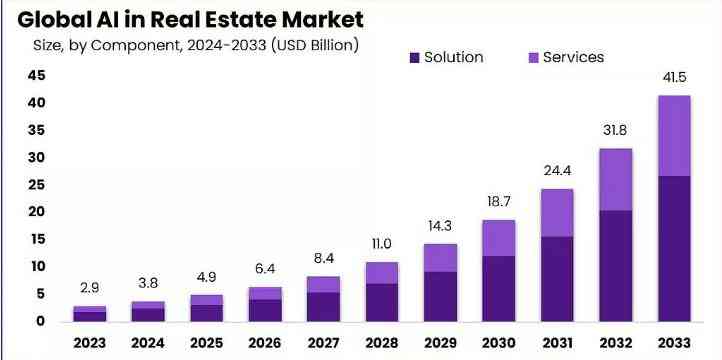
The following figures provide useful context for understanding AI adoption and the data capabilities behind real estate technology.
| Statistic | What it means |
|---|---|
| 46% of surveyed REALTORS reported using AI-generated content, such as listing descriptions. | AI-assisted content creation is an established real estate use case. |
| 20% of surveyed REALTORS said they used AI tools daily, while 22% used them weekly. | Adoption frequency varies considerably among professionals. |
| 82% of surveyed REALTORS reported that clients responded positively or very positively to technology integration in the buying and selling process. | Technology can complement the customer experience when implemented well. |
| Reonomy reports coverage of more than 53 million US commercial properties on its platform. | Commercial property intelligence can help professionals investigate ownership and transaction opportunities at scale. |
| HouseCanary reports property data, valuations, analytics, and forecasts covering more than 136 million properties. | Large-scale property data can support valuation and investment |
10 Best AI Agents for Real Estate
1: Lofty
Lofty is an AI-powered real estate platform that combines customer relationship management, lead insights, marketing automation, and sales workflows. Rather than treating lead management as a simple contact database, the platform helps agents understand prospect activity and identify opportunities that may deserve attention. Its AI capabilities include lead scoring, behavioral analysis, suggested next steps, and automated engagement workflows. Depending on the configuration, the platform can help initiate conversations, nurture prospects, and support appointment booking.
Key features
- AI-powered lead scoring and behavioral insights.
- Real estate CRM with contact and communication management.
- Automated follow-up plans and marketing workflows.
- Lead activity tracking and property alerts.
- AI agents for prospect engagement and other real estate workflows.
How real estate professionals can use Lofty?
Imagine a brokerage receiving inquiries from its website, paid advertisements, and property listing pages. Without automation, an agent may need to review each inquiry, determine the prospect's interest, and schedule follow-ups manually. Lofty can help organize these contacts, surface behavioral signals, and automate parts of the engagement process. Agents can then focus on prospects who have shown meaningful interest, while the system handles routine communication and workflow tasks. For teams, this approach can also improve consistency because leads are less dependent on an individual agent remembering every follow-up.
Pros
- Combines multiple real estate workflows in one platform.
- Helps prioritize leads using behavioral information.
- Supports automated engagement and follow-up.
- Designed specifically for real estate operations.
Cons
- May offer more functionality than a solo agent needs.
- Results depend on lead quality, CRM configuration, and workflow design.
- Buyers should confirm current pricing, plan limitations, and available AI features before committing.
Best for: Residential real estate agents, brokerages, and teams that need lead generation, CRM management, and automated follow-ups.
Verdict: Lofty is a strong starting point for brokerages that want AI-assisted lead management and CRM automation without assembling every component separately.
2. Follow Up Boss
Follow Up Boss is a real estate CRM focused on organizing leads, communications, and team workflows. Its AI-related use cases include call summaries, communication support, and helping teams coordinate follow-ups. The practical value lies in making sure that incoming inquiries and ongoing conversations lead to clear next actions.
Key features and use cases
- Lead organization and assignment.
- Call summaries and communication context.
- Automated tasks triggered by appointments or lead activity.
- Personalized follow-up drafts.
- Call review, transcripts, and team coaching workflows.
- Integrations with real estate business tools.
How real estate professionals can use Follow Up Boss?
Consider a buyer who repeatedly views the same property but does not submit a new inquiry. A team can use CRM activity to trigger a relevant follow-up that references the property and offers similar options. Likewise, when a consultation is booked, automated workflows can send a confirmation, prepare a buyer-specific information packet, and create post-appointment tasks. The agent can concentrate on the conversation rather than administrative coordination. A sensible setup also establishes clear handoffs. AI can assist with initial outreach to new or cold leads, but active buyers and sellers should receive the personal attention required for negotiations, sensitive questions, and important decisions.
Pros
- Useful for teams with established lead pipelines.
- Connects communication history with follow-up tasks.
- Supports consistent workflows and agent coaching.
- Offers practical ways to use AI without automating every client interaction.
Cons
- Not a substitute for a complete property valuation or investment research platform.
- Automation quality depends on CRM data and configuration.
- Teams should verify which AI functions are included in their chosen plan.
Best for: Real estate teams that receive substantial numbers of inbound leads and need structured follow-up workflows.
Verdict: Follow Up Boss is a practical option for real estate teams that want to improve lead follow-up and communication consistency. It is especially relevant when inquiries are being lost because of slow responses or incomplete task management.
3. EliseAI
EliseAI provides conversational AI solutions for real estate leasing and property operations. Its leasing technology is designed to engage prospective renters, answer routine questions, help schedule property tours, and support leasing workflows across communication channels. For apartment operators, the challenge is not limited to attracting leads. Teams must respond to questions about availability, pricing, amenities, application requirements, and viewing appointments while managing existing residents' requests.
Key features
- Automated responses to leasing inquiries.
- Prospect engagement and tour scheduling.
- Support for leasing workflows.
- Tenant communication and selected property operations.
- Integration options with supported CRM and property management systems.
How real estate businesses can use EliseAI?
An apartment community may receive inquiries outside standard office hours. An AI leasing assistant can answer approved questions, collect relevant information, and help a prospect move toward scheduling a tour. For existing residents, suitable workflows may help direct maintenance requests or answer routine questions. Staff can then focus on situations requiring inspection, judgment, negotiation, or personal attention. The platform's official documentation describes integrations with selected CRM and property management systems, so compatibility should be checked against the systems already used by the business.
Pros
- Designed around leasing and property operations.
- Can support prospective tenants beyond office hours.
- Helps standardize routine communications.
- Can connect with supported real estate software.
Cons
- Most useful to operators with sufficient inquiry volume.
- Integration compatibility must be verified.
- Sensitive resident issues and complex leasing decisions still need human review.
Best for: Multifamily property operators, leasing teams, and property managers handling high volumes of inquiries.
Verdict: EliseAI is a strong candidate for multifamily operators seeking to streamline leasing communication and reduce the manual workload associated with high inquiry volumes.
4. Epique.ai
Real estate marketing requires a steady flow of content. Agents may need property descriptions, email campaigns, social media posts, listing promotions, and buyer or seller communications, often while managing active transactions. The SaM Solutions comparison identifies Epique.ai as a real estate-focused content creation tool. Its described use cases include generating property descriptions, emails, and social media content. A real estate-specific writing assistant can be useful when agents want drafts that follow familiar property marketing formats instead of starting with a blank page.
Key features and use cases
- Drafting property listing descriptions.
- Preparing email campaigns.
- Creating social media marketing drafts.
- Repurposing verified property information across channels.
- Supporting consistent brand messaging.
How agents can use Epique.ai?
An agent preparing to market a three-bedroom home can provide verified details about its layout, features, location, and amenities. The AI can turn those inputs into an initial listing description and supporting social media drafts. The agent should then confirm every claim, remove unsupported superlatives, and check that the copy complies with applicable advertising and fair housing requirements. This distinction matters because AI-generated marketing can sound polished while still introducing details that were never supplied.
Pros
- Tailored to common real estate marketing tasks.
- Reduces the effort required to draft routine content.
- Helps teams maintain consistent messaging.
- Useful for agents without dedicated copywriting support.
Cons
- Generated content requires factual and editorial review.
- It does not replace property photography, local expertise, or a marketing strategy.
- Current product availability and feature packaging should be confirmed before purchase.
Best for: Real estate agents and small teams that need help producing listing descriptions and marketing content.
Verdict: Epique.ai is worth evaluating for agents who spend too much time writing marketing materials and want a real estate-focused drafting workflow.
5. REimagineHome
Property photographs strongly influence how buyers and renters perceive a listing. Empty rooms can be difficult to visualize, while outdated interiors may distract attention from a property's layout and potential. REimagineHome uses AI to transform room photographs and create interior design concepts, virtual staging, and other visual redesigns. Its official website describes capabilities for furnishing and redesigning spaces, with controls intended to preserve important structural elements.
Key features
- AI virtual staging for empty rooms.
- Interior redesign and furnishing concepts.
- Exterior design visualization.
- Multiple visual styles and design directions.
- Rapid generation of alternative presentation concepts.
How real estate professionals can use REimagineHome?
Suppose an agent is listing an unfurnished apartment. Rather than physically renting furniture and arranging a photo shoot, the agent can use a virtual staging tool to create a furnished concept for marketing purposes. The resulting images can help potential buyers imagine how a space might be used. Agents can also create different interior styles to appeal to different audiences, provided the imagery is presented accurately. Virtual staging must not conceal material property defects or mislead viewers about the actual condition of a home. Original photographs and clear disclosures should be used where required by local rules or listing-platform policies.
Pros
- Helps make empty properties easier to visualize.
- Supports multiple design directions.
- Can reduce the need for physical staging in suitable situations.
- Useful for real estate listings and renovation concepts.
Cons
- AI-generated interiors are visual concepts, not evidence of the property's actual condition.
- Images need review for altered structures or inaccurate features.
- Visual quality and available editing controls can vary by input.
Best for: Realtors, property marketers, interior designers, and developers who want to improve listing presentation.
Verdict: REimagineHome is a good option for agents who want more engaging property marketing images without arranging physical staging for every listing.
6. Virtual Staging AI
Virtual Staging AI focuses on digitally furnishing empty property photographs. Instead of coordinating furniture delivery, staging appointments, and photography, agents can generate furnished versions of suitable room images. The SaM Solutions guide positions it as an option for professionals who prioritize speed and affordability, while noting that other staging tools may offer more customization.
Key features
- Digital furniture placement.
- Virtual room furnishing.
- Multiple staging concepts, depending on the available product options.
- Listing-ready visual assets for marketing workflows.
How real estate professionals can use Virtual Staging AI?
A property owner preparing to sell a vacant house can upload photographs of an empty living room, bedroom, or dining area and create staged versions for the listing. This can help viewers understand room proportions and imagine potential furniture arrangements. Agents should retain the original images and check that the AI has not changed windows, doors, room dimensions, or other important property features.
Virtual Staging AI vs. REimagineHome
Virtual Staging AI is worth considering when the primary goal is to furnish an empty room quickly. REimagineHome is more suitable when the workflow also requires broader interior redesign or more varied visual concepts.
Pros
- Focused on a clear, practical use case.
- Can simplify the preparation of vacant-property listings.
- Helps create visual marketing assets quickly.
Cons
- Does not manage leads, sales pipelines, or property valuation.
- Generated images need quality control.
- Pricing, output limits, and commercial-use terms should be checked directly with the provider.
Best for: Realtors, property marketers, interior designers, and developers who want to improve listing presentation.
Verdict: Choose Virtual Staging AI when your immediate need is faster digital staging rather than a broader real estate automation platform.
7. Getfloorplan
Property listings become easier to evaluate when buyers can understand the relationship between rooms, circulation, and overall layout. Photographs show the appearance of individual spaces, but they do not always communicate how those spaces connect. Getfloorplan is identified in the SaM Solutions guide as a platform that can generate 2D and 3D floor plans and virtual tours from source materials such as sketches or photographs.
Key features
- 2D floor plan generation.
- 3D floor plan visualization.
- Virtual tour creation.
- Visual assets for property marketing.
- Support for communicating layouts to prospective buyers and renters.
How real estate professionals can use Getfloorplan?
A property marketer can use floor plan and visualization assets to supplement a listing's photographs. Buyers may find it easier to understand room arrangements before booking an in-person visit. Developers and architects can also use visual layouts to communicate design concepts. However, AI-generated or reconstructed floor plans should not be treated as verified architectural measurements unless they have been independently checked.
Pros
- Adds layout context beyond standard listing photographs.
- Supports 2D and 3D presentation.
- Useful for property marketing and visualization.
- Can reduce some manual production work.
Cons
- Source material affects the quality of the output.
- Floor plan accuracy must be verified where dimensions matter.
- Virtual tours and floor plans are not substitutes for professional surveys.
Best for: Realtors, property marketers, architects, and developers who need floor plans or property visualization assets.
Verdict: Getfloorplan is a useful specialist tool for businesses that want to improve how properties are presented online.
8. HouseCanary
Property valuation is one of the most important and challenging tasks in real estate. An asking price needs to reflect comparable sales, property characteristics, local supply and demand, and changing market conditions. HouseCanary provides property data, automated valuation models, comparative market analysis capabilities, forecasts, and analytics. Its tools can help professionals evaluate properties more consistently and prepare for pricing or investment discussions.
Key features
- Automated property valuation models.
- Property data and comparable market analysis.
- Market forecasting and analytics.
- Investment evaluation support.
- Data access for eligible professional and enterprise workflows.
How real estate professionals can use HouseCanary?
An investor considering a residential property can use valuation and market data to establish an initial price range, compare relevant properties, and identify assumptions that require further investigation. An agent preparing a comparative market analysis can use data-driven estimates as one input when discussing a listing price with a seller. The important distinction is that an automated valuation is an estimate, not a guarantee of the final sale price. Unique property features, condition, recent renovations, local demand, and the availability of comparable sales can affect the outcome.
Pros
- Focuses on property data and valuation.
- Useful for research-intensive real estate decisions.
- Supports market analysis and forecasting workflows.
- Offers data capabilities for professional use cases.
Cons
- Valuation accuracy varies by market and property type.
- Data coverage and available features may differ by location and subscription.
- Users should verify important assumptions against local comparable sales and professional assessments.
Best for: Real estate investors, lenders, agents, and professionals who need data-supported property valuations.
Verdict: HouseCanary is a strong candidate for investors and real estate professionals who need structured valuation data rather than a general-purpose conversational assistant.
9. Reonomy
Commercial real estate prospecting often requires connecting information from multiple public records, ownership entities, transaction histories, and company databases. A property may be held by an LLC or another legal entity, making it difficult to identify the people responsible for investment decisions. Reonomy combines commercial property information, ownership records, transaction history, company data, and machine-learning-supported data matching. Its platform helps professionals build prospect lists, investigate property ownership, and identify potential off-market opportunities.
Key features
- Commercial property and ownership research.
- Transaction, debt, and lien information.
- Ownership and company intelligence.
- Prospecting for potential off-market opportunities.
- Predictive signals that can help prioritize properties for outreach.
How commercial real estate professionals can use Reonomy?
A commercial broker seeking potential sellers can filter properties by location, asset class, ownership tenure, and other available criteria. The platform can help identify relevant owners and organize the information needed for prospecting.
Investors can use the resulting data to build research lists and decide which properties deserve more detailed financial analysis.
Reonomy's official website reports coverage of more than 53 million US commercial properties and more than 68 million property transactions. These are platform-reported coverage figures, not a guarantee that every property record or ownership contact is complete.
Pros
- Designed for commercial real estate research.
- Connects property and ownership information.
- Useful for off-market prospecting.
- Offers data and integration options for professional workflows.
Cons
- Primarily suited to the US commercial property market.
- Subscription costs may be significant for small operators.
- Ownership records and predictive signals still require verification.
Best for: Commercial real estate brokers, investors, lenders, and service providers researching properties and ownership.
Verdict: Reonomy is one of the more relevant options for commercial real estate teams that need property intelligence and prospecting data, rather than residential listing marketing features.
10. DealMachine's Alma
Real estate investment requires more than finding a property with an attractive asking price. Investors need to examine comparable sales, likely repair costs, potential resale value, rental income, acquisition expenses, financing, and exit strategies. The SaM Solutions guide identifies Alma, associated with DealMachine, as a conversational assistant for on-demand deal analysis. Its intended role is to help investors explore property opportunities and evaluate deal assumptions more quickly.
Key features and use cases
- Conversational support for property deal evaluation.
- Analysis of comparable properties, where data is available.
- Preliminary investment calculations.
- Support for wholesaling and house-flipping workflows.
- Faster exploration of potential opportunities.
How investors can use an AI deal-analysis assistant?
An investor can provide verified purchase-price assumptions, estimated renovation costs, comparable sales, expected selling costs, and a target profit. An AI assistant can help organize these inputs, calculate preliminary scenarios, and highlight missing information. For example, it can compare a base-case scenario with a higher renovation-cost scenario. The investor can then see how sensitive the potential return is to changes in costs or resale value. The calculations are only as reliable as the inputs. Investors should independently verify property records, repair estimates, financing assumptions, local regulations, and comparable sales before making an offer.
Pros
- Supports a practical, investment-focused workflow.
- Helps organize assumptions and preliminary calculations.
- Useful for investors evaluating multiple opportunities.
- Can make early-stage screening more efficient.
Cons
- Investment projections are not guaranteed outcomes.
- Deal quality depends on accurate source data.
- Investors still need due diligence and professional advice where appropriate.
Best for: Real estate investors, wholesalers, and house flippers evaluating potential deals.
Verdict: DealMachine's Alma is worth investigating if your main goal is to screen real estate investment opportunities rather than manage a brokerage's day-to-day lead pipeline.
Comparison Table: Best AI Agents for Real Estate at a Glance
| Tool | Primary use case | Best for | Main advantage |
|---|---|---|---|
| Lofty | AI CRM and lead management | Agents and brokerages | Combines CRM, lead insights, and automation |
| Follow Up Boss | Lead follow-up and team workflows | Real estate sales teams | Connects lead activity with communication and tasks |
| EliseAI | Leasing automation | Multifamily operators | Handles routine leasing conversations |
| Epique.ai | Content creation | Agents and small teams | Helps draft property and marketing content |
| REimagineHome | Virtual staging and redesign | Realtors and property marketers | Creates alternative interior concepts |
| Virtual Staging AI | Digital furniture placement | Listing marketers | Focuses on fast virtual staging |
| Getfloorplan | Floor plans and tours | Realtors and developers | Improves property visualization |
| HouseCanary | Valuation and analytics | Investors, agents, and lenders | Supports data-driven pricing analysis |
| Reonomy | Commercial property intelligence | Commercial brokers and investors | Connects property and ownership data |
| DealMachine's Alma | Investment deal analysis | Investors and house flippers | Helps explore preliminary deal scenarios |
How to Choose the Best AI Agent for Your Real Estate Business
The best platform is not necessarily the one with the most features. It is the one that addresses a measurable business problem and fits your existing workflow.
1. Define the task you want to automate
Start by identifying where your team loses the most time. If leads are not receiving timely responses, evaluate AI-powered CRM and follow-up platforms. If property listings are difficult to market, explore content generation and virtual staging. If your business depends on underwriting or commercial prospecting, prioritize valuation and property intelligence.
2. Check integrations with your current systems
A real estate AI agent is more useful when it can work with the software your team already uses. Check compatibility with your CRM, property management system, listing database, calendar, email, phone system, and reporting tools.
Do not assume that every integration is available on every plan. Ask the vendor to demonstrate the actual workflow you need.
3. Evaluate the quality of the data
AI tools can produce confident answers from incomplete or outdated information. Before using a system for property pricing or investment screening, check its data sources, coverage, update frequency, and treatment of missing records.
For lead management, make sure contact details and interaction histories are accurate. For virtual staging, verify that generated images preserve the actual layout and relevant property characteristics.
4. Compare total cost, not just the subscription
Your real cost may include software subscriptions, usage charges, implementation, integrations, staff training, and ongoing quality checks. Calculate whether the time saved or improvement in workflow outcomes justifies the expense.
A small team may get more value from a focused staging or writing tool than from an enterprise CRM with features it will never use.
5. Set clear human-approval rules
AI can assist with communication and analysis, but not every task should run without supervision. Establish which actions can be automated and which require approval.
For example, an agent may approve routine follow-up drafts automatically after testing a workflow, but a human should review material claims in a property listing, unusual valuation estimates, sensitive tenant complaints, and contract-related communications.
How to Implement AI Agents in Real Estate: A Practical Roadmap?
A successful implementation begins with a defined workflow, not with purchasing multiple AI subscriptions.
Step 1: Establish a baseline. Measure response time, missed follow-ups, administrative workload, appointment-booking rates, or the time required to prepare a listing. Choose metrics that reflect your actual business problem.
Step 2: Select one high-value use case. Start with a repeatable task, such as responding to new inquiries, preparing listing descriptions, generating staged images, or organizing property research.
Step 3: Configure the system. Connect only the necessary data sources and define the actions the AI can take. Set clear rules for lead routing, escalation, permissions, and client communications.
Step 4: Test the workflow. Use sample cases and a small pilot group. Check factual accuracy, response quality, integration reliability, and the rate of tasks that need human correction.
Step 5: Measure business outcomes. Compare performance against the baseline. Track metrics such as median lead response time, qualified appointments, follow-up completion, content editing time, cost per processed lead, and employee feedback.
Step 6: Expand gradually. If the pilot produces reliable results, extend it to more users or workflows. Keep monitoring errors, data quality, client feedback, and changes in vendor capabilities.
Benefits of AI Agents in Real Estate
AI agents can help real estate businesses improve operational consistency and make better use of their data. The greatest benefit often comes from connecting several small tasks into a workflow instead of automating a single isolated action.
- Faster lead response and follow-up: AI-assisted systems can respond to new inquiries, collect basic information, organize contacts, and trigger follow-up tasks. This reduces reliance on manual reminders and helps teams manage inquiries outside standard working hours.
- More efficient property marketing: Content-generation tools can produce first drafts of listing descriptions, email campaigns, and social posts. Virtual staging tools can create visual concepts for empty rooms, while floor plan tools can help communicate property layouts.
- Better-supported property decisions: Valuation and analytics platforms can organize comparable sales, property records, and market signals. Investors and agents can use these insights to investigate pricing assumptions and identify opportunities that deserve further review.
- More consistent leasing operations: Conversational AI can answer approved questions, coordinate tours, and route tenant requests. Property managers can spend more time resolving complicated cases instead of repeatedly handling the same basic inquiries.
- More time for client relationships: The goal should be to reduce repetitive administrative work, not remove the human element from real estate. Agents still provide local expertise, negotiation, empathy, and judgment that automated systems cannot reliably replace.
Challenges and Risks of Using AI in Real Estate
- Inaccurate information: AI may invent property features, misunderstand a client's request, or produce an incorrect valuation. All material claims should be checked against authoritative property records, verified listing information, and reliable market data.
- Privacy and security: Real estate businesses may process identification details, financial information, contact records, and tenant communications. Review data retention, access controls, vendor security, and applicable privacy requirements before uploading sensitive information.
- Bias and fair housing compliance: Automated systems may reproduce biases present in historical data or generate language that violates applicable fair housing rules. Audit property recommendations, advertising content, lead scoring, and tenant screening workflows. Do not let AI make discriminatory housing decisions.
- Integration complexity: A tool that works well on its own may create extra work if it cannot synchronize with your existing CRM or property management software. Test end-to-end workflows before making a long-term commitment.
- Over-automation: Real estate transactions involve trust, uncertainty, and significant financial decisions. Prospects may become frustrated if they cannot reach a person when needed. Make it clear when clients are interacting with AI and provide an easy route to a human agent.
What Is the Future of AI Agents in Real Estate?
AI in real estate is moving beyond writing assistance and simple chatbots toward systems that can coordinate multi-step workflows. Instead of merely drafting a message, a more capable AI agent may identify a new lead, collect basic preferences, suggest relevant properties, prepare a follow-up, and schedule an appointment within defined permissions.
Several developments are worth watching:
- Agentic CRM workflows: AI systems that coordinate lead engagement, follow-ups, scheduling, and task assignment.
- Conversational property search: Buyers and renters using natural language to describe budgets, locations, amenities, and lifestyle requirements.
- Predictive property intelligence: Models that help identify potential seller activity, evaluate investment assumptions, and prioritize research.
- AI-assisted visual marketing: Faster creation of virtual staging, interior concepts, and property presentation materials.
- Connected property operations: AI working alongside property management systems and building sensors to support maintenance and tenant communication.
These developments will not eliminate the need for reliable data, human judgment, or professional accountability. The businesses most likely to benefit are those that combine automation with strong processes and meaningful oversight.
Conclusion
The best AI agents for real estate are not necessarily the platforms with the most advanced features. They are the tools that solve a specific business problem reliably and fit the way your team works. For residential sales, start by evaluating Lofty or Follow Up Boss for lead management and follow-up. For multifamily operations, consider EliseAI. For listing presentation, compare REimagineHome, Virtual Staging AI, and Getfloorplan. For pricing and investment research, evaluate HouseCanary, Reonomy, and DealMachine's investment-analysis capabilities. Before purchasing, verify current features, pricing, data coverage, integrations, and privacy terms. Begin with a small pilot and measure actual results. Most importantly, keep people involved in high-stakes decisions and client relationships.
The strongest real estate AI strategy combines automation with trustworthy data, professional judgment, and a customer experience that remains personal.
People are also reading:
- Best AI Vibe Coding Tools
- Best AI Background Remover Tools
- Best AI Fitness Tools
- Best AI Music Tools
- Best AI Compliance Tools
- Best AI Presentation Tools
- Best AI Cybersecurity Tools
- Best AI Stock Market Tools
Frequently Asked Questions (FAQs)
1. What are the best AI agents for real estate in 2026?
Lofty is a strong option for AI-powered CRM and lead management, Follow Up Boss for lead follow-up workflows, EliseAI for leasing automation, REimagineHome for virtual staging, HouseCanary for property valuation, and Reonomy for commercial real estate intelligence. The right choice depends on your workflow and business model.
2. How do AI agents help real estate agents?
AI agents can assist with lead qualification, follow-up messages, appointment scheduling, listing content, property recommendations, and routine administrative work. Specialized AI tools can also support virtual staging, market analysis, and property valuation. Human review remains important for significant client-facing and financial decisions.
3. Can AI agents generate real estate leads?
Yes. AI-powered CRM and marketing platforms can help capture inquiries, score prospects, initiate approved outreach, and automate follow-ups. Generating qualified opportunities still depends on the quality of the marketing channels, contact data, and sales process.
4. Which AI agent is best for property management?
EliseAI is a relevant option for multifamily operators that need leasing communication and tenant workflow support. The best choice for a particular property manager depends on portfolio size, property management software, required integrations, and the types of tenant requests that need automation.
5. Can AI agents estimate property values accurately?
AI-powered automated valuation models can estimate property values using comparable sales, property characteristics, and market data. Accuracy varies by location, data quality, property uniqueness, and market conditions. Estimates should be checked against local evidence and professional judgment.
6. What is the best AI tool for real estate investment analysis?
HouseCanary is relevant for valuation and property analytics, while DealMachine's Alma is described as a conversational assistant for preliminary deal analysis. Commercial investors may also benefit from Reonomy's ownership and transaction data. These tools support research but do not guarantee investment returns.
7. Are AI agents replacing real estate agents?
AI agents are more appropriately viewed as workflow assistants than complete replacements for real estate professionals. They can automate repetitive tasks, but negotiation, local market knowledge, relationship-building, complex advice, and professional accountability still require human involvement.
8. How much do AI agents for real estate cost?
Pricing varies by provider, subscription plan, usage, integrations, and team size. Some tools offer limited free access or trials, while enterprise valuation, CRM, and property intelligence platforms may require a sales consultation. Check current official pricing and calculate the total cost of implementation before choosing a tool.
9. Are AI-generated property listings reliable?
AI can draft property descriptions from verified information, but the output should be reviewed for factual accuracy, fair housing compliance, and unsupported claims. Never publish generated details about amenities, dimensions, renovations, or neighborhood features without verification.
10. How should a real estate business start using AI?
Start with one repeatable task that consumes time or causes missed opportunities. Establish a baseline, pilot an appropriate tool, test its accuracy and integrations, measure the results, and expand only after the workflow proves reliable.