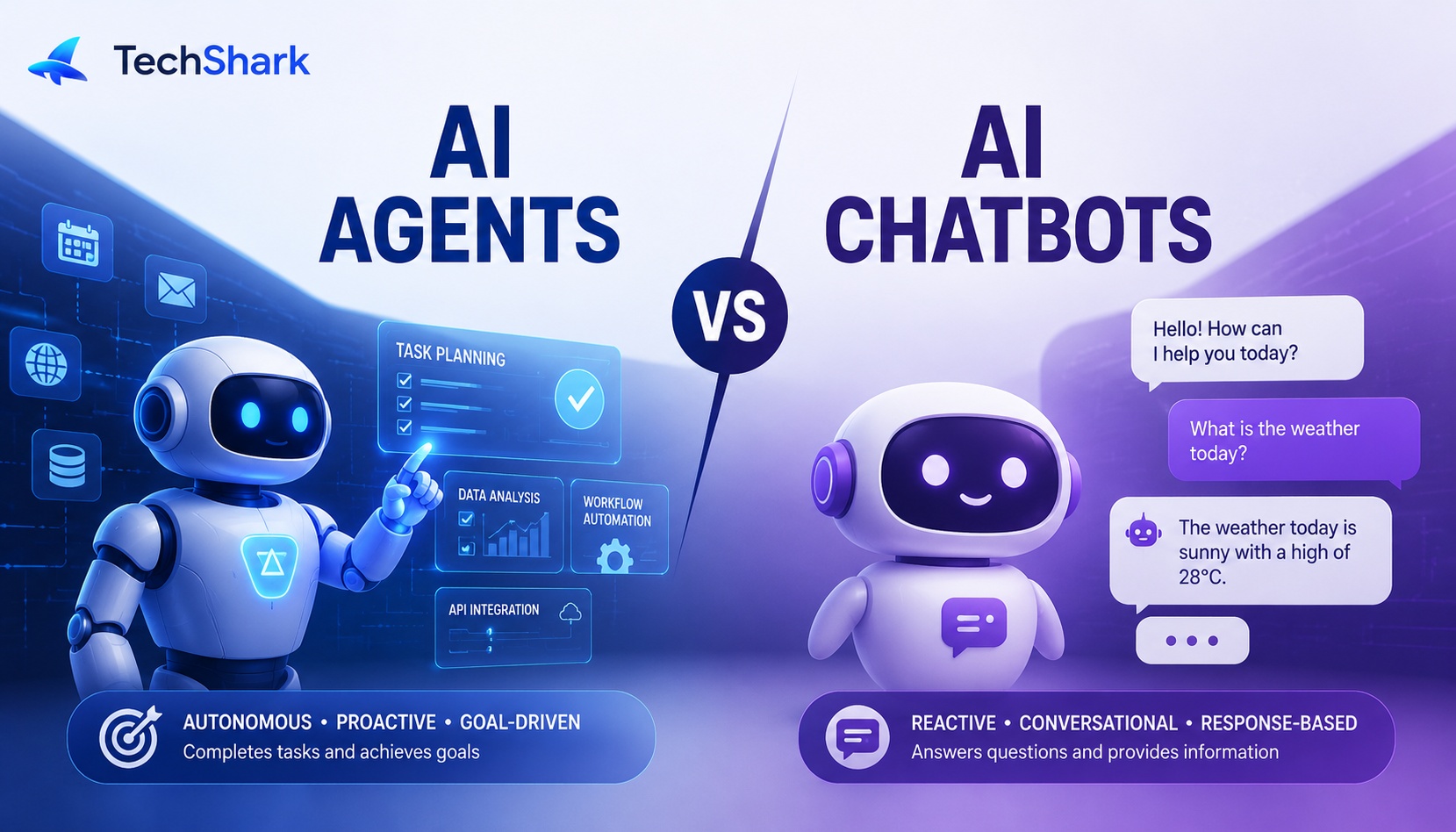
AI Agents vs Chatbots: Key Differences in 2026
Learn the difference between AI agents vs chatbots, including features, use cases, AI assistants, copilots, agentic AI, benefits, and examples.
Explore moreAI agents vs AI chatbots differ mainly in capability and autonomy. AI chatbots are reactive tools designed for conversations—they answer questions and handle simple queries. In fact, around 49% of U.S. adults now use chatbots, with 24% using them daily for tasks like search and support. On the other hand, AI agents are more advanced and autonomous. They can plan, make decisions, and execute multi-step workflows. Adoption is growing fast—about 72% of enterprises are already using or testing AI agents, and 45% have agents in production systems. In simple terms, chatbots respond to questions, while AI agents take action and complete tasks, making them more powerful for automation and business operations.
AI agents and chatbots can both communicate with users, answer questions, and work with natural language, but they are built for different levels of autonomy. A chatbot is mainly designed to understand a request and provide a response, while an AI agent can take a goal, plan the steps needed to achieve it, use tools, make decisions, and complete tasks with limited human input.
The difference is becoming more important in 2026 as businesses move from AI that simply answers questions to AI that can actually perform work. Agentic AI systems can plan and execute multi-step workflows, while traditional chatbots remain useful for conversations, FAQs, customer support, and straightforward tasks.
In simple terms: Chatbots are primarily built to talk, while AI agents are built to act.
Key Facts and Statistics About AI Agents Vs Chatbots
The growth of agentic AI is moving quickly, but adoption is still uneven.
- 62% of respondents in McKinsey's 2025 global AI survey said their organizations were at least experimenting with AI agents. McKinsey also noted that most organizations were still in the early stages of scaling AI.
- More than 80% of Indian organizations surveyed by Deloitte were exploring the development of autonomous agents in its 2025 India State of GenAI research.
- 89% of CEOs surveyed by Deloitte said their organizations were exploring, piloting, or implementing agentic AI in a 2025 CEO survey.
- Deloitte reported that only 21% of organizations in its 2026 survey had mature agentic-AI governance, indicating that adoption is outpacing governance in many organizations.
- Gartner forecasts that 33% of enterprise software applications will include agentic AI capabilities by 2028, up from less than 1% today, according to Deloitte's 2026 Tech Trends discussion.
- Gartner also forecasts that 15% of day-to-day work decisions could be made autonomously through agentic AI by 2028, compared with none in 2024.
These numbers show an important trend: businesses are increasingly experimenting with AI agents, but widespread autonomous deployment still requires better governance, reliability, integration, and trust.
What Is an AI Agent?
An AI agent is a software system designed to pursue a goal and perform actions with limited human supervision. Instead of waiting for a user to provide instructions for every individual step, an agent can break a larger objective into smaller tasks, decide what needs to happen next, use available tools, and adjust its approach based on the results.
For example, imagine telling an AI:
“Find three suitable meeting times for our team, check everyone's availability, schedule the meeting, and send an invitation.”
A basic chatbot might explain how to schedule the meeting. An AI agent could potentially check calendars, identify a suitable time, create the event, and send the invitation if it has the required permissions and integrations.
AI agents commonly combine several capabilities, including:
- Natural language understanding
- Reasoning and planning
- Tool and API usage
- Memory and context
- Decision-making
- External system access
- Multi-step task execution
- Feedback and self-correction
IBM describes agentic AI as systems that can achieve goals with little supervision and highlights autonomy, goal-driven behavior, and adaptability as key characteristics. If you're interested in building these systems, check out our guide to AI agent builder platforms, where we compare different platforms for developers, enterprises, and no-code users.
What Is a Chatbot?
A chatbot is software designed to communicate with people through a conversational interface. It can be used on websites, messaging platforms, applications, customer-service portals, and other digital channels.
Traditional chatbots often rely on predefined rules, keywords, decision trees, or fixed responses. Modern AI chatbots use large language models and conversational AI to understand more natural questions and generate flexible responses.
For example, a customer might ask:
“What is your return policy?”
A chatbot can understand the question and provide the relevant information.
A more advanced chatbot might also help the customer start a return, answer follow-up questions, or retrieve information from a connected knowledge base.
The important point is that being able to chat does not automatically make a system an AI agent.
What Is the Difference Between an AI Agent and a Chatbot? [AI Agent vs Chatbot]
The biggest difference between an AI agent and a chatbot is autonomy and action. A chatbot is generally reactive. The user asks something, and the chatbot responds. An AI agent can be goal-oriented. The user provides an objective, and the agent can determine the steps required to accomplish it.
| Feature | AI Agent | Chatbot |
|---|---|---|
| Primary Purpose | Complete tasks and achieve goals | Communicate and answer questions |
| Autonomy | High or configurable | Usually limited |
| Conversation | Yes | Yes |
| Reasoning | Can support multi-step reasoning | Usually focused on generating responses |
| Planning | Yes | Limited |
| Tool Usage | APIs, databases, browsers, software, and other tools | May have limited integrations |
| Task Execution | Strong | Usually limited |
| Decision-Making | Can make task-specific decisions | Usually follows the conversation |
| Memory | Can use persistent or long-term context | Often limited to conversation context |
| Workflow Automation | Strong | Limited |
| Human Involvement | Can be lower | Usually higher for complex tasks |
| Best Use Case | Complex automation | Conversation and customer support |
IBM similarly distinguishes AI chatbots from agents by noting that agents can plan, make task-specific decisions, execute multi-step workflows, use tools, and adapt their actions to changing conditions.
How Does an AI Agent Work Compared With a Chatbot?
The easiest way to understand the difference is to look at what happens after the user sends a request.
How does a chatbot work?
A typical chatbot workflow looks like this:
User question → Understand request → Generate response → User receives answer
For example:
User: “What are your business hours?”
Chatbot: “We are open Monday to Friday from 9 AM to 6 PM.”
The interaction primarily focuses on answering the question.
How does an AI agent work?
An AI agent can follow a longer process:
Goal → Understand objective → Plan → Select tools → Take action → Check results → Continue or adjust → Complete task
For example:
User: “Find the best flight for my trip next week and add it to my travel plan.”
An agent could potentially:
- Understand the travel requirements.
- Search available flights.
- Compare options.
- Apply the user's preferences.
- Select an option.
- Add the information to a travel plan.
- Ask for confirmation before making a purchase if required.
The key difference is that the agent is not limited to generating a conversational response. It can potentially carry the task forward.
Agentic AI vs. Chatbot: What Is the Difference?
Agentic AI describes AI systems designed to operate with greater autonomy, while a chatbot describes a conversational interface or application. This distinction matters because an AI agent can actually have a chatbot interface.
For example, a user might interact with an AI agent through a normal chat window. From the user's perspective, it looks like a chatbot. Behind that interface, however, the system might be planning tasks, calling APIs, searching databases, executing actions, and monitoring results.
So:
Chatbot = how users interact with the system
AI agent = how the system reasons and acts
This is why the terms Agentic AI vs Chatbot should not always be treated as completely separate categories. They can overlap.
Can an AI Agent Also Be a Chatbot?
Yes.
An AI agent can use a conversational interface, which means it can look and behave like a chatbot while performing agentic tasks in the background.
For example, a customer might type:
“Please check my order and change the delivery address.”
An ordinary chatbot may provide instructions for changing the address.
An AI agent with the appropriate permissions could potentially:
- Identify the customer's order.
- Check whether the address can be changed.
- Update the address.
- Confirm the change.
- Notify the customer.
This type of system is sometimes described as an AI agent chatbot, agentic chatbot, or AI chat agent.
IBM also notes that some AI agents include chatbot interfaces, while conversation is only one part of their functionality
AI Agent Chatbots: Are They Different From Regular Chatbots?
Yes, although the boundary is becoming less clear.
A regular AI chatbot is primarily designed around conversation. It may answer questions, retrieve information, generate content, or guide a user through a process.
An AI agent chatbot combines that conversational experience with the ability to perform actions.
For example:
Regular chatbot:
“Your order is currently being processed.”
AI agent chatbot:
“Your order is delayed by two days. I checked the latest shipment status and updated your delivery preference. You should receive it on Friday.”
The second system is doing more than generating an answer. It is interacting with external systems and completing actions.
AI Agents vs. AI Assistants: What Is the Difference?
AI assistants and AI agents overlap, but they generally differ in how much initiative they take.
An AI assistant usually waits for a user's instruction and helps perform the requested task.
An AI agent can potentially continue working toward a goal after receiving an initial instruction.
For example:
AI assistant:
“Draft an email to the client about the delayed project.”
AI agent:
“Review the project status, identify the cause of the delay, draft the email, check the client's previous communication, and prepare the message for approval.”
The assistant is primarily reactive. The agent has greater responsibility for planning and execution.
IBM describes assistants as generally reactive and agents as more proactive systems that can plan and take actions toward a defined goal.
Chatbot vs. Conversational Agent: What Is the Difference?
A chatbot and conversational agent both use natural language to communicate with people, but a conversational agent generally places more emphasis on context, intent, personalization, and ongoing interaction.
A simple way to think about them is:
Chatbot → Conversation
Conversational agent → Conversation + context
AI agent → Goal + reasoning + action
These categories can overlap. A modern system may combine all three.
For example, a customer-service platform could use a conversational interface to understand a customer's request and then use an AI agent behind the scenes to resolve the issue.
What Can AI Agents Do That Chatbots Cannot?
AI agents can potentially perform tasks that require multiple steps and external actions.
Depending on their design and permissions, they can:
- Search multiple sources
- Access APIs
- Query databases
- Update records
- Send emails
- Create calendar events
- Generate and execute code
- Analyze files
- Monitor workflows
- Make task-specific decisions
- Coordinate with other agents
- Continue working toward a goal without requiring a new prompt for every step
A chatbot can also perform some of these actions if integrations are added. Therefore, the difference is not simply “chatbots cannot use tools.”
The better distinction is how independently the system can plan and execute a goal.
Real-World Examples of AI Agents vs. Chatbots
Customer Support
- Chatbot: Answers questions about refunds, shipping, pricing, and company policies.
- AI agent: Checks the customer's account, investigates an order, determines the appropriate workflow, updates the relevant system, and communicates the result.
Sales
- Chatbot: Answers questions about products and pricing.
- AI agent: Qualifies a lead, researches the company, updates the CRM, prepares a follow-up email, and schedules a meeting.
Marketing
- Chatbot: Provides information about marketing services.
- AI agent: Researches competitors, collects data, prepares a campaign brief, generates content, and organizes campaign assets.
Software Development
- Chatbot: Explains a programming error or generates a code snippet.
- AI agent: Analyzes a repository, identifies the likely problem, changes code, runs tests, reviews the output, and prepares a solution.
What Are the Advantages of AI Agents?
AI agents are particularly useful when a business needs automation rather than just conversation.
- Multi-step automation: Agents can break complex objectives into smaller tasks and execute them sequentially.
- Tool integration: Agents can work with APIs, databases, browsers, software applications, and other tools.
- Reduced manual work: Once properly configured, an agent can handle parts of a workflow without requiring humans to initiate every step.
- Adaptability: Agents can adjust their approach when a tool returns an unexpected result or when the environment changes.
- Workflow execution: Instead of simply recommending what someone should do, an agent can potentially perform the actual workflow.
What Are the Limitations of AI Agents?
AI agents are not automatically better than chatbots.
Their greater autonomy also introduces additional risks and complexity.
Common challenges include:
- Incorrect actions
- Hallucinations
- Poor planning
- Tool failures
- Security risks
- Data privacy concerns
- Prompt injection
- Excessive permissions
- Higher implementation costs
- Difficulty monitoring autonomous behavior
This is especially important when agents can modify business data, communicate externally, make financial decisions, or access sensitive systems.
Deloitte's 2026 research found that only 21% of surveyed organizations reported having mature governance for agentic AI, while about 80% lacked mature governance capabilities. The lesson is simple: the more autonomy an AI system has, the more important permissions, monitoring, testing, and human oversight become.
What Are the Advantages of Chatbots?
Chatbots remain extremely useful for many applications. They are often a better choice when the primary requirement is communication.
Common benefits include:
- Easy customer interaction
- 24/7 availability
- FAQ automation
- Customer support
- Lead qualification
- Information retrieval
- Website assistance
- Lower implementation complexity
- Consistent responses
For many businesses, there is no need to build a fully autonomous AI agent when a well-designed chatbot can solve the problem.
AI Agents vs. Chatbots: Which One Should You Use?
The right choice depends on what you want the AI to accomplish.
Choose a chatbot if:
- Users mainly need answers.
- You want to automate FAQs.
- You need basic customer support.
- The workflow is predictable.
- You want a relatively simple implementation.
- Human agents will handle complex cases.
Choose an AI agent if:
- You need multi-step automation.
- The AI needs to use several tools or applications.
- The workflow requires decisions.
- The system needs to operate with limited supervision.
- You want AI to complete tasks instead of only providing instructions.
Use both if:
You need conversation plus action.
This is likely to become one of the most common approaches because the chatbot interface makes interaction easy while agentic capabilities allow the system to perform work behind the scenes.
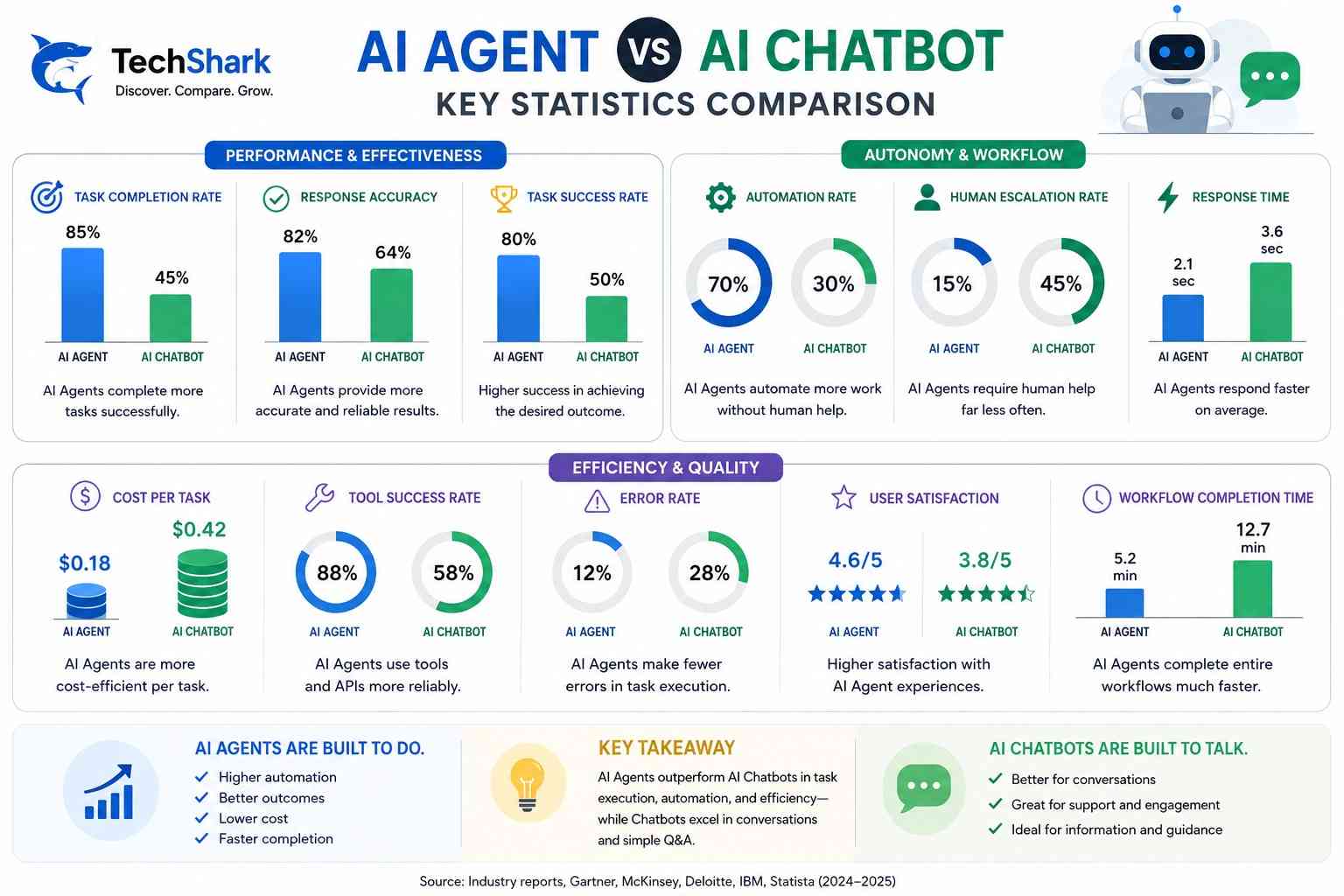
How to Compare AI Agents vs. Chatbots Using Metrics
If you're choosing between an AI agent and a chatbot, don't compare them just by how natural their responses sound.
Measure what they actually accomplish.
Important metrics include:
| Metric | What It Measures |
|---|---|
| Task Completion Rate | Percentage of tasks completed successfully |
| Response Accuracy | Correctness of generated answers |
| Task Success Rate | Whether the desired outcome was achieved |
| Automation Rate | Percentage of work completed without human intervention |
| Human Escalation Rate | How often humans need to take over |
| Response Time | How quickly the system responds |
| Cost per Task | Average cost of completing a task |
| Tool Success Rate | How reliably tools and APIs are used |
| Error Rate | Frequency of incorrect actions |
| User Satisfaction | Quality of the overall experience |
| Workflow Completion Time | Time required to finish the complete process |
For chatbots, metrics such as response accuracy, resolution rate, response time, and customer satisfaction are particularly useful. For AI agents, you should also track task completion, tool-use accuracy, action errors, human intervention, and workflow success.
How to Build an AI Agent Chatbot in VS Code?
If you want to build an AI agent chatbot in VS Code, the project usually needs more than a chat interface.
A basic development process looks like this:
- Choose an AI model: Select an LLM that fits your application's requirements.
- Create the project: Set up your application in VS Code using the programming language and framework you prefer.
- Add the chatbot interface: Create the interface where users can communicate with the system.
- Connect the AI model: Add the model API and create the logic for sending user requests and receiving responses.
- Add agent instructions: Define the agent's role, objectives, limitations, and behavior.
- Add tools: Connect APIs, databases, search, code execution, or other tools the agent needs.
- Add memory when necessary: Allow the system to retain relevant information across interactions or tasks.
- Build the agent loop: The agent should be able to evaluate the task, select an action, observe the result, and determine what to do next.
- Add safeguards: Use permissions, validation, human approval, logging, and monitoring for sensitive actions.
- Test real workflows: Test not only whether the chatbot gives good answers but also whether the agent actually completes tasks correctly.
AI Agents vs. Chatbots in 2026: What Is Changing?
The biggest change in 2026 is that the boundary between chatbots, assistants, copilots, and agents is becoming less obvious.
Older chatbots were primarily designed to answer questions. Modern AI systems can combine conversation, reasoning, memory, tool use, and workflow automation.
As a result, the better question is no longer simply:
“Is this a chatbot or an AI agent?”
Instead, ask:
“How much autonomy does this system have, what tools can it access, and what actions can it take?”
A chatbot may now have agentic capabilities. An AI assistant may perform actions. A copilot may execute parts of a workflow. An AI agent may also communicate through a traditional chat interface.
The technology is moving along a spectrum rather than fitting into completely separate boxes.
Are AI Agents Replacing Chatbots?
Not completely.
AI agents are expanding what conversational AI can do, but chatbots still make sense for many straightforward use cases.
A company that needs a simple FAQ assistant does not necessarily need an autonomous agent. Building an agent for a task that requires only answering common questions can add unnecessary complexity and risk.
At the same time, businesses with complex workflows may benefit from moving beyond conversational bots toward systems that can actually execute tasks. The future will likely see chatbots, copilots, assistants, and AI agents working together, with each used where it provides the most value.
Conclusion
The simplest way to understand AI agents vs. chatbots is to look at their primary job. Chatbots are mainly designed to communicate. AI agents are designed to accomplish goals.
A chatbot can answer a customer's question, explain a product, or guide someone through a process. An AI agent can take that interaction further by planning steps, using tools, making decisions, and executing a workflow with limited supervision. That doesn't mean AI agents are always better. Chatbots are easier to deploy and remain highly effective for customer support, FAQs, and information-based interactions. For businesses, the right choice depends on the complexity of the task. If you need answers, a chatbot may be enough. If you need the AI to do the work, an AI agent is usually the more appropriate approach.
People are also reading:
- Best AI Agent Builder
- AI Tools for Research
- AI Deepfake Tools
- AI Tools for Small Business
- AI Agent vs AI Assistant
- AI Marketing Tools
- How AI Assistants Impact the Formation of Coding Skills?
- What AI Can Do Today?
Frequently Asked Questions (FAQs)
Q: What is an AI agent vs. a chatbot?
An AI agent is designed to pursue goals, plan tasks, use tools, and perform actions with limited supervision. A chatbot is primarily designed to communicate with users and provide conversational responses.
Q: Is ChatGPT a chatbot or an AI agent?
ChatGPT can function as a chatbot through its conversational interface, but modern versions can also provide agent-like capabilities depending on the features, tools, and environment being used. The interface alone does not determine whether a system is agentic.
Q: Are AI agents better than chatbots?
Not always. Chatbots are often better for simple conversations, FAQs, and customer support. AI agents are better suited to complex, multi-step workflows that require planning and action.
Q: Can an AI agent also be a chatbot?
Yes. An AI agent can use a chatbot interface. In this setup, users communicate through chat while the agent performs actions, uses tools, and manages workflows in the background.
Q: What is agentic AI vs. chatbot?
Agentic AI focuses on autonomous or semi-autonomous goal-oriented behavior, while a chatbot primarily focuses on conversation. An agentic system may still use a chatbot interface.
Q: What is the difference between AI agents and AI assistants?
AI assistants generally respond to user instructions and help with tasks. AI agents can take more initiative by planning and executing multiple steps toward a defined goal.
Q; What is the difference between a chatbot and a conversational agent?
A chatbot is primarily a conversational application, while a conversational agent generally emphasizes context-aware and goal-oriented interaction. Modern systems can combine both concepts.
Q: Can chatbots perform tasks like AI agents?
Yes, if they are connected to tools and workflows. However, simply adding an API to a chatbot does not necessarily make it a fully autonomous agent. The level of planning, decision-making, and independent execution matters.
Q: Are AI agents replacing chatbots in 2026?
AI agents are expanding beyond traditional chatbot capabilities, but they are not replacing chatbots completely. Both technologies serve different use cases, and many modern products combine conversational and agentic capabilities.