50+ Amazing AI Facts for Kids: Fun Facts About Artificial Intelligence
Discover 50+ fun AI facts for kids! Learn how artificial intelligence works, explore AI robots, smart assistants, games, and the future of AI.
Explore moreHave you ever asked a computer a question and received an answer in seconds? Have you played a video game where the characters seem to think or used a voice assistant to play your favorite song? You may have already experienced artificial intelligence, also known as AI! Artificial intelligence is a type of technology that helps computers perform tasks that usually require human-like abilities, such as recognizing pictures, understanding language, finding patterns, and solving certain problems.
AI is becoming part of everyday life. It helps people translate languages, discover new music, learn about space, create digital artwork, and even study the weather.
According to UNICEF, children are adopting artificial intelligence (AI) more than three times faster than adults, highlighting how quickly AI is becoming part of everyday childhood. Based on data from 10 countries, UNICEF estimates that at least 20 million children have used AI, around 13 million use it to support learning and homework, and more than 2 million turn to AI for advice about things that worry them. However, this growing adoption also raises concerns about online scams, misinformation, manipulated images, privacy, and children’s safety. The findings highlight the importance of teaching AI literacy from an early age and ensuring children use AI responsibly, with appropriate guidance from parents and educators.
But how much do you really know about it?
In this guide, we will explore more than 50 amazing AI facts for kids. You will discover how AI works, how robots use AI, where you can find AI in daily life, and what makes this technology so interesting. You will also learn how to use AI safely and responsibly. Ready to explore the world of artificial intelligence? Let's begin!
What Is Artificial Intelligence? A Simple Explanation for Kids
Artificial intelligence is technology that enables computers to perform tasks such as recognizing speech, understanding text, identifying objects, and making predictions from data. Imagine teaching a computer to recognize cats. You show it many pictures of cats and other animals. During training, the AI system learns patterns that help it distinguish cats from dogs, birds, and other objects.
When it sees a new picture, it can use those learned patterns to predict whether the picture contains a cat. AI does not think or feel in the same way a human does. It processes information using computer programs and mathematical models. Some AI systems are very good at particular tasks, but they can still make mistakes.
Simple example: A calculator can solve a math problem using programmed rules. An AI-powered learning assistant might explain different ways to solve the same problem. Both are useful, but they work differently.
50+ Amazing AI Facts for Kids
Here are some fascinating artificial intelligence facts that explain the technology in a fun and easy-to-understand way.
Fun Facts About Artificial Intelligence
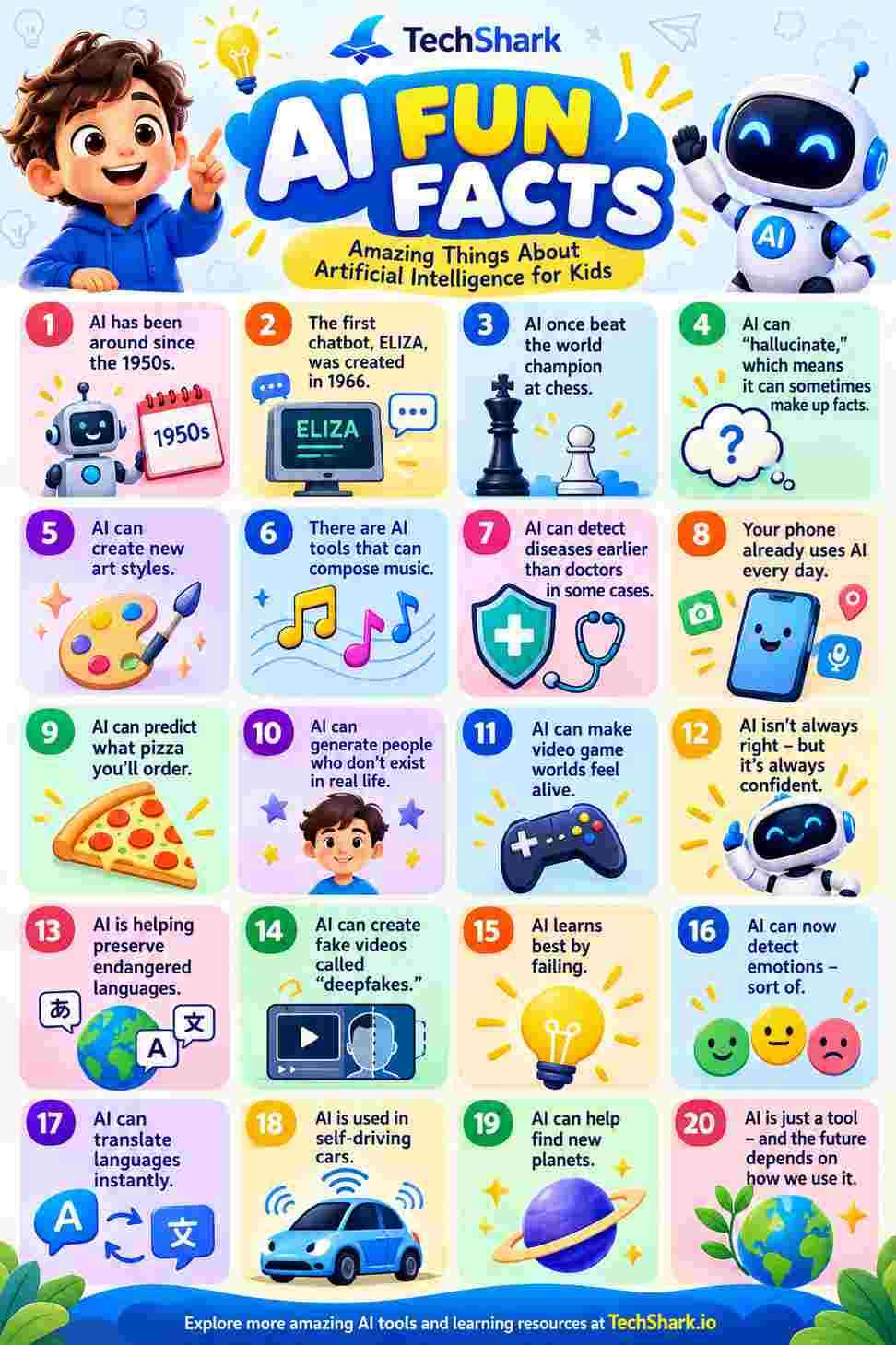
- AI stands for artificial intelligence: "Artificial" means something made by people, while "intelligence" refers to abilities such as learning, recognizing patterns, and solving problems.
- AI is not a new idea: Scientists began seriously exploring artificial intelligence in the 1950s. The term became widely associated with a 1956 research workshop at Dartmouth College.
- AI can recognize pictures: Some AI systems can identify objects such as cars, animals, plants, and everyday items in photographs.
- AI can understand parts of human language: Language models can process questions and generate responses, summaries, stories, and explanations.
- AI can help translate languages: Translation systems can convert text or speech from one language into another, making communication easier.
- AI can recognize speech: Speech recognition technology turns spoken words into text, helping people dictate messages or use voice commands.
- AI can create pictures: Some AI tools generate new images from written descriptions. For example, you might describe a purple elephant flying over a rainbow and ask an image generator to create it.
- AI can help people write stories: Generative AI can suggest story ideas, characters, titles, and endings. Human creativity is still important when developing and editing the final story.
- AI can help people learn mathematics: Certain AI learning tools can explain mathematical steps and provide practice questions.
- AI can make mistakes: An AI system may misunderstand a question, produce an incorrect answer, or invent information. Important answers should be checked.
Amazing Facts About AI in Everyday Life
- AI can help recommend music: Music platforms may use AI and other algorithms to suggest songs based on listening activity and preferences.
- AI can recommend movies: Streaming services can analyze viewing patterns to suggest films or television shows you might enjoy.
- AI can help filter unwanted emails: Email systems use machine learning and other techniques to identify spam and suspicious messages.
- AI can help maps predict traffic: Navigation services may analyze location information and traffic patterns to estimate travel times and suggest routes.
- AI can help phones recognize faces: Some devices use machine learning and other computer vision techniques as part of face-recognition systems.
- AI can help cameras improve photographs: Some cameras and smartphones use AI to adjust lighting, recognize scenes, reduce noise, or improve image quality.
- AI can help online stores recommend products: Recommendation systems use browsing behavior, product information, and other signals to suggest items.
- AI can help detect unusual bank transactions: Financial institutions use machine learning and other systems to identify patterns that may indicate fraud.
- AI can help farmers monitor crops: AI systems can analyze images and sensor data to help identify plant problems, monitor crop conditions, or estimate yields.
- AI can help scientists study the weather: Machine learning models can assist weather forecasting and climate research by analyzing large amounts of data.
Cool Facts About AI Robots
- Not every robot uses AI: Some robots simply follow programmed instructions. Others use AI to interpret information and respond to changing situations.
- AI robots can recognize objects: With suitable cameras and software, robots can identify objects and use that information to guide their actions.
- Some robots can navigate around obstacles: Robots may use sensors, cameras, and AI-assisted systems to detect obstacles and find suitable paths.
- AI can help robots understand spoken commands: Speech recognition and language-processing systems can help a robot respond to a person's instructions.
- Robots can help explore dangerous places: Robotic systems are used in environments where working directly can be difficult or risky, including some industrial sites and disaster zones.
- Scientists use robots to explore space: Space agencies have sent robotic spacecraft and rovers to investigate planets, moons, and other objects. Some use autonomous navigation and intelligent software to assist their missions.
- AI can help robots sort objects: In factories and warehouses, computer vision and machine learning can help robotic systems identify and handle objects.
- A robot and an AI chatbot are different things: A robot is a physical machine, while a chatbot is software that communicates with people. A robot can use a chatbot or another AI system, but it does not have to.
Interesting Facts About Machine Learning
- Machine learning is a branch of AI: It allows computer systems to learn patterns from data rather than relying only on manually written rules.
- AI learns from examples during training: Many machine learning systems are trained using examples, such as pictures, text, sounds, or measurements.
- Training data matters: If the examples used to train an AI system are incomplete, inaccurate, or biased, its results may be less reliable.
- AI can recognize patterns in large datasets: Machine learning can help researchers discover relationships that may be difficult to identify manually.
- AI does not learn exactly like a child: Children learn through many kinds of experiences, emotions, social interactions, and physical exploration. Machine learning systems use mathematical methods and data.
- AI models can be updated: Developers can retrain models, improve their software, or update the information and tools available to a system.
- Some AI systems can identify objects they have never seen before: Depending on how they were trained, certain models can generalize from previous examples to recognize new images or situations. Their predictions are not always correct.
Amazing Facts About Generative AI
- Generative AI can create new content: It can produce text, images, music, audio, video, or computer code, depending on the system.
- Chatbots can answer questions in conversational language: AI chatbots generate responses based on learned patterns and the information available to them.
- AI can help create computer code: Some AI coding assistants suggest code, explain errors, and help programmers explore possible solutions.
- AI can summarize long documents: Summarization tools can turn lengthy text into shorter versions, helping readers find the main points.
- AI can generate different versions of a story: A generative AI tool can suggest a funny, mysterious, adventurous, or science-fiction version of the same basic idea.
- AI-generated pictures can look realistic: Some image-generation systems create images that resemble photographs, even when the scene never existed in real life.
- AI-generated content is not always original in every sense: Models learn patterns from training data and may sometimes reproduce familiar phrases or produce content similar to existing material. Users should respect copyright and attribution rules.
- AI can assist with music creation: Certain systems can generate melodies, rhythms, or musical arrangements based on prompts and examples.
Surprising Facts About AI and Science
- AI can help scientists study animals: Researchers can use computer vision and audio analysis to identify animals and examine wildlife recordings.
- AI can help analyze medical images: Specialized systems can assist qualified healthcare professionals in identifying patterns in some medical scans. They do not replace medical expertise.
- AI can help scientists study proteins: AI systems have contributed to predicting protein structures and understanding biological processes.
- AI can help astronomers analyze space data: Machine learning can help scientists identify objects, classify observations, and search large astronomical datasets.
- AI can support accessibility: Speech-to-text, text-to-speech, image descriptions, and translation tools can help people access information in different ways.
- AI can help protect the environment: Researchers use AI to monitor forests, study wildlife, analyze pollution, and improve energy-management systems.
- AI is used in many different industries: Education, transportation, agriculture, manufacturing, healthcare, entertainment, and scientific research all use AI in different ways.
- AI can help people explore new ideas: Students can use AI to brainstorm science projects, develop quiz questions, and find different approaches to learning.
- AI needs people to set goals and check important results: Humans design, train, evaluate, and manage AI systems. Human oversight remains important, especially when mistakes could cause harm.
How Does AI Work? A Simple Guide for Kids
AI may seem like magic, but it works through computer science, mathematics, and data. Here is a simplified explanation of how a machine learning system can recognize an animal.
- Collect examples: Gather many labeled pictures of cats, dogs, and other animals.
- Train the model: Use a learning algorithm to identify patterns in those pictures.
- Test the model: Check how well it recognizes pictures it did not use during training.
- Make a prediction: Give the trained model a new picture and ask it to identify the animal.
- Check the result: Compare the prediction with the correct answer and improve the system when necessary.
Not every AI system follows this exact process. Different approaches are used for language, images, robotics, forecasting, and other tasks.
Where Can Kids See AI in Real Life?
AI is not limited to science laboratories or futuristic robots. You may encounter it through everyday technology.
| Everyday example | How AI may help |
|---|---|
| Voice assistants | Recognize spoken requests and provide responses. |
| Learning apps | Adapt practice questions or provide explanations. |
| Video platforms | Recommend content based on viewing signals. |
| Translation apps | Translate text or speech between languages. |
| Smartphone cameras | Improve photos and identify scenes. |
| Navigation apps | Estimate travel times and analyze traffic patterns. |
| Creative tools | Generate pictures, stories, or music. |
| Educational robots | Recognize commands or navigate certain environments. |
The exact technology varies by product. Some features use machine learning, while others rely on conventional software, search algorithms, or a combination of methods.
What Are the Benefits of AI for Kids?
When used appropriately, AI can support learning, creativity, and exploration.
- Personalized learning: AI-assisted learning tools can provide practice questions, explain difficult topics, and adjust exercises to a student's progress.
- Creative thinking: Children can use suitable tools to brainstorm stories, develop drawing ideas, or design imaginary worlds. They should still make their own creative decisions.
- Learning new languages: Translation, pronunciation, and conversation tools can help children practice vocabulary and explore languages.
- Exploring science: AI can help explain topics such as planets, dinosaurs, oceans, and the human body in age-appropriate language.
- Accessibility support: Tools such as speech-to-text and text-to-speech can make learning materials easier to access for some students. AI is a learning aid, not a replacement for teachers, parents, reading, practical activities, or independent thinking.
Is AI Safe for Kids?
AI can be useful, but children should learn to use it carefully.
- Check important facts: AI can give incorrect or misleading answers. Confirm information with a teacher, parent, textbook, or reliable source.
- Protect personal information: Do not share your home address, phone number, passwords, school details, or private family information with an AI tool.
- Ask an adult for help: Parents or teachers can help choose age-appropriate tools and explain their rules.
- Think before trusting an answer: Ask where information came from and whether it makes sense.
- Be careful with AI-generated images and videos: Some content may be edited or entirely synthetic.
- Use AI honestly: Follow school rules and explain when AI helped with an assignment.
- Remember that chatbots are not people: They can sound friendly, but they do not have human feelings or personal experiences.
Children should follow each tool's minimum-age requirements, privacy settings, and family or school rules.
Fun AI Activities for Kids
Want to learn about artificial intelligence by trying something practical? Here are five simple activities.
Activity 1: Train a human image classifier
Ask a friend to sort pictures into groups, such as cats, dogs, birds, and fish. Then discuss which features helped them make decisions. This demonstrates the basic idea of classification. A real AI model uses mathematical representations and training algorithms rather than human reasoning.
Activity 2: Create an AI fact-checking challenge
Choose three facts about space or animals. Ask an AI assistant to explain them, then verify the answers using a trusted educational source. The goal is to learn that a confident answer is not always a correct answer.
Activity 3: Write a story with AI
Choose a character, a setting, and a problem. Ask an AI tool for three possible story ideas, then write your own version.
Activity 4: Explore patterns
Create a list of numbers, shapes, or colors. Ask a classmate to identify the pattern and predict what comes next. Discuss how pattern recognition relates to some machine learning tasks.
Activity 5: Design a helpful robot
Draw a robot that solves a real problem, such as helping organize books or reminding someone to water plants. Explain what sensors, information, and instructions it might need. These activities can introduce AI concepts without requiring expensive equipment or advanced coding skills.
Conclusion
Artificial intelligence is one of the most interesting areas of modern technology. From recognizing pictures and translating languages to helping scientists explore space, AI can support many different activities. These 50+ AI facts for kids show that artificial intelligence is not magic. It is technology developed by people using mathematics, computer programs, and data to solve problems. The most important lesson is that AI is a tool. It can help children learn, create, and explore, but it can also make mistakes. Asking questions, checking facts, protecting personal information, and thinking independently are essential skills for using AI responsibly.
Keep exploring, stay curious, and remember: people shape the future of technology with the questions they ask and the ideas they bring to life.
People are also reading:
- Best AI Fitness Tools
- Best AI Music Tools
- Best AI Compliance Tools
- Best AI Presentation Tools
- Best AI Cybersecurity Tools
- Best AI Stock Market Tools
- AI Agents for Real Estate
Frequently Asked Questions
1. What are some fun AI facts for kids?
AI can recognize pictures, help translate languages, recommend music, generate artwork, summarize text, and assist scientists with research. However, AI can make mistakes and does not think or feel exactly like a human.
2. What does AI stand for?
AI stands for artificial intelligence. It refers to computer technology designed to perform tasks such as recognizing patterns, processing language, making predictions, and generating content.
3. How does artificial intelligence work for kids?
AI systems use computer programs, mathematical models, and data to perform specific tasks. Many machine learning systems learn patterns from examples and use those patterns to make predictions or generate responses.
4. Can AI think like a human?
AI can perform some tasks that appear intelligent, but it does not think or experience the world in the same way humans do. Its capabilities depend on its design, training, and available information.
5. Is AI good or bad for children?
AI can support learning and creativity when used responsibly. Risks include inaccurate information, privacy concerns, inappropriate content, and overdependence. Adult guidance and age-appropriate tools help reduce these risks.
6. What are examples of AI in everyday life?
Examples include speech recognition, translation tools, photo enhancement, recommendation systems, navigation services, spam filters, and certain educational applications.
7. What is the difference between AI and a robot?
AI is a type of computer technology, while a robot is a physical machine. Some robots use AI, but many robots follow programmed instructions without advanced AI.
8. Can kids learn AI without coding?
Yes. Children can begin by exploring pattern recognition, simple classification games, AI-assisted creative activities, and discussions about responsible technology use. Coding can be introduced later if they want to build their own projects.
9. Can AI make mistakes?
Yes. AI can misunderstand instructions, produce incorrect facts, reflect biases, or generate misleading content. Important information should be verified with reliable sources.
10. What is the future of AI for kids?
AI may become more common in learning tools, creative applications, accessibility technology, robotics, and scientific exploration. Children can prepare by learning digital literacy, critical thinking, creativity, and responsible technology use.