10 Best AI Stock Market Tools in 2026: AI Stock Analysis & Trading Tools
Discover the 10 best AI stock market tools in 2026 for stock analysis, research, screening, technical analysis, and trading. Compare features, pricing, pros, cons, and use cases.
Explore moreThe best AI stock market tools include TrendSpider, Trade Ideas, Danelfin, Stock Rover, AlphaSense, and TradingView. They help investors analyze stocks, identify trading opportunities, screen companies, evaluate fundamentals, detect technical patterns, and track market trends. For beginners, TradingView and Stock Rover are strong choices, while advanced traders may prefer Trade Ideas, TrendSpider, or Danelfin for AI-powered market analysis and signals.
AI is changing how investors and traders research stocks. Instead of spending hours reading earnings transcripts, comparing financial statements, scanning thousands of stocks, or manually searching for technical patterns, investors can now use AI-powered share market tools to speed up parts of the research process.
But there is an important distinction:
The best AI stock market tools don't magically predict which stock will go up tomorrow. They help you research faster, find relevant opportunities, analyze data, test ideas, and make more informed decisions.
That distinction matters because “AI-powered” has become a broad marketing label. Some platforms are primarily stock screeners. Others focus on technical analysis, fundamental research, financial data, sentiment, or automated trading. After reviewing current search results, the two ranking articles provided for this research, and the capabilities of leading platforms, these are the 10 best AI stock market tools to consider in 2026.
Quick Answer: What Are the Best AI Stock Market Tools?
| Rank | AI Stock Market Tool | Best For | Main Strength |
|---|---|---|---|
| 1 | Trade Ideas | Active stock traders | AI-powered stock scanning and signals |
| 2 | TrendSpider | Technical analysis | Automated chart analysis and backtesting |
| 3 | TradingView | All-around market analysis | Charts, screeners, Pine Script and alerts |
| 4 | Danelfin | AI stock scoring | AI Score and stock ranking |
| 5 | TipRanks | Stock research | Smart Score, analyst data and sentiment |
| 6 | AlphaSense | Professional research | AI-powered financial research and document search |
| 7 | Daloopa | Equity research | Structured, source-linked financial data |
| 8 | Fiscal.ai (formerly FinChat) | Fundamental research | Conversational financial analysis |
| 9 | Tickeron | AI pattern recognition | Automated patterns and trading ideas |
| 10 | Kavout | Quantitative stock screening | AI-powered stock ranking |
Key Facts About AI Stock Market Tools
Before looking at individual platforms, there are a few numbers worth knowing.
- A July 2023 CFA Institute survey cited by Daloopa found that 55% of investment professionals were incorporating unstructured data into their workflows, while 64% were using alternative data sources.
- A 2026 trading-tools review reported a realistic 3–8% improvement in execution/process consistency, rather than the exaggerated 70–90% win-rate claims sometimes associated with AI trading products.
- The same review found that AI trading tools generally fall into four groups: LLM research assistants, AI chart-analysis platforms, automated strategy builders, and API/Python stacks.
- The review also emphasized that walk-forward testing on unseen data is essential because in-sample backtests can produce misleading AI performance claims.
- Daloopa currently says its platform covers 6,000+ global tickers, with source-linked financial data and an average accuracy rate of more than 99% across millions of data points. These are Daloopa's own published figures, not an independent audit.
- Danelfin says its AI score evaluates stocks using 10,000 features per stock every day, drawing from more than 600 technical, 150 fundamental, and 150 sentiment indicators. This is a vendor-reported methodology.
- TipRanks' Smart Score evaluates stocks on eight market factors, including analyst ratings, insider transactions, hedge fund activity, news sentiment, technicals, and fundamentals.
The takeaway is simple: AI is becoming useful for processing financial information, but that doesn't mean an AI-generated stock signal is automatically a profitable trade.
10 Best AI Stock Market Tools
1. Trade Ideas — Best AI Stock Trading Tool for Active Traders
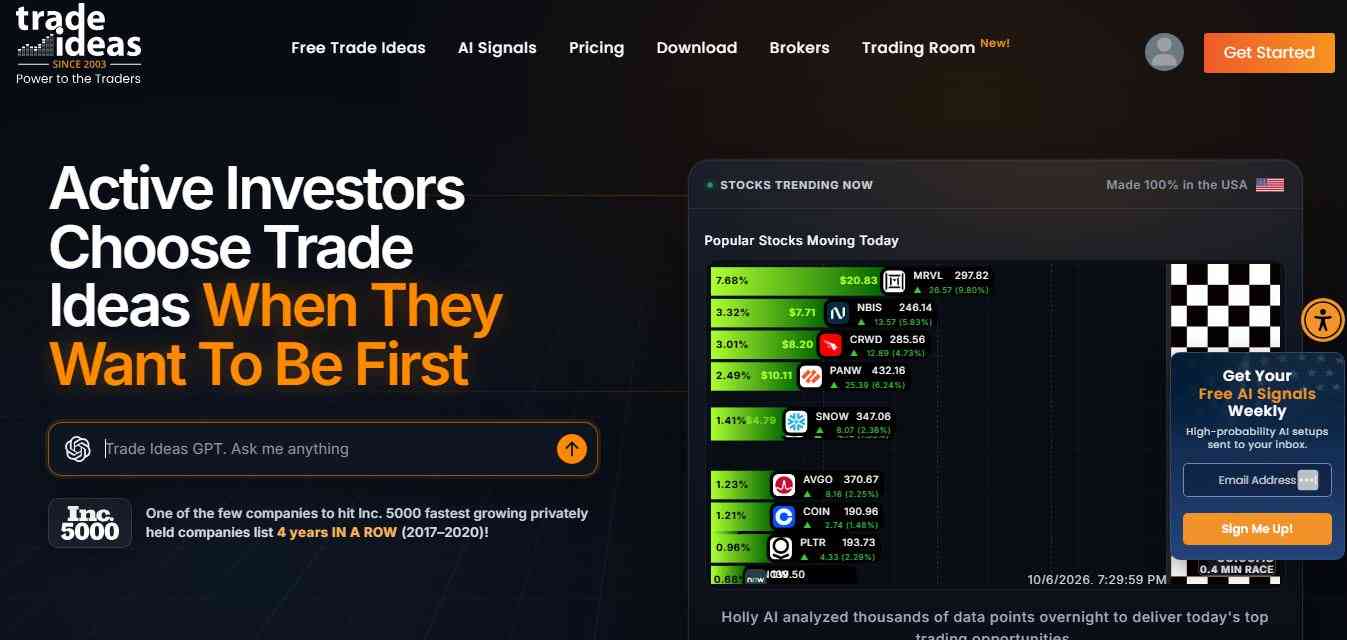
Trade Ideas is one of the strongest options if your goal is to find potential trading opportunities during the market session. Its flagship AI system, Holly, analyzes market conditions and generates trading ideas based on predefined strategies. The platform also combines real-time scanning, customizable screeners, charts, backtesting, and trading functionality.
The current Trade Ideas pricing page lists its Core plan at $127/month and its Premium plan at $254/month, with AI signals, backtesting, and auto-trading available on the Premium plan.
- Best for: Day traders and active U.S. stock traders
- Primary use: Real-time stock scanning, AI signals, and strategy testing
Why Trade Ideas stands out
- The biggest advantage is speed.
- Instead of manually watching hundreds of stocks, traders can define conditions and let the platform surface stocks that match those conditions.
- The 2026 For Traders review also placed Trade Ideas among its leading AI chart-analysis platforms, particularly for intraday U.S. equities.
Key features
- Holly AI signals
- Real-time stock scanning
- Custom screeners
- Backtesting
- Smart risk levels
- Real-time alerts
- Paper trading
- Broker integrations
- Automated trading options
Pros
- Excellent for active traders
- Powerful real-time scanning
- Large number of filters
- AI-assisted trading ideas
- Backtesting available
Cons
- Expensive compared with basic screeners
- Primarily focused on U.S. equities
- Can be overwhelming for beginners
- AI signals should not be treated as guaranteed predictions
Best for
If you trade U.S. stocks actively and need real-time AI stock scanning, Trade Ideas is one of the strongest choices.
2. TrendSpider — Best AI Technical Analysis Software

TrendSpider is designed for traders who want to automate repetitive technical-analysis tasks. Rather than manually drawing trendlines, checking multiple timeframes and scanning charts one by one, TrendSpider automates much of this process.
The platform offers automated technical analysis, scanners, alerts, bots, and backtesting. Current pricing shows Standard, Premium, Enhanced, and Advanced plans, with published prices varying significantly according to plan and billing cycle.
- Best for: Technical traders and swing traders
- Primary use: Automated technical analysis, chart scanning, and backtesting
What makes TrendSpider different?
- One of its biggest strengths is multi-timeframe technical analysis.
- For example, a trader can look for a short-term setup that aligns with a higher-timeframe trend rather than analyzing each chart manually.
- The For Traders review specifically highlighted TrendSpider's automated trendline analysis, multi-timeframe scanning, and Strategy Tester.
Key features
- Automated trendlines
- Automated technical analysis
- Multi-timeframe scanners
- Pattern recognition
- Strategy testing
- Alerts
- Trading bots
- AI-assisted analysis
Pros
- Excellent technical analysis automation
- Powerful scanners
- Good for systematic traders
- Strong backtesting functionality
Cons
- Learning curve
- Can be expensive for casual investors
- More useful for active traders than passive investors
Best for
Choose TrendSpider if your main requirement is AI-powered technical analysis rather than fundamental stock research.
3. TradingView — Best All-Around Stock Market Analysis Tool

TradingView remains one of the most versatile platforms for analyzing financial markets. TradingView is a popular financial analysis platform for traders and investors. It provides interactive charts, technical indicators, market data, stock screeners, trading ideas, alerts, and drawing tools. Users can analyze stocks, cryptocurrencies, forex, commodities, and other markets while sharing strategies and insights with the trading community.
- Best for: Beginners, technical traders, and multi-asset investors
- Primary use: Charts, screening, alerts, and strategy development
Its biggest advantage is that it isn't limited to one trading style.
You can use it for:
- Stock charts
- Technical indicators
- Stock screening
- Market alerts
- Strategy development
- Pine Script
- Community ideas
- Multi-asset analysis
The 2026 For Traders review specifically highlighted TradingView's natural-language screening, Pine Script generation, and broad multi-asset coverage.
Why investors like TradingView
- The platform combines professional charting with a huge community ecosystem.
- For someone learning technical analysis, that makes it easier to find indicators, scripts and examples without building everything from scratch.
Pros
- Excellent charting
- Large user community
- Multi-asset coverage
- Powerful alerts
- Pine Script
- Strong screening capabilities
- Useful free entry point
Cons
- Some advanced features require paid plans
- Beginners may find the interface overwhelming
- AI features shouldn't replace independent research
Best for
TradingView is arguably the safest all-purpose recommendation if someone wants one platform for charts, screening, alerts, and technical research.
4. Danelfin — Best AI Stock Scoring Tool
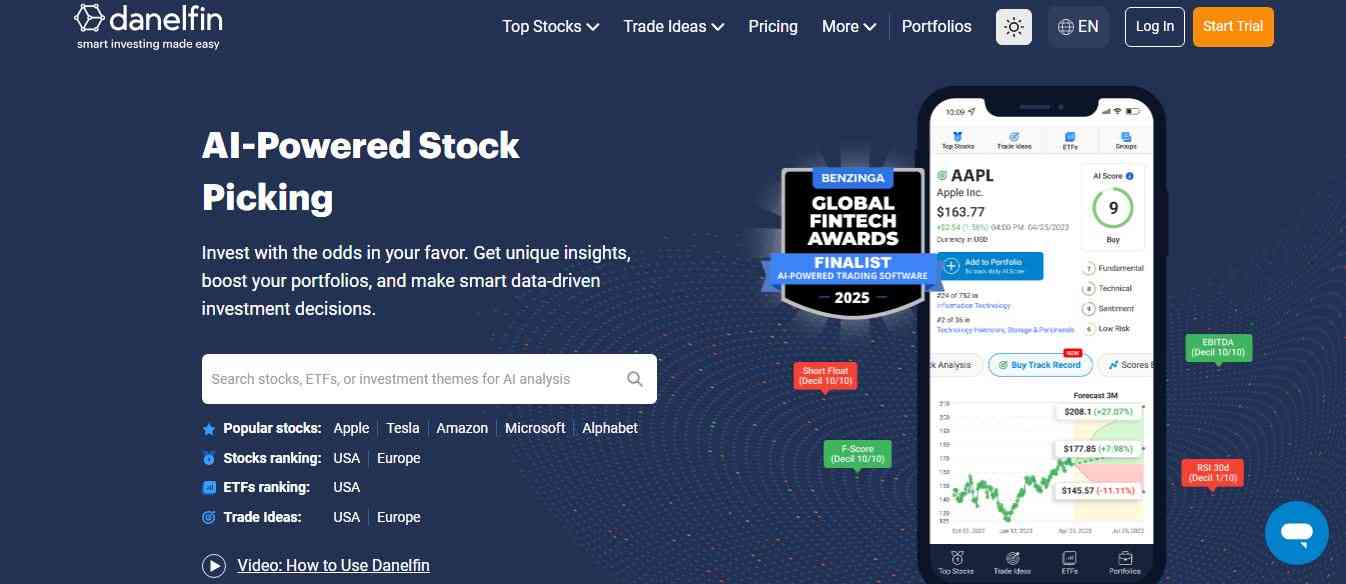
Danelfin takes a different approach. Instead of asking investors to interpret dozens of indicators individually, its AI score attempts to condense large quantities of market information into a simple 1–10 score. Danelfin says its system analyzes 10,000 features for each stock every day, including technical, fundamental, and sentiment indicators.
- Best for: Investors who want AI-generated stock rankings
- Primary use: Stock scoring and idea generation
Pricing
Danelfin currently offers a free plan, while paid plans start at $22/month for Plus and rise to $59/month for Pro and $134/month for Elite on its annual pricing page.
What you can use it for
- Finding highly ranked stocks
- Comparing companies
- Monitoring watchlists
- AI stock scoring
- Portfolio analysis
- Trade idea discovery
- AI price forecasts
Pros
- Easy-to-understand scoring
- Strong for stock discovery
- Free tier available
- Combines multiple data categories
Cons
- A score shouldn't be treated as an investment decision
- Primarily U.S.-market oriented
- Less useful for traders looking for detailed charting
Best for
Danelfin is a good choice if your question is:
“Which stocks deserve a closer look?”
rather than:
“Where exactly should I enter and exit this trade?”
5. TipRanks — Best for AI Stock Ratings and Sentiment
TipRanks combines several different sources of market information into one research platform. Its best-known feature is the Smart Score, which rates stocks from 1 to 10.
- Best for: Retail investors researching stocks
- Primary use: Stock ratings, analyst research, sentiment, and Smart Score
According to TipRanks, the score incorporates eight factors:
- Analyst ratings
- Insider transactions
- Financial blogger opinions
- Individual investor sentiment
- Hedge-fund activity
- News sentiment
- Technical analysis
- Fundamental analysis
That makes TipRanks particularly useful for investors who don't want to manually combine analyst ratings, insider activity and sentiment data.
What TipRanks is good at
- Stock research
- Analyst tracking
- Insider activity
- Hedge-fund activity
- News sentiment
- Stock screening
- Smart Score rankings
The Daloopa ranking also included TipRanks among its six AI-oriented equity-research tools, highlighting its Smart Score and analyst credibility features.
Pros
- Easy stock comparison
- Strong sentiment data
- Analyst tracking
- Useful stock rankings
- Good for retail investors
Cons
- Some advanced data requires paid access
- Smart Score shouldn't be treated as a standalone buy signal
- More useful for research than automated trading
Best for
TipRanks is ideal for investors who want to answer:
“What are analysts, insiders, hedge funds and market sentiment saying about this stock?”
6. AlphaSense — Best AI Investment Research Platform
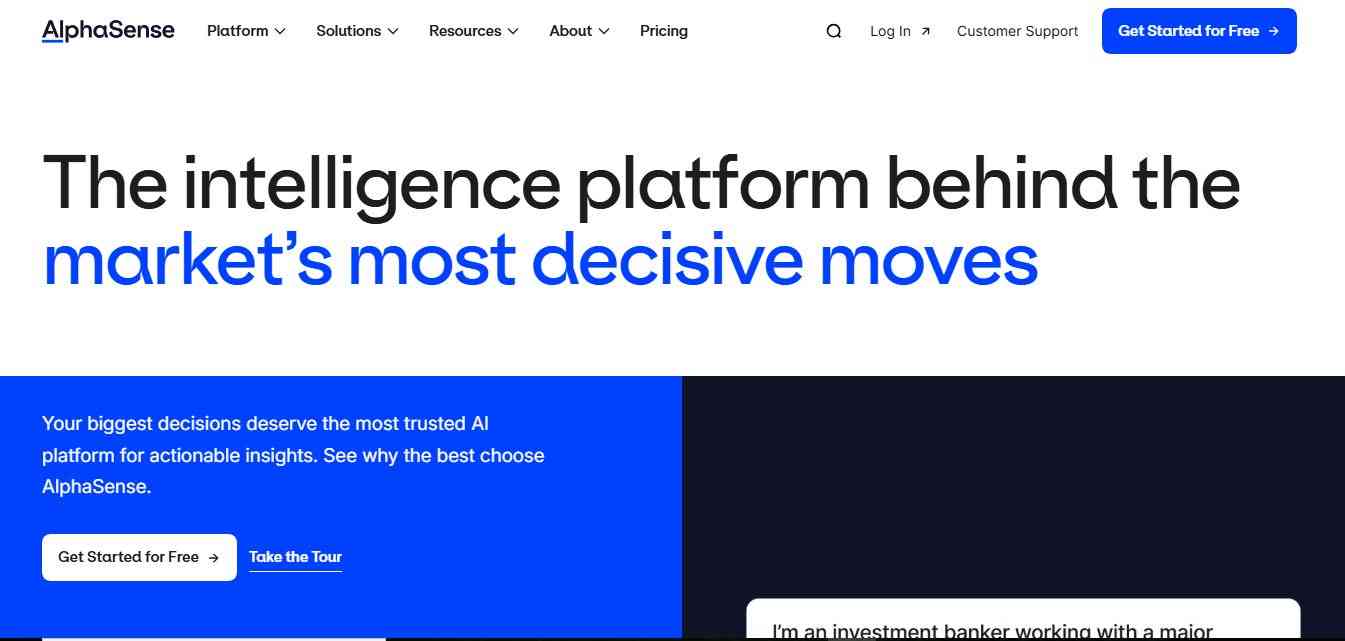
AlphaSense sits closer to the institutional-research side of the market. Instead of primarily focusing on chart patterns or retail trading signals, it helps professionals search, analyze, and summarize huge volumes of financial information. AlphaSense says its platform provides access to 500+ million premium external documents, alongside internal enterprise information.
- Best for: Professional investors, analysts, and corporate strategy teams
- Primary use: Financial research and document intelligence
Its AI capabilities include:
- Generative Search
- Generative Grid
- Smart Summaries
- Sentiment Analysis
- Smart Synonyms
- Financial document search
- Earnings transcript analysis
- SEC filing research
AlphaSense also provides financial data tools such as company financials, screeners, industry comps and an Excel add-in.
Pros
- Excellent for institutional research
- Huge content universe
- Strong document search
- AI summaries
- Citation-based research
- Useful for competitive intelligence
Cons
- Enterprise-oriented
- Pricing isn't aimed at casual retail investors
- More research platform than trading tool
Best for
If you are an equity analyst, investment professional, private-equity professional, or strategy team member, AlphaSense is one of the most sophisticated options in this list.
7. Daloopa — Best for AI-Powered Equity Research Data

Daloopa solves a problem that is less visible to retail investors but extremely important for professional equity research: getting reliable financial data into models without manually copying it from filings. The original Daloopa article you supplied focuses heavily on this use case. It describes Daloopa as a platform that converts earnings releases, SEC filings and investor reports into structured data that can be used in financial models.
Its current platform has expanded significantly.
Daloopa says it covers 6,000+ global tickers, provides 14 years of historical data, and links individual data points back to their source documents.
- Best for: Equity analysts and financial modeling teams
- Primary use: Structured financial data and model automation
Key features
- Structured financial data
- SEC filing extraction
- Earnings data
- KPI tracking
- Excel integration
- API access
- MCP integration
- AI financial modeling
- Source-linked data
Daloopa also says its Scout product can build and update financial models directly in Excel using plain-language prompts.
Pros
- Excellent for equity research
- Source-linked financial data
- Strong Excel workflow
- Useful for financial modeling
- Built for auditability
Cons
- Primarily aimed at professional users
- Not designed as a day-trading scanner
- Enterprise pricing may not suit retail investors
Best for
Daloopa is particularly useful when data accuracy and traceability matter more than flashy trading signals.
8. Fiscal.ai — Best Conversational AI for Fundamental Stock Research

If you've searched for FinChat, you'll find that the platform has evolved into Fiscal.ai. The FinChat brand was reworked as the company expanded into a broader financial research platform. FinChat: The original Daloopa ranking highlighted FinChat for its conversational financial analysis, including earnings transcripts, financial tables, research notes, and natural-language screening.
- Best for: Fundamental investors
- Primary use: Company research, financial analysis, and conversational queries
That basic use case remains important: Instead of opening multiple financial pages and manually comparing numbers, investors can ask questions in natural language.
For example:
“Compare Nvidia's revenue growth with AMD over the last five years.”
Or:
“Summarize the biggest risks mentioned in the company's latest earnings call.”
Or:
“Find companies with accelerating revenue growth and improving margins.”
Pros
- Conversational research
- Fundamental analysis
- Company comparisons
- Financial data
- Earnings research
- Useful for long-term investors
Cons
- Not primarily an intraday trading platform
- Data coverage and features can change
- AI output still needs verification
Best for
Fiscal.ai is a strong choice for fundamental investors who want to ask financial questions instead of manually navigating multiple datasets.
9. Tickeron — Best for AI Pattern Recognition
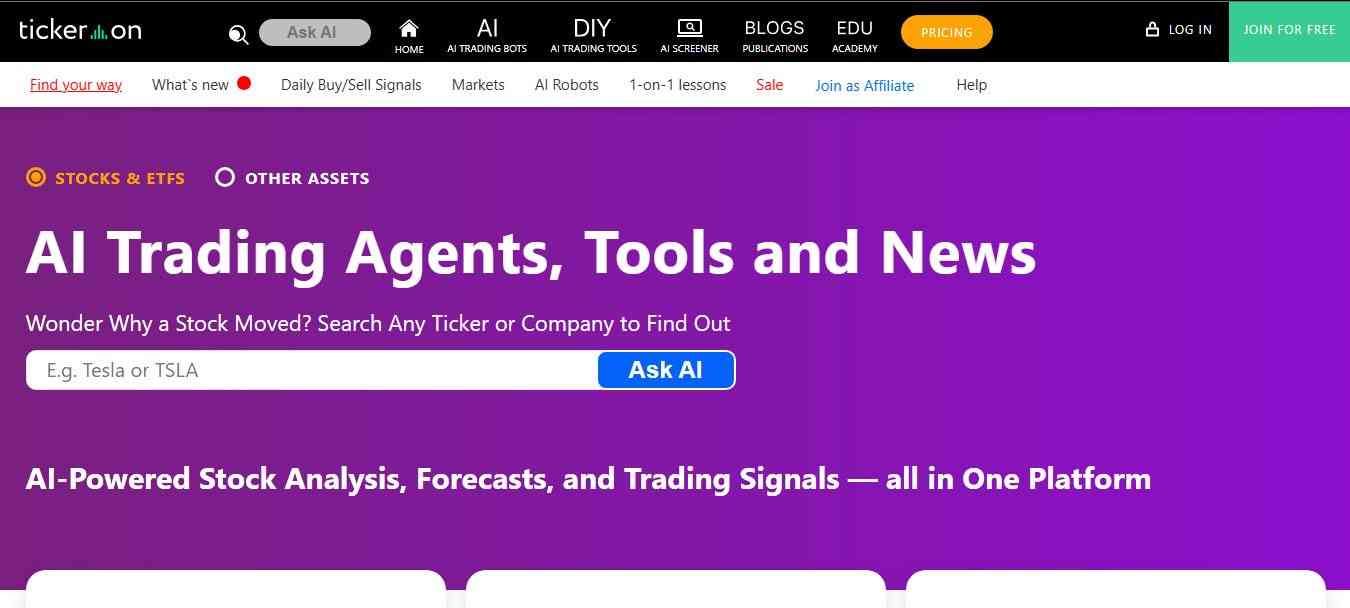
Tickeron focuses heavily on AI-based technical pattern recognition. Its platform currently promotes AI real-time patterns, AI robots, trend prediction, and daily buy/sell signals. The For Traders review describes Tickeron's pattern-recognition functionality as a second opinion that can identify patterns such as head-and-shoulders and double tops.
- Best for: Traders looking for automated pattern recognition
- Primary use: Technical patterns and AI-generated trading ideas
Key features
- AI pattern recognition
- Real-time patterns
- AI trading robots
- Trend prediction
- Buy/sell signals
- Stock and ETF analysis
Pros
- Easy way to scan for patterns
- Good for technical traders
- Multiple AI-based tools
- Useful for idea generation
Cons
- Signal quality varies
- Pattern recognition isn't prediction
- Automated trading features require additional caution
Best for
Tickeron makes the most sense for traders who want AI to help identify technical setups across many stocks.
10. Kavout — Best AI Stock Ranking for Quantitative Screening
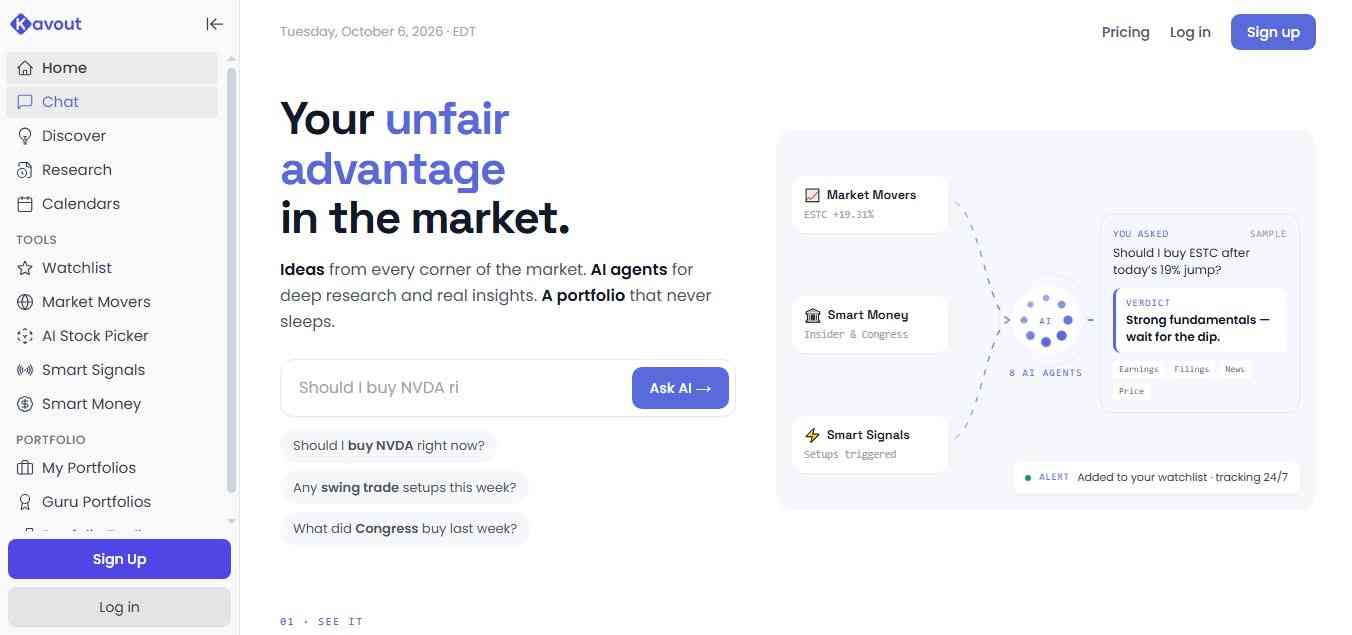
Kavout's best-known feature is its Kai Score, which converts multiple fundamental, technical, and market signals into a simplified stock ranking. The 2026 For Traders review describes Kai Score as a 1–9 stock ranking designed to help investors narrow a watchlist quickly. A current 2026 review reports that Kavout's system covers more than 9,000 U.S. stocks and uses hundreds of factors, although these figures should be treated as platform-specific claims rather than independent performance verification.
- Best for: Quantitative investors and stock screeners
- Primary use: AI stock rankings
Pros
- Simple quantitative ranking
- Useful for screening
- Combines multiple factors
- Good for watchlist creation
Cons
- A score is not an entry signal
- Quantitative models can become less effective when market regimes change
- Less useful for intraday traders
Best for
Use Kavout when you want to reduce a large universe of stocks to a smaller research list.
Which AI Stock Market Tool Should You Choose?
The answer depends on what you actually want AI to do.
If you're a day trader
Start with:
Trade Ideas + TradingView
Trade Ideas handles real-time scanning and AI-generated trade ideas, while TradingView is useful for charting, confirmation, and strategy development.
If you're a technical trader
Choose:
TrendSpider
Its automated technical analysis, scanners, and backtesting make it one of the strongest options for chart-driven strategies.
If you're a beginner
Choose:
TradingView or Danelfin
TradingView gives you a broad market-analysis environment, while Danelfin simplifies stock research through AI scoring.
If you're a long-term investor
Choose:
Fiscal.ai + TipRanks
Fiscal.ai can help with fundamental research, while TipRanks adds analyst, sentiment, and market participant information.
If you're an equity analyst
Choose:
Daloopa or AlphaSense
These platforms are much closer to professional research workflows than typical retail trading tools.
If you want AI stock signals
Consider:
Trade Ideas, Danelfin or Tickeron
But treat their signals as research inputs rather than guaranteed predictions.
How to Choose the Best AI Stock Analysis Tool
Don't choose an AI investing platform simply because its homepage says “AI-powered.”
Instead, look at six things.
1. What data does it actually use?
An AI model is only as useful as the data behind it.
Check whether the platform uses:
- SEC filings
- Earnings transcripts
- Financial statements
- Market prices
- Technical indicators
- Analyst estimates
- Insider transactions
- News
- Alternative data
- Sentiment
- Institutional activity
2. Can you verify the AI's answer?
This is especially important for financial AI. A useful platform should make it possible to trace important information back to a source. AlphaSense, for example, emphasizes source-linked AI responses, while Daloopa links financial data points to their original source documents.
3. Does it support your investing style?
A day trader and a long-term investor need completely different tools.
| Investor Type | Better AI Tool Type |
|---|---|
| Day trader | Real-time scanner |
| Swing trader | Technical analysis platform |
| Long-term investor | Fundamental research platform |
| Quant trader | Backtesting/API platform |
| Equity analyst | Financial data/research platform |
| Beginner | AI stock screener |
| Portfolio investor | AI ranking + portfolio analysis |
4. Does it have real backtesting?
Be careful with screenshots showing incredible historical returns. The 2026 For Traders review specifically evaluated the backtesting methodology and emphasized walk-forward validation on unseen data, rather than relying on in-sample results. A strategy that performs brilliantly on historical data but fails on new data may simply be overfit.
5. How much automation do you actually need?
There's a major difference between:
AI helping you research a stock
and
AI is automatically placing trades.
The more automation you add, the more important execution controls, broker compatibility, and risk management become.
6. Does your workflow justify the price?
A $20 AI research tool may be enough for a long-term investor. A professional day trader may justify a $200+ scanner if it saves substantial time and replaces several other tools. The For Traders research found 2026 AI trading-tool prices ranging from free tiers to more than $200/month for advanced scanners.
Can AI Predict Stock Prices?
Not reliably.
This is probably the most important question to answer when discussing AI stock market tools. AI can analyze historical prices, financial statements, news, sentiment and other information. It can identify patterns and generate scenarios.
But none of that means it knows what a stock will do tomorrow. The 2026 trading-tools research explicitly warns against treating AI as a crystal ball and says realistic benefits are more about research speed, consistency, fewer missed setups and better journaling than extremely high win rates.
A better workflow is:
AI → research → hypothesis → validation → risk management → human decision
rather than:
AI → buy → profit
Are AI Stock Trading Tools Worth It?
They can be—but only when they solve a real problem.
For example, an AI tool can be valuable if it helps you:
- Reduce research time
- Screen thousands of stocks
- Summarize earnings calls
- Compare companies
- Identify technical patterns
- Monitor portfolios
- Build and test strategies
- Track market sentiment
- Organize financial data
- Reduce emotional decision-making
The original Daloopa research provides a useful example: it cites a VanEck deployment where analyst preparation time reportedly fell from 30 hours to 30 minutes using FinChat. That's a compelling productivity result, but it should be treated as a specific customer case rather than a universal expectation.
AI Stock Market Tools vs Traditional Stock Screeners
Traditional screeners generally require you to select filters manually.
For example:
P/E < 20
ROE > 15%
Revenue growth > 10%
AI-powered platforms increasingly allow natural-language workflows such as:
“Find profitable technology companies with accelerating revenue growth, low debt and improving sentiment.”
That doesn't necessarily make the AI answer better. It makes the research interface faster and easier. The best platforms combine both approaches: natural-language interaction plus transparent underlying data and filters.
Free AI Stock Market Tools
If you're looking for free AI stock analysis tools, don't assume you need an expensive subscription.
A sensible free or low-cost starting stack could include:
TradingView
Useful for charts, screeners, and market monitoring.
Danelfin Free
Danelfin currently offers a $0 plan with limited reports, rankings, and AI score functionality.
ChatGPT or Claude
Useful for:
- Summarizing earnings reports
- Explaining financial concepts
- Reviewing research
- Writing screening logic
- Analyzing data you provide
But general-purpose AI models should not be treated as live stock-price databases unless they are connected to an appropriate market-data source. The For Traders research makes the same distinction: LLMs can help with research, coding, and thesis analysis, but they should not be treated as reliable real-time quote engines or standalone signal generators.
A Practical AI Stock Research Workflow
Instead of asking one AI tool to do everything, use different tools for different jobs.
Step 1: Find ideas.
Use:
- Danelfin
- TipRanks
- Kavout
- Trade Ideas
Step 2: Research the company.
Use:
- Fiscal.ai
- AlphaSense
- Daloopa
Step 3: Analyze the chart.
Use:
- TradingView
- TrendSpider
- Tickeron
Step 4: Test your thesis.
Use:
- TrendSpider
- TradingView
- A dedicated backtesting environment
Step 5: Check the risks
Ask:
- Is revenue growth slowing?
- Is debt increasing?
- Are margins declining?
- Is valuation too high?
- Are insiders selling?
- Is sentiment deteriorating?
- What could invalidate the thesis?
Step 6: Make the final decision.
You—not the AI—should make the investment decision.
Common Mistakes When Using AI for Stock Research
Mistake 1: Treating an AI score as a buy signal
A score is a starting point for research.
It isn't a guarantee.
Mistake 2: Trusting backtests blindly
Always ask:
- Was the data out-of-sample?
- Was walk-forward testing used?
- Were transaction costs included?
- Was survivorship bias addressed?
- Did the strategy work across different market regimes?
Mistake 3: Using outdated information
Financial markets change quickly.
A model trained or tested on old data may not behave the same way under a new market regime.
Mistake 4: Asking generic AI chatbots for precise price predictions
Questions such as:
“What will Apple's price be next Friday?”
encourage false precision.
A better question is:
“What fundamental, technical and macro factors could cause this thesis to succeed or fail?”
Mistake 5: Automating before validating
- Build the process first.
- Backtest it.
- Paper trade it.
- Then consider automation.
The Future of AI Stock Research
The biggest development isn't necessarily AI predicting stock prices. It's the combination of AI + high-quality financial data + automation + source verification. That combination is already visible across the market. AlphaSense is combining generative AI with massive financial content libraries. Daloopa is building source-linked financial data infrastructure for AI systems and currently says its platform covers more than 6,000 global tickers. Danelfin is applying machine learning to thousands of daily features across stocks and ETFs. And platforms such as TrendSpider and Trade Ideas are applying AI and automation directly to market scanning and technical workflows.
The direction is clear:
AI is becoming less of a standalone “stock picker” and more of an intelligent research layer around financial data.
Conclusion
AI is changing the way investors and traders research the stock market, but the best AI stock market tools are not necessarily the ones promising the highest returns. Their real value lies in helping you find opportunities faster, analyze more data, automate repetitive tasks, and make better-informed decisions.
For active traders, tools like Trade Ideas and TrendSpider can streamline stock scanning and technical analysis. TradingView remains a strong all-around option for charting and market research, while Danelfin, TipRanks, and Kavout can help investors screen and rank stocks. For deeper fundamental and professional research, Fiscal.ai, AlphaSense, and Daloopa offer more advanced financial-data and research capabilities. Tickeron is another option for investors interested in AI-powered pattern recognition.
The right choice ultimately depends on your investment style, market, budget, and research needs. Instead of relying on a single AI-generated score or prediction, use AI as a research assistant—combine its insights with verified financial data, fundamental analysis, technical analysis, backtesting, and sound risk management.
In 2026, the biggest advantage of AI in investing isn't predicting the market perfectly. It's helping investors spend less time collecting information and more time understanding it.
People are also reading:
- Best AI Vibe Coding Tools
- Best AI Background Remover Tools
- Best AI Fitness Tools
- Best AI Music Tools
- Best AI Compliance Tools
- Best AI Presentation Tools
- Best AI Cybersecurity Tools
Frequently Asked Questions (FAQs)
Q: What is the best AI stock market tool in 2026?
There isn't one best tool for every investor. Trade Ideas is particularly strong for active stock traders, TrendSpider for technical analysis, TradingView for all-around market analysis, Danelfin for AI stock scoring, and Fiscal.ai, AlphaSense, and Daloopa for fundamental and professional research.
Q: What is the best AI stock analysis tool for beginners?
TradingView and Danelfin are good starting points because they simplify market analysis and stock discovery. Beginners should focus on learning how to interpret financial and market data rather than relying entirely on AI-generated recommendations.
Q: What is the best free AI stock analysis tool?
Danelfin has a free plan with limited AI scoring and reports. TradingView also provides a free entry point for charting and market analysis.
Q: Can AI predict which stocks will go up?
AI can identify patterns, analyze historical information, and generate forecasts, but no AI tool can reliably predict future stock prices. AI outputs should be treated as research inputs rather than guaranteed predictions.
Q: What is the best AI stock screener?
The answer depends on your strategy. Trade Ideas is excellent for active real-time scanning, Danelfin for AI stock scores, TipRanks for multi-factor stock research, and Kavout for quantitative ranking.
Q: What is the best AI tool for fundamental stock analysis?
For individual investors, Fiscal.ai is a strong option. For professional equity research, AlphaSense and Daloopa offer much deeper financial-data and research workflows.
Q: Is ChatGPT good for stock analysis?
ChatGPT can be useful for summarizing documents, explaining financial concepts, analyzing user-provided data, creating screening logic, and stress-testing an investment thesis. It should not be treated as a guaranteed stock-picking system or a substitute for verified market data.
Q: Are AI trading bots profitable?
They can be useful, but profitability depends on the strategy, market conditions, execution costs, risk management, and validation methodology. Historical backtests do not guarantee future performance.
Q: What is the difference between AI stock analysis and AI stock trading?
AI stock analysis helps you research and evaluate stocks. AI stock trading can go further by generating signals, building strategies, or automatically executing orders.
Q: Should investors use more than one AI stock market tool?
Often, yes. A combination can be more useful than trying to find one “perfect” platform. For example, an investor could use Danelfin for screening, Fiscal.ai for fundamentals, and TradingView for charts.