Top AI Trends in 2026 — What’s Changing & How to Act?
Discover the latest AI trends, what AI can do today, and how it will change the world with innovations like quantum AI and automation.
Explore moreThe biggest AI trends in 2026 include agentic AI, multimodal systems, AI-powered search, specialized and smaller reasoning models, enterprise AI, personalized AI, physical AI, and stronger AI governance. The major shift is from AI that simply generates answers to AI that can understand context, reason, use tools, and complete tasks. Businesses are also moving from AI experiments toward production-ready systems that deliver measurable results. At the same time, security, privacy, human oversight, and responsible AI are becoming essential as AI becomes more autonomous.
A lot has changed in artificial intelligence over the last few years. Not long ago, the big AI conversation was about chatbots generating text, writing emails, creating images, or answering questions. Today, that feels almost like the starting point. In 2026, the more interesting question is
What can AI actually do for us?
AI systems are increasingly moving from answering prompts to understanding context, using tools, coordinating workflows, analyzing different types of information, and taking actions on behalf of people. That shift is changing how businesses operate, how people search for information, how content is discovered, and even how software is built. Gartner identifies agentic AI, multimodal capabilities, domain-specific models, and smaller reasoning models among the important directions shaping GenAI adoption. Deloitte's 2026 enterprise research also indicates that organizations are moving from AI pilots toward broader deployment, while agentic AI and physical AI are gaining momentum. So, if you're a business owner, marketer, SEO professional, content creator, developer, or simply someone trying to understand where technology is heading, these are the AI trends worth watching.
Key Facts & Statistics About AI in 2026
AI is no longer in its early stage—it has already reached mass adoption and is growing at an extremely fast pace. In fact, AI has expanded faster than previous technologies, such as the internet, with nearly one in six people globally using AI tools and adoption continuing to rise across countries and industries.
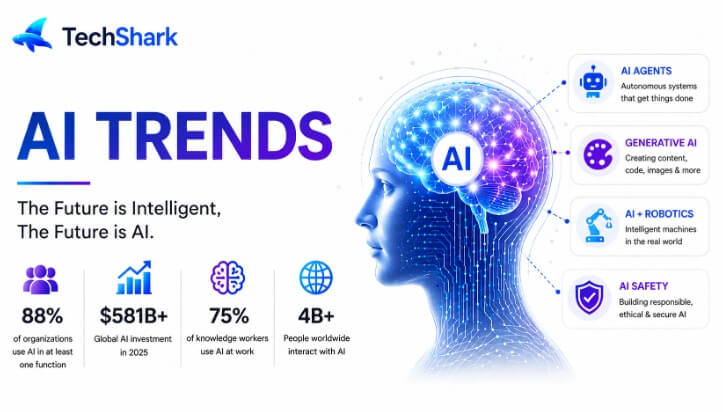
- 88% of organizations use AI in at least one business function
- 75% of knowledge workers use AI at work
- 17.8% of the global working-age population uses AI tools
- ~4 billion people (≈48% of the population) interact with AI globally
- $581+ billion invested in AI globally (2025)
- Generative AI adoption reached ~53% within just 3 years
- 62% of companies are experimenting with AI agents
- 64% of businesses say AI is driving innovation
- 126% productivity boost seen in AI-assisted tasks
- ~1/3 of companies have scaled AI across operations
Around 17.8% of the world’s working-age population actively uses AI, with some countries like the UAE reaching over 70% usage rates. Additionally, broader estimates suggest that nearly half of the global population (over 4 billion people) may already be interacting with AI in some form.
What Are the Top AI Trends in 2026?
Here is a quick look at the major artificial intelligence trends shaping 2026:
- Agentic AI and autonomous AI agents
- Multimodal AI
- AI-powered search and generative engine optimization
- Smaller and domain-specific AI models
- Enterprise AI moving from pilots to production
- Context-aware AI personalization
- Physical AI and robotics
- AI governance, security, and responsible AI
- AI-generated content becoming more quality-focused
- Human-AI collaboration and AI-native workflows
Let's look at each one.
1. Agentic AI Is Becoming the Biggest AI Trend
If you've been following AI closely, you've probably noticed a subtle but important change. The conversation is no longer only about how well AI can answer a question. Increasingly, the focus is on whether AI can take that answer and actually do something with it.
That's where agentic AI comes in.
Traditional generative AI typically waits for a prompt and then produces an answer. An AI agent, on the other hand, is designed to work toward a goal. It can break a task into smaller steps, use connected tools or data, make decisions within defined boundaries, and continue working until the task is completed or it needs human input. Deloitte describes business AI agents as systems that can reason, plan, act, manage complex tasks, collaborate with people and other agents, and adapt to changing business conditions. The Stanford AI Index Report 2026 highlights that AI is growing faster than ever in capability, adoption, and investment, but governance and safety are struggling to keep up. It shows AI models now rival human-level performance in complex tasks, while global adoption has surged rapidly. At the same time, challenges like rising AI incidents, environmental impact, and lack of transparency are increasing, making responsible AI development more critical than ever.
What Is Agentic AI?
In simple terms, agentic AI is AI that can move from answering to doing.
Think about the difference between asking a chatbot, “Give me a list of potential leads,” and asking an AI agent, “Find qualified leads from our database, research their companies, prioritize the strongest opportunities, prepare personalized outreach, and update the CRM.” The first request mainly requires content generation and analysis. The second requires a sequence of actions, access to information, decision-making, and interaction with business software. That is the fundamental shift behind agentic AI.
Google Cloud's 2026 AI Agent Trends report describes this movement as a shift from individual prompts toward systems that can orchestrate complex, end-to-end workflows semi-autonomously. Its research draws on insights from more than 3,466 executives and Google AI experts.
Why Is Agentic AI Different From a Traditional Chatbot?
The easiest way to understand the difference is to look at the workflow. A traditional chatbot generally follows this pattern:
Question → Answer
Agentic AI can follow a much longer process:
Goal → Planning → Information gathering → Tool use → Action → Evaluation → Next action
That doesn't mean every AI agent operates completely independently. In many real business environments, humans still define permissions, review important decisions, approve sensitive actions, or intervene when something goes wrong. That human layer is important because giving an AI system more autonomy also gives it more responsibility. OpenAI's August 2026 enterprise research describes this shift as a move from assistance to execution, with more enterprise work being delegated to agents that have access to context and tools needed to complete complex tasks.
This is why I see agentic AI as more than just another feature added to a chatbot. It represents a change in how organizations can structure work.
How Businesses Can Use AI Agents
The practical applications are already becoming easier to see. A customer-service agent, for example, could potentially read a support request, identify the customer's problem, look up the relevant account information, check the company's policies, suggest or issue an approved resolution, update the support ticket, and escalate unusual cases to a human. In sales, an agent could research prospects, summarize company information, identify buying signals, prepare personalized outreach, and keep CRM records updated. In software development, an agent can work across a codebase, make changes, run tests, identify problems, and prepare the result for human review. OpenAI's 2026 research describes this transition from short AI interactions toward longer, delegated tasks in which agents can use tools and iterate toward a solution.
The same principle can apply to marketing, finance, recruiting, operations, cybersecurity, research, and internal knowledge management. The important point is that the value isn't necessarily in one AI-generated response. The value comes from completing an entire workflow.
Why 2026 Could Be a Turning Point for Agentic AI
One reason agentic AI is getting so much attention in 2026 is that enterprises are becoming more comfortable moving AI from experimentation into real workflows. Deloitte's 2026 State of AI in the Enterprise report found that worker access to AI increased by 50% during 2025, while organizations are expecting a significant increase in projects reaching production. The report also says that autonomous AI agents are rapidly entering enterprise environments, with 85% of surveyed companies expecting to customize agents for their specific business needs.
OpenAI's August 2026 enterprise data provides another indication of this transition. According to its research, agentic AI accounted for 64% of combined Codex and ChatGPT output tokens among enterprise customers as of June 2026. The company also reports that agentic usage is spreading beyond software development into areas such as legal, sales, recruiting, and marketing. These numbers don't mean every business is suddenly fully autonomous. They do show where enterprise experimentation is heading: AI is increasingly taking on work to complete rather than simply questions to answer.
The Biggest Opportunity: Connecting AI to Workflows
This is where agentic AI becomes especially interesting for business owners. Imagine a marketing team that currently spends hours every week collecting campaign data, creating reports, identifying performance changes, and preparing recommendations. A basic AI assistant might summarize the data after someone uploads it. An agentic system could potentially connect to the relevant platforms, collect the data on a schedule, identify unusual changes, generate a report, suggest actions, and notify the marketing team when human attention is required. That is a much bigger productivity opportunity.
Google Cloud's 2026 research similarly frames the agentic shift as moving from individual tasks toward complete workflows or “digital assembly lines." For businesses, this distinction matters because automating one task may save a few minutes, while redesigning an entire workflow can fundamentally change how a team operates.
But Agentic AI Also Creates New Risks
There is another side to this trend that businesses shouldn't ignore. The more autonomy an AI agent has, the more carefully we need to control its permissions and actions. If an agent can read company information, access customer records, modify documents, send messages, or interact with business systems, an incorrect decision can have consequences beyond a bad chatbot response. Deloitte's 2026 research highlights exactly this concern: agentic AI adoption is advancing rapidly, but governance is not always keeping pace. Only about one in five organizations surveyed reported having a mature governance model for autonomous AI agents.
That's why production-ready agentic AI needs more than a powerful model. It also needs:
- Clear permissions
- Reliable business data
- Human approval for sensitive actions
- Monitoring and logging
- Security controls
- Testing and evaluation
- Defined escalation processes
Google Cloud's 2026 infrastructure research makes a similar point, reporting that 83% of organizations surveyed require infrastructure upgrades to support production-grade autonomous systems, while four out of five identify security, governance, or MLOps as major challenges.
2. Multimodal AI Will Become the Default
Multimodal AI is one of the most important developments in the current AI landscape because it changes how machines understand information. Earlier AI systems were largely focused on a single format, especially text. Today, AI models can increasingly work with text, images, audio, video, documents, and voice together. In practical terms, this means you don't always have to explain everything to an AI system through a written prompt. You can give it a product image, upload a PDF, share a video, or provide an audio recording and ask it to understand the information in context. Gartner identifies multimodal capabilities as one of the emerging technologies helping organizations scale generative AI adoption.
What Is Multimodal AI?
Multimodal AI is artificial intelligence that can understand and work with more than one type of data. A traditional text-based system might read a written product description and generate an answer from it. A multimodal system can potentially analyze the product description alongside product photographs, demonstration videos, customer voice recordings, and supporting documents. This provides the AI a broader view of the situation and can make its responses more context-aware. Gartner's 2026 research highlights multimodal capabilities, agentic AI, domain-specific models, and smaller reasoning models as important trends for scaling GenAI.
Think about a customer support team. A customer might send a written complaint along with a screenshot showing an error and a short voice message explaining what happened. A multimodal system can analyze these different inputs together, rather than forcing the employee or the AI to process each piece separately. That can make the process faster and, when implemented properly, more useful.
Why Is Multimodal AI Becoming Important?
The biggest advantage of multimodal AI is context. Humans naturally combine different types of information. When we understand a product, for example, we don't rely only on its written description. We look at it, listen to explanations, watch demonstrations, read specifications, and consider what other people say about it. Multimodal AI is moving toward a similar ability to combine different information formats.
This is particularly valuable for businesses working with large amounts of unstructured information. Companies may have thousands of PDFs, images, videos, call recordings, presentations, emails, and documents. Multimodal AI can potentially help bring these information sources together instead of treating each format as a separate silo.
How Businesses Can Use Multimodal AI
The applications are broader than simply creating images or videos. In e-commerce, AI can analyze product images, descriptions, reviews, and customer questions to provide more relevant product recommendations. In customer service, it can combine conversations, screenshots, documents, and account information to help identify problems. In marketing, teams can use multimodal AI to analyze campaign creatives, videos, customer feedback, and performance data together.
Manufacturing is another interesting example. A multimodal system could potentially combine visual information from cameras with equipment documentation and sensor data to help identify possible problems. Healthcare, education, media, retail, and financial services can similarly benefit from AI systems that understand multiple forms of information. The important thing to remember is that multimodal AI isn't valuable simply because it can process more formats. Its real value comes from connecting those formats to understand a situation more completely.
Multimodal AI Is Also Changing Content Creation
For content creators and marketers, this trend is particularly interesting. Imagine giving an AI system a 30-minute customer interview, a product brochure, five product images, an existing blog post, and a video transcript. Instead of manually reviewing everything, a multimodal AI system can potentially analyze these assets together and help identify common customer pain points, useful quotes, content ideas, or gaps in the existing messaging. This can make the content workflow much more efficient.
However, there is an important distinction between AI-assisted content creation and fully automated content creation. AI can help identify patterns and produce drafts, but human review is still important when accuracy, brand voice, expertise, and originality matter. For SEO, AEO, and GEO, this distinction becomes even more important. Simply producing more content won't necessarily improve visibility. Brands still need to provide useful, original, and trustworthy information that demonstrates genuine expertise.
3. AI Search Is Changing SEO
If there is one AI trend that SEO professionals, content writers, publishers, and marketers should take seriously in 2026, it is the transformation of search itself. For years, the basic SEO model was relatively straightforward: someone searched for a keyword, Google displayed a list of results, and your job was to get your page as high on that list as possible. That model hasn't disappeared, but the experience around it is changing quickly. Google is now combining traditional search with AI Overviews and AI Mode, allowing users to ask longer, more conversational, and more complex questions and receive synthesized answers with links to web sources.
From “10 Blue Links” to AI-Powered Answers
The biggest change isn't simply that Google is using AI. It's that the way people search is changing.
Instead of typing something like:
“best CRM software”
A user might now ask:
“I'm running a 20-person B2B company. Which CRM should I choose if my sales team needs automation, simple reporting, and something that won't require a full-time administrator?”
That's a much more detailed question. Google's AI Mode is designed to handle these longer and more complex queries by breaking them into multiple related searches and combining information from across the web. Google calls this approach “query fan-out.”
For content creators, this is a major shift. You're no longer optimizing only for individual keywords. You're creating content that needs to understand and satisfy the complete intent behind a question. Microsoft has also introduced an AI Performance dashboard in Bing Webmaster Tools that allows brands to see which URLs are being cited in AI-generated answers and which queries are associated with those citations.
What Is AI Search?
AI search refers to search experiences where artificial intelligence helps understand a user's query, retrieve relevant information, and generate a synthesized response. Google's AI Overviews and AI Mode are examples of this evolution. Microsoft also describes AI-powered discovery as a shift toward conversational questions and answers that can provide information before a user clicks a traditional search result.
This doesn't mean traditional search results have suddenly become irrelevant. In fact, Google continues to emphasize connecting users with websites and original content. Its current AI Search updates specifically highlight links, original content, firsthand perspectives, and trusted sources
So the future isn't necessarily
AI Search vs traditional SEO
It's more accurately:
Traditional SEO + AI-powered discovery.
4. Smaller and Domain-Specific AI Models Are Getting More Important
For the last few years, much of the AI conversation has revolved around one simple idea: bigger models are better models. The industry competed on parameters, benchmark scores, context windows, and increasingly powerful general-purpose models. But in 2026, businesses are starting to ask a more practical question: Do we really need the biggest AI model for every task?
The answer, increasingly, is no. For many organizations, the better solution may be a smaller, faster, more affordable, or domain-specific AI model that is designed for a particular task or industry. Gartner identifies domain-specific models and small reasoning models among the important technologies helping organizations scale generative AI. Its 2026 research also says domain-specific models can improve accuracy and efficiency at lower costs by focusing on particular industry needs.
What Are Domain-Specific AI Models?
A domain-specific AI model is designed or adapted to work particularly well within a specific industry, business function, or use case. Instead of trying to be reasonably good at everything, the model focuses on being highly useful for something specific.
For example, a company might use a specialized AI system for:
- Legal document analysis
- Financial research
- Healthcare documentation
- Customer support
- Manufacturing processes
- Software development
- Marketing analytics
- Supply chain management
Think of it like hiring a specialist instead of a generalist. A general-purpose AI model might know something about hundreds of industries. A specialized model can be designed around the terminology, workflows, regulations, data, and requirements of one particular environment. That's particularly valuable when accuracy matters. Gartner reported in August 2026 that global spending on AI-optimized infrastructure is projected to reach about $42.3 billion in 2026, while spending on inference is expected to exceed spending on training. Gartner attributes part of this shift to the operationalization of AI across enterprise applications and workflows.
Is the Era of One AI Model for Everything Ending?
Not necessarily—but the economics are changing. General-purpose models will remain critical because they are flexible and capable of handling a huge range of tasks. But businesses are increasingly likely to combine them with specialized models, smaller models, retrieval systems, tools, and agents. Gartner's 2026 strategic technology trends list includes domain-specific language models and multiagent systems among its top strategic technology trends, reinforcing the broader movement toward specialized and orchestrated AI systems.
So instead of thinking:
One model → Everything
we may increasingly see:
Multiple models → Different tasks → One intelligent workflow
That's a much more flexible architecture.
5. Enterprise AI Is Moving From Experimentation to Execution
AI adoption is entering a more practical phase. Earlier, businesses were mainly experimenting with chatbots, AI writing tools, and small pilot projects. Now the focus is shifting toward using AI inside real business workflows. According to Deloitte’s 2026 State of AI in the Enterprise report, worker access to sanctioned AI tools increased by 50% in 2025, while organizations are increasingly moving AI projects toward production.
The important shift is that companies are no longer asking only, “What can AI do?” They are asking, “How can AI improve our actual business?” For example, AI can now support customer service, sales research, marketing analysis, software development, HR operations, and internal knowledge management. This transition is also visible in OpenAI's latest Enterprise Signals research, which shows enterprise AI moving from simple assistance toward delegated, multi-step work.
For businesses, the biggest opportunity isn't adopting dozens of AI tools. It's identifying repetitive workflows where AI can save time, reduce costs, or improve decision-making. In 2026, successful AI adoption will be less about experimentation and more about measurable business outcomes.
6. AI Personalization Will Become More Context-Aware
Personalization is not a new concept, but AI is making it much more sophisticated. Instead of showing customers recommendations based only on their previous purchases or basic demographics, AI can increasingly combine behavior, preferences, intent, context, and real-time interactions to create more relevant experiences. Deloitte’s 2026 retail research found that 67% of retail executives expect to have AI-driven personalization capabilities within the next year, particularly for tailored experiences, campaigns, and loyalty programs.
For example, an e-commerce brand could understand whether a customer is browsing casually or actively looking to purchase, then adjust recommendations, offers, and messaging accordingly. Similarly, AI can help marketers create different experiences for customers at different stages of the buying journey. This trend is especially important because consumers are becoming less responsive to generic marketing. People don't want another irrelevant email or recommendation—they want information that feels useful and timely.
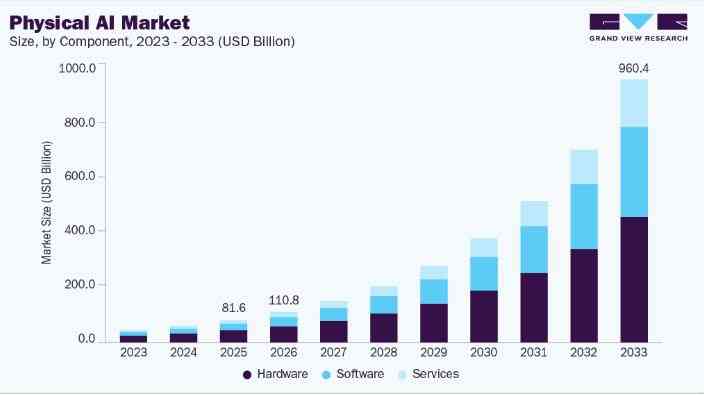
7. Physical AI and Robotics Will Move Into the Spotlight
AI is no longer limited to screens and software. Physical AI is bringing intelligence into robots, autonomous vehicles, drones, smart machines, and industrial systems that can perceive and respond to the real world. Deloitte’s 2026 research reports that 58% of companies are already using physical AI to some extent, with adoption expected to reach 80% within two years.
The biggest early opportunities are appearing in manufacturing, logistics, warehouses, healthcare, and industrial operations. Unlike traditional robots that follow fixed instructions, physical AI systems can use sensors, cameras, and AI models to understand changing environments and adapt their actions. Deloitte notes that industrial robotics is becoming a major proving ground for this technology. Humanoid robots are also attracting significant attention, but widespread adoption will take time. Real-world challenges such as safety, cost, hardware limitations, cybersecurity, and reliable performance still need solutions. What makes this trend exciting is the possibility of AI moving from “thinking digitally” to actually interacting with the physical world.
8. AI Governance and Security Will Become Non-Negotiable
As businesses give AI more access to customer data, internal systems, and important workflows, trust and security are becoming just as important as AI performance. In 2026, organizations are increasingly realizing that deploying AI without clear controls can create privacy, compliance, and operational risks. Deloitte reports that only one in five companies has a mature governance model for autonomous AI agents, showing that adoption is moving faster than oversight.
This becomes even more important as AI agents start taking actions rather than simply providing answers. Companies need to know what an AI system can access, what decisions it can make, and when a human must step in. The World Economic Forum also highlights accountability, human oversight, and governance as critical issues as agentic AI becomes more autonomous. IBM's 2026 research found that 77% of surveyed organizations say AI adoption is already outpacing their governance capabilities.
9. AI Content Creation Will Shift From Quantity to Quality
AI has made content creation dramatically faster. A writer can now generate ideas, outlines, drafts, images, videos, and even multilingual versions much faster. But this convenience is creating another problem: there is simply more content everywhere. Deloitte's 2026 Media & Entertainment Outlook notes that generative AI is lowering the cost of content creation while making differentiation increasingly important.
This means the competitive advantage won't come from publishing 100 AI-generated articles every month. The competitive advantage will come from creating content that has something genuinely different to say. Original research, personal experience, expert opinions, unique data, storytelling, and strong creative ideas will matter more as generic AI content becomes easier to produce. This shift is already visible in video and creator content. Deloitte reports that generative video tools are helping creators produce content faster, reduce production costs, and experiment with more creative ideas.
But faster production doesn't automatically mean better content. In fact, when everyone can create more, audience trust and originality become more valuable. For brands and creators, the winning approach will be simple: use AI to remove repetitive production work, but keep humans responsible for ideas, expertise, creativity, accuracy, and authenticity.
10. Human-AI Collaboration Will Define the Future of Work
AI is becoming better at writing, analyzing data, coding, summarizing information, and handling repetitive tasks—but that doesn't mean humans are becoming less important. In fact, human judgment may become more valuable as AI becomes more capable. The World Economic Forum explains that future work will increasingly involve humans defining problems, setting boundaries, evaluating AI outputs, and making important decisions.
This means the workplace of the future is likely to be less about AI replacing people and more about AI and people working together. Employees may spend less time on repetitive execution and more time on creativity, strategy, communication, problem-solving, and decision-making. Microsoft's Future of Work Report similarly highlights a shift from humans acting as executors toward roles focused on coordinating, refining, and evaluating AI-generated work.
The challenge is that employees will need new skills. AI literacy will matter, but so will critical thinking, adaptability, communication, creativity, and domain expertise. The WEF also stresses that organizations need continuous upskilling as AI changes workplace roles. Ultimately, the companies that benefit most from AI won't necessarily be those that automate the most. They'll be the ones that combine AI's speed with human judgment and responsibility.
Why AI Trends Matter
AI trends aren’t just “tech updates”—they're signals of where the world is heading. From how we work to how businesses grow, AI is quietly reshaping everything. If you ignore these trends, you risk falling behind; if you understand them, you can stay ahead. Today, AI is no longer experimental—it's becoming part of everyday life, with one in six people globally already using AI tools, and adoption is growing rapidly.
From my perspective, tracking AI trends is like having a roadmap for the future. Whether you’re a marketer, developer, or business owner, it helps you make smarter decisions—what to learn, where to invest, and how to stay competitive. For example, companies using AI are already seeing higher productivity, cost reduction, and revenue growth, which clearly shows its real-world impact.
Why it truly matters
- Stay competitive in your field: Most organizations now see AI as a priority, and many believe it’s essential to remain relevant.
- Boost productivity & efficiency: AI helps automate repetitive tasks and can save hours every week, improving overall performance.
- Better decision-making: AI-driven insights enable faster and smarter business decisions, backed by data rather than guesswork.
- Career growth & future skills: With AI becoming part of daily work (especially in countries like India), learning AI-related skills is no longer optional.
- Innovation & new opportunities: AI is opening doors to new industries, products, and services across sectors like healthcare, education, and finance.
- Understanding market direction: AI trends reveal where industries are investing and evolving, helping you align your strategies early.
Which Industries Are Being Most Transformed by AI?
AI isn’t impacting just one or two sectors—it’s acting like a general-purpose technology, similar to electricity or the internet, reshaping almost every industry. But if you look closely, some industries are clearly experiencing deeper and faster transformation than others. From my perspective, the biggest shift is not just automation—it’s how AI is redefining workflows, decision-making, and value creation across industries. Reports from organizations like PwC, NVIDIA, and EY consistently show that sectors such as healthcare, finance, manufacturing, retail, and education are seeing the highest impact and investment. In fact, AI alone could unlock over $550 billion in value in key sectors like healthcare, manufacturing, education, agriculture, and energy by 2035.
Let’s break down the industries where AI is making the biggest difference:
1. Healthcare & Life Sciences
This is one of the most life-changing applications of AI.
- AI is improving diagnosis, early detection, and personalized treatment
- Used in drug discovery, reducing research time significantly
- Helps doctors with decision support instead of replacing them
2. Banking, Financial Services & Insurance (BFSI)
AI is transforming how money flows and risks are managed.
- Automates fraud detection, risk analysis, and compliance
- Improves customer experience through chatbots and personalization
- Redefining hiring—demand for AI-skilled professionals is rising
- Can contribute significantly to sectoral GDP growth in coming years
3. Manufacturing & Industrial Sector
AI is powering the next wave of industrial growth.
- Enables predictive maintenance and smart factories
- Improves supply chain and production efficiency
- Factory output is increasing due to AI-driven automation
- One of the fastest-growing sectors in AI adoption
4. Retail & E-commerce
AI is completely changing how people shop.
- Personalized recommendations and dynamic pricing
- AI-driven customer insights and demand forecasting
- Enhances marketing and customer engagement
5. Education
AI is making learning more personalized and accessible.
- Adaptive learning platforms tailored to individual students
- AI tutors and automated grading systems
- Part of high-growth sectors benefiting from AI investment
6. Technology, Media & Entertainment
This sector is at the core of AI innovation.
- Generative AI for content creation (text, video, music)
- AI in gaming, streaming, and digital experiences
- High share of AI use cases globally (around 27%)
7. Agriculture & Energy
Often underrated, but hugely important.
- AI helps in crop prediction, soil analysis, and smart irrigation
- Optimizes energy usage and supports sustainability
- Among top sectors expected to gain massive economic value
Often underrated, but hugely important.
- AI helps in crop prediction, soil analysis, and smart irrigation
- Optimizes energy usage and supports sustainability
- Among top sectors expected to gain massive economic value
Future of AI
The future of artificial intelligence is not just about smarter tools—it’s about a fundamental shift in how we live, work, and make decisions. Over the next decade, AI will move from being a supportive assistant to becoming an integrated part of everyday life, much like the internet today. From my perspective, the most noticeable change will be how seamlessly AI blends into daily workflows. You won’t always “open” an AI tool; instead, it will quietly power the apps, systems, and services you already use. Whether it’s writing emails, analyzing data, managing tasks, or even making complex business decisions, AI will act as a constant collaborator.
One of the biggest developments will be the rise of more autonomous AI systems. These systems will not just respond to prompts but will be capable of planning, executing, and optimizing tasks with minimal human intervention. At the same time, AI will expand beyond the digital world into the physical one, powering robots, smart devices, and real-world automation in industries like manufacturing, healthcare, and logistics. This means AI will not only think and create but also act in the real world.
Another important shift will be in how AI contributes to innovation. In fields like healthcare, climate science, and research, AI will accelerate discoveries by processing massive amounts of data and identifying patterns that humans might miss. This could lead to faster drug development, more accurate diagnoses, and solutions to global challenges. However, as AI becomes more powerful, concerns around ethics, privacy, and security will also grow. Governments and organizations will focus heavily on building responsible AI systems that are transparent, fair, and safe to use.
The future of AI will also reshape jobs rather than simply replacing them. While automation will take over repetitive tasks, new roles will emerge that require creativity, critical thinking, and collaboration with AI. In simple terms, the future will belong to those who learn how to work alongside AI effectively. Ultimately, AI’s evolution is less about machines replacing humans and more about enhancing human potential, making us more productive, innovative, and capable than ever before.
Conclusion
AI trends are no longer just something to observe—they are something to actively adapt to. From autonomous agents to multimodal systems and real-world robotics, AI is clearly moving from a supportive tool to a core driver of innovation and decision-making. What stands out is not just the speed of advancement but the depth of impact across industries, careers, and everyday life.
In my view, the real opportunity lies in understanding these trends early and using them strategically. Those who stay curious, keep learning, and embrace AI as a partner will have a clear advantage. Ultimately, AI trends are shaping the future—and how you respond to them will define your place in that future.
People are also reading:
- Best AI Agent Builder
- AI Tools for Research
- AI Deepfake Tools
- AI Copilot vs AI Agent
- AI Agent vs AI Assistant
- What AI Can Do Today?
- AI Assistant and Coding Skills
- AI Regulations Around the World
- AI Agents vs Chatbots
Frequently Asked Questions (FAQs)
Q: What are AI trends, and why are they important?
AI trends refer to the latest developments, innovations, and shifts happening in artificial intelligence, such as generative AI, automation, and AI agents. They are important because they indicate where technology is heading and how it will impact industries, jobs, and daily life. Understanding these trends helps individuals and businesses stay competitive, make better decisions, and adapt early to upcoming changes rather than reacting late.
Q: How will AI trends impact jobs in the future?
AI trends will reshape jobs rather than completely replace them. Repetitive and routine tasks will be automated, allowing professionals to focus more on creative, strategic, and decision-making roles. At the same time, new job opportunities will emerge in areas like AI development, data analysis, and AI management. The key is to learn how to work alongside AI tools, as those who adapt will have a clear advantage in the job market.
Q: Which industries are most affected by AI trends?
Industries such as healthcare, finance, manufacturing, retail, and education are being significantly transformed by AI. In healthcare, AI improves diagnosis and treatment; in finance, it enhances fraud detection and risk analysis; in manufacturing, it optimizes production; and in retail, it personalizes customer experiences. However, the reality is that no industry will remain untouched, as AI is becoming a foundational technology across sectors.
Q: What are the biggest AI trends to watch right now?
Some of the most important AI trends include autonomous AI agents, multimodal AI (combining text, images, and video), generative AI for content creation, AI-powered automation, and the rise of domain-specific AI models. Additionally, AI in robotics and real-world applications is gaining momentum. These trends highlight how AI is evolving from simple tools to intelligent systems that can perform complex tasks independently.
Q: Is AI safe and how is it being regulated?
AI safety is becoming a major focus as the technology grows more powerful. Governments and organizations are working on AI regulations to ensure AI is used responsibly, transparently, and ethically. This includes addressing issues like data privacy, bias, and misuse. While AI offers huge benefits, building trust through proper governance and ethical frameworks will be essential for its long-term success and adoption.
Q: What is the future of AI trends in the next 5–10 years?
In the next 5–10 years, AI will become more autonomous, integrated, and widely adopted across industries. It will move beyond digital tools into real-world applications like robotics and smart environments. AI will also drive innovation in areas like healthcare, climate science, and education. At the same time, there will be a stronger focus on ethical AI, regulation, and building systems that are safe and trustworthy for society.
Q: Which AI tools are trending right now for startups and small businesses?
Trending AI tools for startups include ChatGPT and Claude for content and research, Cursor and Lovable for building apps, Canva AI for design, Notion AI for productivity, and Zapier AI for automation. These tools help startups save time, reduce costs, and scale faster with small teams.
Q: What are the best free AI tools for content creation and automation in 2026?
In 2026, some of the best free AI tools for content creation and automation are helping creators and small businesses work faster without spending much. Tools like ChatGPT, Claude, and Google Gemini are widely used for writing blogs, scripts, and research, while Canva AI and CapCut AI make it easy to design visuals and edit videos. For automation, platforms like Zapier AI and n8n help streamline repetitive tasks such as email workflows and data syncing. These tools are powerful enough to manage real workflows and scale productivity even on free plans.