AI Copilot vs AI Agent: Which One Should You Choose?
AI Copilot vs AI Agent explained with key differences, features, benefits, use cases, and how to choose the right AI solution for your needs.
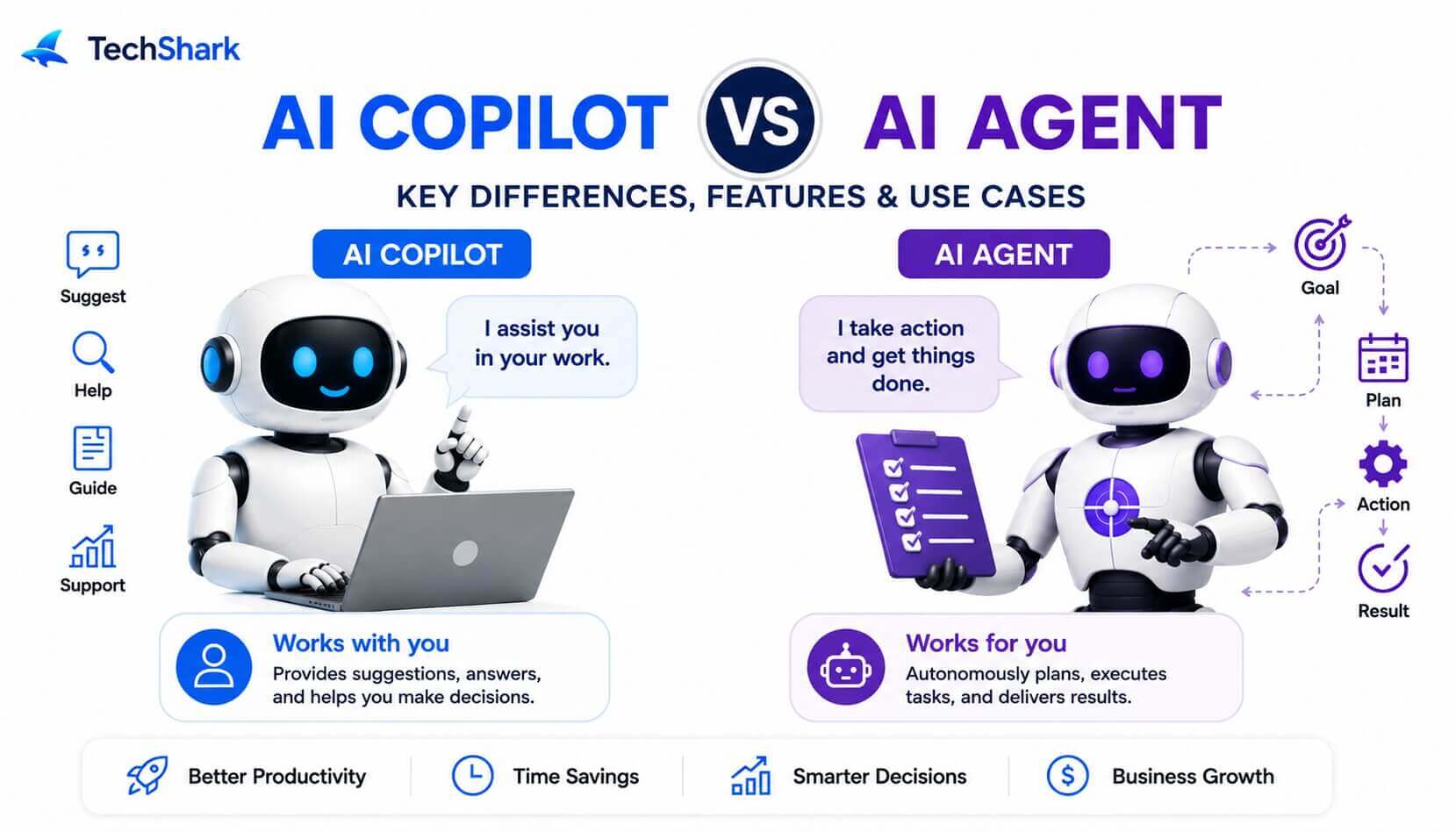
Explore moreAI copilots assist people by providing suggestions, analysis, content, and recommendations, while AI agents can pursue goals, plan multiple steps, use tools, and execute tasks with less human input. Copilots are best suited for human-led productivity and decision support, whereas agents are designed for repeatable, multi-step workflow automation. The shift toward agents is already gaining momentum: McKinsey reports that 62% of organizations are experimenting with AI agents, while 23% are scaling agentic AI somewhere in their enterprise. Stanford’s 2026 AI Index also found AI-agent performance on OSWorld rose from about 12% to 66.3%, showing how quickly autonomous AI capabilities are improving.
AI is moving from simply answering questions to completing work. That is why the discussion around AI Copilot vs AI Agent has become much more important in 2026. An AI copilot generally works alongside you by providing suggestions, analysis, content, or recommendations, while an AI agent can take a goal, plan multiple steps, use tools, and execute actions with less ongoing human input. The key difference is not intelligence alone—it is how much responsibility you delegate to the artificial intelligence.
If you are trying to decide which technology your business or workflow actually needs, the distinction is useful. A copilot may be ideal when you want to remain closely involved, while an agent can make more sense when the goal is to automate a repeatable workflow. But the line between the two is becoming less rigid as modern AI products combine assistance, tool use, approvals, and autonomous execution.
What Is an AI Copilot and How Does It Work?
An AI copilot is an AI-powered assistant designed to work alongside a human rather than completely take over a workflow. It can understand context, generate content, summarize information, analyze data, suggest decisions, write code, or recommend what a user should do next. The human generally remains responsible for reviewing the result and deciding whether to accept, modify, or reject the AI's recommendation.
Think of an AI copilot as having a highly capable colleague sitting beside you. You might ask it to draft an email, explain a piece of code, analyze a spreadsheet, summarize a customer conversation, or brainstorm campaign ideas. It can dramatically reduce the amount of manual work involved, but you are still driving the process.
What are the main characteristics of an AI copilot?
- Human-in-the-loop: The user usually makes the final decision.
- Context-aware: It can understand the document, conversation, code, or task you are working on.
- Interactive: You can refine its output through additional instructions.
- Assistive: Its primary purpose is to improve human productivity.
- Embedded: Many copilots operate inside existing applications.
- Recommendation-focused: They can suggest actions without necessarily executing them.
What are some common AI copilot use cases?
AI copilots are particularly useful for knowledge workers.
- For developers, a copilot can suggest code, explain errors, generate tests, and help navigate unfamiliar repositories.
- For marketers, it can generate campaign ideas, write social posts, analyze customer segments, and create content variations.
- For sales teams, it can summarize customer conversations, draft follow-up emails, and prepare meeting briefs.
- For customer-service teams, it can retrieve information, summarize tickets, detect sentiment, and recommend responses.
- For business teams, it can help analyze documents, create reports, summarize meetings, and explore data.
The common factor is that the human is still closely involved.
What Is an AI Agent and How Does It Work?
An AI agent is an AI system designed to pursue a goal by reasoning through multiple steps and taking actions. Instead of simply responding to each individual prompt, an agent can determine what needs to happen next, use available tools or systems, evaluate results, and continue working toward the desired outcome.
For example, imagine you tell an AI:
“Find qualified leads for our SaaS product and prepare them for outreach.”
A conventional AI assistant might give you a list of lead-generation ideas. A copilot might help you research prospects and write personalized emails.
An AI agent could potentially research prospects, collect relevant information, qualify them against your criteria, update a CRM, prepare personalized messages, and route the results for approval. That is the fundamental difference: you are delegating an outcome rather than requesting an isolated answer.
What are the main characteristics of an AI agent?
- Goal-oriented: Works toward a desired outcome.
- Multi-step: Can coordinate several actions.
- Tool-enabled: Can interact with APIs, applications, databases, or other tools.
- More autonomous: Does not necessarily require a new prompt for every action.
- Adaptive: Can change its approach when conditions change.
- Execution-focused: Success is measured by task completion.
What are some common AI agent use cases?
AI agents are particularly attractive for workflows such as
- Customer-support ticket triage
- Lead qualification
- Appointment scheduling
- Research workflows
- Data processing
- Report generation
- IT service desk operations
- Workflow orchestration
- Routine financial operations
- Employee onboarding
- E-commerce operations
- Monitoring and alerting
The more repetitive and measurable the workflow is, the more attractive agentic automation can become.
What Is the Difference Between an AI Copilot and an AI Agent? [AI Copilot Vs AI Agent]
The simplest distinction is:
- AI copilot = helps you perform the work.
- AI agent = performs parts of the work on your behalf.
But there is more nuance than that.
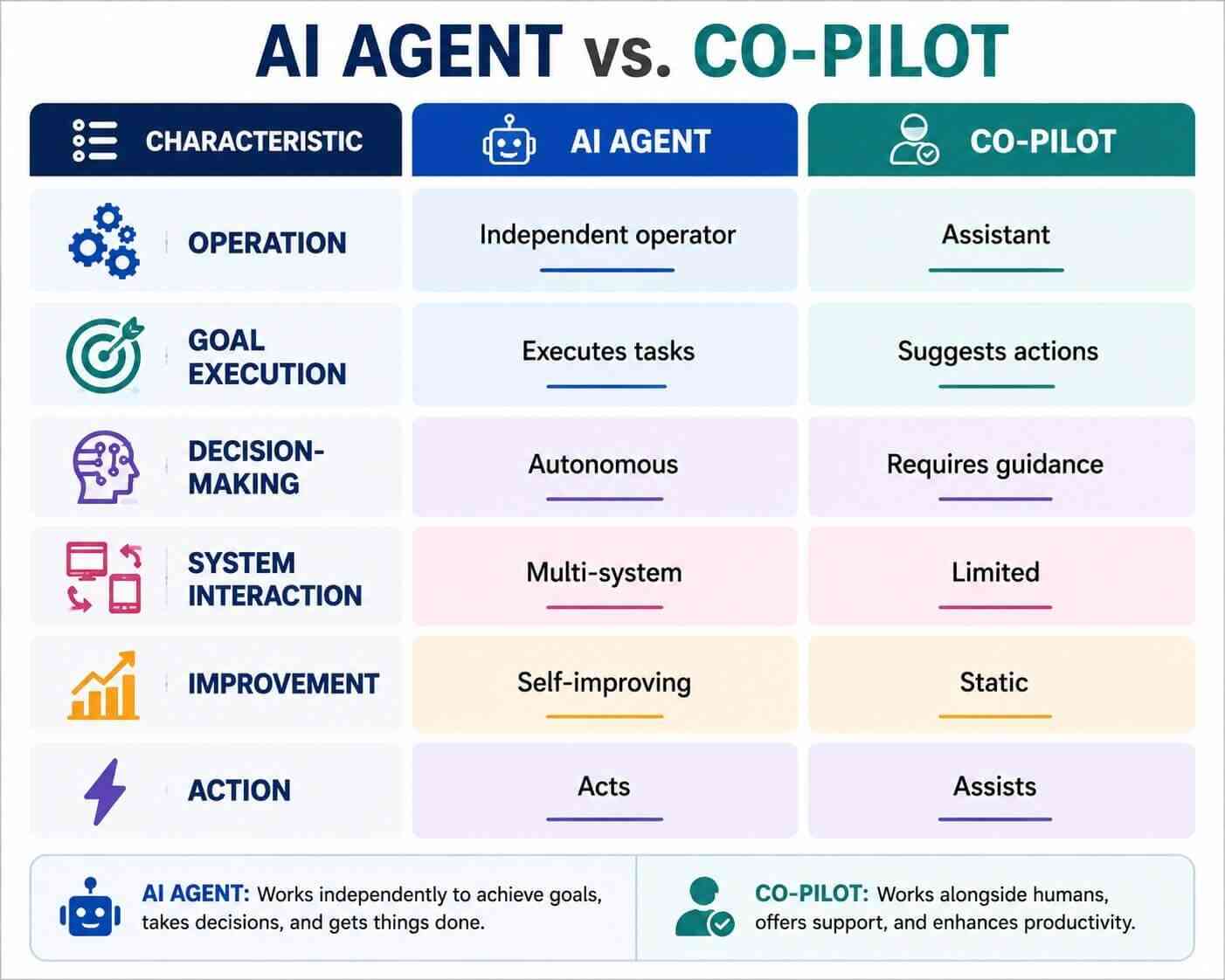
| Feature | AI Copilot | AI Agent |
|---|---|---|
| Primary role | Human assistant | Autonomous task executor |
| Main objective | Improve human productivity | Achieve a defined goal |
| Human involvement | High | Lower or periodic |
| Interaction | Prompt and conversation | Goal and workflow |
| Decision-making | Recommends | Can decide within boundaries |
| Task execution | Usually user-directed | Can execute independently |
| Workflow | Usually individual tasks | Multi-step workflows |
| Tool usage | Limited or integrated | Often central to operation |
| Autonomy | Low to moderate | Moderate to high |
| Best suited for | Knowledge work | Automation |
| Risk level | Generally lower | Higher |
| Setup complexity | Lower | Higher |
| Governance needs | Moderate | High |
| Human role | Driver | Supervisor |
What is the easiest way to remember AI Copilot vs AI Agent?
Use this simple test:
- “Help me do this.” → Copilot
- “Take care of this.” → Agent
It is not a perfect technical definition, but it is a useful way to understand the difference.
How Do AI Copilots and AI Agents Differ in Task Execution?
Let's take a simple example: customer support.
Suppose a customer writes:
“My account has been locked. What should I do?”
What would an AI copilot do?
The copilot could:
- Read the conversation
- Retrieve account information
- Find the relevant support policy
- Summarize the issue
- Detect customer sentiment
- Draft a response
- Recommend the next action
The human support representative would review and send the response.
What could an AI agent do?
An appropriately configured agent could:
- Understand the customer's request.
- Verify the relevant account information.
- Verify whether the request meets predefined conditions.
- Retrieve the applicable policy.
- Perform an authorized account action.
- Update the support system.
- Respond to the customer.
- Escalate the case if it falls outside its permissions.
This is why AI workflow automation is one of the most important use cases for agents.
When Should You Use an AI Copilot?
An AI copilot usually makes more sense when human judgment is still central to the task. If you are creating a strategy, writing an important report, reviewing legal information, developing a new product, or making a high-impact business decision, you may want AI to assist you rather than independently make decisions.
Choose an AI copilot when:
- You want direct control over the workflow.
- Human judgment is important.
- The task requires creativity.
- You need recommendations rather than automatic execution.
- The workflow changes frequently.
- Employees need assistance rather than complete automation.
- You are introducing AI into an organization for the first time.
- Errors could have significant consequences.
Who benefits most from AI copilots?
AI copilots are especially useful for:
- Writers
- Developers
- Designers
- Analysts
- Sales professionals
- Customer-service representatives
- Researchers
- Managers
- Consultants
- Marketing teams
In these roles, AI is often most valuable when it amplifies the person's existing expertise.
When Should You Use an AI Agent?
An AI agent becomes more attractive when you have a process that is repetitive, multi-step, measurable, and governed by clear rules. Imagine a business processing thousands of customer requests every month. Employees may spend hours sorting requests, looking up information, entering data, and routing tickets.
An agent could potentially automate a large portion of that workflow.
Choose an AI agent when:
- The workflow contains repeatable steps.
- The goal is clearly defined.
- The process happens frequently.
- Multiple tools or systems need to interact.
- Human intervention is mainly required for exceptions.
- The organization can define permissions and guardrails.
- The outcome can be measured.
What types of businesses can benefit from AI agents?
Potential applications exist across:
- SaaS
- E-commerce
- Banking
- Insurance
- Healthcare
- Customer support
- Logistics
- Manufacturing
- Marketing
- Sales
- IT operations
However, implementation should be based on the actual workflow rather than simply adopting an agent because it is the latest AI trend.
What Are the Best AI Agent vs AI Copilot Use Cases?
The easiest way to compare them is by looking at what each technology does best.
| Function | AI Copilot | AI Agent |
|---|---|---|
| Content writing | Excellent | Useful for automated workflows |
| Coding | Excellent | Useful for multi-step development tasks |
| Brainstorming | Excellent | Limited need for autonomy |
| Data analysis | Excellent | Useful for recurring analysis |
| Customer support | Response assistance | Automated resolution |
| Lead generation | Research assistance | Research + qualification + routing |
| Marketing | Content and strategy | Campaign workflow automation |
| Research | Research assistance | Multi-step research |
| IT support | Troubleshooting assistance | Ticket triage and resolution |
| Reporting | Helps create reports | Can automate recurring reports |
| Scheduling | Suggests options | Can coordinate scheduling |
| Operations | Recommendations | Workflow execution |
What Are the Benefits of AI Copilots?
The biggest strength of a copilot is that it can increase productivity without requiring a company to hand over complete control of a workflow.
Key benefits include:
- Faster content creation
- Faster research
- Better access to information
- Reduced repetitive work
- Easier decision support
- Improved employee productivity
- Lower adoption barrier
- Greater human control
Microsoft's 2026 Work Trend Index provides an interesting signal here: 49% of Microsoft Copilot usage supports cognitive work, including activities such as analyzing information, reasoning, evaluating options, and making decisions.
What Are the Benefits of AI Agents?
Agents have a different value proposition: delegation.
Instead of helping an employee complete every step, an agent can potentially take ownership of defined workflows.
Key benefits include:
- End-to-end workflow automation
- Reduced manual handoffs
- 24/7 operation
- Faster processing
- Consistent execution
- Multi-system coordination
- Scalable operations
- Reduced repetitive workload
This is particularly powerful when a company has a large volume of predictable tasks. But the benefit depends heavily on workflow design. McKinsey's recent research emphasizes that organizations need to redesign workflows rather than simply add AI on top of existing processes.
What Are the Risks and Limitations of AI Copilots and AI Agents?
The more autonomy an AI system has, the more carefully it needs to be governed.
AI copilot limitations
- It still needs human involvement.
- Employees need to review outputs.
- It may not completely automate a process.
- Poor prompts or context can produce poor results.
- Productivity improvements vary between tasks.
AI agent limitations
- Incorrect actions can happen at scale.
- Integrations can be complex.
- Agents need carefully defined permissions.
- Monitoring becomes more important.
- Sensitive workflows may require approval.
- Autonomous systems can behave unexpectedly.
- Implementation costs can be higher.
This scenario is where current AI research provides an important reality check. Stanford's 2026 AI Index reports that AI agents improved dramatically on computer-use tasks, with OSWorld performance rising from roughly 12% to 66.3%. However, agents still failed roughly one in three attempts on structured benchmarks.
What Do the Latest AI Copilot and AI Agent Statistics Show?
The market data shows that both AI assistance and agentic AI are growing, but enterprise adoption is still developing.
1. 62% of organizations are experimenting with AI agents: McKinsey's 2025 A State of AI survey found that 62% of respondents said their organizations were at least experimenting with AI agents. However, only 23% reported scaling an agentic AI system somewhere in the enterprise.
2. 88% of organizations report regular AI use: McKinsey found that 88% of respondents reported regular AI use in at least one business function, up from 78% the previous year. Yet most organizations remain in experimentation or pilot stages at the enterprise level.
3. Microsoft reports a 15x increase in active agents: Microsoft's 2026 Work Trend Index reports that agents in the Microsoft 365 ecosystem increased 15x year over year, with an 18x increase among large enterprises.
4. AI agents reached 66.3% on OSWorld: Stanford's 2026 AI Index reports that leading AI-agent performance on OSWorld reached 66.3%, compared with roughly 12% previously.
5. 80% of organizations set efficiency as an AI objective: McKinsey reports that 80% of respondents say their companies set efficiency as an objective for AI initiatives, while higher-performing organizations also focus on growth and innovation.
What do these statistics tell us?
- The market is not simply moving from “copilot” to “agent.”
- Instead, it is moving toward different levels of AI autonomy.
- Some tasks need assistance.
- Some need recommendations.
- Some can be delegated.
- And some still require humans.
Is There Really a Clear Difference Between an AI Copilot and an AI Agent?
Not always.
This is one area where many comparison articles oversimplify the technology.
A modern AI system can contain both copilot and agent capabilities.
For example:
- AI understands your request.
- AI suggests a plan.
- You approve the plan.
- AI executes several steps.
- AI monitors the result.
- AI asks for help when something unexpected happens.
Is that a copilot or an agent? The answer depends on which part of the workflow you are describing.
How Are AI Agents, AI Copilots, AI Assistants and Chatbots Different?
How Are AI Agents, AI Copilots, AI Assistants, and Chatbots Different?
| Technology | Primary Function | Autonomy | Typical Example |
|---|---|---|---|
| AI Assistant | Answers and helps | Low | Personal productivity assistant |
| AI Copilot | Works alongside you | Low–Moderate | Coding or workplace copilot |
| AI Agent | Executes goals | Moderate–High | Workflow automation agent |
| AI Chatbot | Conducts conversation | Usually low | Customer FAQ bot |
- AI Assistant
- An AI assistant generally helps users answer questions, generate content, or perform simple tasks.
- AI Copilot
- A copilot is usually embedded in a workflow and provides context-aware support while the human remains in control.
- AI Agent
- An agent can plan and execute multiple steps toward a defined objective.
- AI Chatbot
- A chatbot primarily focuses on conversational interaction and may follow predefined or AI-generated responses.
The important point is that these categories can overlap. A modern product might technically function as an assistant, copilot, and agent depending on what the user asks it to do.
How Should Businesses Choose Between an AI Copilot and an AI Agent?
Instead of asking “Which technology is better?” ask:
“How much autonomy does this workflow actually need?”
Use this simple framework.
Choose a copilot if:
- Human judgment = High
- Task repetition = Low/Medium
- Risk of error = High
- Need for creativity = High
- Automation requirement = Low
Choose an agent if:
- Human judgment = Low/Medium
- Task repetition = High
- Workflow = Multi-step
- Rules = Clearly defined
- Automation requirement = High
- Outcome = Measurable
This approach prevents a common mistake: using autonomous AI where a simple copilot would have been sufficient.
How Can Companies Implement AI Agents Safely?
If you are considering AI agents for business, don't start by giving an agent access to everything.
Start small.
A practical implementation approach
- Identify one workflow: Choose a process that is repetitive and measurable.
- Map every step: Understand where decisions, data, systems, and approvals are involved.
- Start with copilot assistance: Use AI to understand where automation can safely happen.
- Automate low-risk steps: Move predictable tasks to an agent.
- Add human approval: Require approval for sensitive actions.
- Limit permissions: Give agents only the system access they actually need.
- Monitor performance: Track success rate, errors, intervention rate, and cost.
- Expand gradually: Increase autonomy only after the system proves reliable.
McKinsey's recent work also emphasizes data quality, workflow redesign, infrastructure, governance, and carefully selecting high-impact workflows as important foundations for agentic AI.
What Is the Future of AI Copilots and AI Agents?
The future is unlikely to be a simple copilot versus agent battle. Instead, we are likely to see AI systems that combine both.
A user may start with a copilot, ask it to understand a problem, delegate a workflow to an agent, approve sensitive actions, and then monitor the final outcome. Microsoft's 2026 research describes a workplace where AI is increasingly taking on execution while humans focus more on direction, judgment, and ownership of outcomes.
At the same time, McKinsey's research shows that enterprise adoption is still relatively early, with many organizations experimenting rather than scaling agentic systems broadly. So the next phase of AI isn't simply about making models smarter. It is about making AI systems more useful, connected, reliable, and capable of operating inside real workflows.
What Are the Key Takeaways?
If you're comparing AI Copilot vs AI Agent for your business, the decision comes down to control versus delegation. A copilot is the better choice when you want AI to make you faster, smarter, and more productive while keeping yourself involved. An agent is the better choice when you can safely delegate a repeatable workflow.
The most important takeaway is this:
Don't choose an AI agent simply because it is more autonomous. Choose the level of autonomy that your workflow can actually support.
That approach is more practical, more scalable, and usually much safer.
Conclusion
The difference between an AI copilot and an AI agent ultimately comes down to how much responsibility you want AI to take on. AI copilots are ideal when you want AI to work alongside people by providing ideas, analysis, recommendations, and assistance while humans remain in control. AI agents are better suited to repeatable, multi-step workflows where you can delegate tasks and execute them with less ongoing human involvement. As AI capabilities continue to improve, the boundary between copilots and agents is becoming less defined, and many modern AI systems are combining both approaches. For businesses, the best strategy is not choosing one over the other but finding the right balance between AI assistance, automation, and human oversight.
People are also reading:
- Best AI Agent Builder
- AI Tools for Research
- AI Deepfake Tools
- AI Tools for Small Business
- What AI Can Do Today?
- AI Agent vs AI Assistant
- AI Assistant and Coding Skills
- AI Regulations Around the World
- AI Agents vs Chatbots
Frequently Asked Questions (FAQs)
Q: What is the main difference between an AI copilot and an AI agent?
The main difference is the level of autonomy. An AI copilot works alongside a person by providing suggestions, analysis, content, recommendations, or guidance while the user remains involved in the workflow. An AI agent, on the other hand, can work toward a specific goal, break it into multiple steps, use connected tools, and execute actions with less continuous human input. In simple terms, a copilot helps you do the work, while an agent can do parts of the work for you. However, modern AI systems can combine both approaches, so the distinction is increasingly becoming a spectrum rather than a strict boundary.
Q: Is an AI agent better than an AI copilot?
An AI agent is not necessarily better than an AI copilot because each is designed for different types of work. Copilots are often more useful when human judgment, creativity, or decision-making is important, such as writing, coding, research, and business analysis. Agents can be more valuable for repetitive, multi-step workflows where the objective is clearly defined and actions can be automated. The better option depends on the workflow, risk level, and amount of autonomy required. For many businesses, using a copilot for human decision-making and an agent for repetitive execution can provide a more practical approach than relying entirely on either technology.
Q: Is ChatGPT an AI copilot or an AI agent?
ChatGPT can function as both an AI assistant or copilot and, when agentic capabilities are available, as an AI agent. In a typical conversation, ChatGPT behaves more like a copilot because you provide instructions and review the generated response. With agentic capabilities, however, it can handle more complex, multi-step tasks, use tools, interact with websites, and take actions on a user's behalf. This makes ChatGPT a useful example of how the traditional distinction between AI copilots and AI agents is becoming less clear as AI products increasingly combine conversational assistance with autonomous task execution.
Q: What is the difference between an AI agent and a chatbot?
An AI chatbot is primarily designed for conversation, meaning it receives a user's message and generates a response. An AI agent goes further by using reasoning, tools, and actions to pursue a particular goal. For example, a customer-service chatbot might explain a company's refund policy, while an AI agent could potentially check an order, determine whether the request meets the refund rules, initiate an authorized refund, update the customer record, and notify the customer. Therefore, chatbots mainly handle conversation, while AI agents pursue goals, make decisions, and take actions.
Q: When should a business use an AI copilot?
Businesses should consider an AI copilot when employees need assistance but should remain closely involved in the workflow. Copilots work particularly well for tasks such as writing emails, analyzing information, preparing reports, generating code, summarizing customer conversations, researching topics, and creating marketing content. They are also a good starting point for organizations that are adopting AI for the first time because employees can review and control the AI's output. If the task requires significant human judgment or creativity, a copilot can often provide the right balance between increased productivity and human oversight.
Q: When should a business use an AI agent?
Businesses should consider an AI agent when they have a repetitive, multi-step workflow with a clearly defined objective and measurable outcome. Examples include lead qualification, customer-support ticket routing, appointment scheduling, data processing, report generation, workflow orchestration, and certain IT operations. Agents can reduce manual work by handling several connected steps without requiring employees to provide a new instruction at every stage. However, businesses should establish appropriate permissions, monitoring, escalation rules, and approval checkpoints before giving an agent access to important systems or sensitive information.
Q: Can an AI copilot become an AI agent?
Yes, an AI copilot can evolve toward agent-like functionality when it gains capabilities such as tool access, memory, planning, API integrations, workflow execution, and the ability to take actions. A system might initially suggest what a user should do and later gain the ability to execute the approved action itself. This is why many modern AI products are moving toward hybrid models rather than remaining purely copilots or purely agents. The transition is essentially about increasing the amount of responsibility and autonomy delegated to the AI while maintaining appropriate human oversight.
Q: Do AI agents replace humans?
AI agents do not necessarily replace humans; instead, they can automate parts of a person's workload. Agents are particularly effective at repetitive and predictable tasks, while humans remain important for strategic decisions, creativity, relationship management, complex judgment, accountability, and handling unusual situations. A more realistic model is therefore human + copilot + agent, where agents handle execution, copilots support employees with information and recommendations, and humans remain responsible for important decisions. As agent capabilities improve, some jobs will certainly change, but the extent of replacement will depend heavily on the type of work and how organizations implement AI.
Q: Are AI agents safe for business use?
AI agents can be used safely when organizations implement appropriate controls, but they should not be treated as completely autonomous or error-free systems. Companies should carefully determine what information an agent can access, which systems it can modify, and which actions require human approval. Monitoring, audit logs, access restrictions, escalation mechanisms, and regular performance testing can also reduce risk. This is particularly important for financial, legal, healthcare, security, and other sensitive workflows. Current AI-agent benchmarks show significant improvements in performance, but agents can still make mistakes, so autonomy should always be matched with appropriate governance and oversight.
Q: What is the future of AI copilots and AI agents?
The future is likely to involve a combination of copilots and agents rather than one completely replacing the other. People may use copilots to understand information, explore ideas, and make decisions while delegating repetitive execution to agents. In this model, AI becomes less like a single chatbot and more like a collection of specialized systems working within a larger workflow. As agents become more reliable and better integrated with business software, organizations will increasingly decide which tasks should remain human-led, which should be AI-assisted, and which can safely be delegated to autonomous AI systems.