How AI Assistants Impact the Formation of Coding Skills?
Explore how AI assistants impact coding skills, backed by Anthropic research, key statistics, benefits, risks, and future trends in AI-driven programming.
Explore moreArtificial Intelligence (AI) refers to computer systems designed to simulate human intelligence—such as reasoning, learning, and problem-solving. In the context of software development, AI enables machines to generate, analyze, and optimize code with minimal human input. At the heart of modern AI coding tools are Large Language Models (LLMs). These models—such as GPT-based systems and Claude—learn from massive datasets of text and code. They learn patterns in programming languages and can generate functional code from natural language prompts.
AI assistants improve coding speed and productivity but can reduce deep learning and problem-solving skills if overused. Studies show users complete tasks faster but score lower in mastery tests. LLMs work by predicting the most likely sequence of tokens (words or code elements) based on input.
This allows them to:
- Generate complete functions from simple descriptions
- Suggest improvements or optimizations
- Debug code and identify errors
- Explain complex programming concepts
AI coding assistants combine these capabilities into tools that act as:
- Code generators
- Real-time debuggers
- Learning companions
- Pair programmers
This shift marks a new era where developers are not just writing code—they are collaborating with intelligent systems.
Do AI assistants help developers build stronger coding skills—or weaken them over time?
This question is especially relevant in 2026, where AI is no longer experimental but a core part of development workflows. Research shows that more than 90% of organizations now use AI for coding, with many trusting it to handle real development tasks under human supervision.
In this article, we explore how AI assistants influence coding skill formation—covering both benefits and risks—based on real research, including insights from Anthropic and recent academic studies.
How AI Assistants Impact the Formation of Coding Skills?
AI assistants are rapidly transforming the way developers learn, write, and refine code. Tools like coding copilots, intelligent IDEs, and conversational AI systems are no longer just productivity boosters—they are actively shaping how coding skills are formed.
For beginners, AI can feel like a shortcut to instant solutions. For experienced developers, it can accelerate workflows and reduce repetitive work. But this shift raises an important question:
Are AI assistants helping developers become better programmers—or making them overly dependent?
The answer lies in how these tools are used. This article explores the real impact of AI assistants on coding skill development—both the advantages and the risks—and how to use them effectively without compromising learning.
Evolution of Coding in the AI Era
Traditionally, coding required deep knowledge of syntax, algorithms, and debugging techniques. Developers spent significant time writing code manually, fixing errors, and searching for documentation. With AI assistants, this process has changed dramatically.
Research shows that 82% of developers now spend less time writing code, shifting their focus toward reviewing and supervising AI-generated output.
This shift has introduced a new paradigm:
- From manual coding → AI-assisted coding
- From writing → supervising
- From syntax mastery → problem-solving
A new role is emerging: “supervisory engineers”—developers who guide, validate, and refine AI outputs rather than writing everything from scratch.
Positive Impact: How AI Improves Coding Skills
1. Faster Learning Curve
AI assistants help beginners learn programming more quickly by removing friction. Instead of struggling for hours, learners can get instant solutions and explanations. Studies show that AI tools significantly reduce task completion time and improve performance scores.
2. Real-Time Debugging Support
AI can identify and fix errors instantly. This reduces frustration and helps developers move forward faster. However, the real benefit comes when developers understand the fix, not just apply it.
3. Exposure to Best Practices
AI-generated code often follows industry standards, exposing learners to:
- Clean code structure
- Naming conventions
- Efficient algorithms
This helps developers adopt professional coding habits early.
4. Productivity Boost
AI coding assistants can increase productivity significantly. Some studies show moderate but consistent improvements in efficiency across tasks.
In practical scenarios, developers can:
- Build features faster
- Automate repetitive tasks
- Focus on higher-level logic
5. Personalized Learning Experience
AI acts as an always-available tutor:
- Explains concepts on demand
- Adapts to user skill level
- Provides step-by-step guidance
This personalized approach enhances learning—especially for beginners.
Negative Impact: Where AI Hurts Skill Formation
While AI improves performance, its effect on learning and skill development is more complex.
1. Cognitive Offloading
AI allows developers to “offload thinking” to machines. Instead of solving problems, users rely on AI to generate answers. Anthropic research highlights that this approach reduces engagement and effort in learning tasks.
2. Reduced Problem-Solving Ability
Debugging is one of the most critical coding skills. However, when AI handles debugging, developers lose opportunities to practice.
3. Lower Conceptual Understanding
A key finding from Anthropic’s study:
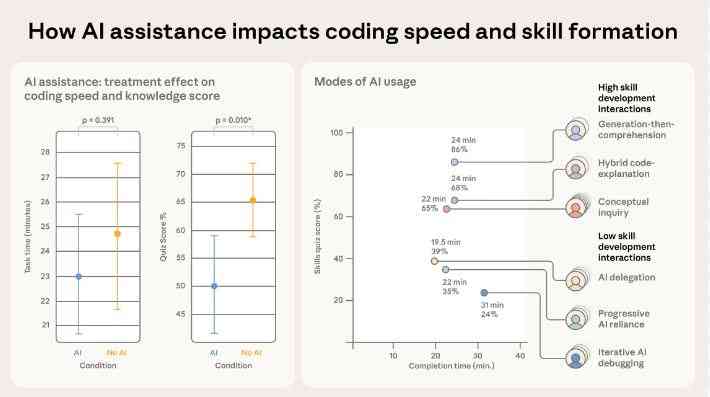
- Developers using AI scored 17% lower in mastery tests compared to those coding manually
This suggests that AI may hinder deep understanding—even when developers complete tasks successfully.
4. The “Comfort Trap”
AI makes coding easier, but this comfort can reduce learning effort.
Research shows that AI users often achieve better performance but no significant improvement in actual learning outcomes.
5. Over-Reliance on AI
Over time, developers may become dependent on AI tools, reducing their ability to:
- Write code independently
- Think critically
- Solve unfamiliar problems
Anthropic Study: Key Insights on AI and Coding Skills
One of the most important studies in this space comes from Anthropic.
Key Findings
- AI users completed tasks slightly faster
- However, they showed lower learning retention
- Debugging skills were most affected
- Heavy AI reliance led to the lowest scores
Participants who relied heavily on AI scored below 40%, while those who used AI strategically scored above 65%.
Learning Patterns with AI
Low Learning Behaviors
- Copy-pasting AI-generated code
- Delegating entire tasks to AI
- Using AI only for answers
High Learning Behaviors
- Asking “why” questions
- Requesting explanations
- Writing code alongside AI
- Verifying outputs independently
Research confirms that active engagement improves learning outcomes, even with AI assistance.
Role of LLMs in Programming Education
LLMs are reshaping how programming is taught and learned.
AI as a Tutor
LLMs provide instant explanations, making them powerful teaching tools.
AI as a Pair Programmer
Developers collaborate with AI to:
- Generate ideas
- Refine solutions
- Improve code quality
AI as a Performance Tool
Studies show that AI improves performance but does not always improve learning outcomes.
Key Facts and Statistics
- 90%+ of organizations use AI for coding
- 82% of developers spend less time writing code
- AI users scored 17% lower in coding mastery
- AI improves productivity but not learning consistently
- AI reduces frustration and cognitive load.
Future of Coding Skills in the AI Era
Skills That Will Matter
- Problem-solving
- System design
- Critical thinking
- AI prompt engineering
- Code review and validation
Rise of Supervisory Engineers
Developers will focus more on:
- Guiding AI
- Evaluating outputs
- Ensuring quality
Coding Without Coding
No-code and AI tools are making programming accessible to non-developers—but understanding systems remains critical.
Best Practices: How to Use AI Without Losing Skills
- Use AI for explanations, not just answers
- Try solving problems manually first
- Practice debugging independently
- Ask conceptual questions
- Review and rewrite AI-generated code
Challenges and Ethical Concerns
- Skill degradation risk
- Overdependence on AI
- Trust in AI-generated code
- AI hallucinations and errors

Conclusion
AI assistants are reshaping how coding skills are formed. They make programming faster, easier, and more accessible—but they also introduce risks to deep learning and critical thinking.
The key takeaway is simple: AI is a powerful tool—but real coding skills still come from thinking, practicing, and understanding. Developers who use AI strategically will gain the most—combining human intelligence with machine efficiency to become truly future-ready.
People are also reading:
- Best AI Agent Builder
- AI Tools for Research
- AI Deepfake Tools
- AI Tools for Small Business
- What AI Can Do Today?
- AI Marketing Tools
- AI Regulations Around the World
- AI Agents vs Chatbots
References:
- How AI assistance impacts the formation of coding skills
- The Impact of AI Coding Assistants on Software Engineering: A Longitudinal Study
Frequently Asked Questions (FAQs)
Q: What is an AI coding assistant?
An AI coding assistant is a tool powered by machine learning that helps developers write, debug, and understand code using natural language prompts.
Q: Does AI improve coding skills?
AI improves productivity and performance but does not always improve learning or skill development unless used actively.
Q: Can AI replace programmers?
No, AI cannot replace programmers. It assists them, but human expertise is still required for problem-solving and decision-making.
Q: Does AI reduce problem-solving ability?
Yes, over-reliance on AI can reduce problem-solving skills due to cognitive offloading.
Q: How to learn coding effectively with AI?
Use AI for guidance and explanations, but practice coding independently and focus on understanding concepts.