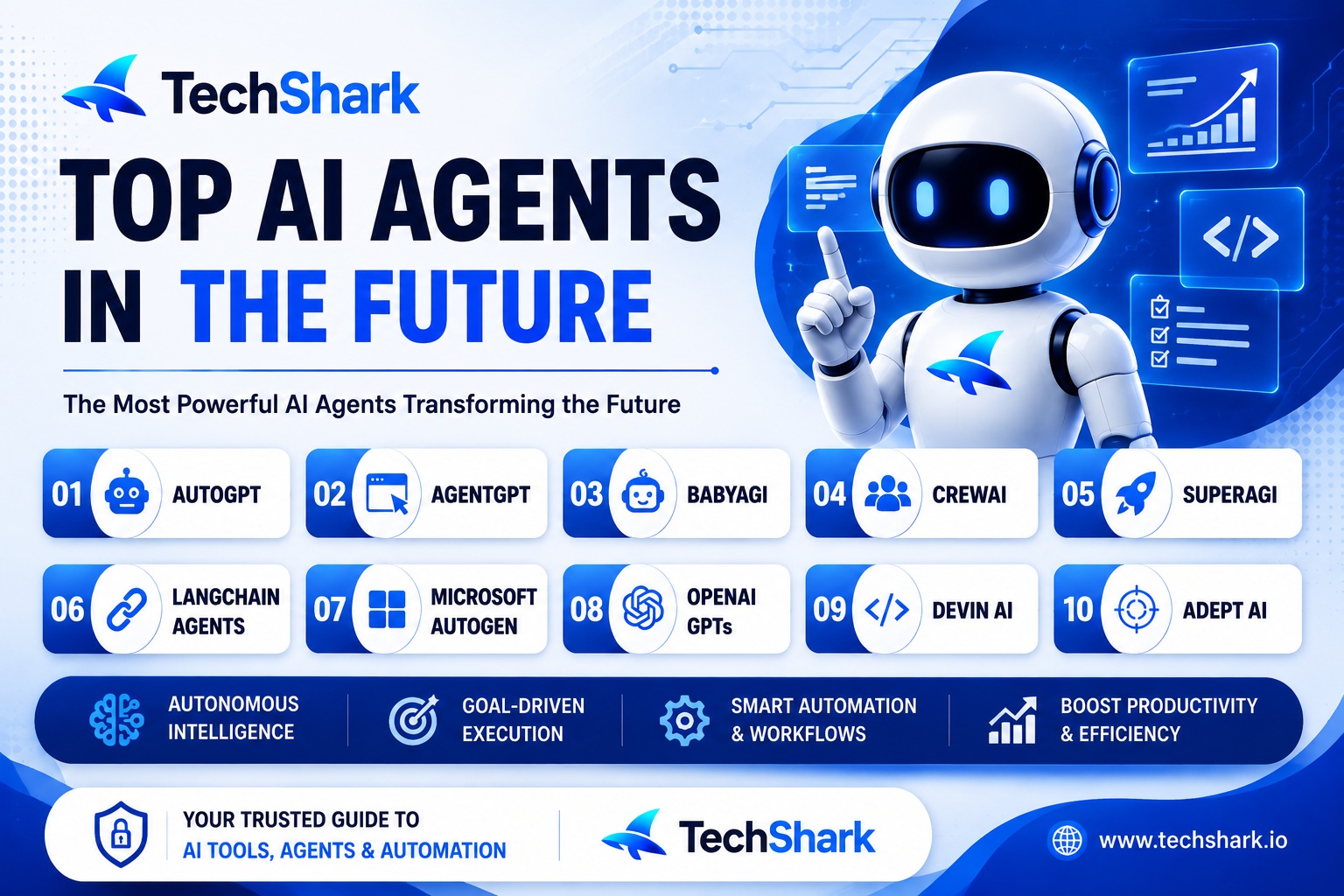
Best AI Agents in 2026: Top Autonomous AI Tools Ranked & Reviewed
Discover the top AI agents in 2026. Explore the best autonomous AI tools for automation, productivity, coding, and business workflows with detailed insights.
Explore moreAI has entered a new age. What started as simple chatbots and automation tools has evolved into advanced AI agents—systems capable of reasoning, planning, and performing complicated tasks with minimal human involvement. By 2026, AI agents will no longer be experimental; they will be vital tools for organizations, developers, marketers, and even common people.
If you're looking for the best AI agents in 2026, this comprehensive guide will help you understand everything—from how they function to the best tools to test, as well as real-world use cases, statistics, and future trends.
The growth of AI agents is supported by strong data and industry trends. The global AI market is projected to exceed $1.8 trillion by 2030, with AI agents playing a critical role in this expansion. By 2026, more than 60% of enterprises are expected to adopt AI-powered automation, including AI agents, to streamline operations and reduce costs. Research shows that AI agents can increase productivity by 30% to 50%, especially in repetitive and data-heavy workflows such as customer service, marketing, and operations.
Additionally, businesses implementing AI automation report up to 40% cost reduction, particularly in support and back-office functions. Venture capital investment in AI startups has surpassed $100 billion annually, highlighting massive confidence in the future of AI agents. These statistics clearly demonstrate that AI agents are not just a passing trend—they are becoming a core technology shaping the future of work and digital transformation globally.
What Are AI Agents?
AI agents are advanced AI systems designed to understand goals, make decisions, and take actions with minimal human input. Unlike traditional AI that only responds to queries, AI agents can plan tasks, use tools, and execute multi-step processes to achieve a desired outcome. They work by analyzing information, reasoning through possible solutions, and continuously improving based on results. For example, an AI agent can research information, book services, or automate workflows without constant supervision. These systems combine language models, memory, and decision-making capabilities, making them highly useful in business, automation, customer support, and productivity, where complex tasks need to be completed efficiently.
A traditional chatbot might answer:
"Here are five competitors in your market."
An AI agent could potentially take the request further by researching those competitors, collecting pricing information, organizing the findings, creating a report, and preparing the final document.
That difference is important.
AI agents are increasingly focusing on completing tasks rather than just having conversations.
OpenAI's current agent direction includes workspace agents designed around repeatable work and workflows rather than isolated prompts.
AI Agents: Key Statistics
AI agents are rapidly gaining adoption worldwide as businesses shift toward automation and intelligent workflows. In 2026, AI agents are not just experimental tools but core components of digital transformation strategies across industries. Companies are investing heavily in agent-based systems to improve productivity, reduce costs, and enhance decision-making. With advancements in large language models and automation frameworks, AI agents are becoming more reliable, scalable, and capable of handling complex tasks. Their growth is driven by increasing demand for efficiency, real-time insights, and end-to-end automation in business operations.
- 70%+ of enterprises are expected to adopt AI agents in some form by 2026
- AI automation can reduce operational costs by up to 30–40%
- Productivity increase of 20–50% reported in businesses using AI agents
- Global AI agent market is projected to exceed $1.5 trillion by 2030, with agents playing a major role
- 60% of customer interactions are now handled by AI-driven systems
- AI agent startups funding has grown by over 3x in the last 2 years
- Developers using AI agents have increased coding speed by 2–3x
- 80% of repetitive business tasks can be automated using AI agents
- E-commerce companies see 15–25% higher conversions with AI-driven personalization
- Time savings of up to 70% in workflows like research, data analysis, and reporting
Why Are AI Agents Transforming Industries in 2026?
AI agents are transforming industries because they go far beyond basic automation, enabling businesses to handle complex, multi-step workflows with intelligence and minimal human intervention. These systems can analyze large volumes of data, make decisions, and take real-time actions, which helps organizations improve efficiency, reduce operational costs, and deliver better customer experiences. From automating customer support to accelerating software development and optimizing marketing campaigns, AI agents are reshaping how companies operate. Their ability to learn, adapt, and scale makes them a key driver of innovation and digital transformation across industries worldwide.
Key Reasons Why AI Agents Are Transforming Industries
- End-to-End Automation – AI agents can complete entire workflows, not just single tasks.
- Cost Reduction – Businesses save significantly on manual labor and operational expenses.
- 24/7 Availability – AI agents work continuously without breaks, improving productivity.
- Better Decision-Making – They analyze real-time data to provide accurate insights.
- Scalability – Companies can handle large workloads without increasing team size.
- Personalization – AI agents deliver tailored customer experiences at scale.
- Faster Execution – Tasks that once took hours or days now take only minutes.
- Cross-Industry Impact – Used in healthcare, finance, marketing, education, and more.
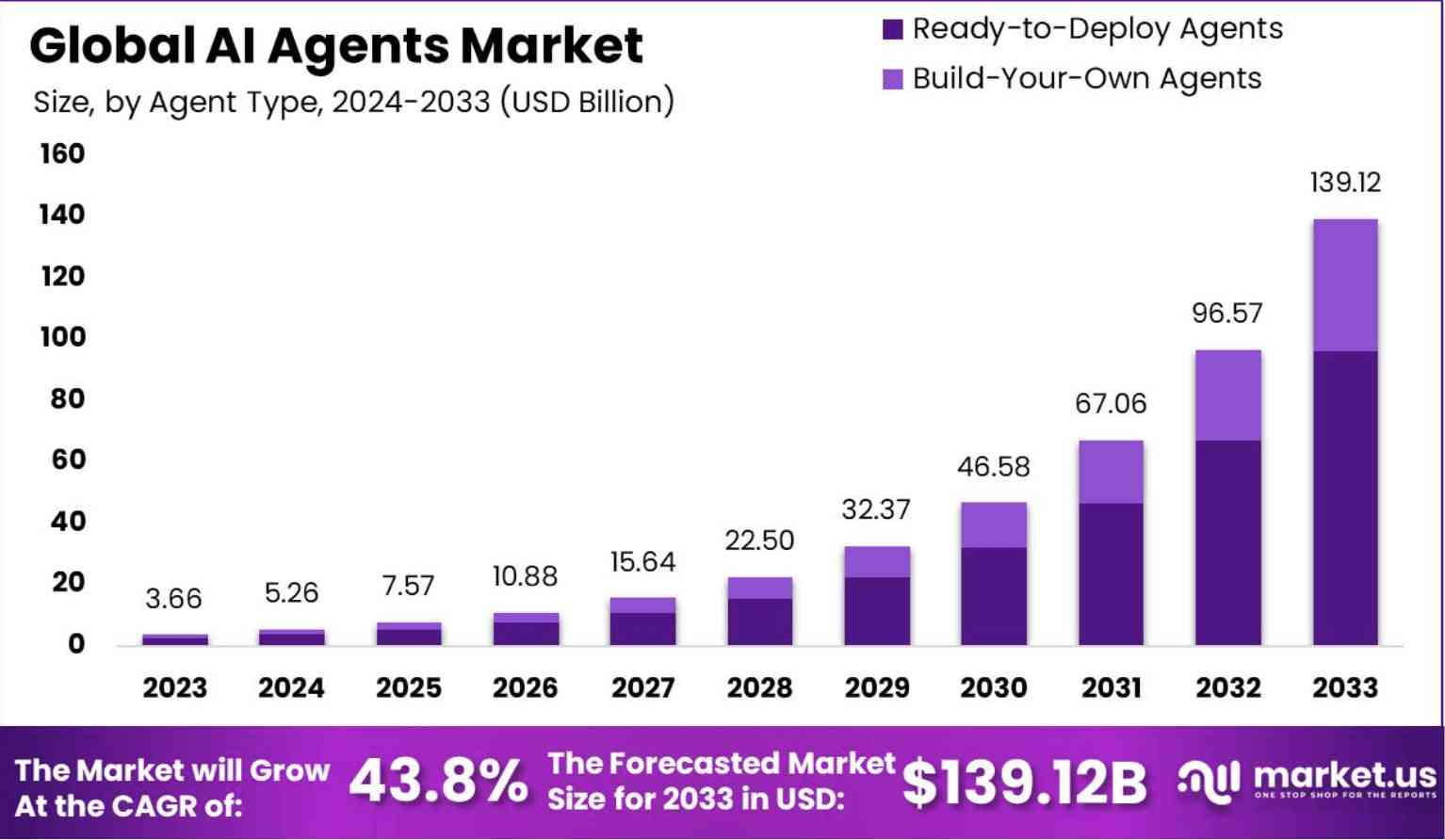
The Global AI Agents Market size is projected to be valued around USD 139.12 billion. By 2033, from USD 3.66 billion in 2023, with a CAGR of 43.88% from 2024 to 2033. North America dominated the market in 2023, accounting for more than 37.92% of total sales of USD 1.3 billion.
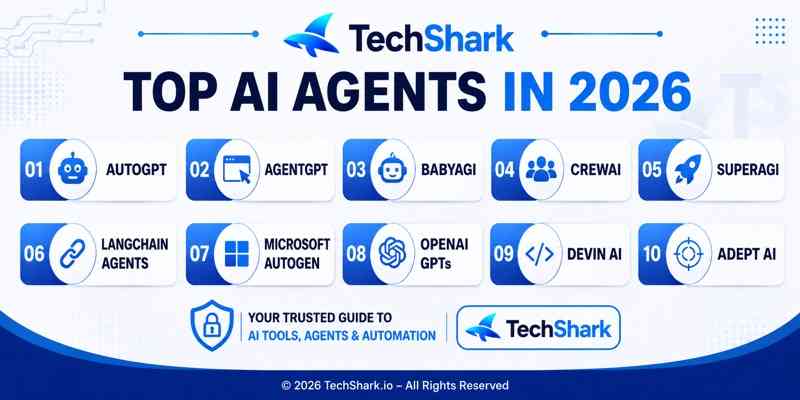
Top AI Agents in 2026
1. AutoGPT
AutoGPT is an open-source AI agent that enables autonomous task execution by breaking down complex goals into smaller, manageable steps. Built on top of advanced language models, it can plan, execute, and refine actions without constant human input. AutoGPT can browse the web, generate content, analyze data, and interact with various tools to complete tasks efficiently. It uses memory to retain context and improve decision-making over time. Widely used for research, automation, and productivity, AutoGPT represents a significant step toward fully autonomous AI systems that can operate independently and handle real-world workflows.
Key Features
- Autonomous Task Execution: AutoGPT can independently plan and execute multi-step tasks, reducing manual effort significantly.
- Self-Prompting Capability: It generates its own prompts to continue working toward a goal.
- Internet Access: Can fetch real-time information and interact with APIs.
- Memory System: Stores previous outputs to improve decision-making.
Best For: Developers and automation enthusiasts
2. AgentGPT
AgentGPT is a browser-based AI agent platform that allows users to create and deploy autonomous agents directly from their web browser. It works by assigning a goal to the agent, which then plans, executes, and iterates on tasks to achieve that objective without constant human guidance. AgentGPT can perform activities like research, content generation, and basic automation by leveraging advanced language models. Its simple interface makes it accessible even for non-technical users, while still offering powerful capabilities. By enabling goal-driven task execution, AgentGPT showcases how AI agents can streamline workflows and boost productivity across various use cases.
Key Features
- No-Code Interface: Easily create AI agents without programming knowledge.
- Goal-Oriented Execution: Breaks down tasks into smaller actionable steps.
- Cloud-Based: No installation required, runs directly in the browser.
- Real-Time Monitoring: Users can see how the agent is thinking and acting.
Best For: Beginners and non-technical users
3. BabyAGI
BabyAGI is an experimental AI agent framework designed to autonomously manage and prioritize tasks based on a given objective. It works by continuously generating, organizing, and executing tasks using a loop of creation, prioritization, and execution. Powered by advanced language models and vector databases, BabyAGI can remember previous results and refine its actions over time. Although lightweight compared to other agent frameworks, it demonstrates how AI can self-direct workflows with minimal human input. BabyAGI is widely used for learning, research, and prototyping autonomous systems, showcasing the potential of intelligent task management and adaptive decision-making in real-world scenarios.
Key Features
- Dynamic Task Management: Automatically creates and prioritizes tasks.
- Iterative Learning: Continuously improves based on feedback.
- Simple Architecture: Easy to understand and modify.
- Open-Source: Fully customizable for developers.
Best For: AI researchers and developers
4. CrewAI
CrewAI is a powerful multi-agent framework that enables multiple AI agents to collaborate as a team to accomplish complex tasks. Instead of relying on a single agent, CrewAI assigns specific roles to different agents—such as researcher, writer, or analyst—allowing them to work together efficiently. Each agent has its responsibilities and can communicate with others to share insights and refine outputs. This collaborative approach improves accuracy, scalability, and task execution speed. CrewAI is widely used for content creation, research automation, and business workflows, making it a popular choice for building advanced, goal-driven AI systems in 2026.
Key Features
- Multi-Agent Collaboration: Multiple agents work together to complete tasks.
- Role-Based Execution: Assign specific roles to different agents.
- Workflow Orchestration: Handles complex processes efficiently.
- Scalability: Suitable for both small teams and large enterprises.
Best For: Teams and businesses
5. SuperAGI
SuperAGI is an advanced open-source AI agent framework designed to build, manage, and scale autonomous agents for real-world applications. It provides a robust infrastructure where developers can create agents that plan, execute, and monitor tasks independently. SuperAGI includes features like task management, memory storage, performance tracking, and tool integration, enabling agents to handle complex workflows efficiently. It also offers a user-friendly interface for monitoring agent activities and optimizing performance. Widely used in automation, research, and business operations, SuperAGI helps organizations streamline processes and build scalable, intelligent systems with minimal manual intervention.
Key Features
- Extensible Architecture: Easily customizable for various use cases.
- Performance Monitoring: Tracks efficiency and output quality.
- Plugin Ecosystem: Supports integrations with multiple tools.
- Developer-Friendly: Simplifies complex AI workflows.
Best For: Developers and AI engineers

6. LangChain Agents
LangChain Agents are AI-powered systems built using the LangChain framework that enable language models to interact with tools, APIs, and external data sources to complete tasks autonomously. Unlike static prompts, these agents can decide which actions to take, such as searching the web, running code, or querying databases, based on the user’s goal. They follow a reasoning and action loop, allowing them to break down complex problems and execute multi-step workflows. Widely used for building chatbots, research assistants, and automation tools, LangChain Agents are essential for creating dynamic, real-world AI applications in 2026.
Key Features
- Tool Integration: Connects AI models with APIs and external services.
- Memory Support: Maintains context for better outputs.
- Custom Workflows: Enables advanced logic and automation.
- Large Ecosystem: Strong community and support.
Best For: Developers building AI apps
7. Microsoft AutoGen
Microsoft AutoGen is a powerful framework developed by Microsoft that enables the creation of multi-agent AI systems capable of collaborating to solve complex tasks. It allows developers to design multiple agents—such as assistants, users, or tools—that can communicate with each other to plan, execute, and refine workflows. AutoGen supports human-in-the-loop interactions, making it flexible for both fully autonomous and guided processes. Widely used in research, coding, and enterprise automation, it helps build scalable AI solutions where agents work together efficiently to achieve high-quality outcomes.
Key Features
- Multi-Agent Conversations: Agents can interact and collaborate dynamically.
- Flexible Architecture: Supports various configurations.
- Enterprise-Ready: Built for scalability and reliability.
- Advanced Reasoning: Enables complex decision-making.
Best For: Enterprises and advanced systems
8. OpenAI GPTs
OpenAI GPTs are customizable AI agents built using OpenAI technology that allow users to create specialized versions of GPT for specific tasks. These agents can be tailored with custom instructions, knowledge, and tools to perform functions like customer support, content creation, research, or automation. Unlike general chatbots, GPTs can follow defined workflows and integrate with external APIs to complete actions. They are easy to build without coding, making them accessible to individuals and businesses alike. OpenAI GPTs are widely used to boost productivity, streamline operations, and create personalized AI-powered experiences in 2026.
Key Features
- No-Code Customization: Create agents without coding.
- Knowledge Integration: Upload data for better responses.
- Tool Integration: Connect with APIs and services.
- Scalable Deployment: Suitable for individuals and businesses.
Best For: Beginners and businesses
9. Devin AI
Devin AI is an advanced autonomous AI software engineer developed by Cognition AI, designed to handle complex coding tasks end-to-end. Unlike traditional coding assistants, Devin can plan projects, write code, debug errors, run tests, and deploy applications with minimal human intervention. It works like a full-stack developer by using its own development environment, allowing it to iterate and improve results independently. Devin can also learn from mistakes and adapt its approach over time. Widely recognized in 2026, it represents a major leap toward fully autonomous AI developers capable of managing real-world software projects.
Key Features
- End-to-End Development: Handles coding, testing, and deployment.
- Autonomous Debugging: Identifies and fixes errors.
- Task Breakdown: Efficiently manages development workflows.
- Continuous Learning: Improves over time.
Best For: Developers and engineering teams
10. Adept AI
Adept AI is an innovative AI system developed by Adept that focuses on enabling agents to interact with real-world software just like humans do. Its core technology allows AI to understand user instructions and perform actions across applications such as browsers, spreadsheets, and enterprise tools. Instead of relying only on APIs, Adept AI can navigate interfaces, click buttons, and complete tasks end-to-end. This makes it highly useful for workflow automation, data entry, and business operations. Adept AI represents a major step toward AI agents that can seamlessly operate existing software ecosystems without complex integrations.
Key Features
- Software Interaction: Works with existing applications seamlessly.
- Workflow Automation: Automates repetitive tasks.
- Human-Like Execution: Mimics user actions.
- Enterprise Integration: Ideal for business use.
Best For: Business automation
AI Agents vs AI Assistants vs AI Tools
AI agents, AI assistants, and AI tools differ mainly in their level of autonomy and functionality. AI agents are the most advanced, capable of understanding goals, making decisions, and executing multi-step tasks independently with minimal human input. In contrast, AI assistants are designed to help users by responding to queries, generating content, or providing suggestions, but they still rely on user prompts to function. AI tools, on the other hand, are specialized applications built to perform specific tasks like design, writing, or data analysis and require full user control. Together, they represent different stages of AI evolution, from simple task execution to fully autonomous systems.
| Feature | AI Agents | AI Assistants | AI Tools |
|---|---|---|---|
| Definition | Autonomous systems that can plan, decide, and execute tasks | AI systems that assist users by responding to queries | Software powered by AI to perform specific functions |
| Autonomy Level | High (can act independently) | Medium (needs user prompts) | Low (user-controlled) |
| Task Handling | Multi-step, goal-oriented workflows | Single-step or conversational tasks | Specific, predefined tasks |
| Decision Making | Yes, can make decisions based on goals | Limited decision-making | No independent decision-making |
| Examples | AutoGPT, CrewAI, BabyAGI | ChatGPT, Siri, Alexa | Grammarly, Canva AI, Midjourney |
| Human Involvement | Minimal | Moderate | High |
| Use Cases | Automation, research, business workflows | Q&A, writing help, virtual assistance | Design, editing, coding, analytics |
| Learning & Adaptation | Continuous learning and improvement | Context-based responses | Limited or task-specific learning |
| Tool Usage | Can use multiple tools and APIs autonomously | Uses tools when prompted | Built for a single or limited function |
| Complexity Level | High | Medium | Low |
How to Choose the Right AI Agent?
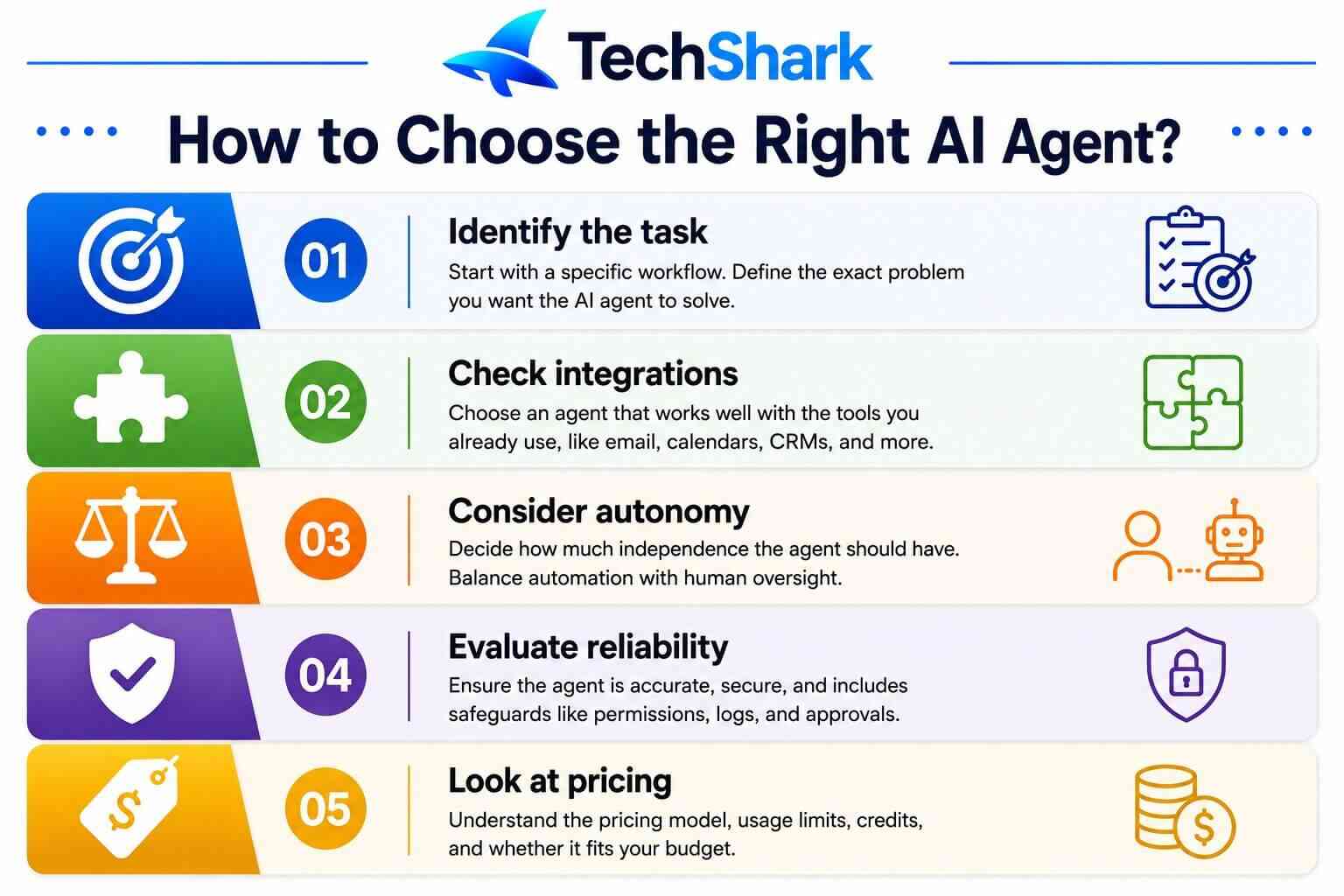
Choosing the right AI agent depends on your specific goals, technical requirements, and budget. Start by identifying the tasks you want to automate—whether it’s content creation, research, coding, or business workflows. Then evaluate the agent’s capabilities, such as tool integration, memory, scalability, and ease of use. For beginners, no-code or low-code agents are ideal, while developers may prefer customizable frameworks. It’s also important to consider performance, reliability, and community support. Finally, test different options to see which one aligns best with your workflow, as the right AI agent should improve efficiency, save time, and deliver consistent, high-quality results.
1. Identify the task
Start with a specific workflow.
Instead of saying, "I need an AI agent," define the problem:
"I want to monitor competitor websites every week."
Or:
"I want an AI system to help me build and test small web applications."
The second approach makes it much easier to choose the right platform.
2. Check integrations
- An agent becomes much more useful when it can interact with the tools you already use.
- Look for integrations with applications such as email, calendars, cloud storage, project management platforms, CRMs, coding environments, and communication tools.
3. Consider autonomy
- Not every task should be completely automated.
- For sensitive workflows, you may want an agent to prepare an action and ask for approval before executing it.
- For low-risk repetitive tasks, greater autonomy may make sense.
4. Evaluate reliability
- AI agents can make mistakes.
- A system that can take actions needs stronger safeguards than one that only generates suggestions.
- Check whether the platform supports approvals, activity logs, permissions, sandboxing, and other controls.
5. Look at pricing
- Agentic workloads can consume considerably more computing resources than simple AI conversations.
- Before adopting an agent for regular use, understand its subscription, usage limits, credits, or enterprise pricing.
Benefits of AI Agents
AI agents can provide several practical advantages.
- Save Time: Agents can handle repetitive steps that would otherwise require manual work.
- Automate Workflows: Instead of using separate tools for every stage, an agent can potentially coordinate several steps in one workflow.
- Handle Complex Tasks: Agents are particularly useful when a task requires research, planning, execution, and evaluation.
- Improve Productivity: Employees can delegate routine work and spend more time on strategic or creative activities.
- Support Development: Coding agents can help developers write, test, debug, and improve software.
- Enable Continuous Work: Some agent platforms can perform scheduled or background tasks, making them useful for monitoring and recurring workflows. Perplexity Computer, for example, supports scheduled tasks that can operate in the background.
Limitations and Risks of AI Agents
AI agents are powerful, but they are not perfect.
- Incorrect Results: Agents can misunderstand instructions or produce inaccurate information.
- Unintended Actions: The more autonomy an agent has, the more important permissions and human oversight become.
- Privacy Concerns: An agent connected to email, documents, databases, or other applications may have access to sensitive information. Users should understand what data the system can access and how it handles that data.
- Security Risks: External integrations can introduce additional security considerations. Organizations should carefully evaluate permissions, third-party services, and connected tools. Salesforce, for example, has introduced security checks for third-party MCP servers in Agentforce, highlighting the growing importance of security as agents connect to more external systems.
- Human Review Still Matters: AI agents can reduce manual work, but they do not eliminate the need for human judgment. Important business, financial, legal, security, and customer-facing decisions should receive appropriate human review.
Are AI Agents Worth Using in 2026?
Yes, but their value depends on the task.
- AI agents are most useful when your workflow includes multiple steps, external tools, repetitive actions, or a clear final deliverable.
- If you simply want to ask a question, summarize a paragraph, or generate a short email, a standard AI assistant may be enough.
- But if you want to research a market, analyze information, create a report, update systems, monitor changes, or build software, an agent can potentially save much more time.
- The most significant change in 2026 is not simply that AI models are becoming better at answering questions. It is that AI systems are increasingly being designed to do work.
- Perplexity Computer, for example, describes its approach as moving from answering questions to executing workflows, while Microsoft is building agents around organizational data and business processes.
Real-World Use Cases of AI Agents
AI agents are rapidly transforming several sectors by automating complex tasks, increasing productivity, and minimizing human effort. Unlike traditional software, they can manage multi-step operations, make decisions, and respond to real-time data. Businesses use AI agents to simplify processes, improve customer experiences, and increase productivity. From automating manual procedures to managing end-to-end workflows, AI agents are changing the way businesses operate by offering better, quicker, and more scalable solutions.
- Customer Support Automation – Resolve queries, generate responses, and handle tickets 24/7.
- Content Creation & Marketing – Generate blogs, social media posts, and ad copy automatically.
- Software Development – Write, debug, and test code with minimal human input.
- Sales & Lead Generation – Qualify leads, send emails, and schedule meetings.
- Data Analysis & Research – Collect, analyze, and summarize large datasets or reports.
- Personal Assistants – Manage calendars, emails, reminders, and daily tasks.
- E-commerce Automation – Handle product listings, pricing, and customer interactions.
- Finance & Accounting – Automate invoicing, expense tracking, and financial reporting.
- Healthcare Support – Assist with patient data, scheduling, and preliminary diagnostics.
- Workflow Automation – Integrate tools and automate end-to-end business processes.
Conclusion
AI agents represent a major shift in how technology supports human work, moving from simple assistance to intelligent, autonomous execution. By combining reasoning, planning, and real-time action, they enable businesses and individuals to automate complex workflows with greater efficiency and accuracy. AI agents are helping organizations scale faster, reduce costs, and make smarter decisions as adoption grows across industries. While challenges like reliability and ethical use remain, their potential is undeniable. In the coming years, AI agents will play a central role in digital transformation, reshaping how we work, innovate, and interact with technology in everyday life.
People are also reading
- Best AI Agent Builder
- AI Tools for Research
- Famous AI Quotes
- Filmora Vs Capcut
- Best Python AI Books
- AI Dating Apps
Frequently Asked Questions (FAQs)
Q: What are AI agents?
AI agents are autonomous software systems that use artificial intelligence to analyze data, make decisions, and perform tasks without constant human input. They can handle multi-step workflows, interact with tools, and continuously improve through feedback.
Q: What are the best AI agents in 2026?
Some of the top AI agents in 2026 include AutoGPT, AgentGPT, CrewAI, LangChain Agents, and OpenAI GPTs. These tools offer advanced automation, customization, and real-world usability.
Q: How do AI agents work?
AI agents work by following a loop of input, reasoning, action, and feedback. They use AI models to understand tasks, break them into smaller steps, execute them using APIs or tools, and refine results based on outcomes.
Q: Are AI agents free to use?
Some AI agents like AutoGPT and BabyAGI are open-source and free to use, while others offer freemium or paid plans depending on features and usage limits.
Q: What is the difference between AI agents and AI tools?
AI tools typically perform single tasks based on user input, while AI agents are autonomous and can handle multi-step workflows, make decisions, and execute tasks independently without constant guidance