Minicod
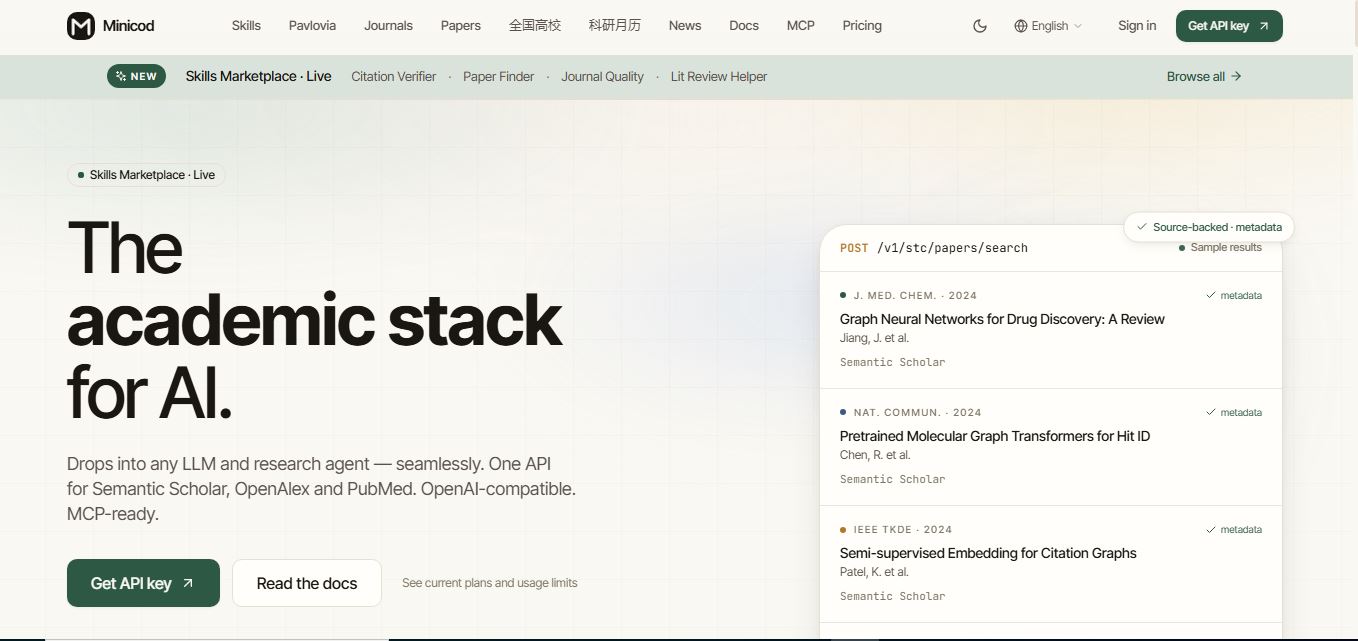
Minicod is an academic data aggregation API, research intelligence platform, and Model Context Protocol (MCP) server that unifies scholarly literature queries across Semantic Scholar, OpenAlex, and PubMed into a single normalized JSON schema, complete with citation graph traversal, open-access link discovery, and an OpenAI-compatible endpoint.
What is Minicod?
Minicod is a unified academic data API, a scientific research aggregation platform, and a tool suite designed for AI researchers, bioinformaticians, academic developers, scientific knowledge engineers, and autonomous agent builders. While conducting literature reviews or building retrieval-augmented generation (RAG) pipelines usually requires managing different rate limits, inconsistent schemas, and separate authentication tokens across multiple scholarly databases, Minicod provides a single consolidated gateway to the world's scientific literature.
Positioned as “One API for Semantic Scholar, OpenAlex, and PubMed data,” Minicod normalizes scientific queries across millions of peer-reviewed papers, clinical trials, preprints, and journals into a consistent JSON response schema. The platform automatically resolves DOIs, direct open-access PDF links, journal impact metrics, and author affiliations while enabling multi-hop citation graph traversal. Built for the modern agentic stack, Minicod features an OpenAI-compatible chat completions proxy, a dedicated npm Model Context Protocol server (
@minicod/mcp-server) for Claude Desktop and Cursor, and a Skills Marketplace of reusable research instruction bundles. Minicod operates on a freemium model with free starter queries and pay-as-you-go developer tiers.
- Platform Role: Academic Literature Aggregator, Scholarly Data API & Research Agent MCP Server
- Integrated Upstream Databases: Semantic Scholar, OpenAlex, PubMed / PMC, and Minicod Journal Index
- Agentic Interoperability: Native Model Context Protocol (MCP) server (
@minicod/mcp-server), OpenAI-compatible REST endpoint, and Research Skills Marketplace - Use Cases:
- Powering academic RAG pipelines and scientific chatbots with clean, de-duplicated paper metadata, abstracts, and direct open-access PDF download links
- Conducting automated multi-hop citation graph traversals to trace seminal foundational papers and track emerging research lineages
- Verifying medical claims and clinical findings against authoritative PubMed/PMC indexed records programmatically
- Deploying packaged scientific research skills from the marketplace to automate systematic literature reviews and meta-analyses
- Technology:
- Unified schema normalizer translating heterogeneous responses from Semantic Scholar, OpenAlex, and PubMed into standard JSON
- Citation network mapping engine indexing bi-directional reference relationships and citation velocities
- Model Context Protocol (MCP) server providing typed scientific discovery tools for agentic runtimes
- Target Users:
- AI engineers and data scientists building scholarly research agents, RAG systems, and automated evidence synthesis tools
- Academic researchers and PhD candidates automating systematic literature reviews and bibliography audits
- BioTech and pharmaceutical analysts monitoring newly published clinical trials and biomedical papers
- Developers seeking a drop-in academic search tool for Claude Code, Cursor, and OpenAI-compatible frameworks
- Acquisition: Operates as an independent private developer platform and academic API service

Key features of Minicod
Minicod's key platform features are
- Unified Multi-Repository Search: Query Semantic Scholar, OpenAlex, and PubMed through a single endpoint with automatic de-duplication and consistent output schemas.
- Standardized JSON Schema: Eliminates custom parsing logic by returning standardized author objects, publication years, venue data, abstract texts, and persistent IDs.
- Open-Access Link Resolution: Automatically resolves direct, legal open-access PDF URLs and DOI landing pages when available from upstream repositories.
- Native Model Context Protocol (MCP) Server: Installable via npm (
@minicod/mcp-server), allowing Claude Desktop, Cursor, and autonomous agents to search literature natively. - OpenAI-Compatible Endpoint: Drop Minicod into existing LangChain, LlamaIndex, or OpenAI SDK workflows as a custom completions and search proxy.
- Citation Graph Traversal: Inspect inbound citations and outbound references to map how concepts evolve across academic disciplines.
- Journal Metadata & Metrics: Retrieve publication frequency, publisher details, ISSN classifications, and impact indicators across global scientific journals.
- Skills Marketplace: Access and run pre-configured research workflow prompts and agent instructions designed for academic synthesis and evidence vetting.
Minicod Pricing
Minicod operates a developer-friendly freemium model that combines recurring free query allowances with pay-as-you-go credit top-ups and volume subscription plans.
Free Plan:
- $0 / Free Tier: Baseline monthly request allocation for developers and students to test paper lookups, citation queries, and the MCP server
- Full access to standard unified JSON responses, PubMed/Semantic Scholar/OpenAlex aggregation, and public documentation
Developer & Team Tiers:
- Pay-As-You-Go & Subscription Tiers: Flexible per-request micro-pricing and monthly packages designed for high-concurrency production RAG systems and autonomous agent loops
- Increased rate limits, priority upstream query routing, dedicated support, and higher concurrent connection thresholds
Disclaimer: Query quotas and rate limits depend on selected plan tiers and upstream database constraints. For the latest API documentation, pricing tiers, and MCP configuration steps, visit minicod.com.
Who is using Minicod?
Minicod is used by research software engineers, academics, and AI builders, including
- AI Engineers & RAG Developers: Building retrieval-augmented generation applications that require grounded, peer-reviewed scientific citations without hallucinations
- Bioinformatics & Life Science Researchers: Tracking biomedical discoveries across PubMed and PubMed Central via a programmatic API
- Cursor & Claude Power Users: Equipping coding agents with academic search capabilities via MCP to look up algorithmic proofs and machine learning papers
- Academic Institutions & Science Startups: Developing specialized research intelligence dashboards without negotiating individual data provider agreements
Best Minicod Alternatives
Some of the strongest Minicod alternatives include
- Semantic Scholar API (Allen Institute for AI)
- OpenAlex API (OurResearch Open Scholarly Metadata)
- Consensus (AI Academic Search Engine)
- Elicit (AI Research Assistant & Literature Review Platform)
- Scite.ai (Smart Citations & Context Evaluation)
- Europe PMC REST API (Biomedical & Life Sciences Literature)
Pros and Cons of Minicod
Pros
- Consolidates Semantic Scholar, OpenAlex, and PubMed into a single API endpoint with a normalized schema
- First-class agentic support with an official Model Context Protocol (MCP) server on npm
- Automatically surfaces open-access PDF links and resolved DOIs for frictionless document retrieval
- OpenAI-compatible endpoint makes integration into existing agentic frameworks straightforward
- Simplifies academic data infrastructure by managing separate upstream rate limits and token headers internally
Cons
- Depends on upstream repository availability and indexing freshness for real-time paper lookups
- Paywalled full-text article content is not served directly (provides open-access links only when legally available)
- Deep citation graph traversals across extensive literature trees require careful API rate-limit management
Why Choose Minicod?
Integrating academic research into AI applications is notoriously frustrating: Semantic Scholar has strict rate limits, OpenAlex uses its own bespoke data entities, and PubMed requires specialized XML parsing. Minicod eliminates this architectural friction.
- Provides a single API key and unified schema that queries all three major scholarly repositories simultaneously
- Plugs directly into Cursor and Claude Desktop via native MCP tooling so your coding assistant can review papers
- Ensures factual grounding for AI pipelines with direct citation links, DOIs, and verified abstracts
- Saves engineering hours otherwise spent maintaining fragile custom scrapers and API adapters
Minicod vs. Competitors
The main difference between Minicod, the standalone Semantic Scholar API, Consensus, and Elicit lies in developer orientation and protocol compatibility. While Elicit and Consensus operate primarily as consumer-facing research web apps, and Semantic Scholar covers only its proprietary graph, Minicod functions as an aggregation infrastructure layer—unifying Semantic Scholar, OpenAlex, and PubMed behind a single normalized API and an official Model Context Protocol (MCP) server for autonomous AI agents.
| Feature / Platform | Minicod (minicod.com) | Semantic Scholar API | Consensus | Elicit |
|---|---|---|---|---|
| Core Focus | Unified Academic API & Agent MCP Server | Proprietary Scholarly Graph API | AI Search Engine for Scientific Claims | Automated Literature Review Assistant |
| Multi-Source Aggregation | Yes (Semantic Scholar, OpenAlex, PubMed) | Semantic Scholar database only | Semantic Scholar + internal index | Semantic Scholar + proprietary index |
| Form Factor | Developer API & MCP Server | Developer REST API | Web Application & Search Engine | Web Application & Research Workspace |
| Native MCP Integration | Yes (@minicod/mcp-server) |
Community wrappers | No | No |
| Starting Price | Freemium / Developer Usage Pricing | Free with rate limits / Partner tiers | Free tier / Premium from $9.99/mo | Free basic / Plus from $10/mo |
| Best For | Developers & agents needing unified literature APIs | Direct single-source Semantic Scholar integration | Students & casual users verifying research claims | Researchers screening papers and extracting table data |
How do we rate Minicod?
| Parameter | Rating (out of 5) |
|---|---|
| Academic Coverage & Multi-Source Aggregation | 4.9 |
| Schema Consistency & Open-Access Resolution | 4.9 |
| Model Context Protocol (MCP) & Agent Tooling | 5.0 |
| OpenAI SDK Compatibility & Developer Ergonomics | 4.8 |
| Value for Money | 4.8 |
| Overall Score | 4.88 |
Minicod Review
Minicod provides an essential bridge between the academic literature ecosystem and the modern agentic AI workspace. By resolving the operational headache of maintaining separate API connectors for Semantic Scholar, OpenAlex, and PubMed, it offers developers a single, dependable pipeline for scholarly intelligence. Its official npm Model Context Protocol (MCP) server allows coding assistants like Claude Desktop and Cursor to verify algorithms and ground research without manual web browsing. For teams building academic AI applications, scientific RAG pipelines, or autonomous literature review bots, Minicod delivers a focused, highly practical infrastructure layer.
Conclusion
Minicod is a powerful unified academic data API platform designed to simplify how developers and researchers access scholarly information by aggregating data from multiple sources into a single, consistent interface. Instead of dealing with fragmented APIs, authentication methods, and formats, users can query papers, authors, citations, and institutions through one streamlined system, significantly reducing complexity. Its biggest strength lies in developer-first design and AI integration, offering RESTful APIs, OpenAI-style authentication, and even natural language search for research workflows.
FAQ
What is Minicod and how does it work?
Minicod is a unified academic data API that aggregates scholarly metadata from multiple sources into one interface. Developers can query papers, authors, and citations through a single API instead of integrating multiple fragmented research databases.
Who should use Minicod?
Minicod is ideal for developers, researchers, EdTech startups, and data scientists building research tools or AI applications. It’s especially useful for teams that need structured academic data without managing multiple APIs and inconsistent data formats.
What features does Minicod offer?
Minicod offers unified API access, academic paper search, author and citation metadata, and AI-powered natural language queries. It also provides RESTful endpoints, Bearer authentication, and scalable infrastructure for building research-driven applications.
Can Minicod be used with AI tools like ChatGPT or Claude?
Yes, Minicod integrates with AI tools via MCP, allowing assistants to search academic literature directly within chat. Users can ask natural-language queries and receive structured research results without switching platforms.
How is Minicod different from traditional academic databases?
Unlike traditional databases with separate APIs and formats, Minicod normalizes data into one consistent interface. This reduces integration complexity and allows developers to build applications faster using standardized academic metadata.
Is Minicod free or paid?
Minicod offers a free tier with limited API usage for prototyping, while paid plans provide higher request limits and advanced capabilities. Pricing is transparent and scales based on usage and application needs.
User Reviews
No reviews yet for Minicod.
Featured Tools
Featured AI tools from TechShark
Melody Genie
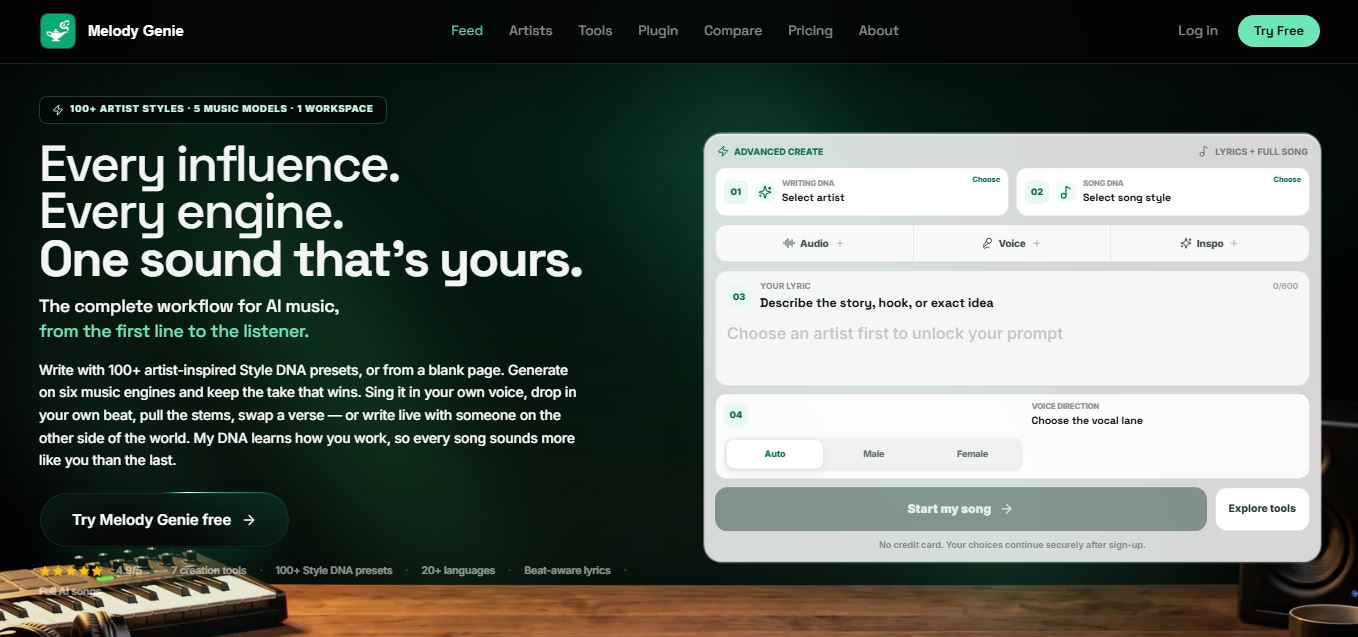
MelodyGenie is an AI-powered music generator that creates original songs from simple text prompts. Users can choose styles, moods, and genres, then instantly generate melodies and full tracks, making it easy for creators, marketers, and hobbyists to produce custom music without musical expertise.
Freemium
Kimi AI
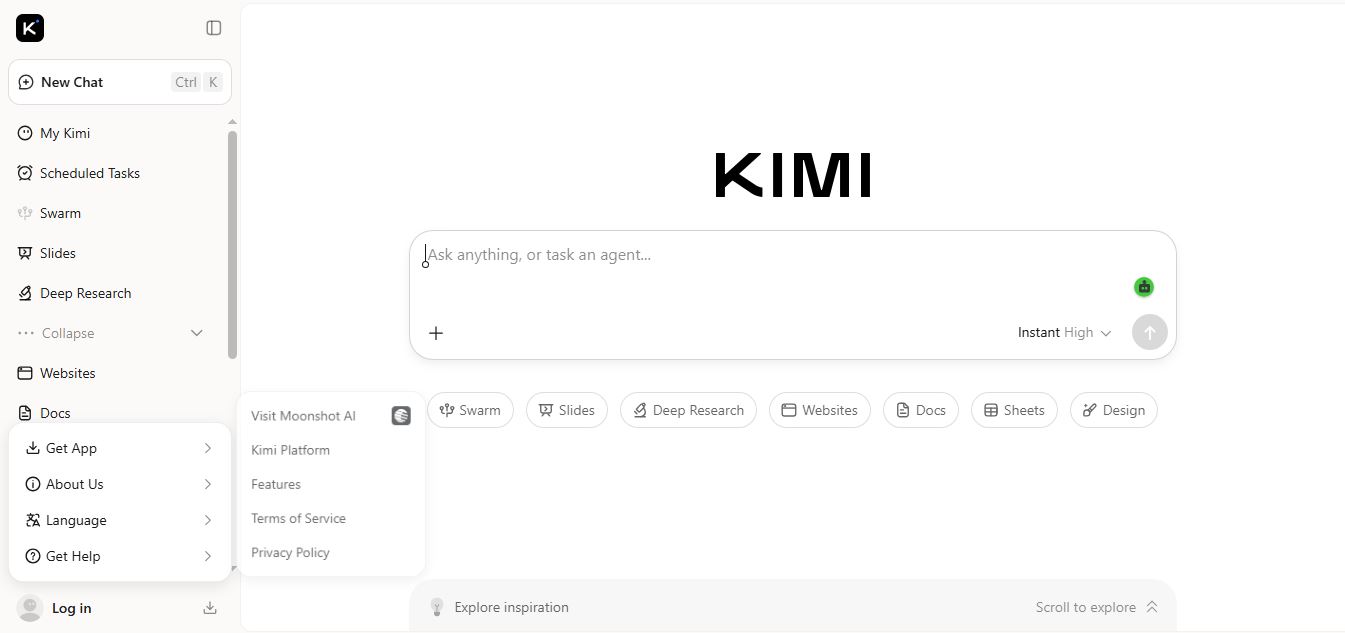
Kimi AI is an advanced AI assistant developed by Moonshot AI that helps you chat, research, write, code, and automate tasks in one place. It supports web search, file analysis, and multimodal inputs, and can even run autonomous “agent” workflows to complete complex tasks end-to-end.
Freemium
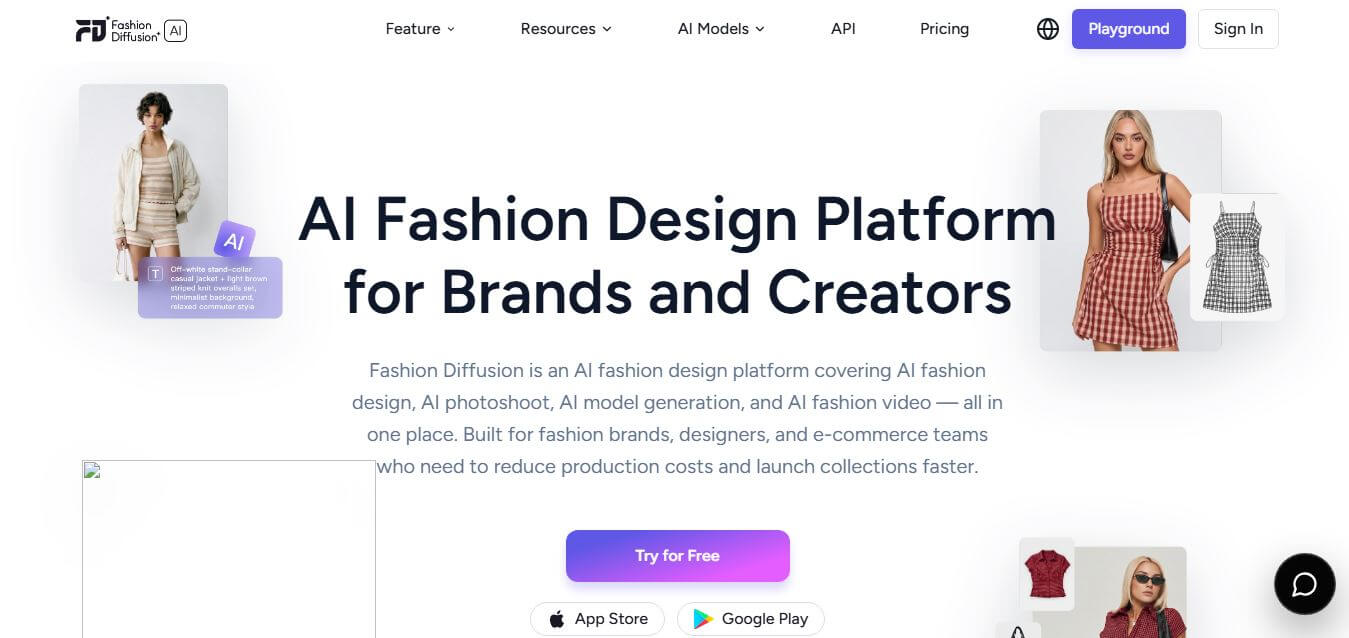
Fashion Diffusion AI
Fashion Diffusion is an AI-powered fashion design platform that helps brands and designers create clothing designs, virtual try-ons, AI models, product photos, and marketing visuals faster and cost-effectively.
Paid
Veo 4
Veo 4 AI is an AI video creation platform that generates dramatic videos from text, images, audio, and video prompts using realistic motion and synchronized sound.
Paid
Alternatives
Alternatives to Minicod
The best Minicod alternatives include Semantic Scholar API, OpenAlex API, Consensus, Elicit, Scite.ai, and Europe PMC. These tools provide scholarly literature search, citation metadata, and research analysis. While Minicod specializes in a developer-first aggregation API and npm Model Context Protocol (MCP) server unifying Semantic Scholar, OpenAlex, and PubMed into a standardized JSON response with citation graph traversal, alternatives like Elicit and Consensus focus primarily on end-user web applications for claim evaluation and literature review tables.
 4.9
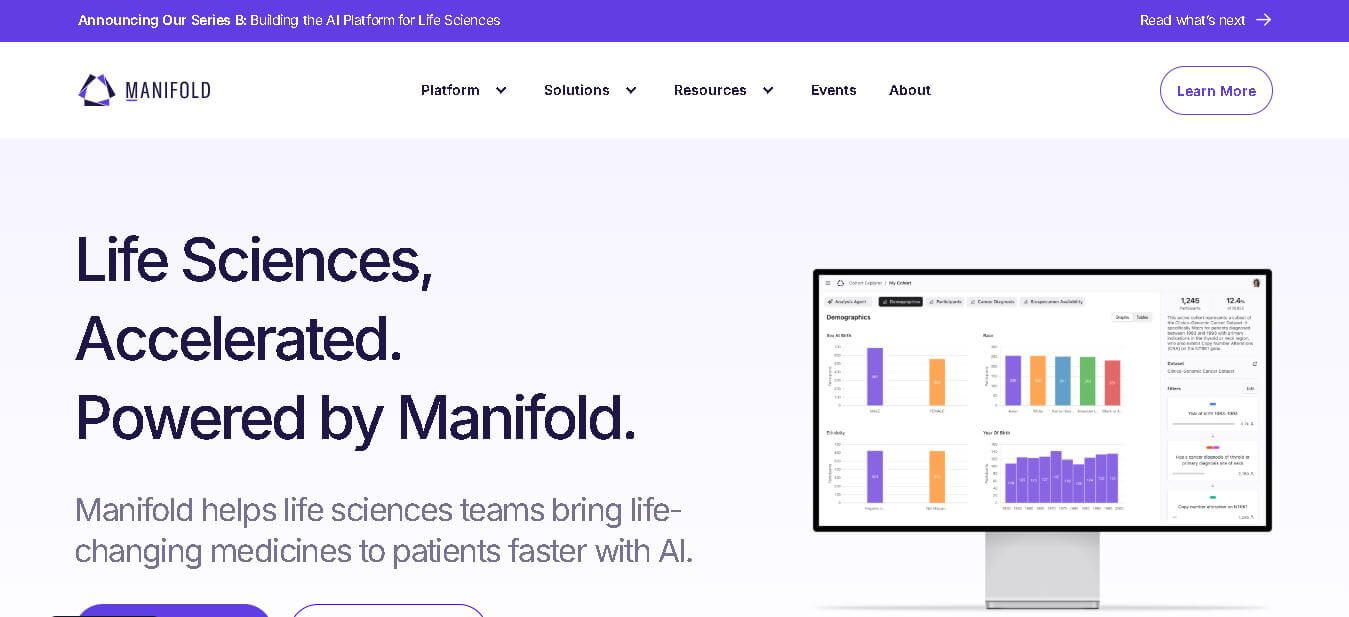
4.9Manifold
Research
Manifold helps life sciences organizations turn complex clinical, genomic, and real-world data into governed, self-service insights. Its specialist agents support natural-language queries, cohort building, bioinformatics, statistical analysis, data partnerships, and evidence generation. Teams can keep sensitive data within their cloud while controlling access, auditing activity, and scaling research workflows securely.
 5.0
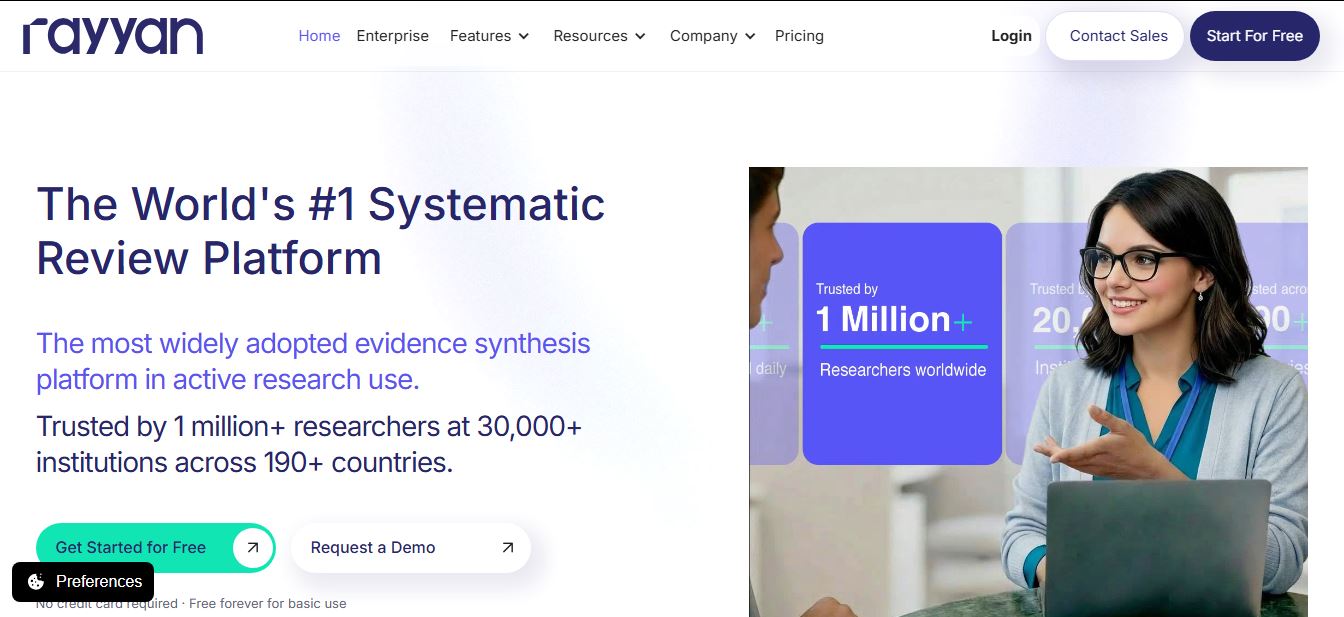
5.0Rayyan
Research
Rayyan is an AI-powered systematic review and literature review platform that helps researchers organize references, remove duplicates, screen studies, extract data, assess risk of bias, and generate PRISMA reports. Its AI features assist with relevance ranking, article screening, and structured data extraction while keeping researchers in control.
 4.9
4.9EvidenceHunt
Research
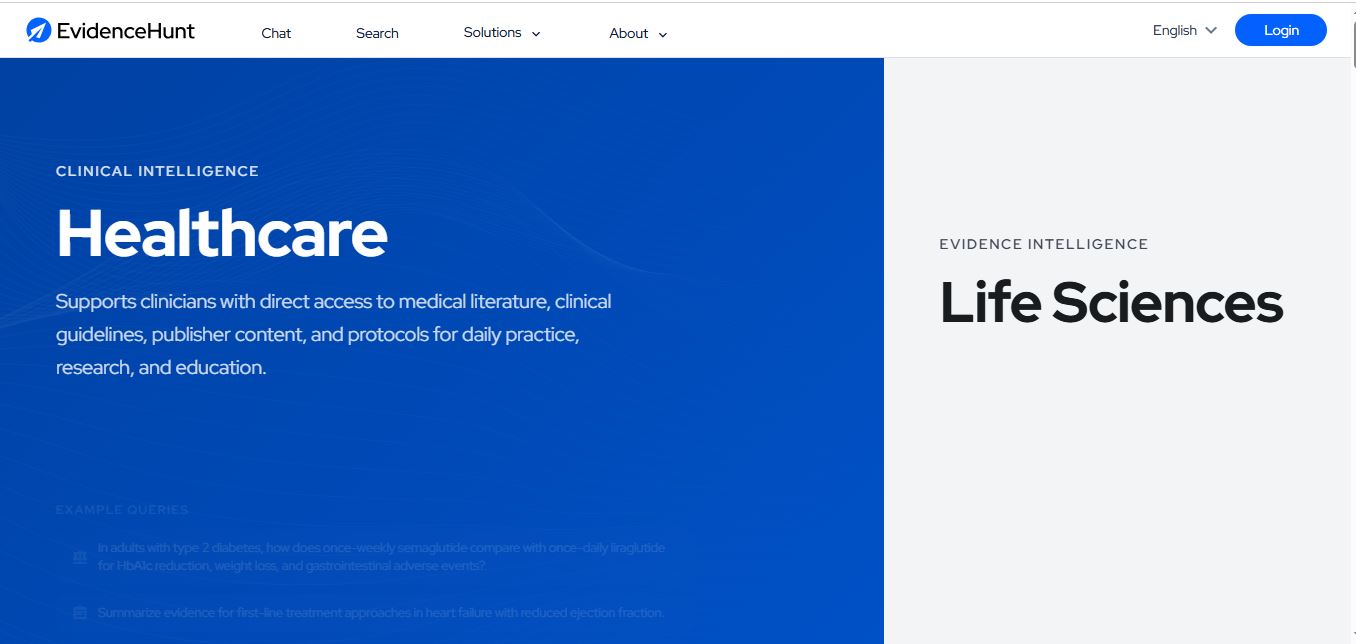
EvidenceHunt is an AI-powered medical research platform that helps clinicians, researchers, and life science teams find and analyze scientific evidence. It searches medical literature, guidelines, and internal documents, then generates citation-grounded answers, evidence tables, systematic reviews, and traceable insights for faster, evidence-based research.
 4.9
4.9Elicit
Research
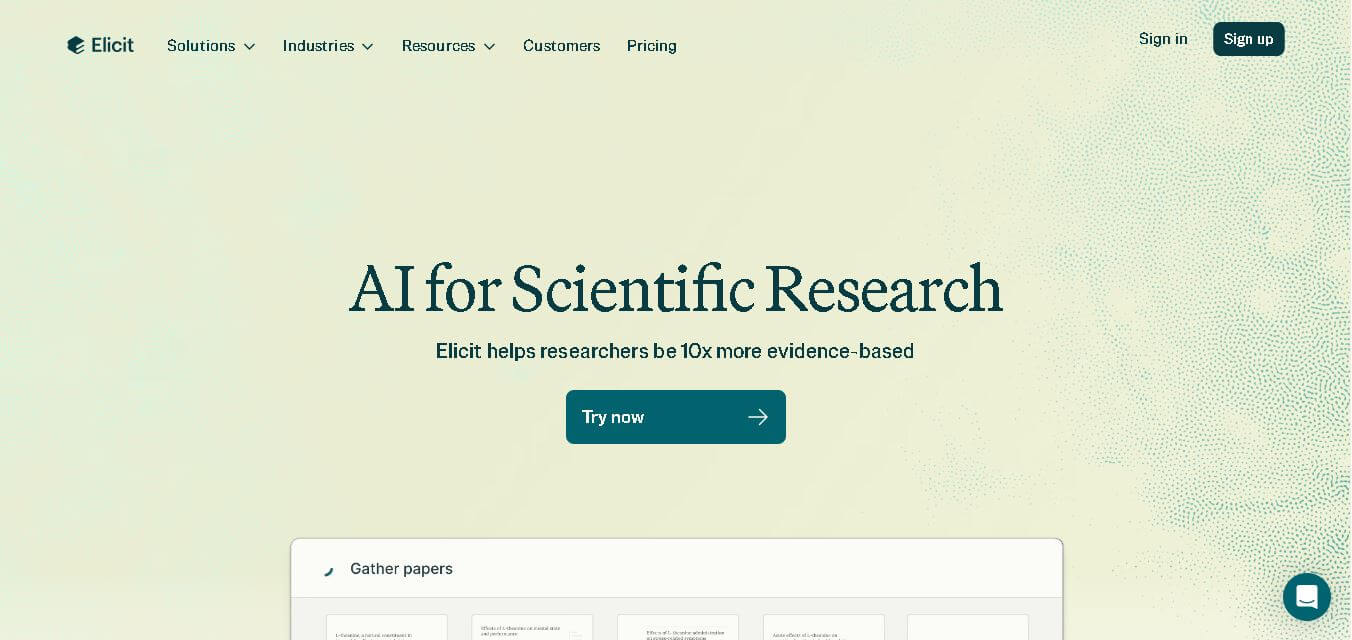
Elicit is an AI-powered research assistant that helps users find, summarize, and analyze academic papers at scale. It searches millions of studies, extracts key data, and generates evidence-backed reports, enabling researchers to conduct literature reviews, compare findings, and make informed decisions faster.
 4.8
4.8Scholarcy
Research
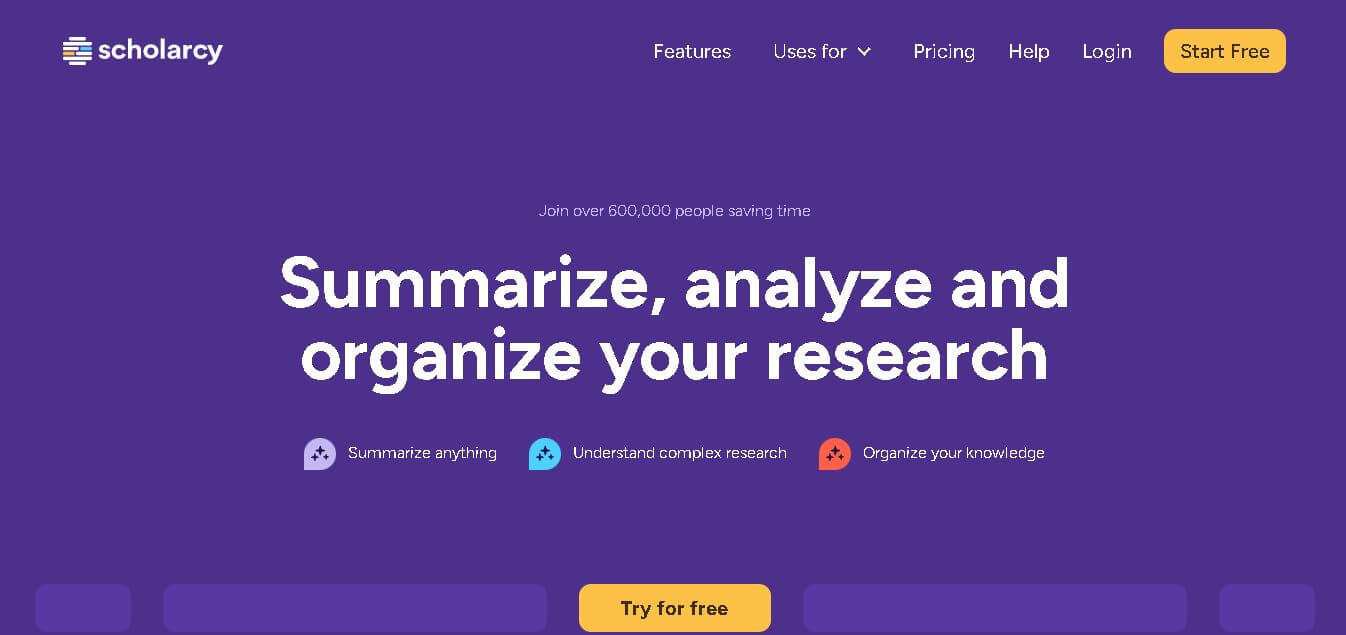
Scholarcy is an AI-powered research assistant that helps students and researchers summarize, analyze, and organize academic papers. It turns complex documents into structured flashcards with key findings, concepts, and references, enabling faster reading, better understanding, and efficient literature review workflows.
 4.9
4.9Resoomer
Research
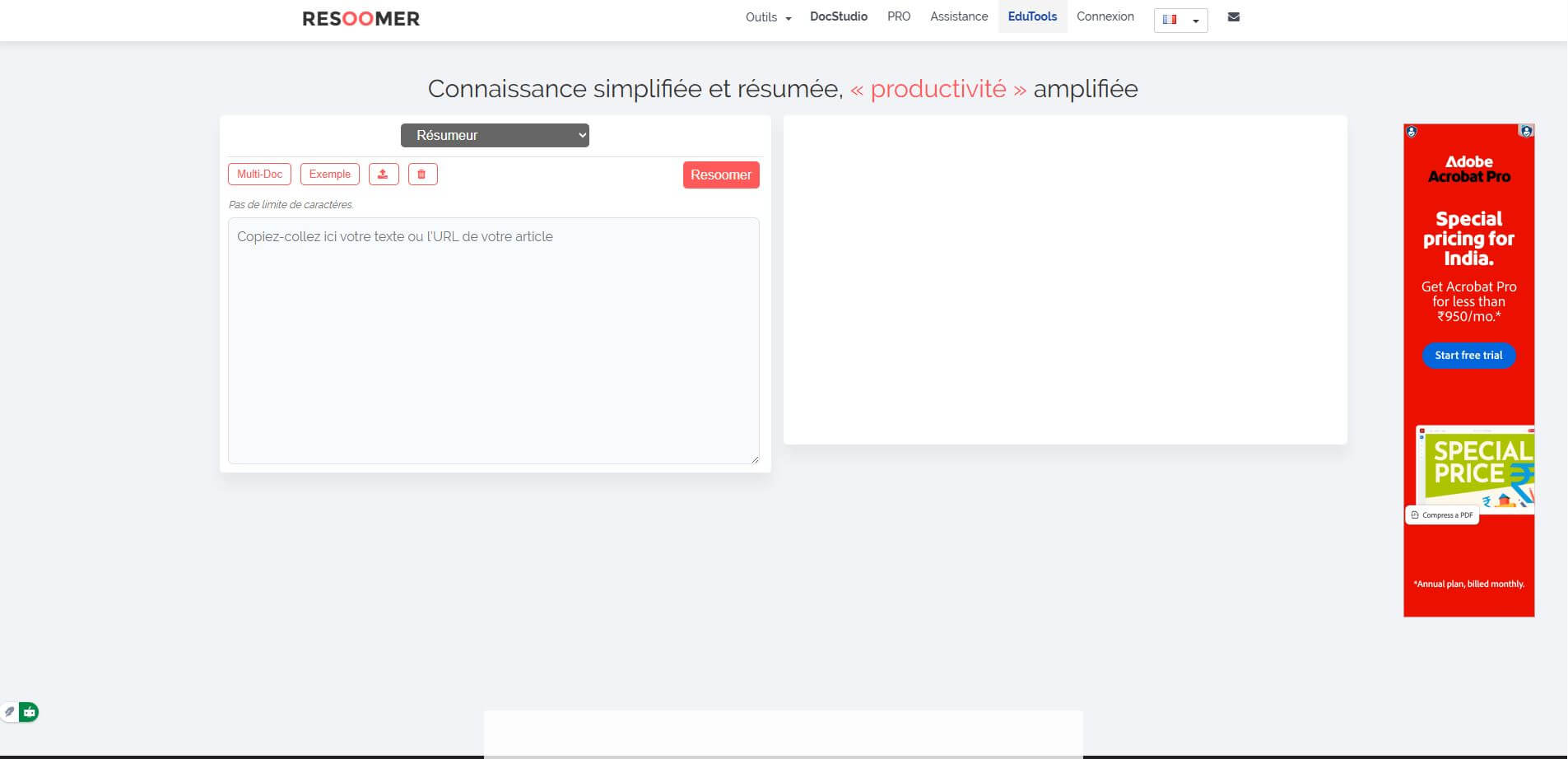
Resoomer is an AI-powered text summarization tool that helps users quickly turn long articles, research papers, and documents into concise summaries. It identifies key ideas, supports multiple formats like PDFs and URLs, and includes tools for paraphrasing, translating, and analyzing content for faster understanding.
 4.9
4.9Consensus
Academic
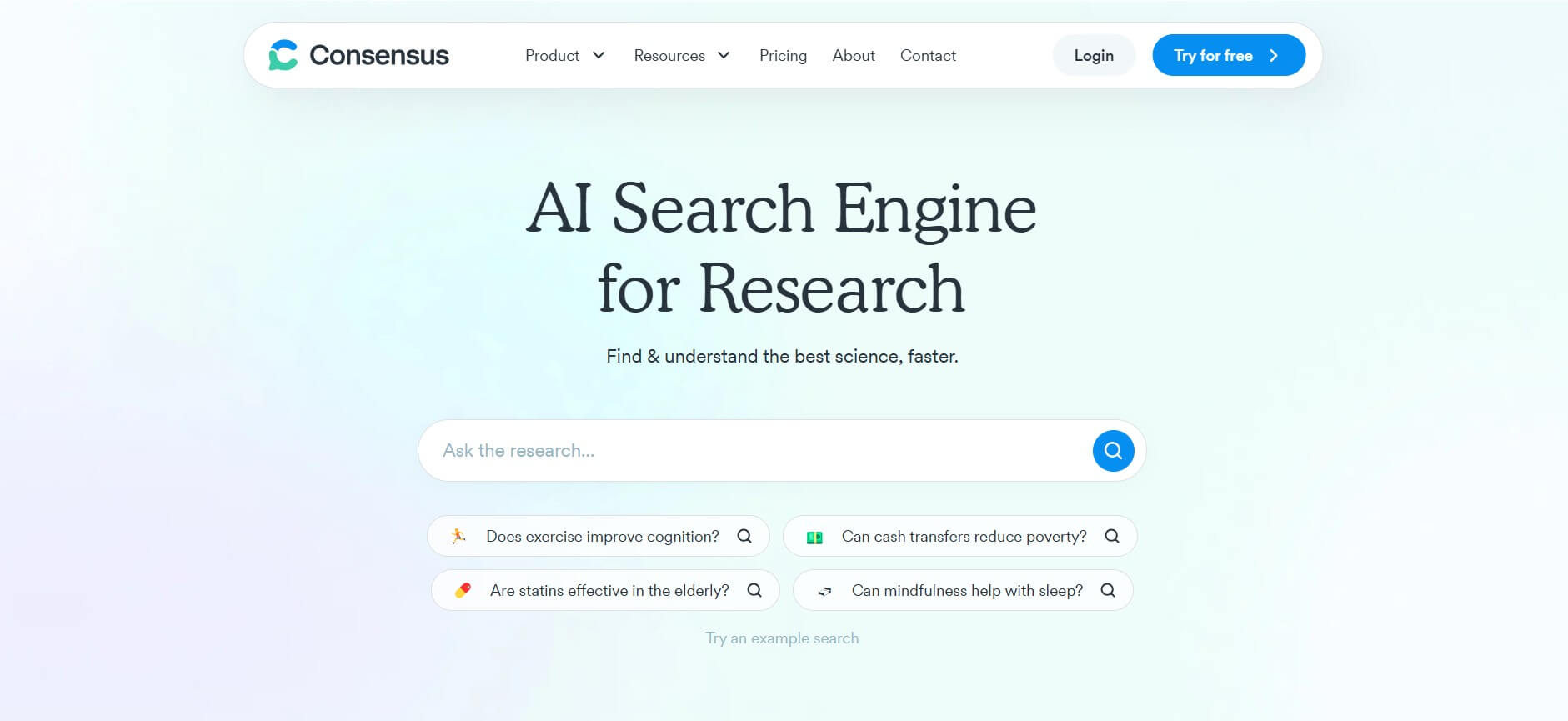
Consensus is an AI-powered academic search engine that helps users find, understand, and summarize scientific research from over 200 million peer-reviewed papers. It delivers clear, cited answers backed by real studies, making it easier to explore evidence, compare findings, and conduct research faster and more reliably.
 5.0
5.0Perplexity AI
AI Chatbot Tools
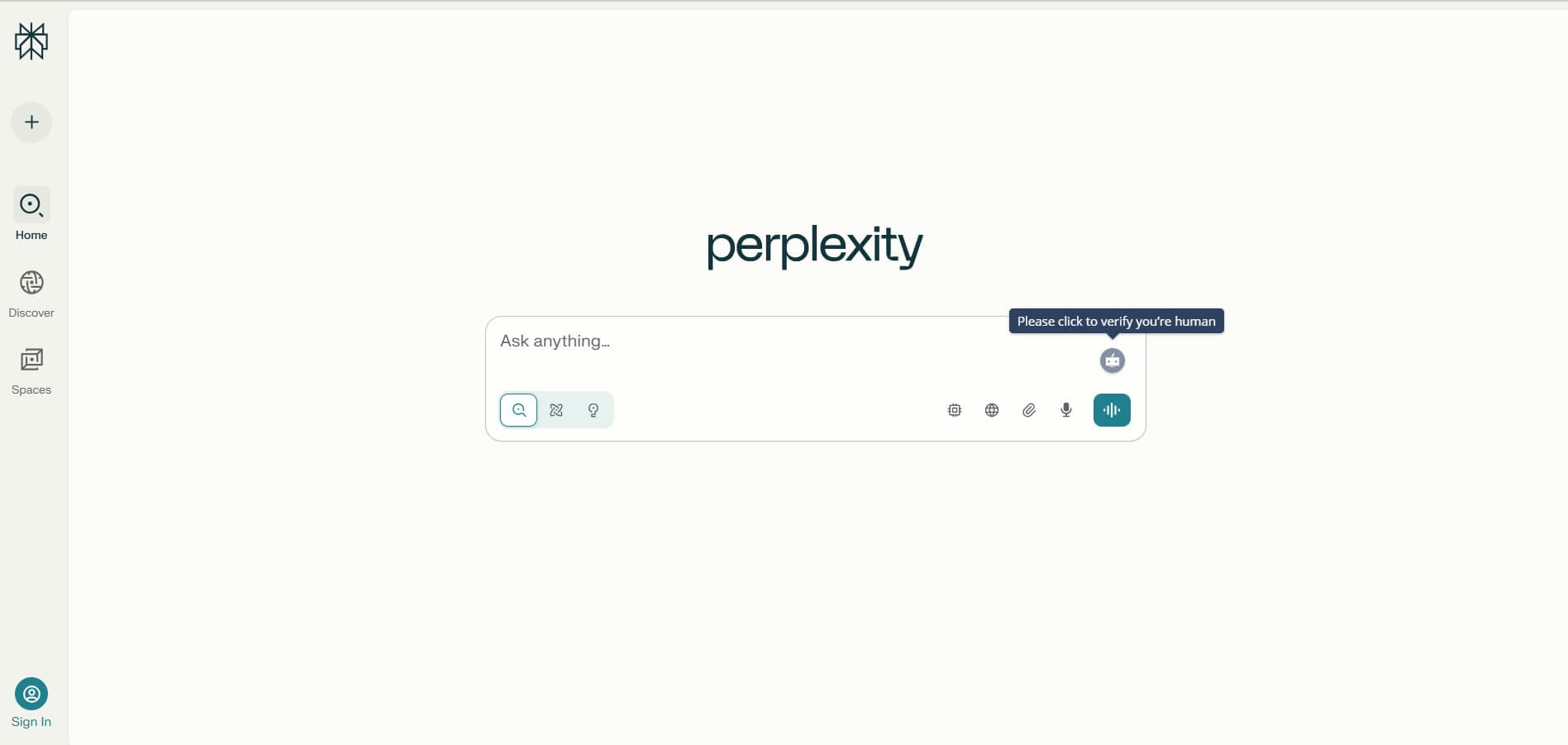
Perplexity is an AI-powered answer engine that searches the web in real time and delivers clear, cited responses instead of just links. It combines conversational AI with live data, helping users research topics, compare information, and get reliable insights quickly with verifiable sources.
OneSearch.bio
Research
OneSearch.bio is an AI-powered bio link and search aggregation platform designed for creators, brands, and digital marketers to consolidate links, social profiles, monetization tools, and searchable content into a single custom hub.