
Lightmatter
Lightmatter develops photonic computing technologies that help AI data centers connect processors and transfer information more efficiently. Its products include Passage optical interconnects, Guide light engines, and Envise photonic AI computing technology. The company aims to address bandwidth and power constraints affecting large-scale AI training, inference, and high-performance computing infrastructure.
What is Lightmatter?
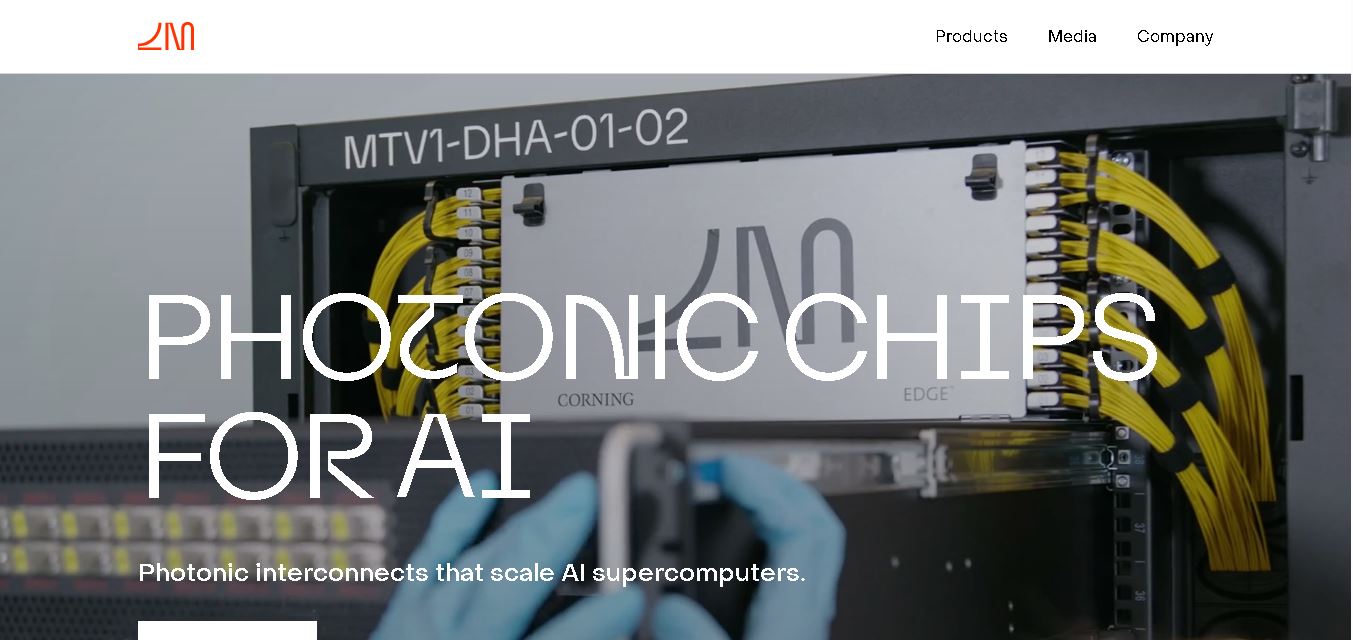
Lightmatter is a technology company developing photonic chips and optical interconnects that use light to move data between processors in large-scale AI computing systems. Founded in 2017 by researchers associated with MIT, the company focuses on improving bandwidth, energy efficiency, and scalability in AI data centers. Its Passage interconnect platform, Guide light engines, and Envise photonic computing technology target demanding artificial intelligence and high-performance computing workloads.
Lightmatter was founded in 2017 by Nicholas Harris, Darius Bunandar, and Thomas Graham. Headquartered in Mountain View, California, the company develops photonic technologies for AI infrastructure. It has raised approximately $850 million and reached a reported $4.4 billion valuation in October 2024. Its Passage M1000 reference platform supports up to 114 terabits per second of bandwidth. Guide provides integrated laser technology, while Envise explores photonic AI computing. No standard consumer software subscription is its primary offering; its focus is specialized hardware.
- Platform Focus: Photonic computing hardware, optical interconnects, co-packaged optics (CPO), 3D photonic interposers, and laser light engines
- Developer / Entity: Lightmatter, Inc.
- Launch Year: 2017
Use Cases:
- Scaling AI supercomputer clusters to 100,000+ GPUs for trillion-parameter frontier model training
- Overcoming electrical SerDes bandwidth limits and pin-edge congestion in multi-rack GPU architectures
- Deploying co-packaged optics (CPO) and 3D photonic interposers (Passage L200, M1000) for ultra-high-speed tensor parallelism
- Supplying universal multi-wavelength laser light sources (Guide VLSP) for the broader optical networking industry
Technology:
- Passage 3D Photonic Interposer platform combining edgeless I/O and co-packaged optics up to 114+ Tbps
- Guide Very Large Scale Photonics (VLSP) light engines integrating hundreds of lasers and optical components on a single chip
- High-efficiency bidirectional WDM (Wavelength Division Multiplexing) links achieving low pJ/bit energy consumption
Target Users:
- Hyperscale data center operators, cloud providers, and AI infrastructure architects
- GPU and accelerator manufacturers (including NVIDIA NVLink Fusion partner ecosystems)
- AI research labs training massive multi-modal and reasoning foundation models
Corporate Entity: Operates as Lightmatter, Inc. / lightmatter.com

Key features of Lightmatter
Lightmatter's key features are
- Passage Interconnect Platform: 3D photonic interposers and co-packaged optics (CPO) enabling edgeless I/O and unlimited bandwidth scaling.
- Guide VLSP Light Engines: Universal semiconductor laser light sources integrating hundreds of photonic components on a single chip.
- NVIDIA NVLink Fusion Integration: Seamlessly connects photonic links into the world's most advanced AI training clusters.
- Extreme Energy Efficiency: Reduces interconnect power consumption down to low pJ/bit metrics, bypassing electrical SerDes thermal walls.
- Passage M1000 Reference System: Rack-level 3D photonic interposer platform delivering 114 Tbps across a 4,000 mm² footprint.
- High Bandwidth Density: Supports bidirectional WDM links achieving 8x bandwidth density improvements over traditional fiber approaches.
Lightmatter Pricing
Lightmatter operates as a deep-tech hardware and optical component manufacturer, engaging through enterprise partnership agreements and evaluation kits (EVKs).
Enterprise Hardware & EVK Tiers:
- Custom enterprise and hyperscale deployment pricing
- Evaluation platforms (Passage M1000 EVK, EVK100, EVK50, Guide EVK) available for infrastructure qualification and lab integration
Who is using Lightmatter?
Lightmatter is utilized by global AI infrastructure leaders, including
- Hyperscale Cloud Providers: Building next-generation data centers for massive LLM training and inference
- AI Accelerator Ecosystems: Partners in the NVIDIA NVLink Fusion and open networking consortia
- Data Center Hardware Architects: Overcoming copper and electrical interconnect bottlenecks
Best Lightmatter Alternatives
Some of the strongest photonic and optical interconnect alternatives include
- Ayar Labs
- Ranovus
- Celestial AI
- Broadcom (Optical interconnects)
- Cisco / Acacia Communications
- POET Technologies
Pros and Cons of Lightmatter
Pros
- Solves the critical electrical SerDes bandwidth wall threatening future AI cluster scaling
- Unmatched optical bandwidth density (up to 114+ Tbps) using 3D photonic interposers
- Drastically lowers data center interconnect power consumption (measured in pJ/bit)
- Strong industry validation and partnerships including NVIDIA NVLink Fusion
Cons
- Enterprise hardware requires specialized co-packaging and chiplet integration with GPU/TPU architectures
- Adoption depends on industry-wide transitions toward co-packaged optics (CPO) standards
- Capital-intensive hardware development cycle typical of deep-tech semiconductor startups
Why Choose Lightmatter?
Lightmatter is the premier choice for AI data center operators and hardware architects seeking to eliminate electrical I/O bottlenecks and scale supercomputer clusters using revolutionary silicon photonics and co-packaged optics.
- Pioneers 3D photonic interposers (Passage) and laser light engines (Guide)
- Delivers terabit-scale optical bandwidth essential for trillion-parameter AI models
- Reduces latency and energy consumption compared to copper electrical interconnects
- Backed by Tier-1 foundry partnerships (TSMC, GlobalFoundries) and elite ecosystem integrations
Lightmatter vs. Competitors
The main difference between Lightmatter, Ayar Labs, Celestial AI, and Ranovus is that Lightmatter provides an end-to-end photonic interconnect platform utilizing 3D photonic interposers (Passage) and multi-wavelength laser engines (Guide) for massive GPU cluster scale-up, whereas Ayar Labs focuses on optical I/O chiplets, Celestial AI specializes in optical compute fabrics, and Ranovus offers modular CPO solutions. Lightmatter stands out for its comprehensive wafer-to-rack 3D photonic interposer architecture.
r r r
| Feature / Tool | Lightmatter (lightmatter.com) | Ayar Labs | Celestial AI | Ranovus |
|---|---|---|---|---|
| Core Focus | 3D Photonic Interposers & Co-Packaged Optics (Passage & Guide) | Optical I/O Chiplets & Laser Sources | Photonic Fabric for Compute & Memory Interconnect | Modular Co-Packaged Optics (ODIN) |
| Optical Technology | Passage Interposers & VLSP Light Engines | TeraPHY Optical I/O & SuperOptical Sources | Photonic Fabric Architecture | ODIN CPO & Multi-Wavelength Lasers |
| Ecosystem Integration | NVIDIA NVLink Fusion & Open Consortia | Multi-Vendor Foundry & Processor Integration | Compute & Memory Interconnect Fabrics | Data Center Switch & Router Integration |
| Pricing Model | Enterprise Hardware Partnerships & EVKs | Enterprise Commercial Licensing & Chips | Enterprise Deployment & Licensing | Enterprise Hardware Commercialization |
| Best For | Frontier AI Supercomputer Cluster Scaling & Rack-Level Photonics | Chip-to-Chip Optical Die Interconnects | Optical Compute & Memory Bandwidth Expansion | Data Center Switch Optical Upgrades |
How do we rate Lightmatter?
| Parameter | Rating (out of 5) |
|---|---|
| Photonic Innovation & Architecture | 4.9 |
| Bandwidth Scaling & Density | 5.0 |
| Energy Efficiency (pJ/bit) | 4.9 |
| Ecosystem Partnerships (NVIDIA & Foundries) | 4.8 |
| Value for Money (Enterprise) | 4.6 |
| Overall Score | 4.84 |
Lightmatter Review
Lightmatter is a transformative force in AI infrastructure. By replacing electrical copper interconnects with its Passage 3D photonic interposers and Guide VLSP light engines, it successfully solves the bandwidth and power walls holding back modern AI supercomputers. Backed by major foundry partnerships and NVIDIA NVLink Fusion integration, Lightmatter is defining the optical future of AI data centers.
Conclusion
Lightmatter is an emerging technology leader focused on photonic computing and optical interconnects for next-generation AI infrastructure. Its Passage, Guide, and Envise technologies address challenges involving bandwidth, energy efficiency, and large-scale computing. The company is particularly relevant to semiconductor manufacturers, cloud providers, and advanced AI developers rather than everyday consumers. For technology researchers and infrastructure decision-makers, understanding Lightmatter's products, capabilities, and deployment requirements can help assess its role in the evolving AI hardware ecosystem.
FAQ
What does Lightmatter do?
Lightmatter develops photonic technologies that help AI data centers transfer information between processors using light. If your organization builds large AI systems, its optical interconnects can help address bandwidth bottlenecks and improve scalability. The company focuses on infrastructure hardware rather than everyday AI writing, image generation, or productivity applications for individual consumers.
How does Lightmatter's photonic technology work?
Lightmatter uses silicon photonics and optical components to transmit data through light instead of relying entirely on electrical connections. Photons can carry multiple signals through optical fibers, potentially improving bandwidth density and energy efficiency. This approach helps connect processors in large computing clusters, although actual performance depends on system architecture, integration, workloads, and deployment conditions.
What are the main products offered by Lightmatter?
cLightmatter's main technologies include Passage, Guide, and Envise. Passage focuses on optical interconnects for connecting processors, Guide provides integrated light-source technology, and Envise explores photonic AI computation. Together, these technologies address data movement and processing challenges in advanced computing systems. Their availability and maturity differ, so verify current product specifications before purchasing.
Who should consider using Lightmatter?
Lightmatter is relevant to AI infrastructure developers, hyperscale cloud providers, semiconductor companies, and organizations building large computing clusters. If your business trains advanced AI models or operates demanding data centers, photonic interconnects may help address communication bottlenecks. Smaller businesses seeking ready-to-use AI applications may find conventional cloud software more suitable for their needs.
What is the Passage platform?
Passage is Lightmatter's photonic interconnect platform designed to connect processors across advanced AI computing systems. It uses optical technology to increase bandwidth density and support larger computing clusters. Its product family includes different configurations for optical integration. If you manage AI infrastructure, review each model's bandwidth, compatibility, power requirements, and deployment specifications before selecting a solution.
How is Lightmatter different from traditional semiconductor companies?
Traditional semiconductor systems primarily use electrical signals to move information between chips, while Lightmatter develops optical interconnect technologies that use light. This approach targets limitations in bandwidth, power consumption, and physical connectivity. Rather than replacing every electronic component, Lightmatter combines photonics with electronics to support more scalable AI infrastructure and advanced computing architectures.
User Reviews
No reviews yet for Lightmatter.
Featured Tools
Featured AI tools from TechShark

Klap
Klap is an AI-powered video editing tool that turns long videos into engaging short clips for TikTok, Instagram Reels, and YouTube Shorts. It automatically finds the best moments, adds captions, and resizes videos, helping creators save time and create more content with less effort.
Free

Melody Genie
MelodyGenie is an AI-powered music generator that creates original songs from simple text prompts. Users can choose styles, moods, and genres, then instantly generate melodies and full tracks, making it easy for creators, marketers, and hobbyists to produce custom music without musical expertise.
Freemium

Fashion Diffusion AI
Fashion Diffusion is an AI-powered fashion design platform that helps brands and designers create clothing designs, virtual try-ons, AI models, product photos, and marketing visuals faster and cost-effectively.
Paid
Veo 4
Veo 4 AI is an AI video creation platform that generates dramatic videos from text, images, audio, and video prompts using realistic motion and synchronized sound.
Paid
Alternatives
Alternatives to Lightmatter
The best Lightmatter alternatives include Ayar Labs, Ranovus, Celestial AI, Broadcom, and POET Technologies. These companies offer optical interconnects and silicon photonics solutions. While Lightmatter specializes in comprehensive 3D photonic interposers (Passage) and multi-wavelength laser light engines (Guide) for rack-level AI supercomputer scaling, alternatives like Ayar Labs focus on optical I/O chiplets.
 4.8
Summate.it
Research
Summate.it is a web-based AI article summarizer that helps users understand lengthy online content quickly. It extracts article text and uses OpenAI to generate concise summaries highlighting essential information. Students, researchers, marketers, and professionals can use it to review online articles efficiently, save reading time, and simplify everyday information gathering.
 4.9
Cradle
Research
Cradle helps biotechnology researchers design, engineer, and optimize proteins using artificial intelligence and laboratory data. Its capabilities include protein sequence generation, multi-property optimization, candidate scoring, and experimental learning. The platform supports pharmaceutical, agricultural, and industrial biotechnology research, helping scientific teams explore promising molecules while reducing unnecessary experimental cycles and improving research workflows.
 4.9
Iris.ai
Research
Iris.ai helps enterprises and research teams organize complex information, analyze scientific literature, and build AI workflows using organizational knowledge. Its solutions support document extraction, contextual search, data processing, and AI response evaluation. The platform is particularly relevant to research-intensive businesses seeking better information retrieval, reliable answers, and controlled enterprise AI applications.
 4.8
FigEditor
Research
FigEditor AI helps researchers create scientific illustrations, flowcharts, graphical abstracts, and academic diagrams from text prompts, sketches, or reference images. Its editing and vectorization features simplify visual revisions, while SVG and high-resolution PNG exports support different research workflows. It is useful for students, scientists, educators, and research professionals preparing visual materials.
 4.8
GoMim
Research
GoMim is an AI math solver that helps students understand mathematical concepts through step-by-step solutions. It supports typed questions, image uploads, and subjects including algebra, geometry, and calculus. With an interactive AI tutor, question history, and free and paid plans, GoMim makes homework assistance and independent study more accessible.
 4.8
AlphaResearch
Research
AlphaResearch helps investors, financial analysts, and corporate strategists research companies using financial documents, earnings transcripts, market data, and sentiment analysis. Its features include document search, filing alerts, stock screening, institutional ownership tracking, and research notes. The platform simplifies financial information discovery, helping users investigate companies and support informed investment research decisions.
 4.8
Gatsbi
Research
Gatsbi is an AI research assistant that helps researchers discover ideas, draft academic papers, review scientific literature, and prepare patent disclosures. It combines research discovery, manuscript generation, and evidence synthesis in one workflow. The tool is useful for academics, scientists, engineers, and innovation teams seeking to streamline complex research tasks.
 4.9
Metagene-1
Research
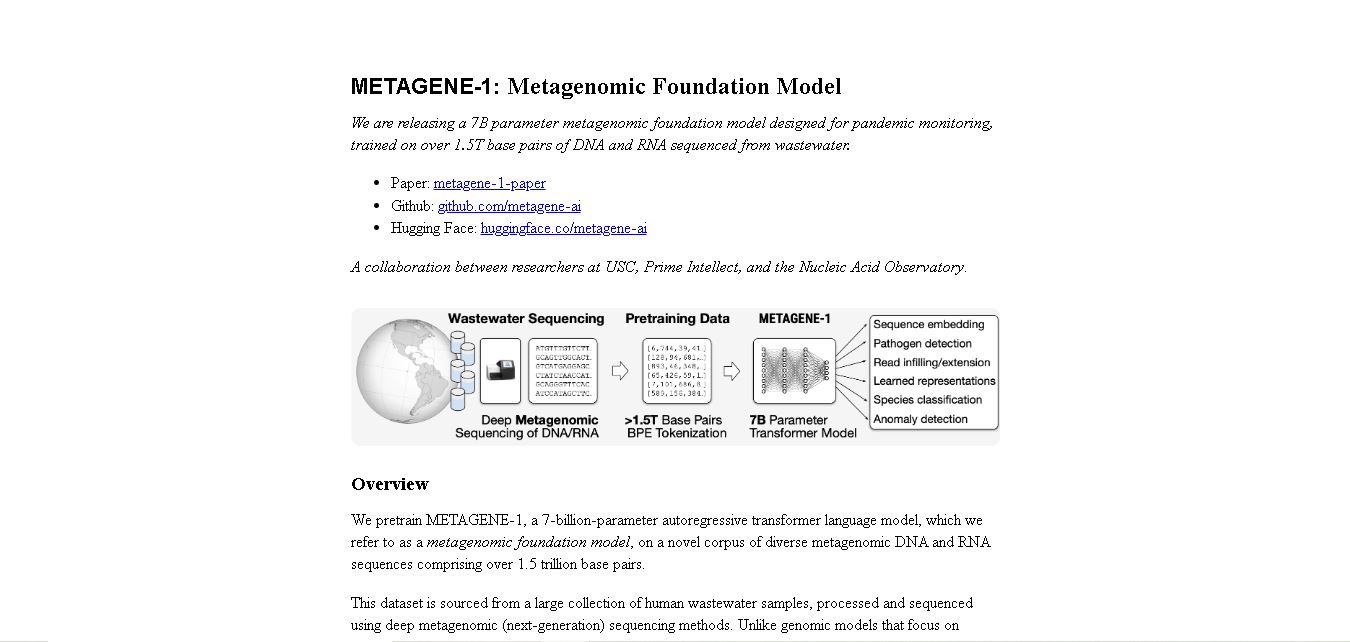
METAGENE-1 is a metagenomic foundation model designed to help researchers analyze DNA and RNA sequences. Trained on extensive wastewater sequencing data, it supports genomic embedding, pathogen detection research, biosurveillance, and pandemic monitoring. The model provides researchers with an AI-based approach to studying microbial diversity and identifying patterns in complex metagenomic datasets.
 4.8
WisPaper
Research
WisPaper AI helps students, academics, and researchers search scientific literature, explore research questions, and organize academic papers. Its features include AI-powered search, paper summaries, library-based question answering, research assistance, and personalized literature updates. It simplifies literature discovery and supports evidence-based research while allowing users to review sources and verify findings.