
Google WeatherNext 3
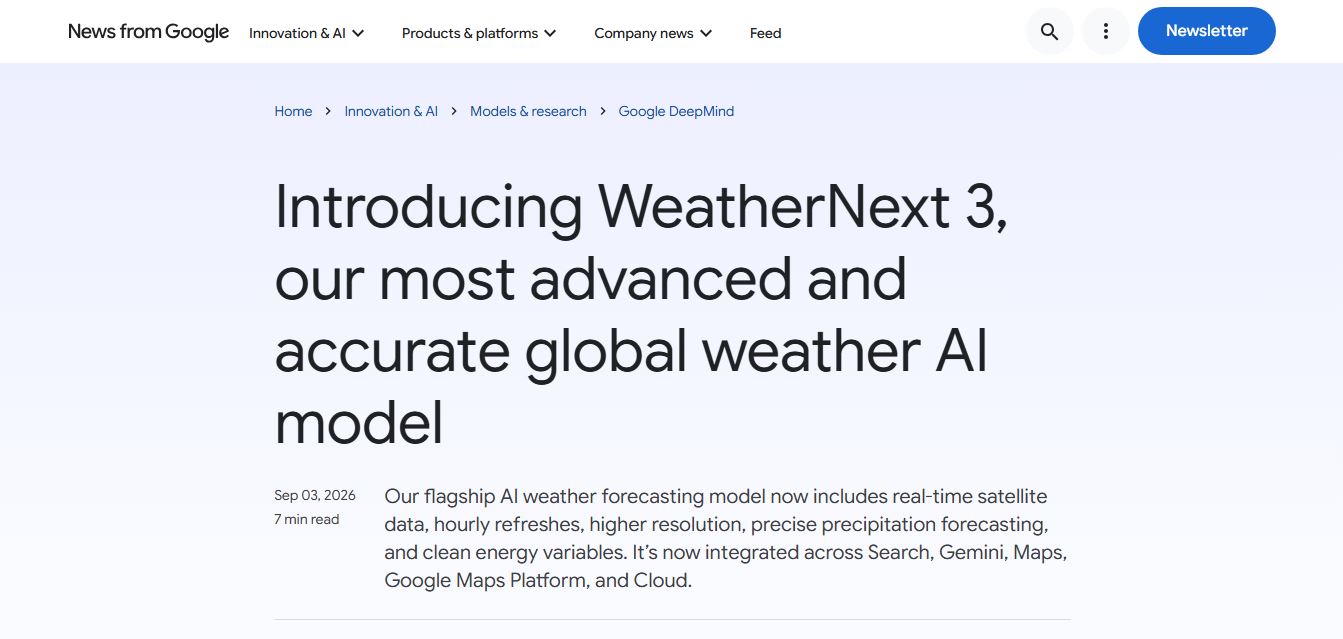
WeatherNext 3 is Google DeepMind’s latest AI weather forecasting model designed to deliver faster, higher-resolution, and more accurate global forecasts. It uses real-time satellite and observational data to update predictions hourly, capturing fast-changing conditions like rain and storms with much finer detail.
What is WeatherNext 3?
WeatherNext 3 is Google DeepMind’s latest AI weather forecasting model designed to deliver faster, higher-resolution, and more accurate global predictions. It improves on earlier versions by using real-time satellite and observational data to generate forecasts every hour instead of every few hours, with much finer spatial detail. The model can better predict events like rainfall, wind, and temperature—even in regions with limited data—while significantly boosting accuracy, especially for precipitation forecasts. WeatherNext 3 represents a major shift toward AI-driven weather systems that complement traditional physics-based models with faster insights and more granular predictions.
Engineered around the concept of “Rapid weather prediction at unprecedented resolution,” WeatherNext 3 breaks free from the ~6-hour data lag inherent in traditional Numerical Weather Prediction (NWP) analysis. By ingesting a continuous mosaic of live geostationary satellite observations and training against raw weather station measurements, the model refreshes forecasts every hour. It produces multi-resolution outputs reaching down to 5-kilometer (~0.05°) resolution for surface temperature and moisture, 10-kilometer resolution for solar radiation and precipitation, and 25-kilometer resolution for upper-air atmospheric fields. WeatherNext 3 provides up to a 15-day outlook via a 64-member probabilistic ensemble and is currently powering weather insights across Google Search, Gemini, Google Maps, Google Cloud, BigQuery, and Earth Engine.
- Research Organization: Google DeepMind & Google Research
- Architecture: Functional Generative Network (FGN) mesh transformer supporting multi-resolution regional outputs
- Cadence & Horizon: Hourly initialization cycles with global forecasts stretching up to 15 days (360 hours)
Use Cases:
- Tracking fast-developing storms, convective rain bands, and microclimate temperature shifts with 5km spatial precision
- Assisting renewable energy operators with specialized forecasting variables, including 100-meter turbine wind speeds and solar irradiance
- Improving agricultural planning, supply chain management, and disaster response preparedness globally
- Empowering regions across Latin America, Africa, and Asia-Pacific with high-resolution localized forecasting previously limited by high supercomputing costs
- Powering up-to-50% more accurate daily precipitation forecasts across consumer apps like Google Search and Google Maps
Technology:
- Direct ingestion of live global geostationary satellite mosaics enabling 24 daily re-initialization cycles
- Dedicated observational heads trained on raw weather station measurements to accurately capture local topography
- Advanced precipitation calibration trained using NASA IMERG retrievals and Google's global satellite-radar reanalysis
Target Users:
- Meteorologists, climate researchers, and atmospheric scientists evaluating AI-driven weather models
- Renewable energy grid operators and solar/wind farm developers planning power generation capacity
- Agriculture enterprises, logistics managers, and supply chain operators mitigating weather disruptions
- Everyday consumers checking weather conditions via Google Search, Maps, and Gemini applications
Acquisition: Proprietary meteorological AI model developed by Google DeepMind

What are the key features of WeatherNext 3?
WeatherNext 3's key platform features are
- Hourly Global Initialization: Refreshes forecasts 24 times a day by ingesting live geostationary satellite data, eliminating traditional 6-hour data lags.
- High-Resolution Multi-Tier Output: Generates ~5 km surface temperature/moisture grids, ~10 km gridded variables, and ~25 km upper-air atmospheric fields.
- Sharp Precipitation Modeling: Outperforms coarse models by avoiding smeared rain blobs, achieving up to a 60% improvement in Continuous Ranked Probability Score (CRPS) compared to IMERG.
- Renewable Energy Variables: Includes specialized tracking for 100-meter wind speed (turbine hub height), solar irradiance (GHI), and cloud cover fractions.
- 64-Member Probabilistic Ensemble: Runs comprehensive ensemble simulations to model uncertainty spreads over a 15-day forecast horizon.
- Station-Trained Calibration: Incorporates raw weather station measurements to account for microclimates, mountains, valleys, and coastlines.
- Native Ecosystem Integration: Automatically powers enhanced weather predictions across Google Search, Maps, Gemini, and Google Cloud (BigQuery and Earth Engine).
How much does WeatherNext 3 cost?
WeatherNext 3 model outputs and developer data pipelines are integrated into Google Cloud infrastructure and consumer services.
Consumer Access:
- $0 / Free Integration: Enhanced weather forecasts are integrated natively into Google Search, Google Maps, and Gemini at no additional cost to end-users
Developer & Enterprise Infrastructure:
- Google Cloud, BigQuery & Earth Engine: Gridded forecast data, ensemble Zarr arrays, and station observations are accessible via standard Google Cloud storage and analytics pricing
Disclaimer: Access to raw forecast datasets follows standard Google Cloud and BigQuery data egress/query rates. For developer implementation guides, visit developers.google.com/weathernext.
Who should use WeatherNext 3?
WeatherNext 3 is designed for meteorologists, developers, and energy operators, including
- Renewable Energy Managers: Estimating solar and wind power generation accurately using 100m wind and solar irradiance metrics
- Logistics & Supply Chain Planners: Anticipating heavy storms and precipitation changes days in advance
- Agricultural Enterprises: Optimizing planting and harvesting schedules using high-resolution localized temperature and moisture data
- App Developers & Researchers: Accessing granular meteorological datasets via BigQuery and Google Cloud Storage
What are the best alternatives to WeatherNext 3?
Some of the strongest WeatherNext 3 alternatives include
- Huawei Pangu-Weather
- Google GraphCast
- NVIDIA FourCastNet
- ECMWF AIFS
- Microsoft Aurora
- IBM GRAF
What are the pros and cons of WeatherNext 3?
What are the pros of WeatherNext 3?
- Hourly updates and satellite ingestion eliminate traditional 6-hour forecast data lags
- Sharper 5 km spatial resolution resolves intricate local topography and prevents over-smoothed thermal maps
- Significant accuracy gains in precipitation forecasting compared to conventional models
- Dedicated renewable energy metrics, including 100-meter wind speeds and solar irradiance
- Seamlessly integrated into global Google consumer products and enterprise cloud infrastructure
What are the cons of WeatherNext 3?
- Accessing full 64-member ensemble data streams requires robust cloud data infrastructure (BigQuery/GCS)
- Specialized meteorological data processing requires technical familiarity with Zarr arrays and geospatial tools
- Experimental forecasts are intended for operational planning rather than official government warnings
Why should you choose WeatherNext 3?
Traditional numerical weather prediction models rely on heavy physics simulations that suffer from data lag and coarse regional resolution. Previous AI weather models inherited these delays by depending on pre-processed reanalysis grids. WeatherNext 3 bypasses these bottlenecks entirely.
- Receive fresh global forecasts every hour driven directly by live geostationary satellite mosaics
- Leverage 5 km resolution mapping that captures local microclimates and sharp storm boundaries
- Benefit from specialized variables engineered for wind and solar energy planning
- Access reliable weather insights built right into Google Search, Maps, and enterprise cloud pipelines
How does WeatherNext 3 compare to competitors?
The main difference between WeatherNext 3, GraphCast, Pangu-Weather, and ECMWF AIFS is how often they take in real-time satellite data and how they style their multi-resolution output. While legacy AI weather models typically initialize every six hours using delayed numerical weather prediction analysis and output coarse 25 km blocks, WeatherNext 3 ingests live geostationary satellite observations hourly, runs station-trained calibration, and emits sharp 5 km local predictions alongside dedicated renewable energy metrics.
| Feature / Platform | WeatherNext 3 | GraphCast (Google) | Pangu-Weather (Huawei) | ECMWF AIFS |
|---|---|---|---|---|
| Core Focus | Hourly Satellite-Injected Global Weather AI | Medium-Range Global Weather Prediction | Fast 3D Global Atmospheric Forecasting | Data-Driven Operational Numerical Weather AI |
| Update Cadence | Hourly (24 runs/day via live satellites) | 6-Hourly cycles | 6-Hourly cycles | Operational 6-Hourly cycles |
| Spatial Resolution | ~5 km (0.05°) surface resolution | ~25 km resolution | ~25 km resolution | ~28 km resolution |
| Renewable Energy Variables | Yes (100m wind speed & solar irradiance) | Standard meteorological fields | Standard meteorological fields | Standard meteorological fields |
| Access & Pricing | Integrated in Google Search/Maps & GCS | Open research weights | Published benchmarks | Institutional meteorological access |
| Best For | High-resolution hourly local forecasting & renewables | Fast 10-day global synoptic forecasting | Rapid extreme weather tracking | Operational meteorological agency comparison |
How do we rate WeatherNext 3?
| Parameter | Rating (out of 5) |
|---|---|
| Forecast Accuracy & Resolution (5km Sharpness) | 5.0 |
| Real-Time Satellite Ingestion & Hourly Cadence | 5.0 |
| Precipitation & Renewable Energy Variables | 4.9 |
| Ecosystem Integration (Search, Maps & Cloud) | 4.9 |
| Value for Money | 4.8 |
| Overall Score | 4.92 |
What is our review and verdict on WeatherNext 3?
WeatherNext 3 represents a significant leap forward in meteorological artificial intelligence. By bypassing the 6-hour data lags of traditional numerical models and directly ingesting live geostationary satellite mosaics, Google DeepMind has built a weather model that delivers 5 km resolution forecasts every single hour. By including dedicated clean-energy variables like 100-meter wind speed and solar irradiance, it becomes especially valuable for modern grid operators and agricultural planners, and its seamless integration into Google Search and Maps provides high-precision weather insights to billions of users worldwide.
Conclusion
WeatherNext 3 transforms global weather prediction from coarse, delayed simulations into sharp, real-time intelligence. With its hourly satellite intake, multi-tier spatial resolution, improved precipitation accuracy, and robust renewable energy metrics, WeatherNext 3 sets a new benchmark for operational meteorological AI.
FAQ
What is WeatherNext 3 and why is it important?
WeatherNext 3 is the latest AI-powered weather forecasting model developed by Google DeepMind and Google Research, designed to deliver faster, more accurate, and higher-resolution global weather predictions. It is important because it improves how we forecast weather by combining machine learning with real-time observational data, helping individuals, businesses, and governments make better decisions in areas like travel, agriculture, and disaster preparedness.
How is WeatherNext 3 different from traditional weather models?
Traditional weather forecasting relies on physics-based simulations run on supercomputers, which can be slow and computationally expensive. WeatherNext 3 uses AI to learn patterns from historical and real-time data, allowing it to generate forecasts much faster while still maintaining high accuracy, especially for complex and rapidly changing weather conditions.
What improvements does WeatherNext 3 bring over previous versions?
WeatherNext 3 significantly improves both resolution and update frequency compared to earlier models. It can generate forecasts every hour instead of every few hours and provides much finer spatial detail, enabling more precise predictions at a local level. It also incorporates richer datasets, including satellite observations, which enhances its ability to predict rainfall, storms, and other weather events.
How accurate is WeatherNext 3 compared to older systems?
WeatherNext 3 achieves higher accuracy than previous AI and traditional models, particularly in predicting precipitation and extreme weather events. Reports suggest that rainfall forecasts can be up to 50% more accurate at least a day in advance, which is a major improvement for planning and risk management.
Can WeatherNext 3 make real-time or frequent updates?
Yes, one of the key strengths of WeatherNext 3 is its ability to update forecasts hourly using real-time observational data such as satellite inputs. This allows it to track rapidly changing weather systems more effectively than older models that update less frequently.
Where is WeatherNext 3 being used today?
WeatherNext 3 is integrated into Google products like Search, Maps, and Gemini, making its forecasts accessible to billions of users worldwide. It is also used in collaboration with weather agencies and industries such as energy and logistics to improve planning and operational efficiency.
Who should use WeatherNext 3 and what are its use cases?
WeatherNext 3 is useful for a wide range of users, including individuals checking daily forecasts, businesses optimizing operations, and governments preparing for extreme weather events. It is particularly valuable in sectors like renewable energy, agriculture, transportation, and disaster management, where accurate and timely weather data is critical.
User Reviews
No reviews yet for Google WeatherNext 3.
Featured Tools
Featured AI tools from TechShark
Melody Genie
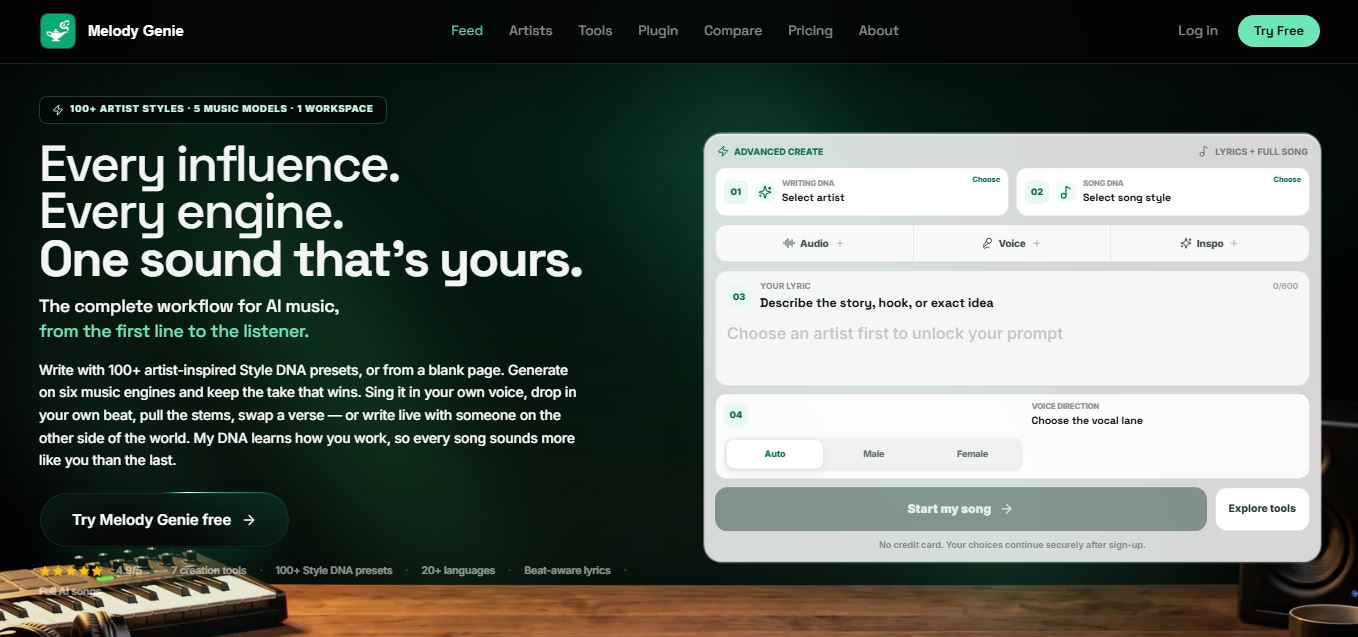
MelodyGenie is an AI-powered music generator that creates original songs from simple text prompts. Users can choose styles, moods, and genres, then instantly generate melodies and full tracks, making it easy for creators, marketers, and hobbyists to produce custom music without musical expertise.
Freemium
Kimi AI
Kimi AI is an advanced AI assistant developed by Moonshot AI that helps you chat, research, write, code, and automate tasks in one place. It supports web search, file analysis, and multimodal inputs, and can even run autonomous “agent” workflows to complete complex tasks end-to-end.
Freemium

Fashion Diffusion AI
Fashion Diffusion is an AI-powered fashion design platform that helps brands and designers create clothing designs, virtual try-ons, AI models, product photos, and marketing visuals faster and cost-effectively.
Paid
Veo 4
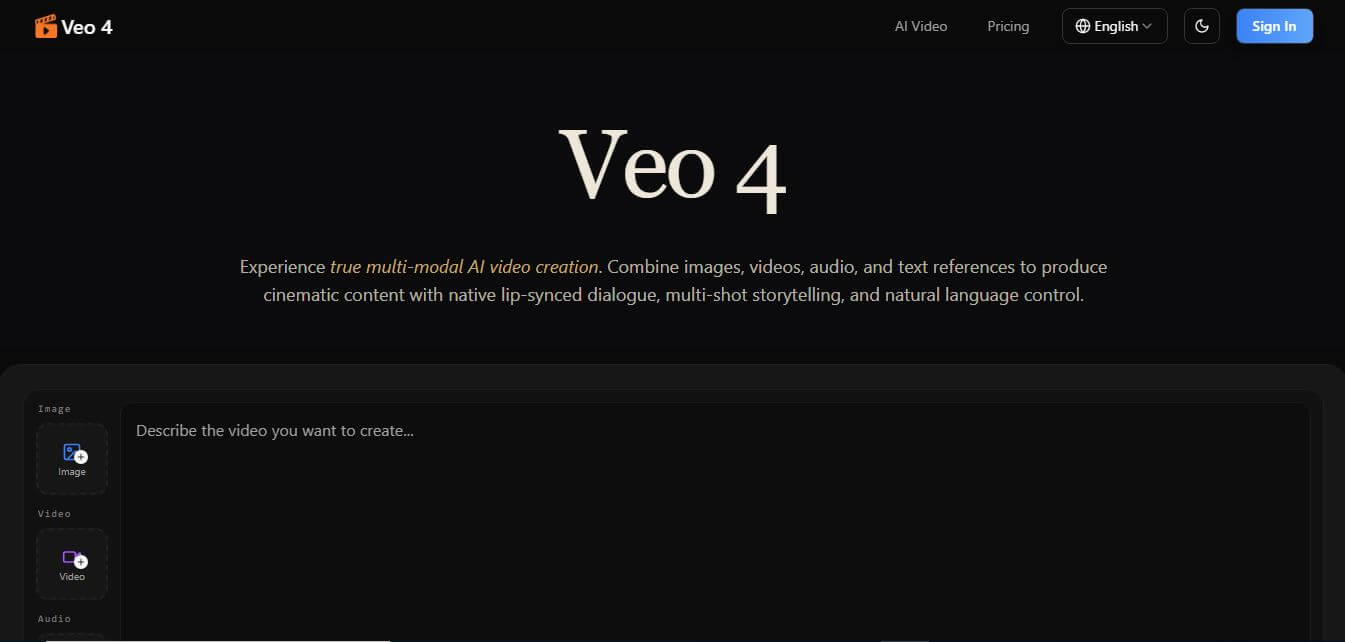
Veo 4 AI is an AI video creation platform that generates dramatic videos from text, images, audio, and video prompts using realistic motion and synchronized sound.
Paid
Alternatives
Alternatives to Google WeatherNext 3
The best WeatherNext 3 alternatives include Google GraphCast, Huawei Pangu-Weather, NVIDIA FourCastNet, ECMWF AIFS, Microsoft Aurora, and IBM GRAF. These AI and machine learning weather forecasting systems provide data-driven atmospheric predictions across global grids. While WeatherNext 3 distinguishes itself through direct hourly ingestion of live geostationary satellite mosaics, 5 km high-resolution surface mapping, station-trained local calibration, and specialized renewable energy metrics for wind and solar operators, alternatives like GraphCast and Pangu-Weather operate primarily on 6-hourly numerical prediction reanalysis cycles.
 4.7
4.7Quinvio AI
Productivity
Quinvio AI helps you turn ideas, scripts, blogs, or web content into polished video presentations. You can refine messaging, choose branded templates, add AI avatars and voiceovers, and produce shareable visual content without traditional recording or editing workflows. It is especially useful for marketers, educators, trainers, creators, and business teams.
 4.9
4.9HubSpot
Marketing
HubSpot is an AI-powered customer platform that helps businesses manage marketing, sales, customer service, and content in one place. It offers a free CRM, automation tools, analytics, and AI features, enabling teams to attract leads, close deals, and deliver better customer experiences at scale.
 4.9
4.9TestSprite
Testing
TestSprite is an AI-powered software testing agent that helps developers automatically generate, run, and fix end-to-end tests for web apps. It simulates real user behavior, detects issues, and provides root-cause insights with suggested fixes, enabling faster releases and more reliable software without manual QA effort.
 4.8
4.8Microsoft Copilot
Productivity
Microsoft Copilot is an AI-powered assistant that helps users write, research, analyze data, and automate tasks across apps like Word, Excel, Outlook, and Teams. It combines large language models with real-time data to generate content, answer questions, and improve productivity across personal and professional workflows.
 4.9
4.9Casablanca AI
Productivity
Casablanca AI is an AI-powered virtual camera that corrects your gaze in real time during video calls, making it appear like you’re maintaining natural eye contact. It works with tools like Zoom and Teams, improving trust, engagement, and communication without needing extra hardware.
 4.9
4.9Granola
Productivity
Granola is an AI-powered meeting assistant that helps you capture, organize, and act on conversations without losing focus. It listens to meetings, turns notes into structured summaries, and generates action items and follow-ups automatically—so you stay present while everything important is documented and ready to use.
 4.8
4.8AI Perfect Assistant
Productivity
AI Perfect Assistant brings AI assistance directly into everyday work applications. It helps users write emails, improve documents, summarize content, translate text, create presentations, generate SEO content, explain Excel formulas, and handle repetitive tasks through 60+ specialized tools and multiple integrations for everyday professional and business workflows with less effort.
 4.9
4.9Kroolo
Project Management
Kroolo is an AI-powered productivity and project management platform that helps teams plan tasks, track progress, and collaborate in one place. It combines project tracking, document management, and AI assistance to streamline workflows, automate routine work, and improve team efficiency across projects.
 4.8
4.8Sunsama
Productivity
Sunsama is a digital daily planner and time-blocking application designed to cultivate intentional work habits, consolidate tasks across third-party tools, and facilitate guided morning planning and evening reflection rituals.