Parler-TTS
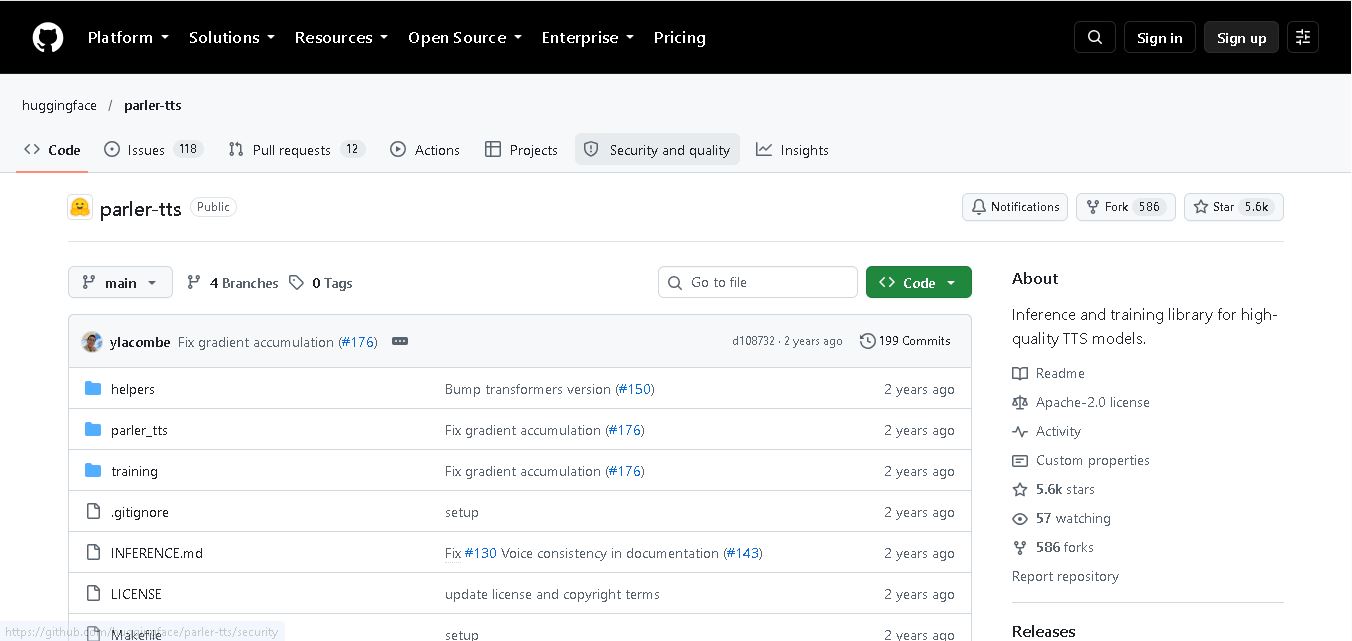
Parler-TTS is an open-source text-to-speech tool that transforms written content into natural-sounding audio. It lets developers describe voice characteristics using natural language, including pitch, speaking speed, and recording quality. With publicly available model weights, training resources, and customizable checkpoints, it supports experimentation, research, and tailored speech-generation applications across projects.
What is Parler-TTS?
Parler-TTS is an open-source text-to-speech system that converts written text into natural-sounding speech using descriptions of a desired voice. Developed as a community-focused research project, it allows users to control characteristics such as speaking speed, pitch, voice style, and background noise through natural-language prompts. Its publicly available models, training code, and datasets help developers, researchers, and content creators build customized speech-generation applications without depending entirely on proprietary voice-generation services.
Parler-TTS is an open-source text-to-speech project available on GitHub under the Apache 2.0 license. Its published model family includes Mini v1, with approximately 880 million parameters, and Large v1, with around 2.2 billion parameters. Both models were trained using approximately 45,000 hours of audiobook data. The project supports natural-language voice descriptions, speaker selection, and model fine-tuning. It provides no mandatory subscription fee for accessing its open-source code, although computing resources, hosting, and implementation may involve additional costs.
- Developer / Organization: Hugging Face & Open-Source Contributors
- License: Apache 2.0 License (100% Open-Source GitHub Repository)
- Core Focus: Open-Source Text-to-Speech (TTS), Natural Language Prompt Control & Controllable Prosody
Use Cases:
- Generating customized audio voiceovers for video games, podcasts, and digital media using text prompts to specify tone and gender
- Building self-hosted, privacy-focused voice assistant applications with low-latency local inference
- Fine-tuning specialized speech models on custom datasets for domain-specific applications or multi-speaker voice synthesis
- Simulating various acoustic environments (e.g., reverberant rooms, distant microphones, quiet studios) for audio dataset generation
Technology:
- Decoupled causal transformer architecture predicting discrete audio tokens from text and descriptive prompt embeddings
- Integrated with DAC (Descript Audio Codec) neural audio tokenizers for high-fidelity 44.1kHz wave reconstruction
- Fully compatible with Hugging Face Transformers, Accelerate, and Flash Attention 2 libraries for optimized inference and training
Target Users:
- AI researchers, ML engineers, and audio scientists exploring controllable speech synthesis and generative voice models
- Open-source software developers building privacy-first or edge-deployed speech tools without commercial API costs
- Game developers and media creators seeking customizable voice characters generated via simple text prompts
- Content creators using writing tools to draft technical documentation, research scripts, and open-source tutorials
Corporate / Organization Entity: Hugging Face, Inc. (github.com/huggingface)

Key features of Parler-TTS
Parler-TTS's key features are
- Natural Language Prompt Control: Describe speaker traits, gender, accent, tone, pacing, pitch, and background acoustics directly in simple English text prompts.
- Open-Source & Permissive License: Full source code, training code, dataset preparation scripts, and model weights hosted under the Apache 2.0 license on GitHub.
- Hugging Face Ecosystem Integration: Native integration with `transformers`, `diffusers`, and `datasets` libraries for streamlined python workflows.
- Multiple Model Scale Checkpoints: Offers lightweight model sizes (e.g., Mini, Large) optimized for both resource-constrained devices and high-fidelity generation.
- Custom Training & Fine-Tuning Codebase: Includes complete recipes to fine-tune the model on domain-specific voices or custom languages.
- Acoustic Environment Control: Simulates audio attributes such as background noise, room resonance, reverb, and recording quality through prompt description.
- Streaming Inference Support: Enables real-time sub-second audio chunk streaming for low-latency conversational AI applications.
Parler-TTS Pricing
Parler-TTS is a 100% free, open-source project released under the Apache 2.0 License.
Open-Source Access:
- $0 / Completely free and open-source
- Full source code, pretrained model checkpoints, and training scripts available via GitHub and Hugging Face Hub for personal, academic, and commercial usage
Disclaimer: Running local inference or model fine-tuning with Parler-TTS requires GPU hardware compute resources (e.g., NVIDIA GPUs with CUDA support). For code and installation details, visit github.com/huggingface/parler-tts.
Who is using Parler-TTS?
Parler-TTS is designed for AI developers, machine learning researchers, and open-source builders, including
- Machine Learning Engineers & Researchers: Experimenting with prompt-driven speech prosody and generative audio architectures
- Indie Game Developers: Generating dynamic multi-speaker voice lines and ambient voice characters using text prompts
- Open-Source Developers: Deploying self-hosted, offline text-to-speech engines inside private applications
- Content Creators: Using writing tools to draft technical documentation, research scripts, and open-source tutorials
Best Parler-TTS Alternatives
Some of the strongest Parler-TTS alternatives include
- Bark (Suno AI)
- XTTS v2 (Coqui)
- IMS Toucan
- Piper TTS
- Tortoise TTS
- CosyVoice (Alibaba)
Pros and Cons of Parler-TTS
Pros
- Completely open-source and free under the permissive Apache 2.0 license for commercial and personal projects
- Unique natural language prompt-based control over speaker characteristics, tone, pitch, and acoustic background
- Native integration with the Hugging Face Transformers ecosystem for rapid deployment in Python pipelines
- Includes full training and fine-tuning scripts to adapt the model to custom voice datasets
- Lightweight architecture options (such as Parler-TTS Mini) support fast local GPU inference
Cons
- Requires technical familiarity with Python, PyTorch, and GPU hardware management
- Requires prompt tuning and trial-and-error text descriptions to achieve exact desired vocal inflections
- Does not offer an out-of-the-box managed cloud web dashboard for non-technical users
Why Choose Parler-TTS?
Parler-TTS is a premier choice for developers and AI researchers seeking a fully open, controllable text-to-speech model that can be steered via simple text descriptions.
- 100% free and open-source under Apache 2.0 with zero commercial license restrictions or API costs
- Allows precise control over speaker gender, tone, pitch, and room acoustics using natural language prompts
- Backed by Hugging Face's active open-source AI community and ongoing framework updates
- Supports self-hosted local execution for strict data privacy and air-gapped environments
- Provides complete codebase access for custom fine-tuning and academic research
Parler-TTS vs. Competitors
The main difference between Parler-TTS, Bark, XTTS v2, and Piper TTS is that Parler-TTS specializes in natural language prompt-guided speech control backed by Hugging Face's open-source architecture, whereas Bark generates expressive non-speech sounds and music tokens, XTTS v2 focuses on zero-shot voice cloning from audio samples, and Piper TTS emphasizes lightweight CPU execution for smart home microcontrollers.
| Feature / Tool | Parler-TTS (Hugging Face) | Bark (Suno AI) | XTTS v2 (Coqui) | Piper TTS |
|---|---|---|---|---|
| Core Focus | Natural Language Prompt-Controlled Open TTS | Transformer-Based Generative Audio & Sound Effects | Zero-Shot Voice Cloning & Cross-Lingual TTS | Fast Local CPU Speech Synthesis |
| Controllability Method | Text Prompt Descriptions (Gender, Tone, Reverb) | Text Prompts & Speaker Preset Tags | Reference Audio Sample (3-6 secs) | Fixed Voice Models & Speaker IDs |
| License | Apache 2.0 (100% Free Open-Source) | MIT License | CPML / Open-Source Options | MIT License |
| Hugging Face Integration | Native (`transformers` library) | Supported via `transformers` | Standalone Library | Standalone C++ / Python Engine |
| Pricing | $0 / Open-Source | $0 / Open-Source | $0 / Open-Source | $0 / Open-Source |
| Best For | Developers wanting prompt-driven voice customization & HF stack integration | Experimental generative audio with laugh/hesitation effects | Fast zero-shot voice cloning from audio files | Low-power embedded devices (Raspberry Pi, Home Assistant) |
How do we rate Parler-TTS?
| Parameter | Rating (out of 5) |
|---|---|
| Prompt Controllability & Prosody Tuning | 4.9 |
| Open-Source Codebase & License Freedom (Apache 2.0) | 5.0 |
| Hugging Face Ecosystem Integration | 5.0 |
| Audio Quality & Naturalness | 4.7 |
| Value for Money | 5.0 |
| Overall Score | 4.92 |
Parler-TTS Review
Parler-TTS represents a significant step forward in open-source text-to-speech technology. Developed by Hugging Face, its stand-out feature is its ability to shape speech parameters—such as gender, accent, tone, pacing, and room acoustics—using plain English text prompts. Distributed under the permissive Apache 2.0 license with full integration into the Hugging Face `transformers` library, Parler-TTS provides AI developers and researchers with a powerful, customizable, and cost-free foundation for building open speech applications in 2026.
Conclusion
Parler-TTS is a useful option for developers and creators who want greater control over AI-generated speech without relying exclusively on paid, proprietary services. Its open-source code, customizable voice descriptions, and Mini and Large checkpoints make it suitable for experimentation and application development. However, hardware requirements, language coverage, and output consistency deserve careful evaluation. For your next project, start with the Mini model, test representative scripts, and assess audio quality before choosing a production deployment strategy.
FAQ
What can you use Parler-TTS for?
You can use Parler-TTS to convert articles, scripts, educational materials, and other written content into spoken audio. For example, developers can integrate it into reading applications, while creators can generate narration for videos or podcasts. Its voice-description controls help you experiment with different speaking styles and audio characteristics for specific projects.
Is Parler-TTS free to use?
Yes, Parler-TTS provides publicly available code and model weights under the Apache 2.0 license. You can download the repository, experiment with its models, and develop applications without paying a mandatory subscription fee to access the code. However, GPU computing, cloud hosting, storage, and deployment may introduce additional expenses depending on your setup.
How does Parler-TTS generate realistic speech?
Parler-TTS processes written text alongside a natural-language description of the desired voice. You can describe characteristics such as pitch, speaking speed, expressiveness, and recording quality. The model uses these inputs to generate speech that reflects the instructions. Results can vary depending on your prompts, selected checkpoint, hardware, and text.
Can you customize voices with Parler-TTS?
Yes, you can customize generated speech by describing the voice you want in ordinary language. For example, you might request a calm female voice with a moderate pace and clear recording quality. Certain published checkpoints also support named speakers. Your results depend on the model's training, supported characteristics, and the clarity of your description.
Does Parler-TTS support multiple languages?
Parler-TTS's published Mini v1 and Large v1 checkpoints are primarily designed for English speech generation. The project's documentation identifies multilingual training as an area for further exploration, so you should not assume comprehensive multilingual support. If your application requires another language, verify the selected checkpoint's capabilities and test pronunciation, accent, and speech quality before deployment.
What are the system requirements for Parler-TTS?
Parler-TTS requires a compatible Python environment and supporting machine-learning libraries, including PyTorch and Transformers. You can run inference on a CPU or supported GPU, but performance and memory requirements vary considerably. The Mini checkpoint is generally a more practical starting point than Large. Check the official installation and inference guides before choosing hardware.
User Reviews
No reviews yet for Parler-TTS.
Featured Tools
Featured AI tools from TechShark
Melody Genie
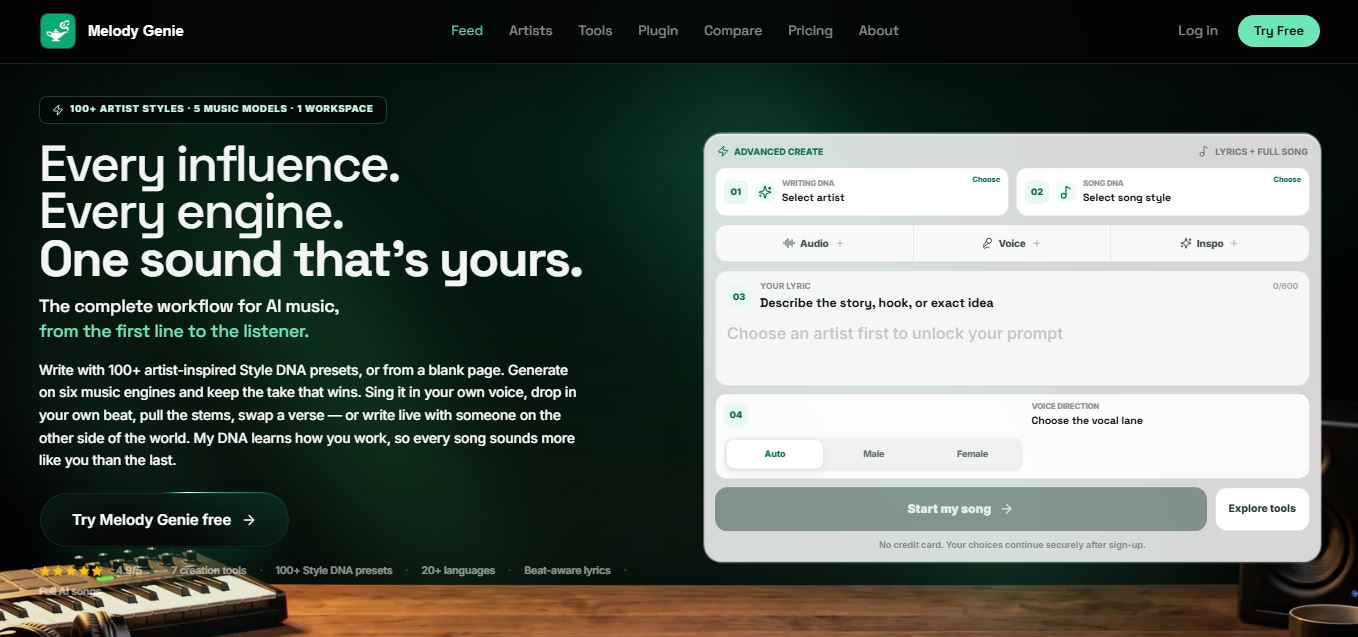
MelodyGenie is an AI-powered music generator that creates original songs from simple text prompts. Users can choose styles, moods, and genres, then instantly generate melodies and full tracks, making it easy for creators, marketers, and hobbyists to produce custom music without musical expertise.
Freemium
Kimi AI
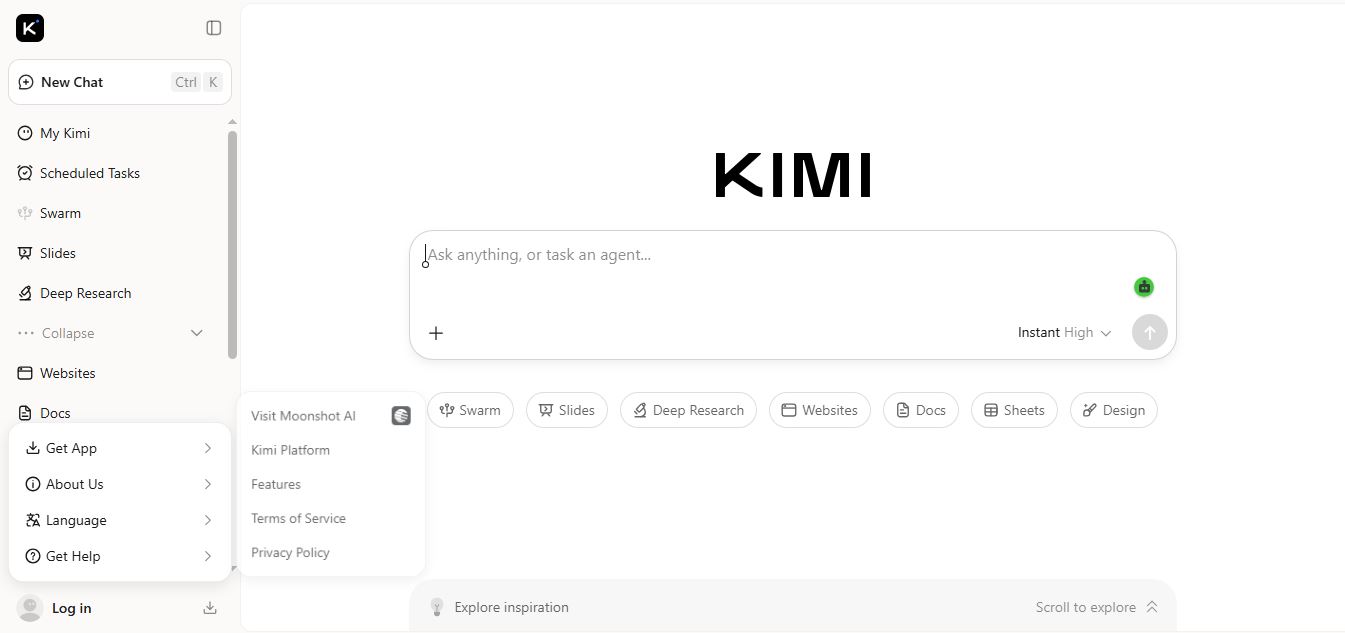
Kimi AI is an advanced AI assistant developed by Moonshot AI that helps you chat, research, write, code, and automate tasks in one place. It supports web search, file analysis, and multimodal inputs, and can even run autonomous “agent” workflows to complete complex tasks end-to-end.
Freemium
Fashion Diffusion AI
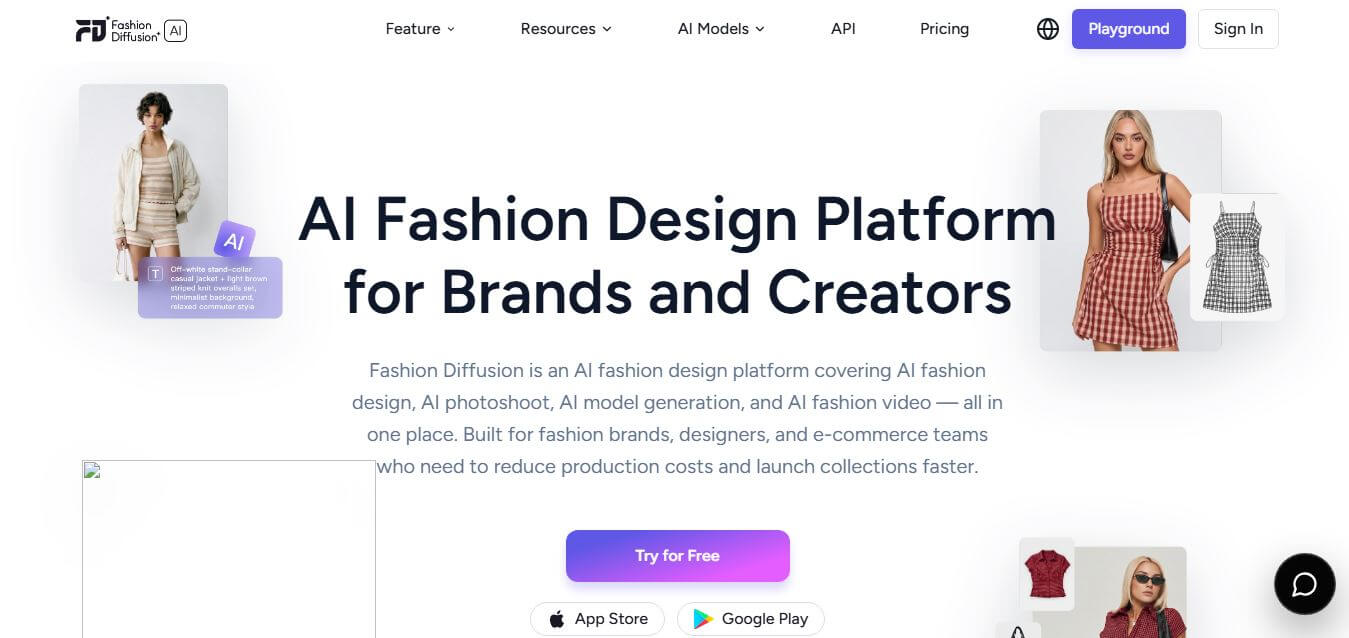
Fashion Diffusion is an AI-powered fashion design platform that helps brands and designers create clothing designs, virtual try-ons, AI models, product photos, and marketing visuals faster and cost-effectively.
Paid
Veo 4
Veo 4 AI is an AI video creation platform that generates dramatic videos from text, images, audio, and video prompts using realistic motion and synchronized sound.
Paid
Alternatives
Alternatives to Parler-TTS
The best Parler-TTS alternatives include Bark (Suno AI), XTTS v2 (Coqui), IMS Toucan, Piper TTS, Tortoise TTS, and CosyVoice (Alibaba). These open-source toolkits provide text-to-speech synthesis, voice cloning, and audio generation. While Parler-TTS excels at controlling speech attributes using natural language prompts inside the Hugging Face ecosystem, alternatives like XTTS v2 focus on fast zero-shot voice cloning from audio files, and Piper TTS targets fast CPU-optimized local speech.
 4.9
4.9KittenTTS Web
Text-to-Speech
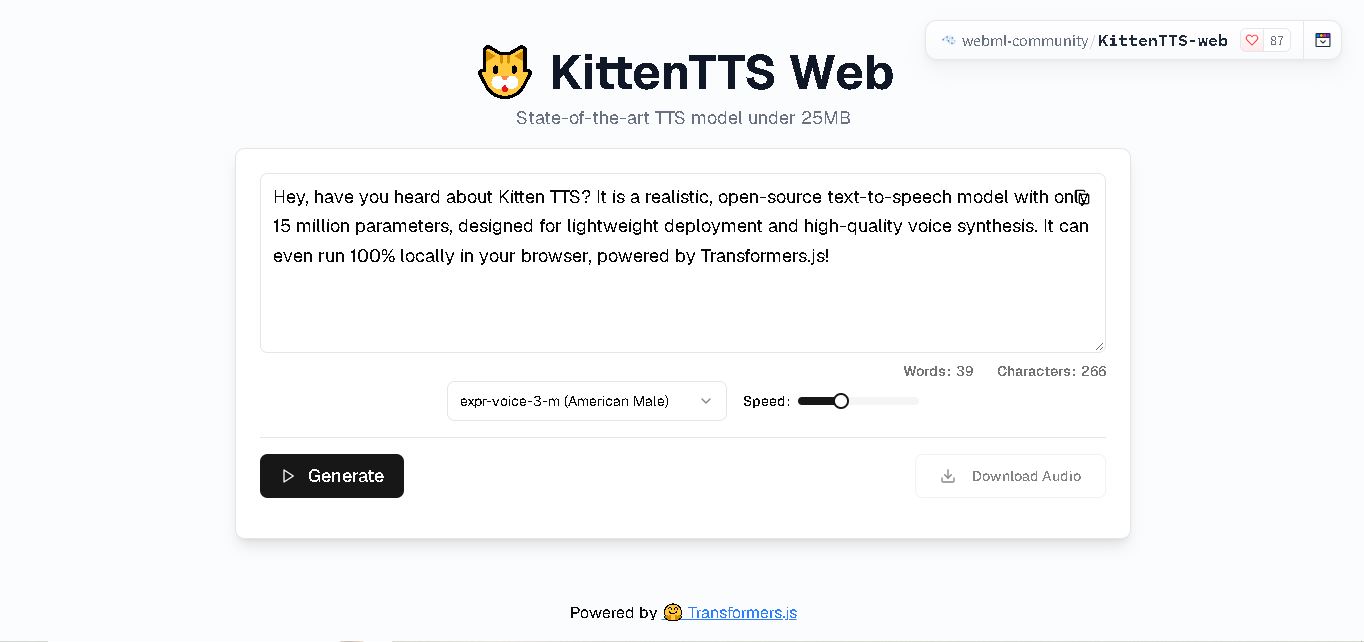
KittenTTS Web is a lightweight text-to-speech demo hosted on Hugging Face Spaces. It helps users explore how written text can be transformed into spoken audio using neural voice synthesis. The project is particularly relevant to developers, content creators, and accessibility-focused users interested in experimenting with compact speech generation technology directly through a web browser.
 4.9
4.9IMS Toucan
Text-to-Speech
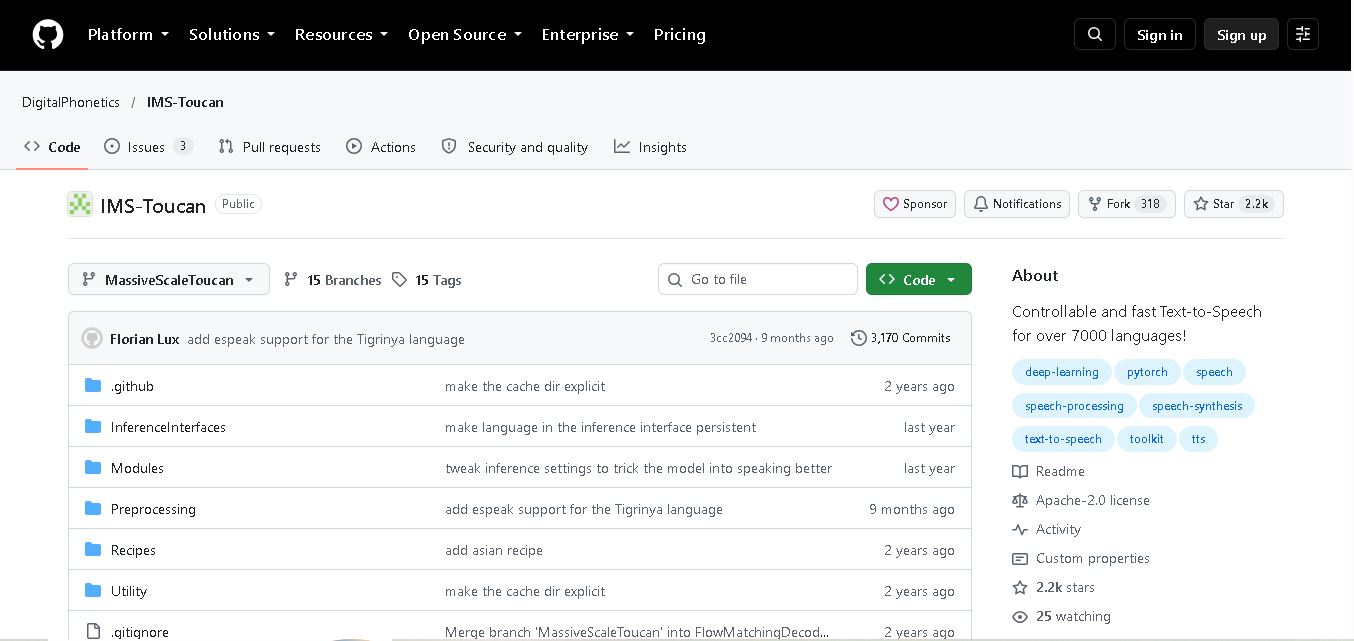
IMS Toucan is an open-source text-to-speech toolkit from the University of Stuttgart designed for multilingual speech generation. It converts text into audio and provides tools for inference, voice and prosody control, and model training. Supporting more than 7,000 languages, it serves developers and researchers exploring technology across linguistic contexts.
 4.6
4.6Speechelo
Text-to-Speech
Speechelo is a text-to-speech tool designed to help creators turn written scripts into voiceovers. It offers different voices, languages, tones, and audio adjustments for creating narration. Video creators, educators, marketers, and content teams can use it to produce audio for tutorials, presentations, promotional videos, and other digital content projects.
 4.7
4.7Leelo AI
Text-to-Speech
Leelo AI helps you turn written content into natural-sounding speech without recording your own voice. You can choose from 800+ voices across 142 languages and accents, adjust available voice settings, generate audio, store files in the cloud, export recordings, and use generated speech commercially for different content and communication needs.
 4.7
4.7MyVocal AI
Text-to-Speech
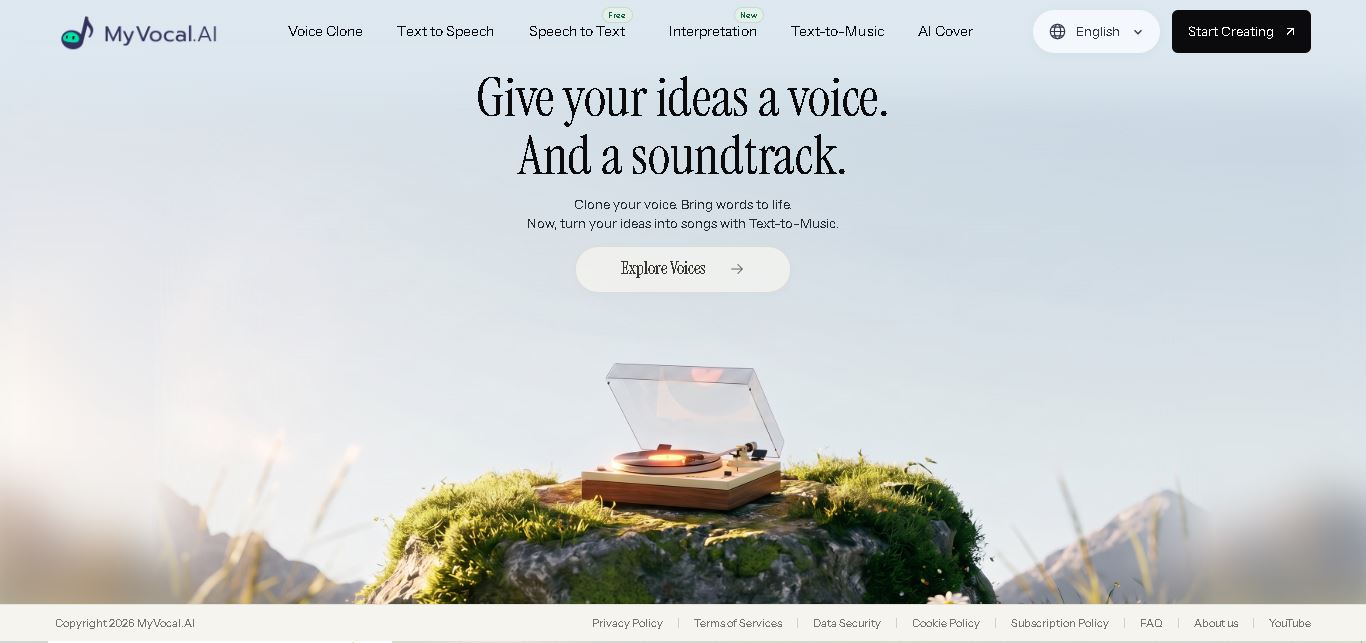
MyVocal AI helps creators turn written content and voice recordings into natural-sounding audio. Users can clone voices, generate multilingual speech, create AI song covers, transcribe recordings, and produce music from text. Its combination of voice customization, emotion control, and multilingual generation makes it useful for content, narration, music, products, and interactive experiences.
 4.8
4.8Article Audio
Text-to-Speech
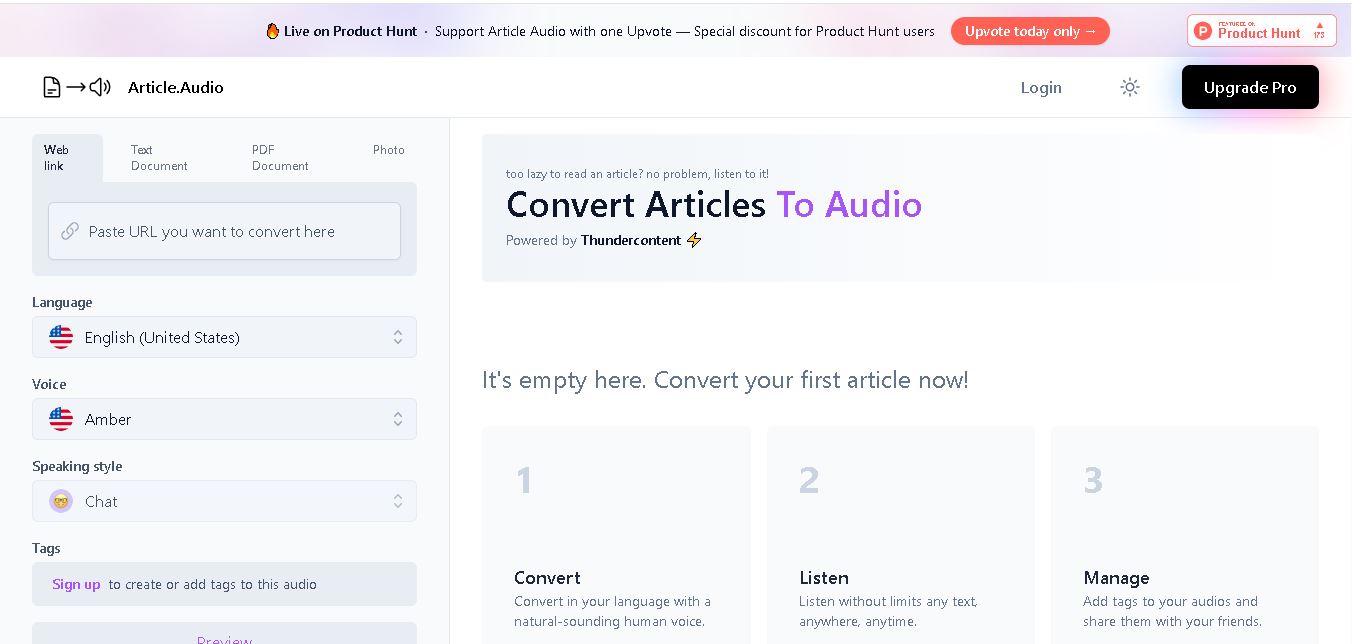
Article.Audio turns online articles into listenable audio from a simple web link. You can choose a language, voice, and speaking style to create a more personalized listening experience. It is useful for readers who want to consume articles while commuting, exercising, working, or handling other activities.
 4.8
4.8Google Cloud Speech-to-Text
Text-to-Speech
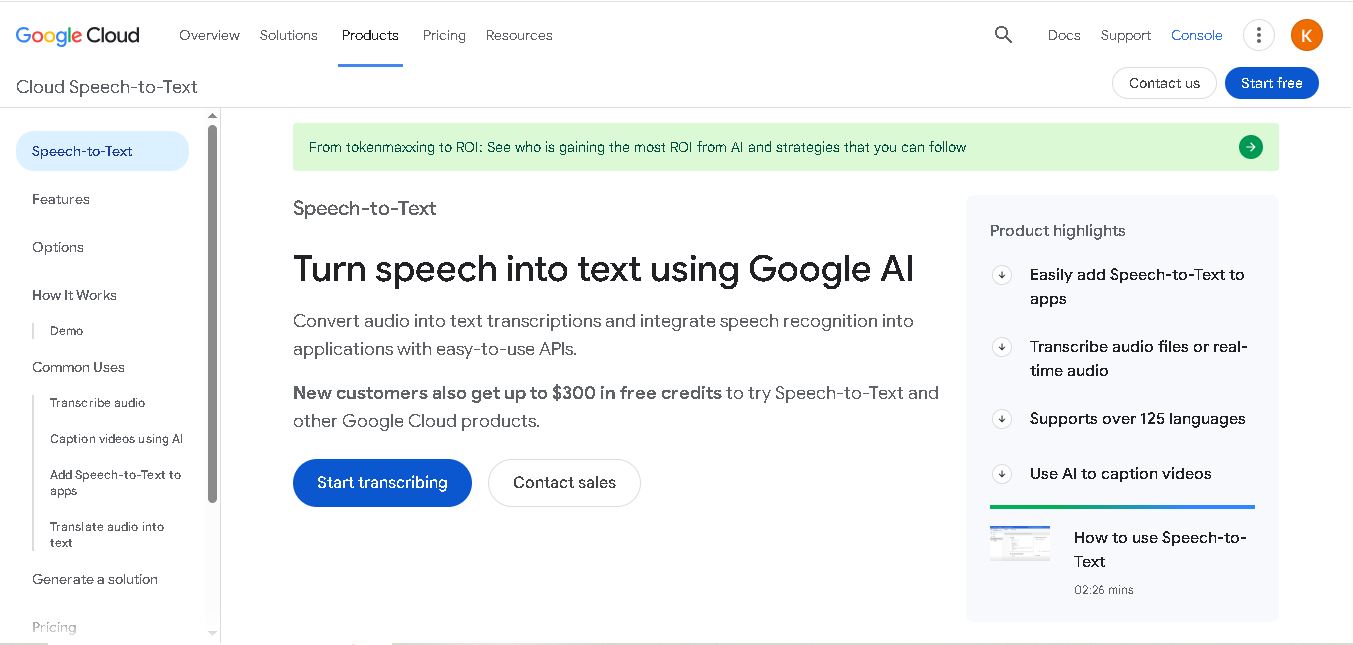
Google Cloud Speech-to-Text helps developers turn spoken audio into text for applications, captions, voice commands, meetings, calls, and searchable content. With streaming recognition, multilingual support, model adaptation, speaker diarization, and multiple transcription methods, it provides speech recognition capabilities for applications and enterprise workflows. It fits teams seeking integrated transcription workflows.
 4.8
4.8Apple Books
Text-to-Speech
Apple Books is a digital bookstore and reading app for ebooks and audiobooks. It combines millions of titles, personalized recommendations, curated collections, reading goals, offline downloads, and cross-device synchronization. Users can purchase individual books without a monthly subscription and continue reading or listening across compatible Apple devices.
 4.8
4.8WellSaid Labs
Text-to-Speech
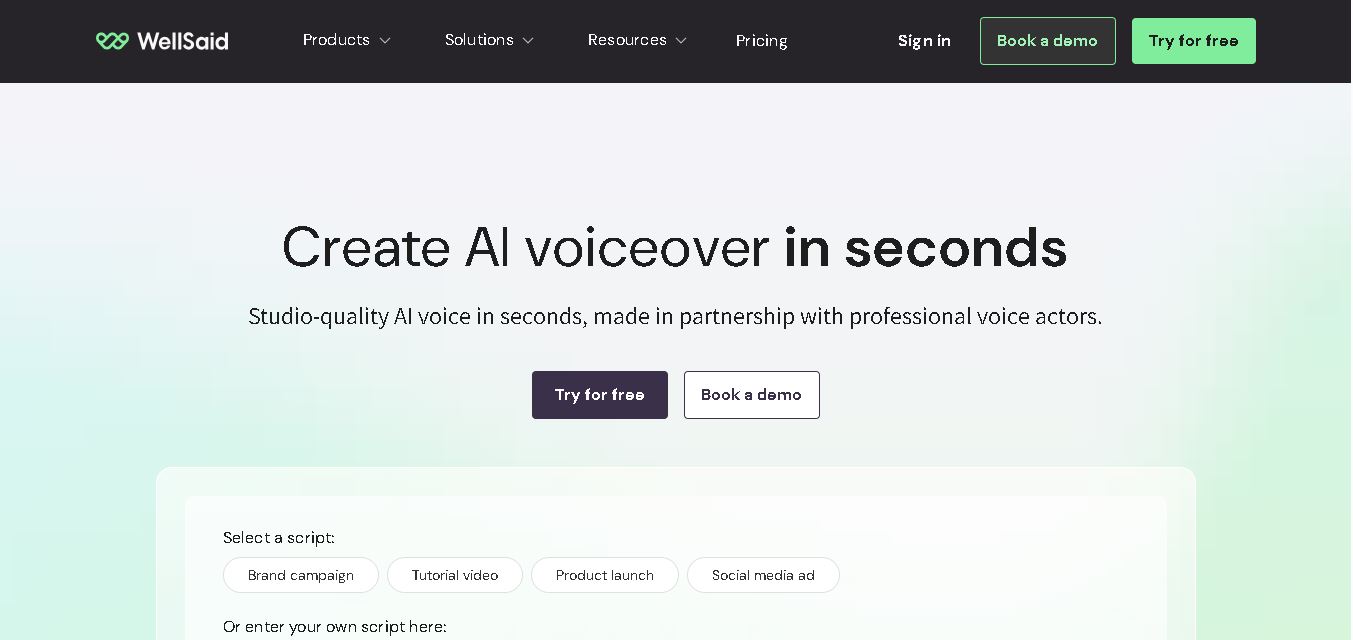
WellSaid Labs is a professional voice-generation platform for creating natural-sounding AI voiceovers from written scripts. It offers hundreds of voice options, multiple languages and accents, expressive controls, pronunciation customization, commercial usage rights on paid plans, and developer APIs. It is useful for e-learning, marketing, training, video production, podcasts, and business applications.