
F5
F5 is an enterprise multi-cloud application security, API protection, and load balancing platform that delivers advanced web application firewall (WAF) defense, bot mitigation, distributed cloud services, and high-performance traffic management across hybrid infrastructures.
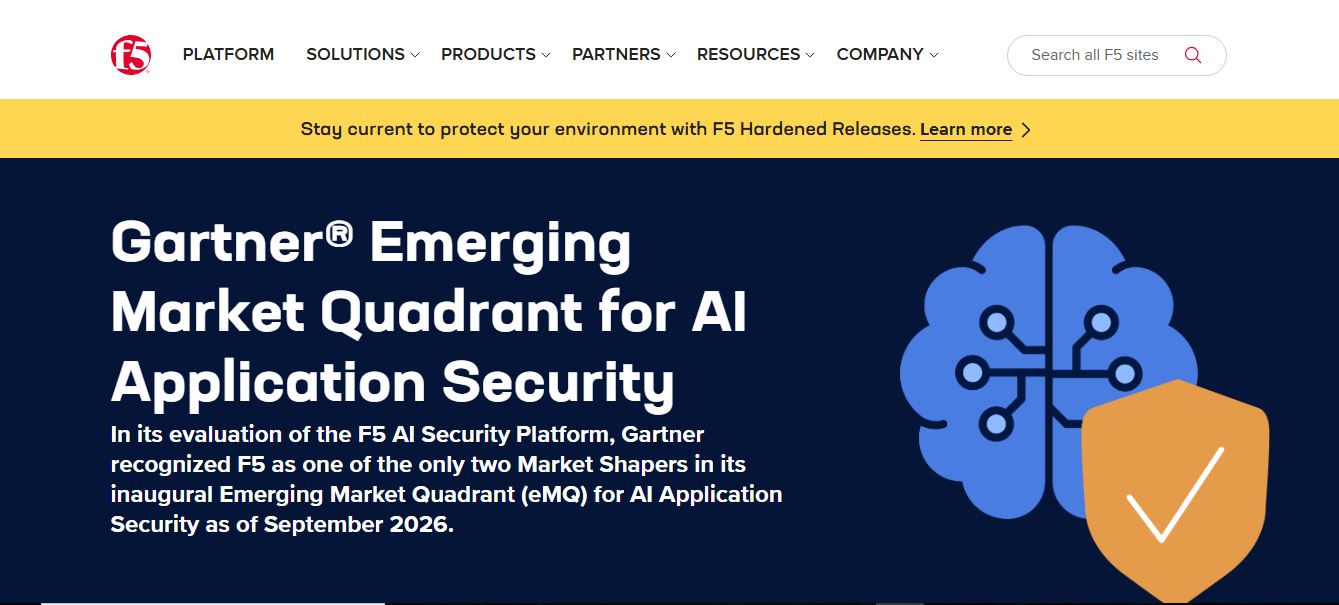
What is F5?
F5 F5 is a global application delivery and cybersecurity company that helps organizations ensure their apps and APIs are fast, secure, and always available. It provides a unified platform that combines load balancing, traffic management, and advanced security features like web application firewalls and DDoS protection. Businesses use F5 to manage applications across data centers, the cloud, and edge environments. Trusted by a large share of Fortune 500 companies, F5 enables enterprises to deliver reliable digital experiences while protecting against modern cyber threats.
F5 is an American technology company founded in 1996 that specializes in application delivery and cybersecurity solutions, helping organizations ensure apps and APIs are fast, available, and secure across cloud, on-premise, and edge environments. It serves 80%+ of the Fortune Global 500 and generated around $3.1B in revenue (FY2025) with strong margins (~83.6%). The platform combines app delivery, security, and analytics into a unified system, supporting modern hybrid multicloud and AI-driven infrastructure while protecting businesses from evolving cyber threats.
- Founder / Leadership: Jeffrey S. Hussey (Founder) and François Locoh-Donou (President & CEO)
- Launch Year: 1996
Use Cases:
- High-performance multi-cloud application load balancing, SSL offloading, and global server traffic management
- Securing web applications and enterprise APIs against OWASP Top 10 vulnerabilities using advanced WAF
- Mitigating sophisticated automated bot swarms, credential stuffing, and web scraping attacks
- Protecting hybrid Kubernetes and containerized microservices infrastructure with NGINX ingress controllers
Technology:
- F5 BIG-IP Traffic Management OS (TMOS) and hardware/virtual ADC architecture
- NGINX high-performance open-source and commercial web server and API gateway engine
- F5 Distributed Cloud global SaaS edge mesh and behavioral security analytics
Target Users:
- Chief Information Security Officers (CISOs) and enterprise security directors
- Network Operations (NetOps) engineers and infrastructure managers
- DevSecOps teams and cloud-native Kubernetes architects
- Enterprise IT directors managing hybrid data center transitions
Acquisition: Publicly traded on NASDAQ (NASDAQ: FFIV); acquired NGINX (2019) and Shape Security (2020)

Key features of F5
F5's key features are
- F5 Distributed Cloud WAAP: Unified Software-as-a-Service (SaaS) security combining WAF, API security, bot defense, and volumetric DDoS protection at the edge.
- BIG-IP Application Delivery Controller (ADC): Industry-standard hardware and virtual appliances (VE) providing high-performance traffic management, SSL offloading, and global server load balancing (GSLB).
- NGINX Application Platform: High-performance open-source and enterprise web server, reverse proxy, and API gateway optimized for microservices and containerized environments.
- Advanced Bot Mitigation: Uses behavioral analytics, machine learning, and device fingerprinting to stop automated credential stuffing, web scraping, and scalping bots.
- API Discovery & Threat Protection: Automatically discovers shadow APIs, inspects JSON/XML payloads, and blocks unauthorized parameter tampering in real time.
- Multi-Cloud Networking & Mesh: Connects disparate Kubernetes clusters and cloud VPCs securely with consistent traffic routing and visibility.
- Centralized Intersight Management: Manage, monitor, and deploy security policies across thousands of distributed app instances from a single glass-pane console.
- Zero-Day Exploit Shielding: Dynamic signature updates and telemetry intelligence protect applications against newly disclosed CVEs before official patches are applied.
F5 Pricing
F5 operates on an enterprise B2B licensing model with flexible subscription tiers, virtual appliance licenses, SaaS consumption billing, and hardware appliance purchases.
Distributed Cloud SaaS Services:
- Usage-based consumption billing and annual subscriptions based on throughput capacity (Mbps/Gbps), request volume, and security modules
BIG-IP Virtual Edition (VE):
- Tiered software licensing based on throughput (25 Mbps up to 10 Gbps+) via annual subscriptions or Enterprise Agreements (EA)
NGINX Enterprise:
- Annual subscription pricing per instance or core for NGINX Plus, App Protect, and Kubernetes ingress controllers
Hardware Appliances:
- Custom enterprise hardware purchases (BIG-IP iSeries and rSeries chassis) with enterprise maintenance contracts
Disclaimer: For the latest enterprise licensing options and custom hardware quotes, please visit the official F5 website at f5.com.
Who is using F5?
F5 is designed for a broad range of enterprise and mission-critical IT environments, including
- Global Financial Institutions: Securing high-value online banking portals, trading platforms, and payment APIs
- Telecommunications Operators: Managing massive subscriber traffic, core routing, and edge security
- Global eCommerce & Retailers: Defending digital storefronts against scalping bots, scraping, and layer-7 DDoS attacks
- Healthcare Organizations: Protecting patient records and ensuring strict data transmission compliance
- Content Creators: Using writing tools to draft enterprise security architecture whitepapers and compliance blueprints
- DevSecOps Teams: Standardizing application delivery and security policies across multi-cloud Kubernetes deployments
Best F5 Alternatives
Some of the strongest F5 alternatives include
- Cloudflare
- Akamai
- Palo Alto Networks
- Check Point
- Citrix ADC
- AWS WAF & Shield
Pros and Cons of F5
Pros
- Industry gold standard for high-performance application delivery, load balancing, and traffic management
- Comprehensive protection covering WAF, DDoS, API security, and behavioral bot mitigation in one ecosystem
- Exceptional scalability across physical hardware, virtual appliances, and distributed cloud SaaS edges
- Deep NGINX and BIG-IP pedigree trusted by the world's largest enterprise networks
- Unified central management console simplifies multi-cloud security policy enforcement
Cons
- Enterprise pricing and hardware investments represent a significant budget allocation for smaller businesses
- Steep learning curve for administrators mastering advanced BIG-IP TMOS configurations and iRules scripting
- Initial deployment across hybrid legacy and containerized microservices requires careful network planning
- Enterprise support and professional services may be necessary for complex multi-cloud migrations
Why Choose F5?
F5 is the ideal choice for global enterprises and large-scale organizations that require uncompromising performance, advanced security, and reliable traffic management across complex multi-cloud architectures.
- Secures applications and APIs against sophisticated automated bot attacks and zero-day exploits
- Delivers legendary high-performance traffic routing and SSL offloading via BIG-IP and NGINX
- Enforces unified security policies across multi-cloud, on-premises, and edge environments
- Protects revenue streams with multi-terabit DDoS mitigation and behavioral defense
- Backed by decades of enterprise networking leadership and 24/7 global support
F5 vs. Competitors
The main difference between F5, Cloudflare Enterprise, Akamai, and Palo Alto Prisma is that F5 offers an unmatched combination of high-performance physical/virtual hardware (BIG-IP), developer-centric web gateways (NGINX), and distributed SaaS edge security (WAAP), whereas Cloudflare and Akamai focus primarily on global CDN-edge security, and Palo Alto emphasizes cloud-native workload protection. F5 stands out for its deep networking roots, hybrid cloud flexibility, and robust application delivery control.
| Feature / Tool | F5 (f5.com) | Cloudflare Enterprise | Akamai App & API Protector | Palo Alto Prisma Cloud |
|---|---|---|---|---|
| Core Focus | Multi-Cloud ADC, WAF & API Security | Global CDN & Edge Security | Enterprise Edge Cloud Security | Cloud-Native Application Security |
| Hardware & Virtual ADC | Yes (BIG-IP iSeries / rSeries) | No (Edge Proxy Only) | No (Edge Proxy Only) | No |
| NGINX Web Server Integration | Yes (Native NGINX Plus Integration) | No | No | No |
| Distributed Cloud WAAP | Yes (F5 XC WAAP) | Yes | Yes | Yes (Cloud Native) |
| Best For | Hybrid Enterprise NetOps & Security | Global Edge CDN & Fast DNS | Massive Media & Enterprise CDN | Container & Cloud-Native Security |
How do we rate F5?
| Parameter | Rating (out of 5) |
|---|---|
| Application Delivery & Load Balancing | 5.0 |
| WAF & API Security Effectiveness | 4.9 |
| Multi-Cloud & Hybrid Scalability | 4.9 |
| Bot Mitigation & Threat Defense | 4.9 |
| Value for Money | 4.6 |
| Overall Score | 4.86 |
F5 Review
F5 remains an undisputed pillar of enterprise application security and delivery infrastructure. While the software industry has shifted toward cloud-native architectures, F5 has successfully bridged the gap—evolving its proven BIG-IP and NGINX foundations into a flexible, multi-cloud distributed SaaS platform. Its ability to inspect complex API payloads, defeat automated bot swarms, and manage heavy traffic loads without dropping packets makes it a trusted partner for mission-critical operations. For large enterprises seeking uncompromised reliability and robust security across hybrid IT estates, F5 is an essential platform.
Conclusion
F5 helps organizations secure and deliver applications by combining traffic management, application security, and performance optimization into one platform. Instead of managing separate tools, teams can protect apps, balance traffic, and ensure reliability across environments. This is especially important for modern, distributed applications. Overall, F5 improves application performance and security, helping businesses deliver fast, safe, and reliable digital experiences at scale.
FAQ
What is F5 and how does it work?
F5 is an enterprise technology company that provides application delivery and security solutions for modern digital businesses. It works by sitting in the data path of applications and APIs, ensuring they are fast, available, and secure across cloud, on-premise, and edge environments. Its platform combines traffic management, load balancing, and cybersecurity into a unified system that protects applications while optimizing performance.
What does F5 actually do in a network?
F5 manages and secures application traffic between users and servers. It distributes incoming traffic across multiple servers (load balancing), protects applications from threats like DDoS attacks and bots, and ensures high availability. By operating directly in the application data path, F5 can block malicious traffic before it reaches backend systems and maintain consistent performance even during high demand.
What are the main products offered by F5?
F5 offers a wide range of products, including its Application Delivery and Security Platform, BIG-IP for high-performance app delivery, NGINX for cloud-native environments, and Distributed Cloud Services for multicloud management. These products cover load balancing, API security, web application firewall (WAF), bot protection, and AI security, allowing businesses to manage both traditional and modern applications in one ecosystem.
How does F5 help with application security?
F5 provides advanced security features such as web application firewalls, API protection, bot management, DDoS mitigation, and zero-trust access control. It continuously monitors application traffic, detects threats like exploits or unauthorized access, and blocks them in real time. This approach helps organizations secure sensitive data, prevent fraud, and protect applications across hybrid and multicloud environments.
What is the F5 Application Delivery and Security Platform (ADSP)?
F5 ADSP is a unified platform that combines application delivery and cybersecurity into a single solution. It provides centralized visibility, automation, and policy enforcement across all applications and APIs, regardless of where they are deployed. This helps reduce complexity, eliminate security gaps, and ensure consistent protection and performance across cloud, edge, and on-premise environments.
Which industries use F5 solutions?
F5 is used across industries such as banking, telecom, healthcare, government, retail, and technology. Many large enterprises and service providers rely on F5 to deliver secure digital experiences, manage high traffic volumes, and protect critical infrastructure, especially in environments where uptime and security are essential.
Can F5 integrate with cloud and DevOps tools?
Yes, F5 integrates with major cloud providers like AWS, Microsoft Azure, and Google Cloud, as well as DevOps tools like Kubernetes, Terraform, and Ansible. This allows businesses to automate deployments, manage infrastructure efficiently, and maintain consistent security policies across different environments.
User Reviews
No reviews yet for F5.
Featured Tools
Featured AI tools from TechShark

Melody Genie
MelodyGenie is an AI-powered music generator that creates original songs from simple text prompts. Users can choose styles, moods, and genres, then instantly generate melodies and full tracks, making it easy for creators, marketers, and hobbyists to produce custom music without musical expertise.
Freemium
Kimi AI
Kimi AI is an advanced AI assistant developed by Moonshot AI that helps you chat, research, write, code, and automate tasks in one place. It supports web search, file analysis, and multimodal inputs, and can even run autonomous “agent” workflows to complete complex tasks end-to-end.
Freemium
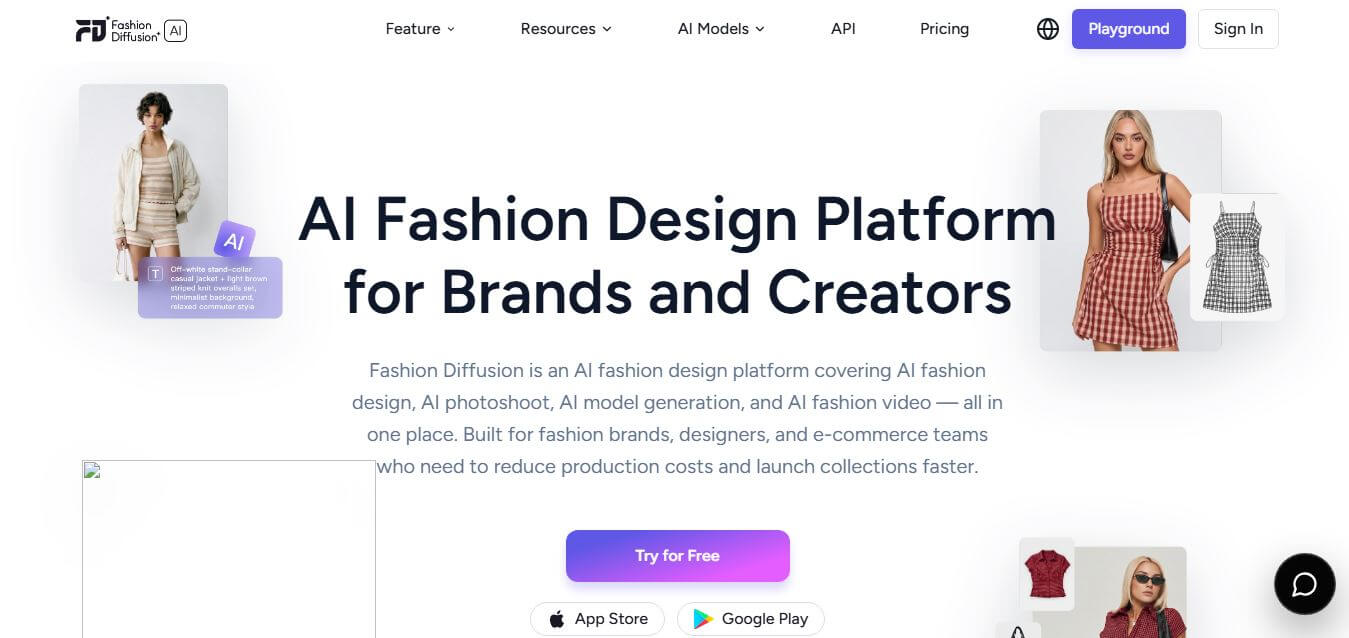
Fashion Diffusion AI
Fashion Diffusion is an AI-powered fashion design platform that helps brands and designers create clothing designs, virtual try-ons, AI models, product photos, and marketing visuals faster and cost-effectively.
Paid
Veo 4
Veo 4 AI is an AI video creation platform that generates dramatic videos from text, images, audio, and video prompts using realistic motion and synchronized sound.
Paid
Alternatives
Alternatives to F5
The best F5 alternatives include Cloudflare Enterprise, Akamai App & API Protector, Palo Alto Networks (Prisma Cloud), Check Point CloudGuard, Citrix ADC (NetScaler), and AWS WAF. These platforms provide cloud security, web application firewalls, and application delivery services. While F5 specializes in hybrid enterprise networking with BIG-IP hardware/virtual ADCs, NGINX integration, and Distributed Cloud WAAP, alternatives like Cloudflare focus on global CDN-edge proxy security. Choosing the right tool depends on whether you require hybrid data center traffic control or pure cloud-edge security.
 4.9
4.9HashiCorp Vault
Security
HashiCorp Vault is a secrets management platform that helps organizations securely store, access, and control sensitive data like API keys, tokens, and credentials. It provides encryption, identity-based access, and automated secrets rotation, enabling secure application deployment and compliance across cloud and on-prem environments.
 4.9
4.9Arista Networks
Security
Arista Networks is an AI-driven cloud networking platform that helps businesses build high-performance, scalable networks across data centers, campuses, and cloud environments. It delivers automation, analytics, and security through a unified operating system, enabling reliable connectivity and efficient data flow for modern, large-scale digital infrastructure.
 4.9
4.9Mimecast
Security
Mimecast is an AI-powered email and collaboration security platform that helps businesses prevent phishing, ransomware, and data leaks. It combines threat detection, data protection, and employee awareness tools into one system, enabling organizations to reduce human risk, ensure compliance, and maintain secure, uninterrupted communication.
 4.9
4.9Cato Networks
Security
Cato Networks is an AI-powered SASE platform that combines networking and security into a single cloud service. It connects users, apps, and data globally while enforcing zero-trust access, simplifying infrastructure, reducing risk, and delivering secure, high-performance connectivity across distributed and cloud-first business environments.
 4.9
4.9Microsoft Defender for Endpoint
Security
Microsoft Defender for Endpoint is an AI-powered endpoint security platform that helps businesses prevent, detect, and respond to cyber threats across devices like laptops, servers, and mobile systems. It combines antivirus, threat intelligence, and automated response to stop attacks, reduce risk, and provide full visibility across environments.
 4.9
4.9Securiti AI
Security
Securiti is an AI-powered data security, privacy, and governance platform that helps organizations discover, manage, and protect sensitive data across systems. It enables compliance with regulations like GDPR and CCPA, automates data workflows, and provides unified control over data access, risk, and usage.
 4.9
4.9Relyance AI
Security
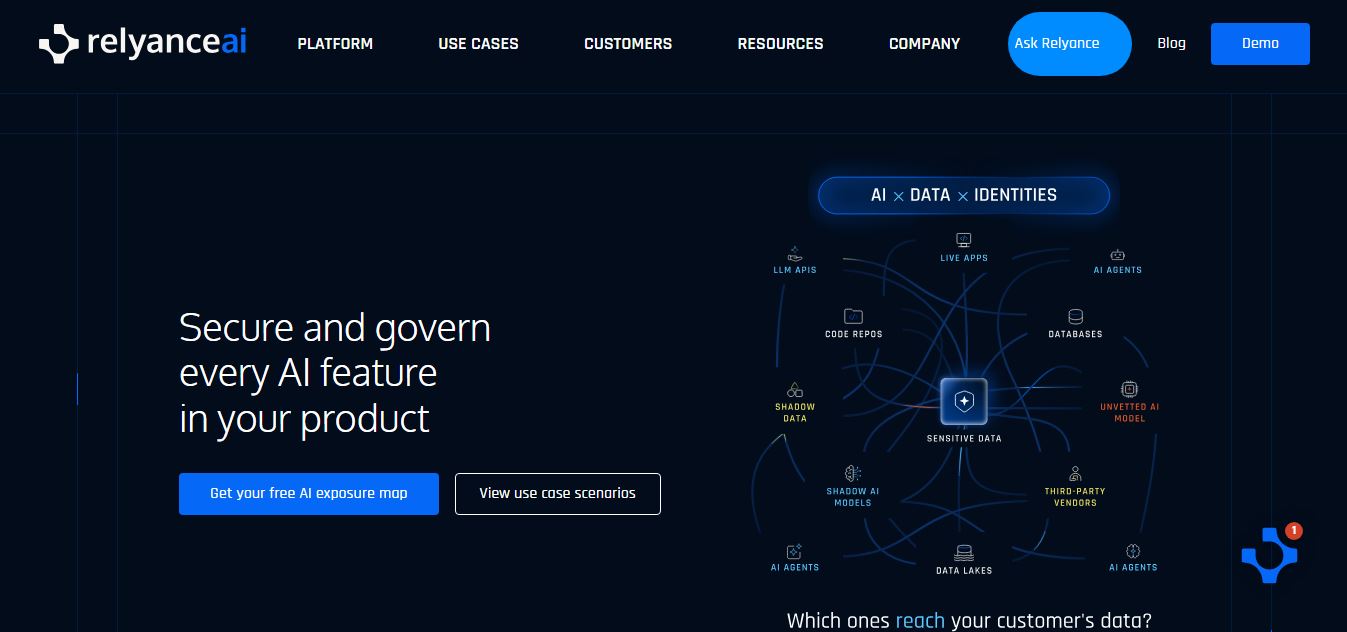
Relyance AI is a data governance and privacy platform that helps businesses manage data usage, ensure compliance, and reduce risk. It uses AI to map data flows, monitor how data is used, and enforce policies, making it easier to stay compliant with regulations like GDPR and CCPA.
 4.9
4.9GitHub Advanced Security
Security
GitHub Advanced Security is a security solution built into GitHub that helps developers find and fix vulnerabilities in their code. It offers features like code scanning, secret scanning, and dependency alerts, enabling teams to identify risks early and secure applications throughout the development lifecycle.
 4.8
4.8HiddenLayer
Security
HiddenLayer provides purpose-built security for organizations deploying generative, predictive, and agentic AI. Its platform helps security teams discover AI assets, inspect models for malware and vulnerabilities, continuously simulate attacks, and detect runtime threats. It integrates with existing security and MLOps environments while protecting sensitive models, prompts, data, and intellectual property.