
Arista Networks
Arista Networks is an AI-driven cloud networking platform that helps businesses build high-performance, scalable networks across data centers, campuses, and cloud environments. It delivers automation, analytics, and security through a unified operating system, enabling reliable connectivity and efficient data flow for modern, large-scale digital infrastructure.
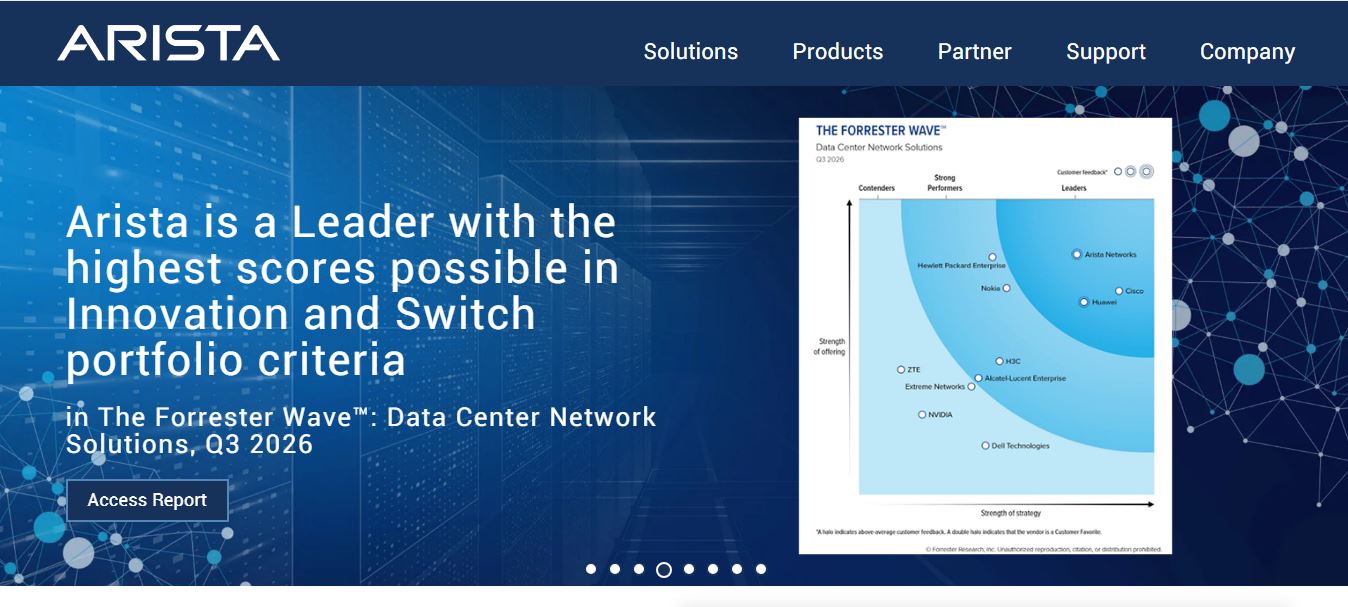
What is Arista Networks?
Arista Networks is the premier global provider of data-driven, client-to-cloud networking solutions designed for hyperscale cloud titans, enterprise data centers, AI compute clusters, high-frequency financial trading firms, and campus environments. Engineered for Chief Information Officers (CIOs), Chief Information Security Officers (CISOs), cloud infrastructure architects, and Network Operations (NetOps) engineers, Arista disrupted legacy proprietary networking by introducing merchant-silicon hardware architectures paired with a single, open, and programmable operating system: Arista EOS (Extensible Operating System).
Founded in 2004 as Arastra and incorporated in 2008 by legendary technologists Andy Bechtolsheim (co-founder of Sun Microsystems), David Cheriton (Stanford Professor and renowned tech visionary), and Kenneth Duda (CTO & SVP of Software Engineering), Arista Networks is led by President and CEO Jayshree Ullal. Headquartered in Santa Clara, California, Arista is a publicly traded technology powerhouse (NYSE: ANET) generating over $7 billion in annual revenue. Holding the #1 global market share in high-speed 100G, 400G, and 800G data center switching and connecting over 10,000 customers worldwide with more than 150 million cumulative ports shipped, Arista serves foundational cloud providers—including Microsoft, Meta, and major hyperscalers—alongside global financial institutions.
- Founder / Leadership: Andy Bechtolsheim (Co-founder & Chief Architect), Kenneth Duda (Co-founder & CTO), and Jayshree Ullal (President & CEO)
- Launch Year: 2004 / 2008 (Completed NYSE IPO in 2014)
Use Cases:
- Building non-blocking ultra-high-bandwidth 400G and 800G Ethernet backbones for massive GPU AI clusters and LLM training
- Delivering deterministic sub-microsecond latency switching for high-frequency trading (HFT) and algorithmic financial exchanges
- Automating network-wide configuration, continuous compliance, and change validation with Arista CloudVision
- Consolidating telemetry, flow traces, and device states into an AI-ready Network Data Lake (NetDL) and Autonomous Virtual Assist (AVA)
Technology:
- Multi-process state-sharing Arista EOS architecture built on an unmodified Linux kernel separating network state from protocol execution
- EOS Network Data Lake (NetDL) consolidating device telemetry, flow metrics, and third-party events into a single unified API surface
- CloudVision turn-key network automation, cognitive telemetry, and CI/CD-driven continuous integration pipeline (AVD)
Target Users:
- Hyperscale cloud operators and AI data center architects designing resilient multi-tier spine-and-leaf fabrics
- Quantitative trading firms, hedge funds, and investment banks demanding nanosecond-precision network routing and FPGA switching
- Enterprise network directors and SecOps teams consolidating campus, data center, and multi-cloud WAN operations
- Content creators using writing tools to draft high-performance network engineering whitepapers, RFP evaluations, and AI fabric deployment architectures
Corporate Entity: Operates as Arista Networks, Inc. (NYSE: ANET, Santa Clara, CA & Global)

Key features of Arista Networks
Arista Networks' key features are
- Single Universal Binary (Arista EOS): A single, consistent Linux-based operating system deployed across all platforms—from edge campus switches to 800G modular core routers—eliminating fragmented software branches.
- State-Sharing Architecture (Sysdb): All system states reside in a centralized, multi-process memory database (Sysdb), enabling self-healing restarts, in-service software upgrades (Smart System Upgrade), and zero network downtime.
- Smart Etherlink 800G AI Platforms: High-radix, non-blocking 800GbE and 400GbE switches engineered specifically for distributed AI cluster computing and high-density GPU interconnects.
- Arista CloudVision Automation: Centralized telemetry, automated provisioning, rollback validation, and day-to-day operations management across enterprise data centers, campus, and hybrid clouds.
- EOS Network Data Lake (NetDL): Collects, normalizes, and streams real-time state, sensor, and packet telemetry into a high-capacity data lake accessible via open APIs (gNMI, gRPC).
- Autonomous Virtual Assist (Arista AVA): AI/ML-powered analytics and proactive network detection and response (NDR) engine that diagnoses performance degradation and flags threat anomalies.
- Ultra-Low Latency & Financial FPGA Switching: Purpose-built switching lines (Arista 7130 Series) engineered for high-frequency trading with composable FPGAs and sub-nanosecond port-to-port latency.
- Open & Programmable DevOps Tooling: Comprehensive programmability with native Python, Go, and Ansible integrations, eAPI JSON-RPC, OpenConfig models, and support for SONiC open networking.
Arista Networks Pricing
Arista Networks operates on a hardware-plus-software licensing model distributed through authorized enterprise distributors, systems integrators, and direct sales for hyperscale cloud accounts.
Data Center & Top-of-Rack Switches:
- Fixed leaf and spine switches (such as Arista 7050X, 7060X, and 7280R series) typically range from $8,000 to $45,000+ per switch depending on port density (10G/25G/100G/400G/800G) and optic configurations
- Modular chassis spine routers (7500R3, 7800R4 series) scale from $50,000 to several hundred thousand dollars based on line cards, fabric modules, and deep buffer requirements
Enterprise Campus & Cognitive Edge:
- Cognitive campus switches (720XP, 750 Series) typically range from $2,500 to $9,000 per unit with multi-gigabit PoE capabilities
- Cognitive Wi-Fi access points start from approximately $600 to $1,500 per hardware unit
CloudVision & EOS Software Subscriptions:
- EOS software feature licenses (FLX, Spine, Virtualization) and CloudVision (CloudVision as-a-Service or on-prem) are licensed as 1-, 3-, or 5-year subscriptions based on device type and management tier
Disclaimer: Hardware configurations, transceiver optics, and multi-year support agreements (A-Care) vary significantly based on project scale and distributor discounts. For current RFP scoping and formal quotes, visit arista.com.
Who is using Arista Networks?
Arista Networks is designed for hyperscale cloud builders, high-performance computing centers, and modern enterprises, including
- Hyperscale Cloud Titans & Web Giants: Building high-scale distributed data center fabrics that handle billions of web requests with zero packet drop
- AI Compute & LLM Training Clusters: Connecting thousands of GPUs using low-latency 400G/800G Smart Etherlink fabrics as an alternative to proprietary InfiniBand
- High-Frequency Trading (HFT) & Global Exchanges: Executing algorithmic financial orders with ultra-low latency FPGA-accelerated 7130 series switches
- Tier-1 Telecommunications & Cloud Service Providers: Delivering cloud-grade core IP routing, peering, and multi-cloud interconnects
- Content Creators: Using writing tools to draft high-performance network engineering whitepapers, RFP evaluations, and AI fabric deployment architectures
- Enterprise Campus & Healthcare Networks: Replacing legacy proprietary switching stacks with cloud-managed, cognitive campus networks managed via CloudVision
Best Arista Networks Alternatives
Some of the strongest Arista Networks alternatives include
- Cisco
- Juniper Networks
- NVIDIA Networking
- Extreme Networks
- HPE Aruba Networking
- Dell PowerSwitch
Pros and Cons of Arista Networks
Pros
- Single universal EOS binary across all platforms drastically simplifies lifecycle management, firmware upgrades, and regression testing
- Unmatched market leadership in 100G, 400G, and 800G Ethernet switching, driving the modern AI center architecture
- Unique Sysdb state-sharing architecture enables true self-healing process restarts and in-service software upgrades (SSU)
- CloudVision delivers one of the most sophisticated, Git-like declarative network automation and telemetry engines in the industry
- Open programmability with Linux shell access, eAPI, gNMI, and native support for community projects like SONiC
Cons
- High-end data center switches and 800G modular chassis carry premium price tags tailored for large enterprise and hyperscale budgets
- Campus and branch wireless portfolio—while rapidly expanding through acquisitions—has a smaller global deployment footprint than Cisco Meraki
- Linux-centric architecture and advanced programmatic APIs present a learning curve for engineers accustomed to legacy proprietary network CLIs
- Requires careful optical transceiver and cabling planning to achieve advertised wire-speed throughput across high-density ports
Why Choose Arista Networks?
Arista Networks is the premier choice for organizations that demand high performance, software reliability, and cloud-scale automation for their data center, AI, and campus networks.
- Runs a single, reliable operating system (EOS) across every switch and router in your fleet
- Provides the highest-throughput 400G/800G Ethernet interconnects for modern GPU and AI workloads
- Eliminates network downtime with self-healing processes and non-disruptive software updates
- Provides automated network operations and deep telemetry through CloudVision and NetDL
- Trusted by the world's largest cloud titans, leading financial exchanges, and global enterprise innovators
Arista Networks vs. Competitors
The main difference between Arista Networks, Cisco, Juniper Networks, and NVIDIA Networking is that Arista pioneered open, merchant-silicon cloud networking powered by a single universal binary (EOS) and state-sharing Sysdb architecture, whereas Cisco delivers an extensive end-to-end portfolio spanning proprietary silicon, hardware, and Splunk observability, Juniper emphasizes Mist AI for campus wireless and service provider core routing, and NVIDIA focuses on proprietary InfiniBand and Spectrum-X for specialized AI supercomputers. Arista stands out for its software stability, 800G AI data center leadership, and declarative CloudVision automation.
| Feature / Tool | Arista Networks (arista.com) | Cisco | Juniper Networks | NVIDIA Networking |
|---|---|---|---|---|
| Core Focus | Cloud Data Center, AI & High-Speed EOS | Enterprise Networking, Security & Splunk | AI-Native Networking & Mist Cloud | AI Supercomputing & InfiniBand/Ethernet |
| Network OS | Single Universal Binary (Arista EOS) | Multiple (IOS XE, IOS XR, NX-OS) | Junos OS / Junos Evolved | Cumulus Linux / MLNX-OS |
| AI Cluster Networking | Smart Etherlink 800G Deep Buffer | Silicon One 800G Platforms | PTX & QFX 800G Series | Quantum InfiniBand & Spectrum-X |
| Automation & Telemetry | CloudVision & EOS NetDL | Cisco Catalyst Center & Meraki | Mist AI & Apstra Intent-Based | NVIDIA NetQ / UFM |
| Starting Price Range | Hardware from ~$2,500 (Campus) to $45k+ | Hardware from ~$500 to tens of thousands | Hardware from ~$1,500 to enterprise chassis | Enterprise AI Fabrics ($20k–$100k+) |
| Best For | Hyperscale Clouds, AI Fabrics & Finance | Global Enterprise Campus & Data Centers | AI-Driven Enterprise Campus & Telco | Dedicated GPU Supercomputing Fabrics |
How do we rate Arista Networks?
| Parameter | Rating (out of 5) |
|---|---|
| Software Architecture & Single EOS Binary | 5.0 |
| High-Throughput Performance & AI 800G Fabrics | 5.0 |
| CloudVision Automation & NetDL Telemetry | 4.9 |
| Ultra-Low Latency & Financial Engineering | 5.0 |
| Value for Money | 4.8 |
| Overall Score | 4.94 |
Arista Networks Review
Arista Networks fundamentally transformed the networking industry by proving that open, programmable software running on merchant silicon could outshine proprietary hardware designs. The secret to Arista's enduring market leadership is EOS: while competitors forced IT teams to juggle multiple incompatible operating systems across different product generations, Arista maintained a single universal binary. Its state-sharing Sysdb engine introduced self-healing capabilities that made catastrophic switch crashes a relic of the past. As enterprise computing transitions to generative AI and LLM training, Arista’s Smart Etherlink 800G platforms position standard, non-blocking Ethernet as the premier choice over proprietary alternatives. For organizations demanding cloud-scale throughput, programmable automation, and software stability, Arista Networks is an exceptional platform.
Conclusion
Arista Networks is an industry-leading data-driven cloud networking platform that redefines how organizations architect data centers, AI compute clusters, financial trading networks, and campus backbones. By pairing a single universal Extensible Operating System (EOS), self-healing Sysdb architecture, 800G high-radix switching, and CloudVision declarative automation into an open ecosystem, it eliminates downtime and operational complexity. While enterprise campus environments evaluate mixed switching options, Arista’s technical elegance, AI cluster leadership, and proven cloud reliability make it an indispensable networking platform.
User Reviews
No reviews yet for Arista Networks.
Featured Tools
Featured AI tools from TechShark

Melody Genie
MelodyGenie is an AI-powered music generator that creates original songs from simple text prompts. Users can choose styles, moods, and genres, then instantly generate melodies and full tracks, making it easy for creators, marketers, and hobbyists to produce custom music without musical expertise.
Freemium
Kimi AI
Kimi AI is an advanced AI assistant developed by Moonshot AI that helps you chat, research, write, code, and automate tasks in one place. It supports web search, file analysis, and multimodal inputs, and can even run autonomous “agent” workflows to complete complex tasks end-to-end.
Freemium

Fashion Diffusion AI
Fashion Diffusion is an AI-powered fashion design platform that helps brands and designers create clothing designs, virtual try-ons, AI models, product photos, and marketing visuals faster and cost-effectively.
Paid
Veo 4
Veo 4 AI is an AI video creation platform that generates dramatic videos from text, images, audio, and video prompts using realistic motion and synchronized sound.
Paid
Alternatives
Alternatives to Arista Networks
The best Arista Networks alternatives include Cisco (Catalyst, Nexus, Silicon One), Juniper Networks, NVIDIA Networking (Mellanox InfiniBand and Spectrum-X), Extreme Networks, HPE Aruba Networking, and Dell PowerSwitch. These platforms provide data center switching, routing, campus networks, and network operating systems. While Arista Networks specializes in a single universal Linux-based binary (EOS), state-sharing Sysdb architecture, and high-performance 100G/400G/800G Ethernet for cloud and AI fabrics, alternatives like Cisco offer an end-to-end technology portfolio spanning campus Wi-Fi to Splunk SIEM, and NVIDIA specializes in proprietary InfiniBand fabrics. Choosing the right tool depends on whether you require open programmable cloud Ethernet, global enterprise hardware breadth, or specialized GPU cluster fabrics.
 4.9
4.9HashiCorp Vault
Security
HashiCorp Vault is a secrets management platform that helps organizations securely store, access, and control sensitive data like API keys, tokens, and credentials. It provides encryption, identity-based access, and automated secrets rotation, enabling secure application deployment and compliance across cloud and on-prem environments.
 4.9
4.9Mimecast
Security
Mimecast is an AI-powered email and collaboration security platform that helps businesses prevent phishing, ransomware, and data leaks. It combines threat detection, data protection, and employee awareness tools into one system, enabling organizations to reduce human risk, ensure compliance, and maintain secure, uninterrupted communication.
 4.9
4.9Cato Networks
Security
Cato Networks is an AI-powered SASE platform that combines networking and security into a single cloud service. It connects users, apps, and data globally while enforcing zero-trust access, simplifying infrastructure, reducing risk, and delivering secure, high-performance connectivity across distributed and cloud-first business environments.
 4.9
4.9Microsoft Defender for Endpoint
Security
Microsoft Defender for Endpoint is an AI-powered endpoint security platform that helps businesses prevent, detect, and respond to cyber threats across devices like laptops, servers, and mobile systems. It combines antivirus, threat intelligence, and automated response to stop attacks, reduce risk, and provide full visibility across environments.
 4.9
4.9Securiti AI
Security
Securiti is an AI-powered data security, privacy, and governance platform that helps organizations discover, manage, and protect sensitive data across systems. It enables compliance with regulations like GDPR and CCPA, automates data workflows, and provides unified control over data access, risk, and usage.
 4.9
4.9Relyance AI
Security
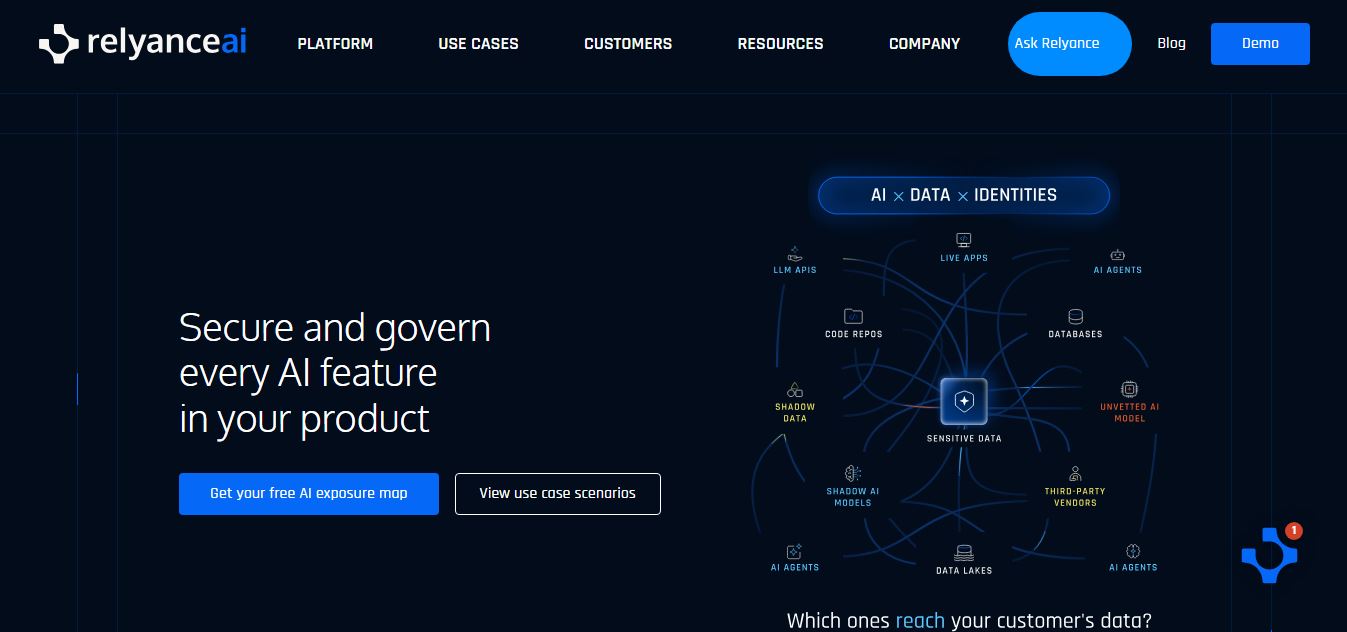
Relyance AI is a data governance and privacy platform that helps businesses manage data usage, ensure compliance, and reduce risk. It uses AI to map data flows, monitor how data is used, and enforce policies, making it easier to stay compliant with regulations like GDPR and CCPA.
 4.9
4.9GitHub Advanced Security
Security
GitHub Advanced Security is a security solution built into GitHub that helps developers find and fix vulnerabilities in their code. It offers features like code scanning, secret scanning, and dependency alerts, enabling teams to identify risks early and secure applications throughout the development lifecycle.
 4.8
4.8HiddenLayer
Security
HiddenLayer provides purpose-built security for organizations deploying generative, predictive, and agentic AI. Its platform helps security teams discover AI assets, inspect models for malware and vulnerabilities, continuously simulate attacks, and detect runtime threats. It integrates with existing security and MLOps environments while protecting sensitive models, prompts, data, and intellectual property.
 4.9
4.9Cloudflare
Security
Cloudflare is a leading global connectivity cloud platform that delivers fast content delivery (CDN), authoritative DNS, unmetered DDoS mitigation, Web Application Firewall (WAF) security, serverless edge compute (Workers), and Zero Trust network access across 330+ cities worldwide.