
Basedash
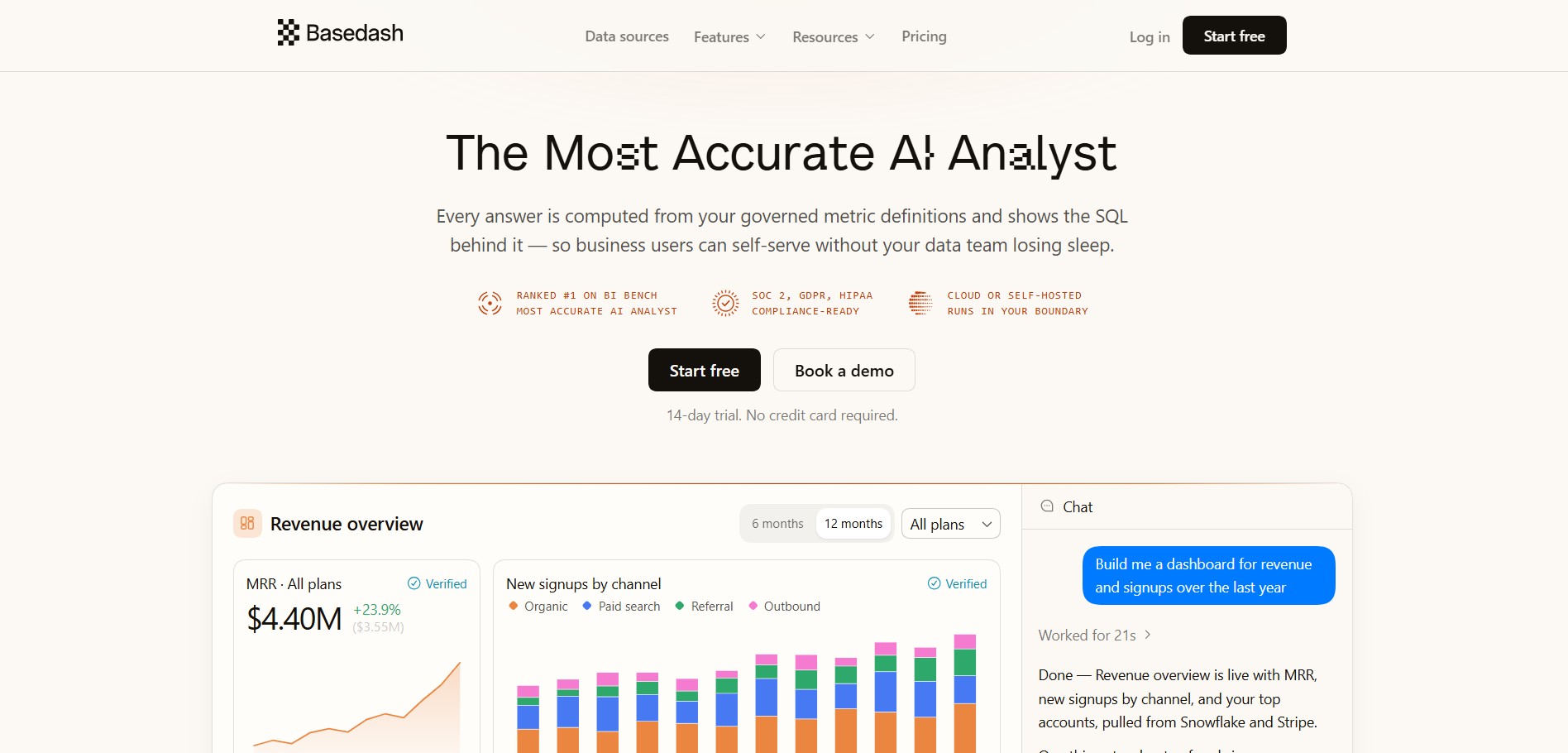
Basedash AI Sources is a transparency feature that reveals how AI-generated answers are built, showing underlying data, queries, and logic. Users can inspect tables, charts, and SQL queries with results, making it easier to verify insights, understand outputs, and trust AI-driven analytics without relying on black-box systems.
What is Basedash?
Basedash AI Sources is a feature within Basedash that makes every AI-generated answer fully transparent by showing exactly what data and queries were used to produce it. Instead of just trusting outputs, users can open a “Sources” panel to inspect underlying tables, charts, connected databases, and even the exact SQL queries with returned rows. This creates a clear path from answer to evidence, allowing teams to verify insights instantly without digging through dashboards or exports. Designed for data-driven teams, it turns AI analytics into something auditable, reliable, and easy to trust—bridging the gap between automated insights and real business data.
Founded by Max Musing, Basedash addresses the black-box opacity and hallucination risks that frequently undermine AI-assisted data analysis. Through its flagship AI Sources framework, Basedash introduces complete auditability to every AI-generated metric—allowing users to inspect the exact database tables, semantic definitions, generated SQL statements, and returned rows behind every chart and answer. Basedash connects to over 750 data sources and offers a free starter tier alongside paid team plans starting at $25 per user per month.
- Founder & CEO: Max Musing
- Platform Model: AI-Native Business Intelligence Platform & Conversational Data Analyst
- Data Connectivity: 750+ Direct Databases, Warehouses & SaaS Integrations
Use Cases:
- Exploring company metrics conversationally and generating multi-chart dashboards without writing manual SQL
- Verifying AI-generated answers via AI sources by inspecting executed SQL logic and raw data rows
- Standardizing corporate metric formulas (e.g., net MRR, cohort activation) across the organization using reusable Basedash Skills
- Automating operational alerts and scheduled data workflows (low-stock warnings, weekly revenue digests) via Tasks
- Connecting external AI agents (Grok Bot, Claude, Cursor) directly to company data via native read-only Model Context Protocol (MCP) integrations
Technology:
- High-performance 60 FPS canvas interface supporting comprehensive keyboard shortcuts and real-time multiplayer sharing
- Automated schema inference and semantic context mapping engine operating with zero-write access to production databases
- Read-only Model Context Protocol (MCP) server ecosystem and enterprise-grade SOC 2 Type 2 compliance architecture
Target Users:
- Startup founders, product managers, and growth teams needing fast, self-serve data visibility without dedicated analysts
- Operations and revenue leads tracking live customer KPIs, churn signals, and sales pipeline metrics
- Data engineers seeking to eliminate repetitive ad-hoc query requests while preserving strict schema governance
- Security-conscious companies requiring auditable SQL reasoning and compliance-certified data boundaries
Acquisition: Operates as an independent private enterprise data software company (Basedash, Inc.)

Key features of Basedash
Basedash's key features are
- AI Sources & Auditable Provenance: Open the "Sources" drawer beneath any answer to inspect the exact database tables, definitions, charts, MCP connections, executed SQL syntax, and previewed row sets used to generate the response.
- Basedash Skills (Lightweight Semantic Layer): Reusable bundles of natural language instructions (up to 50,000 characters) that teach the AI how specific metrics, exclusions, and business terms are defined across the workspace.
- Natural Language Dashboard Creation: Describe the visual layout or business question in plain English, and the platform automatically writes verified queries and generates interactive visualizations.
- 750+ Data Connectors: Native integrations across major SQL databases (PostgreSQL, MySQL, ClickHouse, Snowflake, BigQuery) and hundreds of third-party SaaS platforms (Stripe, HubSpot, Shopify).
- Autonomous Suggestions Engine: Rather than opening to a blank screen, Basedash proactively surfaces personalized questions, dashboard templates, and alerts tailored to your schema and recent queries.
- Basedash Tasks & Automations: Schedule autonomous workflows and recurring operational alerts (such as daily KPI digests and inventory alerts) that run on autopilot.
- Native Model Context Protocol (MCP) & Grok Bot: Connect external AI agents, IDE assistants, and Slack/Grok bots directly to governed company data using read-only MCP channels.
- Public Sharing & Embedding: Securely share live, interactive dashboards via password-protected links or embed dynamic charts directly into internal portals and SaaS applications.
Basedash Pricing
Basedash provides a functional free-forever tier alongside scalable seat-based team subscriptions and custom enterprise deployments.
Free Starter Plan:
- $0 / month: Core conversational AI querying and dashboard exploration for individual users
- Standard data source connections, basic chart building, and full access to the AI Sources verification drawer
Team Plan:
- $25.00 / user/month: Designed for collaborative startups and growing teams
- Unlimited dashboards, shared workspace Skills, automated Task scheduling, public link sharing, and team collaboration controls
Enterprise Tier:
- Custom enterprise pricing for high-volume organizations requiring self-hosted / on-premise VPC deployments, SSO/SAML, custom SLAs, audit logs, and dedicated technical onboarding
Disclaimer: For current enterprise deployment options, self-hosted container configurations, and team seat discounts, please check the official website at basedash.com.
Who is using Basedash?
Basedash is used by data-driven companies and engineering teams, including
- Growth-Stage SaaS Companies: Empowering non-technical product managers and marketers to query product usage and revenue data directly
- E-commerce Brands: Monitoring real-time order volume, fulfillment status, and ad-spend efficiency across Stripe and Shopify databases
- Security-Conscious Organizations (e.g., Taxfyle, FullEnrich): Generating audit-compliant business reports in hours rather than weeks without compromising production data
- Engineering Teams: Connecting autonomous developer agents and terminal tools to internal operational metrics via read-only MCP endpoints
Best Basedash Alternatives
Some of the strongest Basedash alternatives include
- Metabase
- Hex
- Omni
- ThoughtSpot
- Looker
- Airbook AI
Pros and Cons of Basedash
Pros
- AI Sources eliminates black-box hallucination risks by letting users verify exact SQL and previewed data rows
- Basedash Skills provides a lightweight, natural language alternative to maintaining heavy, complex dbt semantic models
- Broad connectivity spanning 750+ data sources, databases, and third-party SaaS platforms
- Proactive Suggestions engine removes the "blank canvas" problem by recommending relevant questions and dashboards
- Native read-only Model Context Protocol (MCP) server support connects external agents like Claude and Cursor directly to company data
Cons
- Highly complex multi-hop relational schemas with ambiguous column naming still require initial guidance via Skills
- Team collaboration and automated background Tasks require the paid per-user subscription tier
- Heavily nested NoSQL document databases (like Firestore) offer more limited native analytics compared to relational SQL engines
Why Choose Basedash?
Traditional BI platforms like Tableau or Looker require dedicated data engineering teams to model schemas and build static dashboards, while basic AI chat plugins often hallucinate numbers without explanation. Basedash provides an AI data analyst that proves its work.
- Enables anyone to build dashboards in plain English while providing complete SQL auditability via AI Sources
- Maintains consistent metric definitions company-wide through reusable natural language Skills
- Keeps production systems safe using certified read-only execution layers and zero-write guarantees
- Integrates seamlessly into modern developer workflows via embeddable widgets, public links, and MCP servers
Basedash vs. Competitors
The main difference between Basedash, Metabase, Hex, and Omni lies in AI provenance and semantic flexibility. While Metabase relies on traditional visual query builders and Hex caters to data scientists writing Python/SQL notebooks, Basedash is built from the ground up as an AI-native analyst—pairing conversational exploration with transparent AI Sources verification and a no-code, instruction-based semantic layer.
| Feature / Tool | Basedash (basedash.com) | Metabase | Hex | Omni |
|---|---|---|---|---|
| Core Focus | AI-Native BI & Auditable Analyst | Open-Source Visual BI | Collaborative Data Notebook & BI | Next-Gen BI & Modeling Layer |
| AI Sources / SQL Provenance | Yes (Full SQL, rows & MCP trace) | SQL editor inspection | Cell execution logic | SQL model audit |
| Instruction Semantic Layer | Yes (Basedash Skills) | Data model metadata | Semantic models / dbt | Omni Modeling Layer |
| Native MCP Agent Connectivity | Yes (Read-only MCP server) | No | No | No |
| Starting Price | Free / $25/user/month | Free OSS / From $85/mo | Free / From $36/user/mo | Custom Annual Pricing |
| Best For | Teams wanting verified, auditable conversational BI | Self-hosted relational data exploration | Data teams writing advanced Python/SQL | Enterprises needing deep data modeling |
How do we rate Basedash?
| Parameter | Rating (out of 5) |
|---|---|
| AI Querying & Natural Language Dashboards | 4.9 |
| Auditability & AI Sources Verification | 5.0 |
| Semantic Governance (Basedash Skills) | 4.8 |
| Data Connector Breadth (750+ sources) | 4.9 |
| Value for Money | 4.8 |
| Overall Score | 4.88 |
Basedash Review
Basedash sets a new standard for trustworthiness in AI-assisted analytics. While early generative data tools struggled with mysterious hallucinated numbers, Basedash's introduction of AI Sources gives operators and data leaders immediate visibility into the underlying SQL, active schema definitions, and returned row sets. Combined with its lightweight Basedash Skills semantic layer, native Model Context Protocol support, and intuitive 60 FPS dashboard builder, Basedash provides a comprehensive, modern intelligence platform for data-informed teams.
Conclusion
Basedash AI Sources is a powerful transparency layer that solves one of the biggest problems in AI analytics—lack of trust in outputs—by showing exactly how every answer is generated. Instead of acting like a black box, it surfaces the full chain of evidence behind each response, including database tables, charts, definitions, web sources, and even the exact SQL queries used to produce the result. Its biggest strength lies in real-time explainability, allowing users to move from a final answer to the underlying data, queries, and context in one click, making verification instant and actionable. By keeping answers clean while making the underlying logic accessible, it balances usability with accountability.
FAQ
What is Basedash AI Sources?
Basedash AI Sources is a feature inside Basedash that shows exactly what data and steps were used to generate an AI answer. It helps you verify results by exposing the full context behind every response.
How does AI Sources work?
After the AI gives an answer, you can open the “Sources” panel to see all the inputs used—like database tables, charts, definitions, and even web pages—along with the exact queries that produced the result.
What kind of data does AI Sources show?
It shows everything the AI used, including connected databases, SaaS tools, SQL queries, returned rows, charts, and external sources. This gives a full breakdown of how the answer was generated.
Can you see the exact SQL queries behind answers?
Yes, AI Sources lets you inspect every query the AI ran. You can expand each query to view the SQL and even preview the data rows that were returned.
Why is AI Sources important?
It solves the “black box” problem of AI. Instead of blindly trusting answers, you can verify the data, logic, and calculations behind them instantly.
Is AI Sources a separate product?
No, it’s not a standalone tool. It’s a built-in feature of Basedash that enhances its AI data analyst by making outputs transparent and traceable.
Can you use AI Sources for auditing or validation?
Yes, it’s especially useful for auditing analytics results, validating metrics, and ensuring accuracy before sharing insights with teams or stakeholders.
Who should use Basedash AI Sources?
It’s ideal for data teams, analysts, startups, and businesses that rely on AI-driven analytics but need transparency, trust, and verifiable insights from their data.
User Reviews
No reviews yet for Basedash.
Featured Tools
Featured AI tools from TechShark
Melody Genie
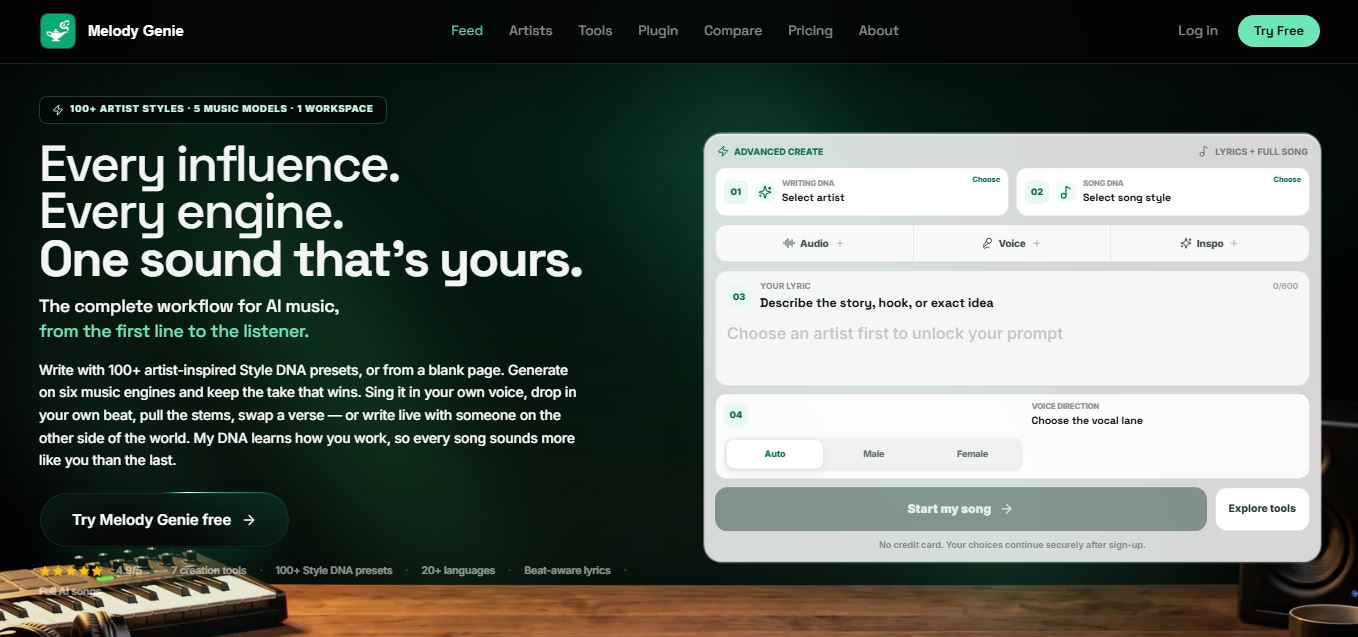
MelodyGenie is an AI-powered music generator that creates original songs from simple text prompts. Users can choose styles, moods, and genres, then instantly generate melodies and full tracks, making it easy for creators, marketers, and hobbyists to produce custom music without musical expertise.
Freemium
Kimi AI
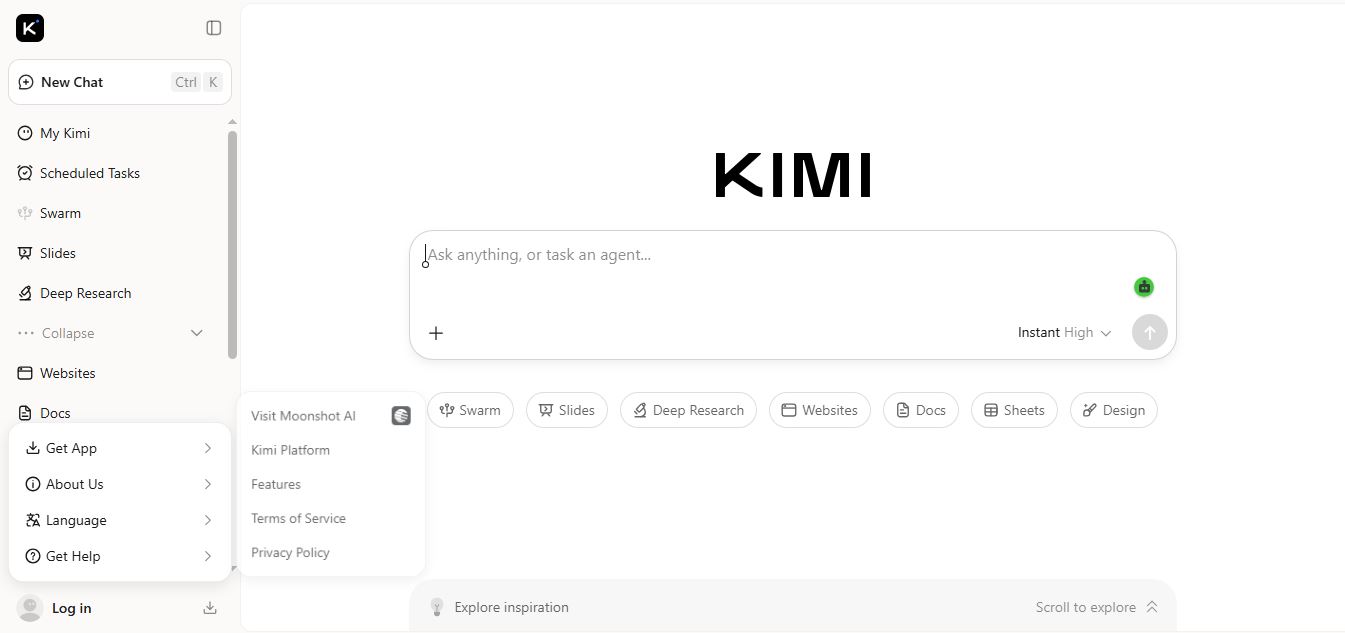
Kimi AI is an advanced AI assistant developed by Moonshot AI that helps you chat, research, write, code, and automate tasks in one place. It supports web search, file analysis, and multimodal inputs, and can even run autonomous “agent” workflows to complete complex tasks end-to-end.
Freemium
Fashion Diffusion AI
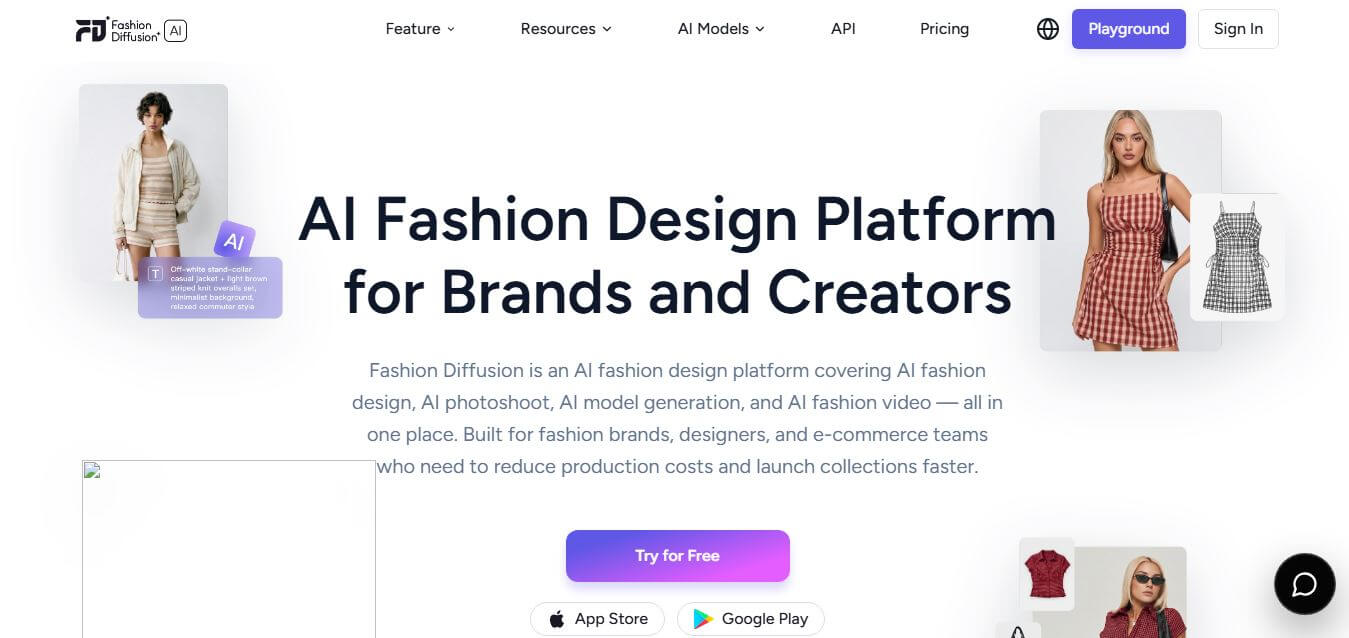
Fashion Diffusion is an AI-powered fashion design platform that helps brands and designers create clothing designs, virtual try-ons, AI models, product photos, and marketing visuals faster and cost-effectively.
Paid
Veo 4
Veo 4 AI is an AI video creation platform that generates dramatic videos from text, images, audio, and video prompts using realistic motion and synchronized sound.
Paid
Alternatives
Alternatives to Basedash
The best Basedash alternatives include Metabase, Hex, Omni, ThoughtSpot, Looker, and Airbook AI. These platforms provide business intelligence, visual reporting, and data analytics environments. While Basedash specializes in conversational natural language dashboard building paired with transparent AI Sources verification (showing exact SQL queries, returned rows, and semantic definitions) and native MCP agent connectivity, alternatives like Metabase focus on traditional self-hosted visual queries, and Hex caters to technical data teams authoring collaborative SQL and Python notebooks.
 4.7
4.7Quinvio AI
Productivity
Quinvio AI helps you turn ideas, scripts, blogs, or web content into polished video presentations. You can refine messaging, choose branded templates, add AI avatars and voiceovers, and produce shareable visual content without traditional recording or editing workflows. It is especially useful for marketers, educators, trainers, creators, and business teams.
 4.9
4.9HubSpot
Marketing
HubSpot is an AI-powered customer platform that helps businesses manage marketing, sales, customer service, and content in one place. It offers a free CRM, automation tools, analytics, and AI features, enabling teams to attract leads, close deals, and deliver better customer experiences at scale.
 4.9
4.9TestSprite
Testing
TestSprite is an AI-powered software testing agent that helps developers automatically generate, run, and fix end-to-end tests for web apps. It simulates real user behavior, detects issues, and provides root-cause insights with suggested fixes, enabling faster releases and more reliable software without manual QA effort.
 4.8
4.8Microsoft Copilot
Productivity
Microsoft Copilot is an AI-powered assistant that helps users write, research, analyze data, and automate tasks across apps like Word, Excel, Outlook, and Teams. It combines large language models with real-time data to generate content, answer questions, and improve productivity across personal and professional workflows.
 4.9
4.9Casablanca AI
Productivity
Casablanca AI is an AI-powered virtual camera that corrects your gaze in real time during video calls, making it appear like you’re maintaining natural eye contact. It works with tools like Zoom and Teams, improving trust, engagement, and communication without needing extra hardware.
 4.9
4.9Granola
Productivity
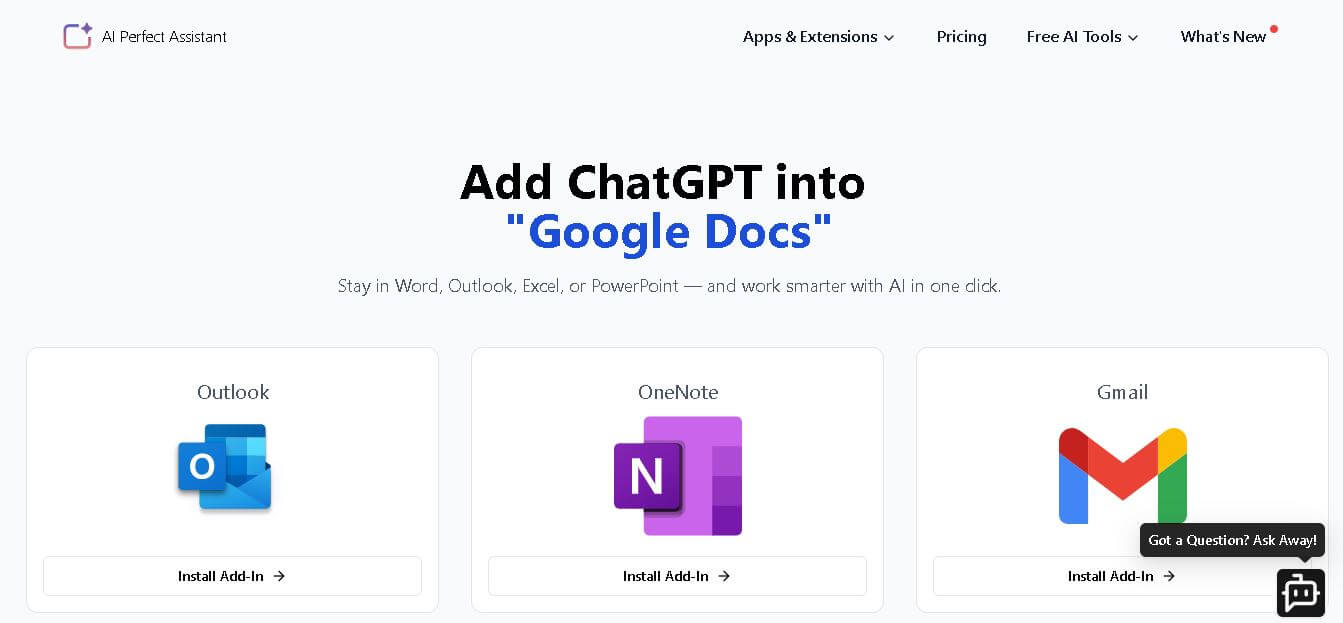
Granola is an AI-powered meeting assistant that helps you capture, organize, and act on conversations without losing focus. It listens to meetings, turns notes into structured summaries, and generates action items and follow-ups automatically—so you stay present while everything important is documented and ready to use.
 4.8
4.8AI Perfect Assistant
Productivity
AI Perfect Assistant brings AI assistance directly into everyday work applications. It helps users write emails, improve documents, summarize content, translate text, create presentations, generate SEO content, explain Excel formulas, and handle repetitive tasks through 60+ specialized tools and multiple integrations for everyday professional and business workflows with less effort.
 4.9
4.9Kroolo
Project Management
Kroolo is an AI-powered productivity and project management platform that helps teams plan tasks, track progress, and collaborate in one place. It combines project tracking, document management, and AI assistance to streamline workflows, automate routine work, and improve team efficiency across projects.
 4.8
4.8Sunsama
Productivity
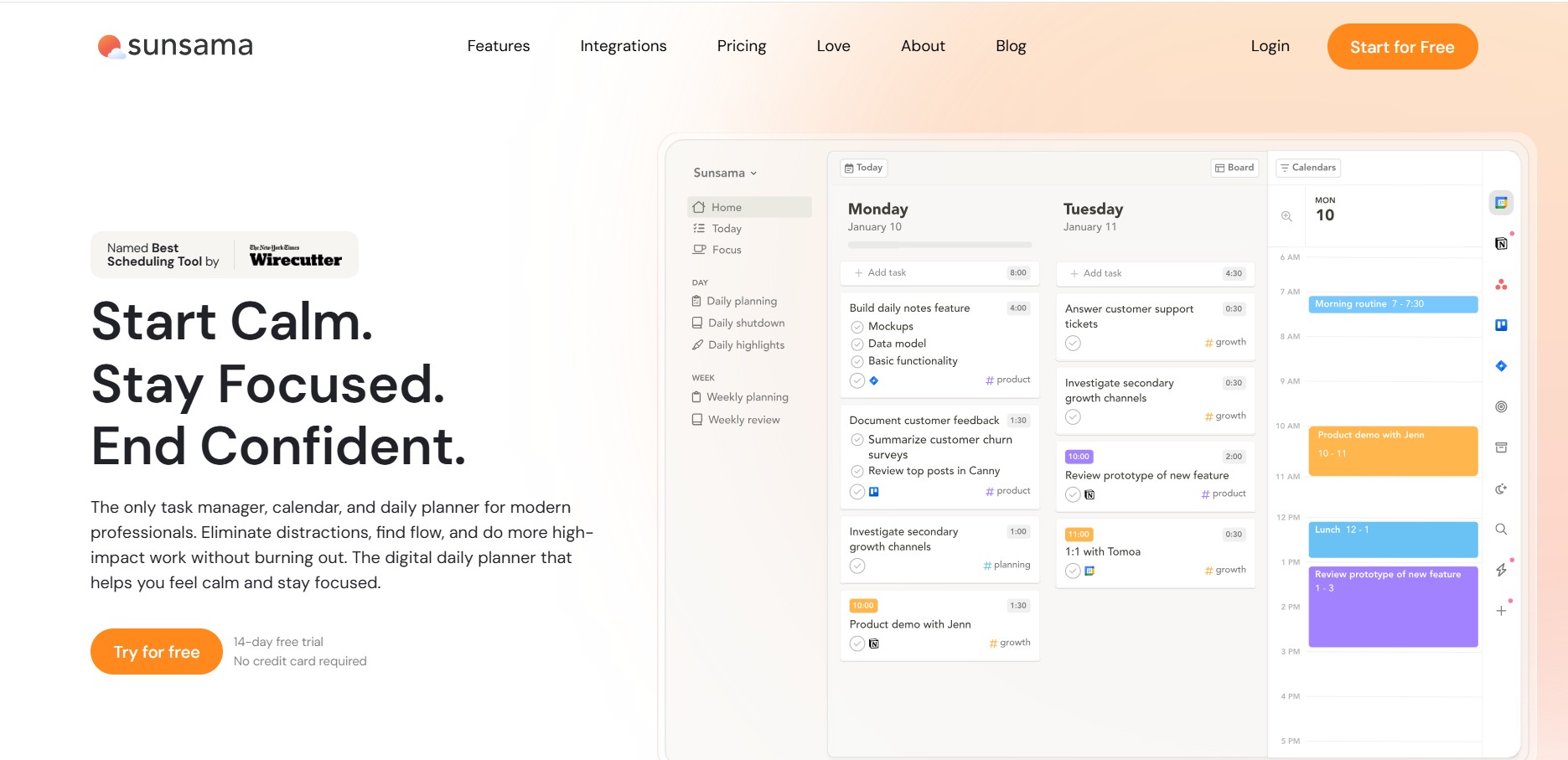
Sunsama is a digital daily planner and time-blocking application designed to cultivate intentional work habits, consolidate tasks across third-party tools, and facilitate guided morning planning and evening reflection rituals.