What is Scholarcy AI?
- Founders/Company: Public information on exact founders is limited; the company focuses on AI summarization tools for academic research.
- Launch/History: Scholarcy has been publicly available for several years and continues to evolve features like bulk summarization, library, and browser extensions.
Use Cases:
- Rapid screening of research articles
- Literature review and comparative analysis
- Extracting data and tables
- Organizing references and annotated bibliographies
- Saving time in academic reading workflows
- Supporting non-native speakers by simplifying language
Technology:
- Scholarcy uses natural language processing (NLP), machine learning, document parsing, and summarization models. It identifies key sections, highlights important sentences, extracts structured data, and builds comparative summaries.
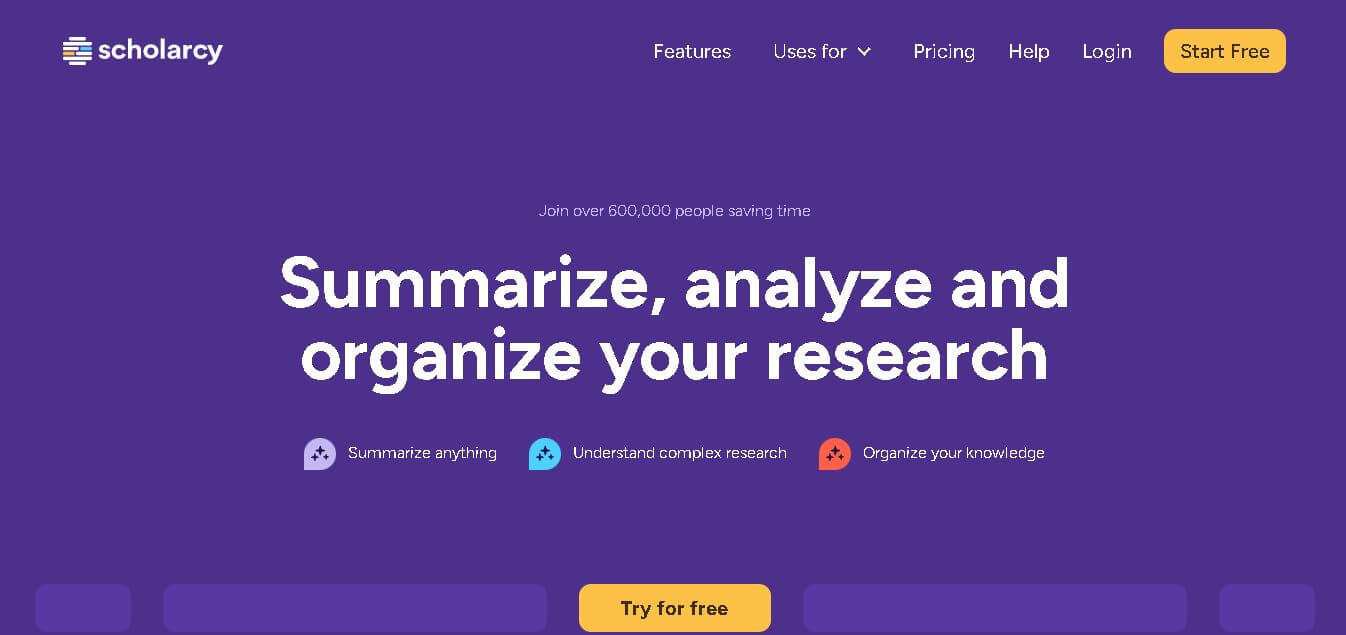
Scholarcy is an AI-powered research platform that dramatically accelerates how you digest scientific literature. Instead of wading through dense, lengthy papers, you upload or link them and Scholarcy transforms them within seconds into structured summaries, flashcards, and highlights. The system extracts key findings, methods, figures, and references, enabling you to screen papers faster, build literature overviews, and navigate large collections with ease. With bulk import, comparison tools, export options, and integration with reference managers, Scholarcy helps researchers, students, and academics reclaim time and energy for deeper insight and more creative thinking.
Key Features
Scholarcy AI key features are
- Interactive Flashcards & Snapshots—Condenses each document into digestible “flashcards” or snapshot summaries covering vital points.
- Smart Highlighting / Robo-Highlighter—Automatically emphasizes significant sentences or phrases in the original text.
- Bulk Summarization—Supports uploading multiple papers and creating summaries en masse.
- The Cross-Paper Comparison/Insights feature helps you see how papers relate, compare findings, and identify gaps or contradictions.
- Data & Table Extraction—Extracts tables, figures, and data in a usable format.
- Export & Integration—Export summaries or bibliographies to Word, PowerPoint, Markdown, Excel, or reference managers.
- Document Import Flexibility—Accepts PDF, Word, HTML, LaTeX, cloud storage, or URLs.
- Customizable Summaries—Users can choose different levels of detail or styles in the summary.
- I use my personal library/organization to save, organize, and revisit summaries.
- Browser Extensions—Chrome, Firefox, and Edge extensions allow direct summarization as you browse academic articles.
Pricing
- Free limited access
- Monthly subscription
- Annual discounted plan
- Institutional pricing
Disclaimer: For the latest and most accurate pricing information, please visit the official Scholarcy AI website.
Who Is Using it?
A wide range of users and organizations are using Scholarcy AI
- University students
- Academic researchers
- PhD scholars
- Educators and lecturers
- Research professionals
Alternatives
Some Scholarcy AI alternatives are
- Elicit AI
- SciSpace
- Scite AI
- QuillBot
- ResearchFlow
Conclusion
Scholarcy is a platform powered by AI that simplifies the usually cumbersome process of reading, categorizing, and comparing academic literature. After scanning dense papers, it automatically converts the papers' information into structured summaries, flashcards, and data extractions for users to skim intelligently, quickly narrow down relevant work, and, for the most part, spend more time reading and synthesizing. The platform includes a bulk process feature, comparison functions, export integrations, and a library organization of other relevant literature, which makes it an invaluable program for any researcher's workflow. It certainly cannot replace the benefits of nuanced human reading, particularly for long and technical passages, but it works excellently as a first pass. Ultimately, it provides the researcher with a personal assistant that will help them navigate large amounts of literature much more efficiently.
People are also reading








 Verified