Postshots
Postshot helps creators generate photorealistic 3D models and scenes from ordinary photos or videos using advanced AI reconstruction technology.
What is Postshot?
PostShot is an AI-powered 3D reconstruction software developed by Jawset that converts ordinary photos and videos into photorealistic 3D scenes and objects. The software uses Neural Radiance Fields (NeRF) and 3D Gaussian Splatting technology to create highly detailed digital environments without needing expensive 3D scanners. Users simply capture images or videos with a smartphone, DSLR, or other camera, import them into Postshot, and let the AI generate production-ready 3D models. Since all processing happens locally on the user's computer, creators maintain full ownership of their content. VFX artists, game developers, architects, researchers, and 3D professionals widely use Postshot.
Postshot is an AI-based desktop application for high-fidelity 3D reconstruction using Neural Radiance Fields and Gaussian Splatting. It supports unlimited image counts, 4K and 8K image processing, local AI computation, RAW image formats, and exports for Unreal Engine and Adobe After Effects. Unlike many cloud-based solutions, Postshot performs all machine learning and rendering locally, giving users complete ownership and privacy of their projects. The software also supports JPG, PNG, RAW, MP4, MOV, MKV, EXR, and many additional professional formats.
- Founder: Developed by Jawset Visual Computing.
- Launch: Postshot was initially released in public beta before reaching commercial release as Jawset's flagship AI reconstruction platform.
- Use Cases: 3D scanning, game asset creation, VFX production, architectural visualization, product digitization, digital twins, virtual production, AR/VR development, engineering, and research.
- Technology: Neural Radiance Fields (NeRF), Gaussian Splatting, AI Reconstruction, Computer Vision, Machine Learning, GPU Computing, and Neural Rendering.
- Target Users: 3D artists, VFX studios, game developers, architects, engineers, researchers, filmmakers, product designers, and content creators.
- Acquisition: No public acquisition has been announced.
In this review, we'll explore Jawset Postshot's features, pricing, real-world applications, and strengths and weaknesses and compare it with leading 3D reconstruction tools such as RealityCapture, Polycam, Luma AI, and Meshroom.

Postshot Key Features
Postshot key features are
- AI 3D Reconstruction: Converts ordinary photos and videos into photorealistic 3D scenes using Neural Radiance Fields and Gaussian Splatting.
- Works with Any Camera: Capture content using smartphones, DSLRs, mirrorless cameras, drones, or professional cinema cameras without specialized scanning hardware.
- Local AI Processing: All AI training and rendering occur on the user's computer, ensuring complete ownership and privacy of project files.
- Unlimited Image Support: Train scenes using virtually unlimited numbers of images without strict upload limitations.
- Supports 8K Images: Import high-resolution photos, including 4K and 8K images, for maximum reconstruction quality.
- Live Training Preview: Monitor reconstruction progress in real time while the AI builds the 3D scene.
- Scene Editing Tools: Edit, crop, merge, mask backgrounds, remove unwanted objects, and optimize reconstructed scenes.
- Unreal Engine Integration: Export reconstructed scenes for use inside Unreal Engine workflows and virtual production pipelines.
- Adobe After Effects Integration: Import Postshot scenes directly into After Effects for compositing and motion graphics.
- Professional Export Formats: Export Gaussian Splatting models, PLY files, rendered videos, and compatible assets for third-party software.
Postshot Pricing
Postshot offers various pricing plans
| Plan | Price | Best For | Features |
|---|---|---|---|
| Free | Free | Beginners & Students | Personal use, AI 3D reconstruction, local processing, basic export features |
| Indie | Starting at $29/month | Individual Creators | Commercial use, higher-quality exports, priority updates, advanced reconstruction tools |
| Studio | Custom Pricing | Studios & Agencies | Team licensing, premium support, commercial production workflows, advanced integrations |
| Enterprise | Custom Pricing | Large Organizations | Custom licensing, dedicated support, enterprise deployment, workflow integration |
Is Jawset Postshot Worth Paying For?
For professionals working in VFX, game development, architecture, or digital twins, Postshot offers a streamlined Gaussian Splatting workflow with local processing, professional export options, and integration into existing creative pipelines. If your work involves frequent 3D scene reconstruction, the paid edition can provide substantial value.
Disclaimer: For the latest and most accurate pricing information, please visit the official Astria Postshot website.
Who is using PostShot?
A diverse range of users and organizations utilize PostShot
- 3D artists creating digital assets.
- Game developers building realistic game environments.
- VFX studios producing visual effects.
- Filmmakers creating virtual production scenes.
- Architects generating building visualizations.
- Product designers digitizing real-world objects.
- AR/VR developers building immersive experiences.
- Engineering companies creating digital twins.
- Researchers working on computer vision projects.
- Creative agencies producing interactive content.
What Are the Best Postshot Alternatives?
Some PostShot alternatives are
- Luma AI
- RealityCapture
- Polycam
- KIRI Engine
- Meshroom
- Nerfstudio
Pros and Cons of Postshot
Pros
- High-quality AI 3D reconstruction.
- Uses advanced Gaussian Splatting technology.
- Local processing ensures complete privacy.
- Supports unlimited image inputs.
- Compatible with DSLR, smartphones, and drones.
- Supports 4K and 8K images.
- Unreal Engine integration.
- Adobe After Effects support.
- Professional export formats.
- No cloud upload required.
Cons
- Requires a powerful GPU.
- Desktop software only.
- Beginners may face a learning curve.
- Large projects require high-end hardware.
- Some commercial features require paid licensing.
- Processing speed depends on system performance.
- Not suitable for low-spec computers.
Why Choose Postshot?
Postshot is an excellent choice for professionals who need photorealistic 3D reconstruction without relying on expensive scanners or cloud services. Its AI-powered NeRF and Gaussian Splatting technology delivers highly detailed digital environments while keeping all data securely on the user's computer.
Reasons to Choose Postshot
- AI-powered 3D reconstruction.
- Local processing for maximum privacy.
- Supports unlimited photos and videos.
- Works with almost any camera.
- Unreal Engine compatibility.
- Adobe After Effects integration.
- Professional-quality exports.
- Suitable for VFX and game development.
- High-resolution image support.
- Commercial production ready.
Postshot vs Competitors
The main difference between Postshot, Luma AI, RealityCapture, and Polycam is that Postshot does AI-powered NeRF and Gaussian Splatting reconstruction entirely on local hardware, so users have complete control over their data and rendering process. Luma AI focuses on cloud-based reconstruction, RealityCapture specializes in professional photogrammetry, and Polycam is optimized for mobile LiDAR scanning. Postshot combines advanced AI rendering, privacy, and professional production workflows into a powerful desktop solution.
| Tool | Best For | Local Processing | Gaussian Splatting | NeRF | Commercial Use |
|---|---|---|---|---|---|
| Postshot | AI 3D Reconstruction | Yes | Yes | Yes | Yes |
| Luma AI | Cloud 3D Capture | No | Yes | Yes | Yes |
| RealityCapture | Photogrammetry | Yes | No | No | Yes |
| Polycam | Mobile 3D Scanning | Partial | No | Limited | Yes |
| Meshroom | Open-Source Photogrammetry | Yes | No | No | Yes |
How Do We Rate Postshot?
| Category | Rating (Out of 5) |
|---|---|
| Features | 4.9/5 |
| Ease of Use | 4.6/5 |
| AI Reconstruction | 4.9/5 |
| Performance | 4.8/5 |
| Export Options | 4.8/5 |
| Pricing | 4.6/5 |
| Customer Support | 4.5/5 |
| Overall Rating | 4.8/5 |
Postshot Review
Jawset Postshot is one of the most mature desktop applications built around Gaussian Splatting. Instead of following a traditional mesh-first photogrammetry pipeline, it embraces radiance fields to generate highly realistic scenes from ordinary photos and videos. Features such as live reconstruction previews, local processing, command-line automation, and integrations with Unreal Engine and Adobe After Effects make it well suited for professional production environments.
While it does not replace mesh-based photogrammetry for engineering or CAD applications, it excels in visualization, virtual production, digital twins, and cinematic rendering where photorealistic view synthesis is the primary goal.
Conclusion
Postshot is a powerful AI-based 3D reconstruction platform that enables creators to generate photorealistic digital scenes from ordinary photos and videos. Its support for Neural Radiance Fields, Gaussian Splatting, local AI processing, unlimited image inputs, and professional export formats makes it an excellent choice for game developers, VFX artists, architects, researchers, and filmmakers. Although it requires capable hardware and some advanced features are available only through paid licenses, Postshot stands out as one of the best desktop AI reconstruction solutions for professional-quality 3D content creation.
FAQ
What is Postshot?
Postshot is an AI-powered desktop application that converts photos and videos into photorealistic 3D scenes using Neural Radiance Fields (NeRF) and Gaussian Splatting technology.
Is Postshot free?
Yes. Postshot offers a free version for personal learning and evaluation, while commercial users can upgrade to paid licenses for additional features.
What devices can I use with Postshot?
You can capture content using smartphones, DSLR cameras, mirrorless cameras, drones, action cameras, and professional cinema cameras.
Does Postshot work offline?
Yes. All AI training and rendering are performed locally on your computer without requiring cloud processing.
Does Postshot support Unreal Engine?
Yes. Postshot allows users to export reconstructed scenes for Unreal Engine and other professional 3D workflows.
What file formats does Postshot support?
It supports JPG, PNG, RAW images, MP4, MOV, MKV videos, EXR files, Gaussian Splatting exports, PLY files, and other professional formats.
Who should use Postshot?
Postshot is suitable for VFX artists, game developers, architects, engineers, filmmakers, researchers, AR/VR developers, and 3D content creators.
Is Postshot better than Luma AI?
It depends on your workflow. Postshot focuses on local AI processing and privacy, while Luma AI provides cloud-based reconstruction and mobile-friendly workflows.
Does Postshot require an NVIDIA GPU?
For optimal performance, Jawset recommends a compatible NVIDIA GPU for training and rendering Gaussian Splats.
What are the best Jawset Postshot alternatives?
Popular alternatives include RealityCapture, Polycam, Luma AI, Meshroom, Agisoft Metashape, RealityScan, Nerfstudio, and Scaniverse.
User Reviews
No reviews yet for Postshots.
Featured Tools
Featured AI tools from TechShark

Melody Genie
MelodyGenie is an AI-powered music generator that creates original songs from simple text prompts. Users can choose styles, moods, and genres, then instantly generate melodies and full tracks, making it easy for creators, marketers, and hobbyists to produce custom music without musical expertise.
Freemium
Kimi AI
Kimi AI is an advanced AI assistant developed by Moonshot AI that helps you chat, research, write, code, and automate tasks in one place. It supports web search, file analysis, and multimodal inputs, and can even run autonomous “agent” workflows to complete complex tasks end-to-end.
Freemium

Fashion Diffusion AI
Fashion Diffusion is an AI-powered fashion design platform that helps brands and designers create clothing designs, virtual try-ons, AI models, product photos, and marketing visuals faster and cost-effectively.
Paid
Veo 4
Veo 4 AI is an AI video creation platform that generates dramatic videos from text, images, audio, and video prompts using realistic motion and synchronized sound.
Paid
Alternatives
Alternatives to Postshots
The best Postshot alternatives include Luma AI, RealityCapture, Polycam, KIRI Engine, Meshroom, Agisoft Metashape, Nerfstudio, COLMAP, and Instant NeRF. These 3D reconstruction platforms offer photogrammetry, AI scene generation, LiDAR scanning, Gaussian Splatting, and NeRF technologies for creating digital assets from photos and videos. Luma AI excels in cloud-based workflows, RealityCapture is popular for professional photogrammetry, and Polycam is optimized for mobile scanning. Postshot distinguishes itself with local AI processing, high-quality Gaussian Splatting, unlimited image support, and seamless integration with Unreal Engine and Adobe After Effects, making it an outstanding choice for professional 3D content creation.
 4.9
4.9Bria AI
Image
Bria helps businesses and teams generate and edit visual content using controllable generative AI. Its capabilities cover image generation, product visuals, background editing, video workflows, and developer integrations. With licensed training data, attribution, provenance, and enterprise deployment options, Bria is positioned for businesses that need scalable, commercially focused visual AI.
 4.8
4.8Prisma AI
Image
Prisma AI turns everyday photos into artistic images with stylized filters and creative effects. It offers hundreds of art and portrait styles inspired by famous artists, allowing beginners to create distinctive visuals quickly. Users can capture or upload photos, apply a chosen style, and save or share the finished result.
 4.7
4.7Unwatermark
Image
Unwatermark.ai helps creators, marketers, photographers, and businesses remove watermarks, logos, text, people, and unwanted objects from images and videos. Its automatic detection handles quick edits, while the manual brush provides precise control over difficult areas. With browser-based processing, format support, previews, and free usage, it simplifies everyday visual cleanup.
 4.9
4.9invideo Nano Banana
Image
Nano Banana is an AI image generation and editing model by Google (Gemini family) that helps users create, modify, and refine visuals using natural language prompts. It supports 4K outputs, consistent characters, accurate text rendering, and real-time editing, enabling fast, production-ready creative workflows.
 4.8
4.8Banana Nano
Image
BananaNano (Nano Banana AI) is an AI-powered image generation and editing platform that lets users create visuals from text or edit photos using natural language. It supports multi-image fusion, character consistency, and up to 4K output, enabling fast, flexible visual creation without complex design tools.
 4.8
4.8Vheer
Image
Vheer is a free AI image and video generator that helps users create visuals from text or photos instantly. It includes tools for image editing, background removal, and image-to-video conversion, offering unlimited generations without signup, making it ideal for quick, creative content production.
 4.9
4.9QOVES
Image
QOVES is an AI-powered facial analysis and beauty consulting platform that helps users understand their facial features and improve appearance through personalized, science-backed recommendations. It analyzes hundreds of facial markers and provides a non-surgical transformation plan, enabling informed decisions about aesthetics, skincare, and overall self-improvement.
 4.8
4.8Airbrush AI
Image
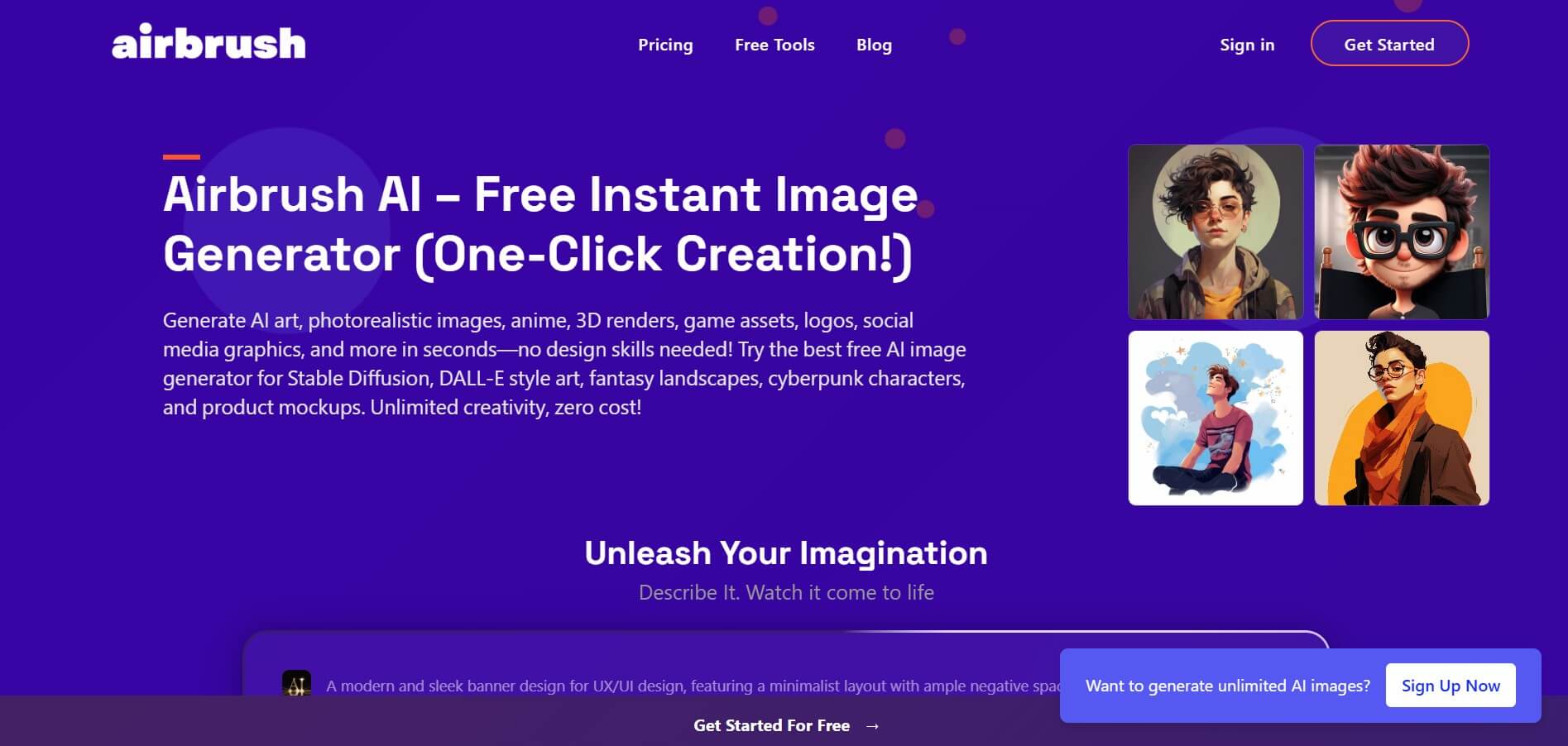
Airbrush is an AI-powered image generation and editing platform that helps users create, enhance, and customize visuals from simple text prompts. It supports multiple AI models and styles, enabling creators to generate artwork, marketing assets, and realistic images quickly without advanced design skills.
 4.7
4.7Palette.fm
Image
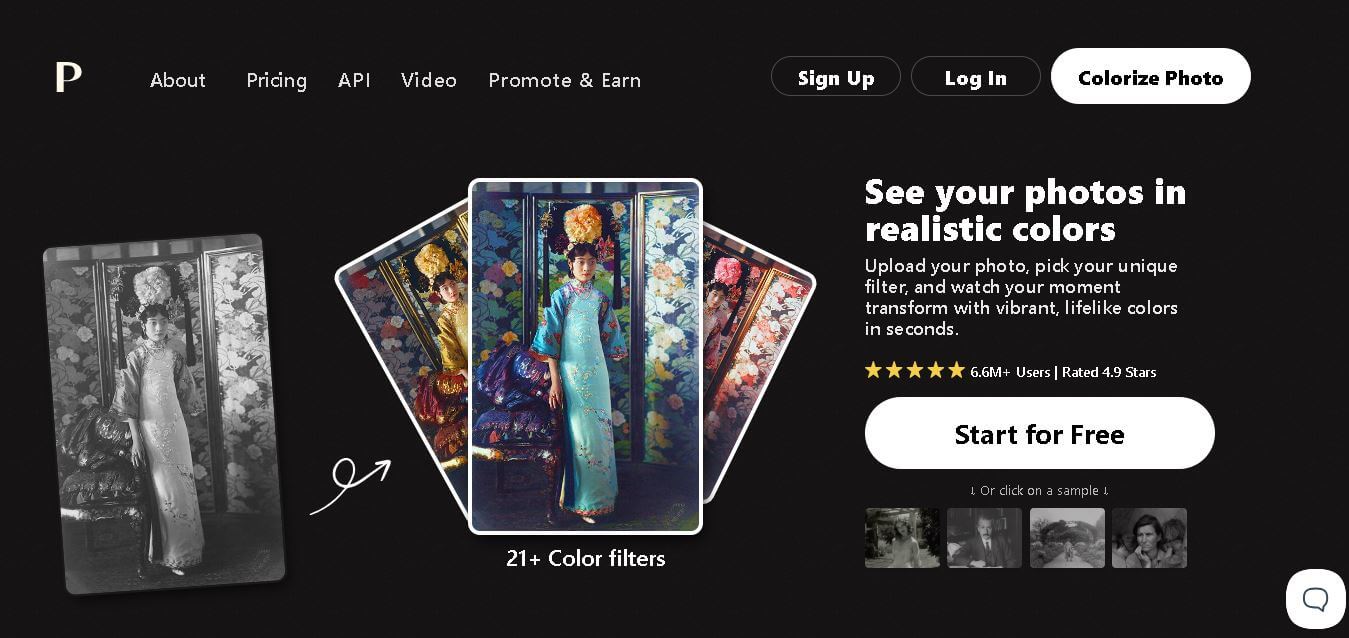
Palette.fm helps turn black-and-white photographs into vivid color images with customizable filters and keyword-based adjustments. You can upload one or multiple photos, preview different looks, and refine the colorization before downloading. The service supports high-resolution outputs for paid credits, making it useful for restoration, creative editing, archives, and photography projects.