What is Chatbot?
A chatbot is a computer program that communicates with people through text or voice. It can answer questions, solve problems, and assist people automatically. Chatbots are used on websites, apps, and messaging platforms to provide quick support, save time, and improve customer experience without needing a human every time.
The chatbot market has grown from a curiosity into a core piece of enterprise software infrastructure in a remarkably short time. The global chatbot market was valued at approximately $7.76 billion in 2023 and is projected to reach $46.6 billion by 2029, according to MarketsandMarkets—a compound annual growth rate of around 34%. That growth reflects the shift from simple scripted bots to genuinely capable AI systems that can handle complex, open-ended interactions.
Salesforce's 2023 State of Service research showed that 61% of service employees feel AI and automation solutions, such as chatbots, are changing client demands. Separately, a Drift survey in 2023 showed that 42% of customers had used a chatbot to make a purchase choice in the preceding year, up from 13% in 2019, indicating the growing normalization of chatbot interactions in ordinary commercial activity.
How Does a Chatbot Work?
The answer is totally dependent on the kind of chatbot. A rule-based customer service bot and a huge language model chatbot have radically different underlying mechanics. Understanding the architecture at each level reveals both the capabilities and constraints of each kind.
- Rule-based chatbots: The earliest and simplest chatbots compare user input against a set of preset rules, keywords, or decision trees. When a user inputs "track my order," the system recognizes the term "track" and directs them to the order-tracking answer. These systems do not need machine learning; instead, developers program them manually, specifying every potential input pattern and its associated output. They are quick, predictable, and simple to audit, but they are fragile: they fail completely when the user expresses their request in a way that the developer did not expect. They fail to understand words; instead, they recognize patterns.
- Retrieval-Based ChatBots: Retrieval-based chatbots select responses from a pre-existing database of candidate responses, which is an improvement above pure rule matching. Given a user message, the system calculates a similarity score between the message and each possible answer, utilizing approaches ranging from TF-IDF to neural phrase embeddings, and returns the highest-scoring match. The quality of the answer is determined by the quality of the response database. These algorithms do not provide original replies, but they can handle more complex phrasings than basic keyword matching. They're often utilized in FAQ bots and knowledge base systems.
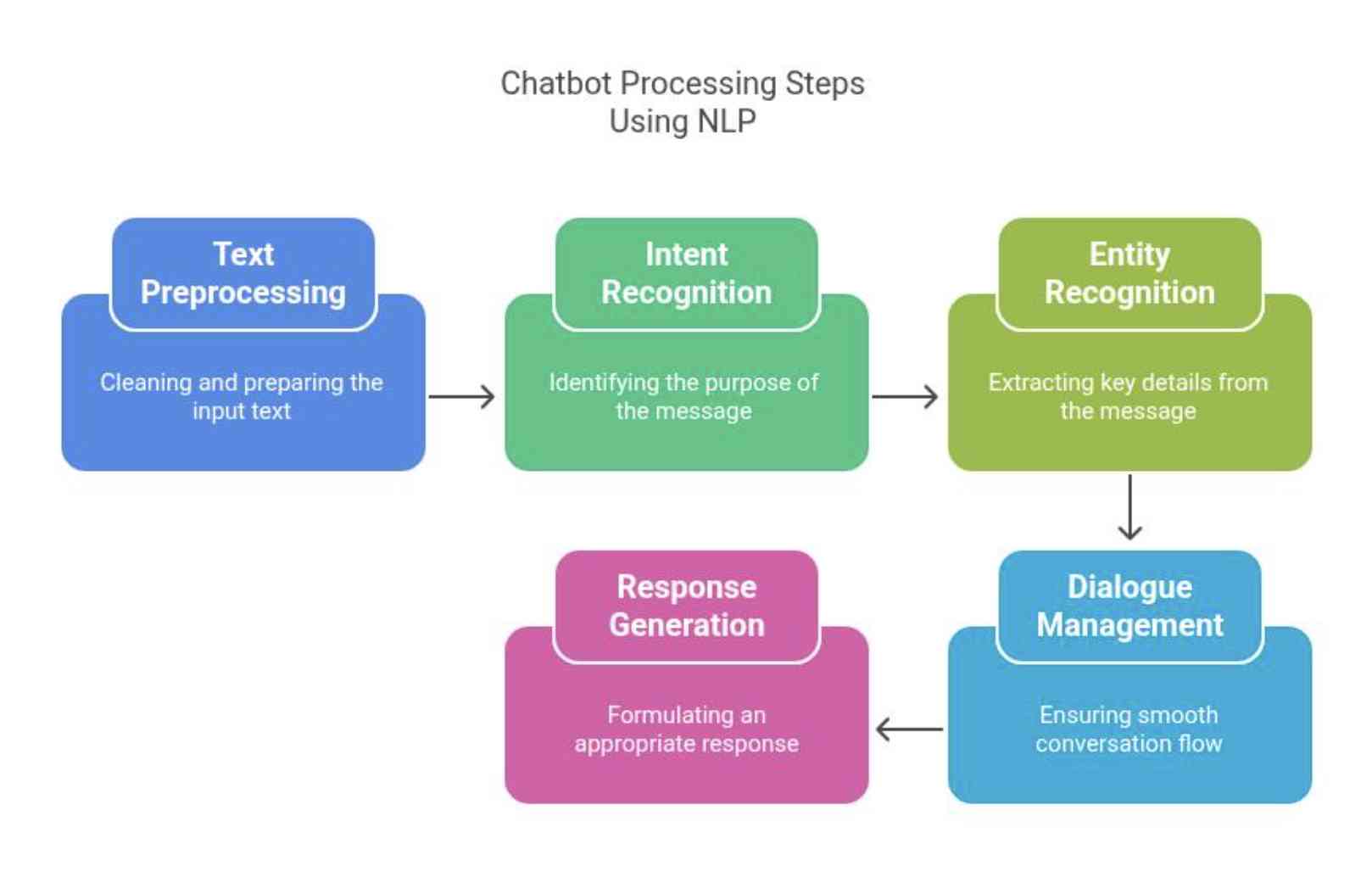
- Intent Classification and Slot Filling: Modern business chatbots often mix intent categorization (determining what the user wants to achieve) with slot filling (extracting the exact information required to fulfill that purpose). A user saying, "Book me a flight to Paris on Friday," activates the "book flight" intent and fills the slots with the destination, Paris, and the date, Friday. The system then uses backend APIs to finish the booking. Rasa, Dialogflow, and the Microsoft Bot Framework employ machine learning classifiers and named entity recognition to address these tasks. They are significantly more adaptable than rule-based systems, but they still require explicit definitions of intentions and things.
- Large Language Model Chatbots: The latest generation of AI chatbots is based on transformer-based large language models trained on huge text corpora using self-supervised learning. Models such as GPT-4, Claude, Gemini, and LLaMA do not match patterns or extract replies; instead, they produce responses token by token, sampling from a probability distribution of probable next words based on the complete conversation history. This generative design is what gives current chatbots their apparent agility, adaptability, and capacity to answer new inquiries.
Why are Chatbots Important?
Chatbots are important because they allow intelligent, responsive interaction with software systems at scale, at any time, and through any channel—without requiring a person on the other end of every discussion. Chatbot usage has increased substantially across sectors due to its accessibility, scalability, and increasingly real capacity.
- Customer Service at Scale: Before AI chatbots, each customer inquiry needed a human representative. Staffing levels determined response times. Support was delayed since it was provided after hours. Chatbots completely break this limitation. A well-designed chatbot can handle thousands of simultaneous chats, react quickly at 3 a.m., speak various languages, and answer the bulk of regular questions without requiring human intervention. According to Juniper Research, chatbots will handle more than 70% of customer service contacts across banking, retail, and healthcare by 2026, saving businesses an estimated $11 billion each year in support costs.
- Access to Information and Expertise: Chatbots powered by LLM have transformed information that was previously only available through expensive professional consultations. A small company owner may have a first-pass legal review, a student in a remote place can receive instruction on any topic, and a non-English speaker can have documents translated and explained—all via a chat interface. This equalization of access to expertise is one of the most socially relevant elements of today's AI chatbots.
- Developer Productivity: Chatbot interfaces have become the main approach many developers communicate with AI, thanks to tools such as GitHub Copilot, which is built on OpenAI's Codex, and conversational coding aids like Cursor. According to studies released by Microsoft Research in 2022, developers who used AI coding assistants finished jobs 55% quicker than those who did not—a productivity boost that has made AI chatbots fundamental to the software development process.
- Research and Knowledge Work: Chatbots that can summarize research articles, do literature reviews, explain statistical methods, and answer domain-specific inquiries have become popular tools in academic and professional research. They do not replace expert judgment, but they do significantly reduce the time required for information collection, synthesis, and first-draft writing.
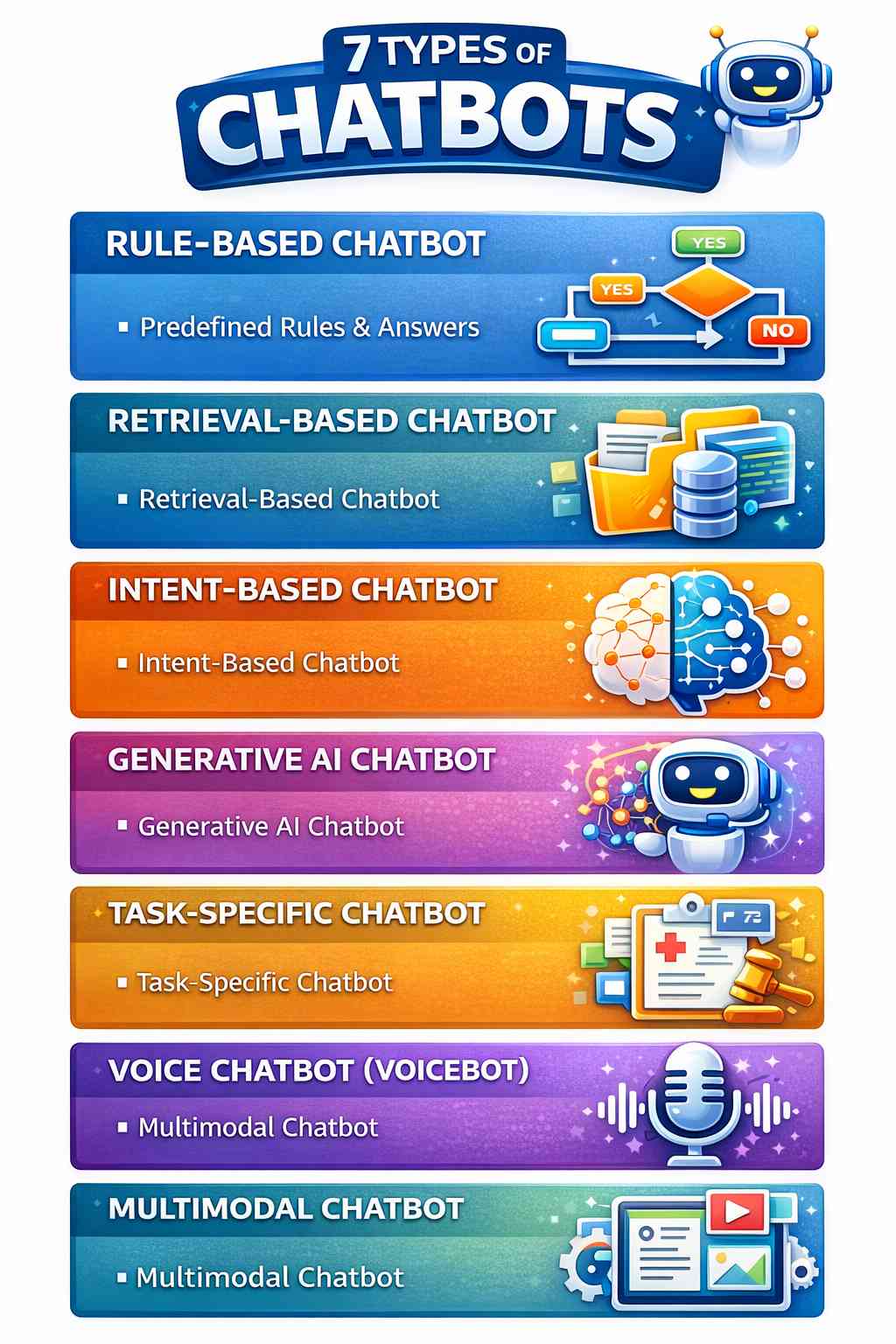
Types of Chatbots
Chatbots are classified along two primary dimensions—their underlying architecture and the domain they serve.
- Rule-Based Chatbot: Responds using predefined decision trees and keyword matching. Fast, predictable, and auditable, yet fragile and narrow in scope. It can only handle queries that follow its predefined patterns. It finds use in basic FAQ pages and customer service scripts.
- Retrieval-Based Chatbot: Selects replies from a curated database by comparing user input to the nearest competitor. More adaptable than rule-based systems, but still limited by the quality and depth of the response library. Used in structured knowledge base systems.
- Intent-Based Chatbot: Utilizes machine learning classifiers to identify user intent and named entity recognition to extract important parameters. Connects with backend systems to execute tasks. The common architecture for customer service bots in businesses. Frameworks like Dialogflow, Rasa, and Amazon Lex power these bots.
- Generative AI Chatbot: Based on large language models, it generates replies from scratch rather than finding or selecting them. Can handle almost any conversational input, participate in long-context conversations, and execute sophisticated linguistic tasks. Examples include ChatGPT, Claude, Gemini, Mistral, and LLaMA-based assistants. The present state of chatbot capabilities.
- Task-Specific Chatbot: Designed and optimized for a single domain or workflow—a medical triage bot, a legal document assistant, a coding helper, or a customer returns bot. May use any of the above architectures but is tuned on domain-specific data to improve accuracy and relevance in its target area.
- Voice Chatbot (Voicebot): A chatbot that receives spoken input and responds with spoken output utilizing automated speech recognition (ASR) and text-to-speech (TTS). It is compatible with devices like Amazon Alexa, Google Assistant, and IVR systems used in telephony. The conversational logic underlying the speech interface employs the same architectures provided above.
- Multimodal Chatbot: Accepts and creates numerous sorts of input and output, including text, graphics, audio, video, and code, all inside a single conversational interface. GPT-4o and Gemini Ultra are modern examples. Represents the direction in which chatbot development is progressing.