What is Temporal?
- Founders: Founded by the creators of Uber Cadence (Maxim Fateev and Samar Abbas)
- Launch: Temporal Technologies launched in 2019
-
Use Cases:
- Microservices orchestration
- Long-running business processes
- Payment and order processing
- Data pipelines and integrations
-
Technology:
- Event-driven architecture
- Durable execution engine
- Supports Go, Java, TypeScript, Python, and PHP
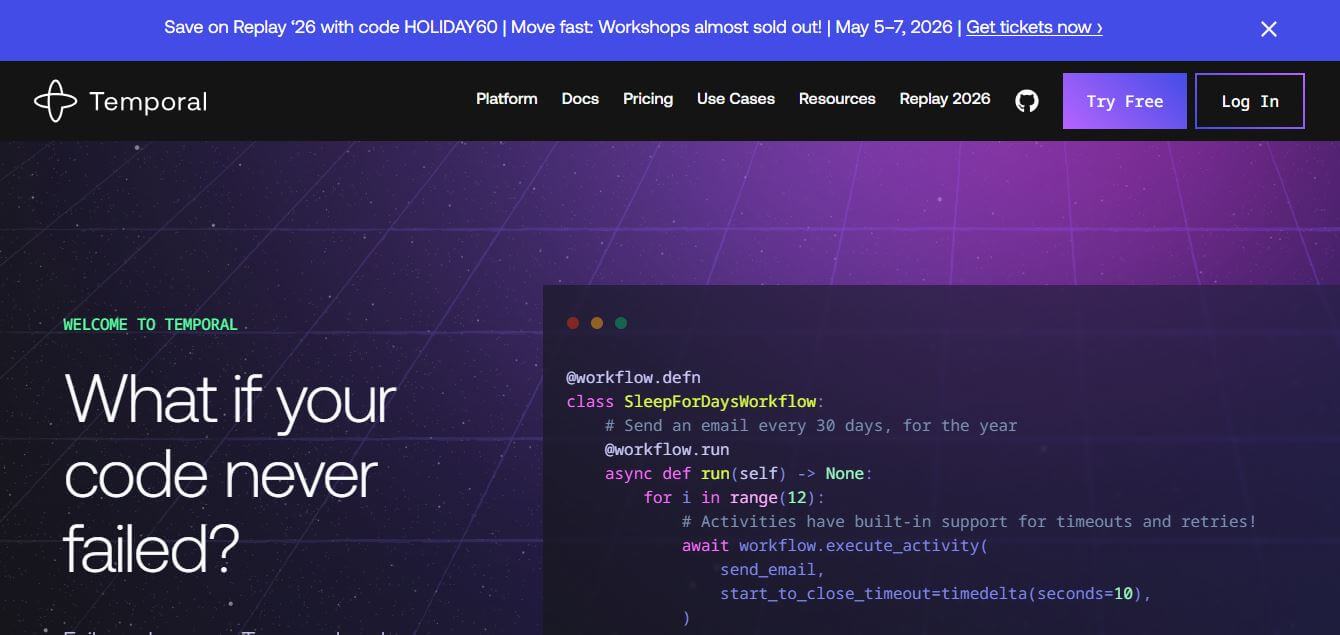
Temporal is an AI-powered workflows platform on a quest to help developers create and operate distributed applications through workflow orchestration and automatic application state management. It makes retries, failures, timeouts, and long-running processes in microservices architecture an implementation detail. Temporal enables developers to code their workflows in the language they know, while the platform takes care of durability and consistency in its own way. By removing all infrastructure-level concerns, Temporal improves developer productivity, lowers operational risk, and keeps applications resilient at scale. Engineering teams that build important systems needing high reliability, scalability, and visibility in distributed environments often choose Temporal.
Key Features
Temporal key features are
- Durable Workflows: Automatically retains workflow states even in crash situations or when restarted.
- Code-First Development: Define workflows using standard programming languages without DSLs.
- Automatic Retries & errors Multiplicity: retry policies and timeouts, as well as failure recovery, are built in.
- Scalability: Millions of concurrent workflows, always performing the same.
- Observability: a view into workflow execution, historical data, and state transitions.
- Versioning Support: Workflows may be evolved with complete safety and without breaking running executions.
- Cloud & Self-Hosted Options: Deploy on Temporal Cloud or manage your own infrastructure.
Pricing
Temporal has designed a managed cloud-based pricing model depending on the number of executions, storage, and usage. In addition to this, Temporal offers open-source self-hosting, which can be run at no cost, excluding infrastructure expenses.
Disclaimer: For the latest and most accurate pricing information, please visit the official Temporal website.
Who is using Temporal?
A wide range of users and organizations are using Temporal
- Large enterprises with distributed systems
- SaaS and cloud-native startups are the primary users.
- The list also includes fintech and payment platforms.
- These encompass e-commerce and logistics enterprises.
- Engineering teams specialize in microservices architecture.
Alternatives
Some Temporal alternatives are
- Apache Airflow
- AWS Step Functions
- Netflix Conductor
- Camunda
- Perfect
Conclusion
Temporal is a compelling workflow orchestration platform for modern distributed applications, dealing with failures, state management, and retries behind the scenes. Therefore, developers can focus on business logic rather than infrastructural complexity. Its scalability, reliability, and developer-friendly nature make it an excellent platform for organizations creating mission-critical systems.
People are also reading:









 Verified