
Muse Glimmer
Muse Glimmer is an open-weights 30-billion-parameter multimodal agentic foundation model released by Meta Superintelligence Labs under an Apache 2.0 license, distilled from Muse Spark and optimized with DFlash speculative decoding to run always-on autonomous agent workflows locally on consumer GPUs and Apple Silicon Macs.
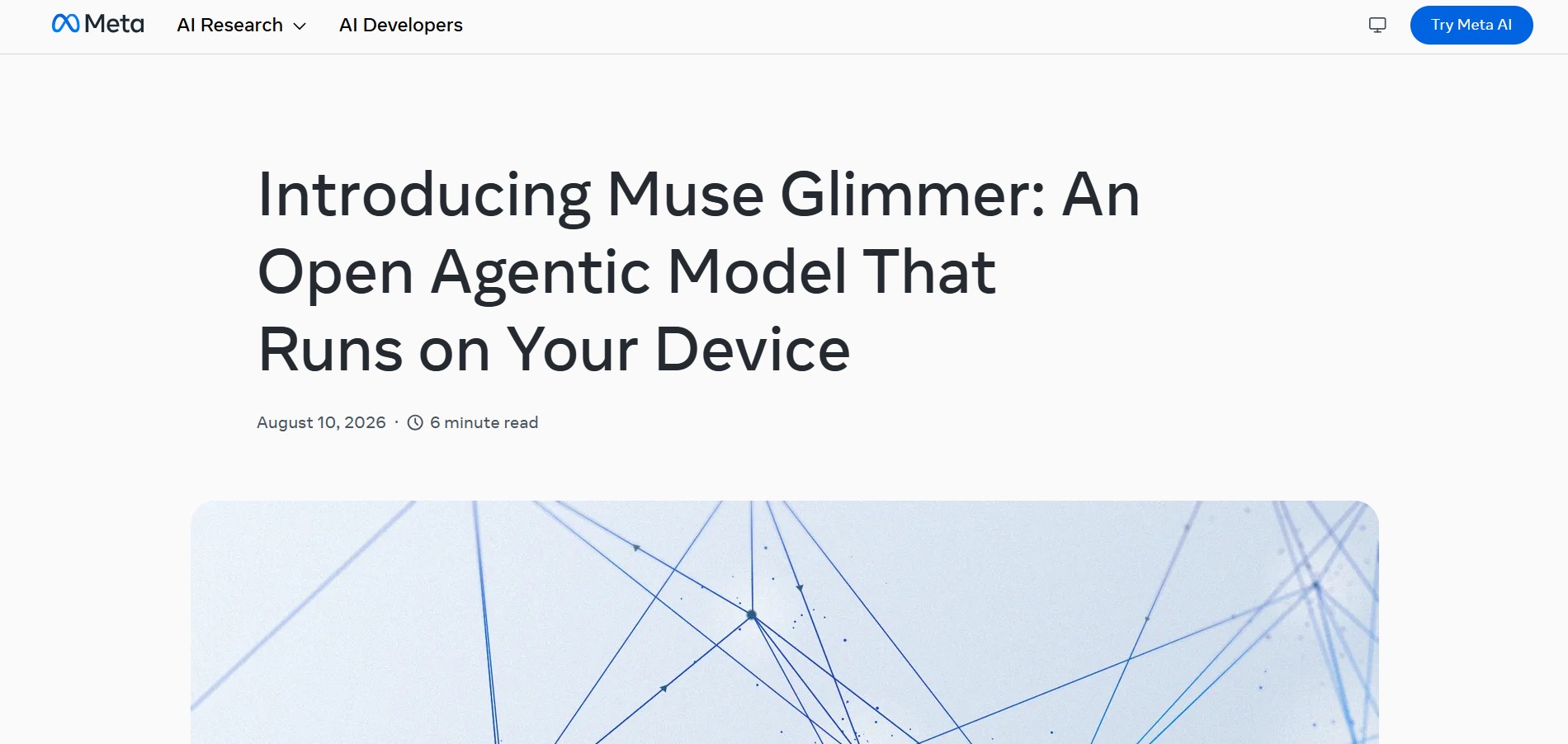
What is Muse Glimmer?
Muse Glimmer is an open-weighted multimodal foundation model, autonomous local agent runtime, and developer-focused reasoning engine developed by Meta Superintelligence Labs. Released in August 2026 under a permissive Apache 2.0 license, Muse Glimmer is Meta's flagship entry into device-native agentic AI, designed to close the performance gap between monolithic cloud-hosted frontier APIs and private, consumer-grade desktop hardware.
Positioned around the principle of “An open agentic model that runs on your device,” Muse Glimmer features a dense 30-billion-parameter causal transformer architecture distilled directly from Meta's teacher model, Muse Spark. Built specifically to power always-on personal agents that organize local files, manage schedules, write code, and navigate tools privately without sending company data to external cloud providers, the model integrates a native perception encoder for interleaved text and image understanding (interpreting screenshots, UI layouts, charts, and documents). Sized down through 4-bit quantization from over 55 GB to under 20 GB of memory, Muse Glimmer runs within a standard 24 GB or 32 GB VRAM envelope (such as RTX 3090/4090/5090 or Apple Silicon unified memory). Utilizing DFlash speculative decoding for accelerated generation and trained across 100+ languages with native failure-recovery reflexes, Muse Glimmer is 100% free to download and self-host on Hugging Face.
- Research Organization: Meta Superintelligence Labs (Meta AI Research)
- Architecture & Licensing: 30B Dense Transformer | Native ViT Perception Encoder | Apache 2.0 Permissive Open Weights
- Target Hardware Footprint: 4-bit compressed to <20 GB (runs on 24 GB/32 GB VRAM GPUs and 32 GB+ Apple Silicon Macs)
Use Cases:
- Operating always-on, privacy-first personal desktop agents that organize local file directories, draft email correspondence, and schedule calendar meetings without internet connectivity
- Running local software engineering and debugging workflows inside developer harnesses like OpenClaw, SWE-bench scaffolds, and local terminal environments
- Parsing multimodal screenshots, architectural diagrams, PDF contracts, and system dashboards locally on edge workstations
- Executing long-horizon function calling and Model Context Protocol (MCP) tool sequences with automated retry mechanisms when external APIs fail
- Serving as a fast, cost-free local judge model (LLM-as-a-judge) to score and evaluate output quality across larger AI generation pipelines
Technology:
- Logit and trajectory distillation pipeline transferring complex long-horizon reasoning and planning capabilities from Muse Spark into a 30B dense model
- Integrated perception encoder converting interleaved visual inputs and screenshots into up to 4,096 visual tokens for native multimodal comprehension
- DFlash block speculative decoding where an integrated companion drafter proposes token blocks in parallel, significantly accelerating local generation speeds
Target Users:
- Autonomous AI agent builders and software engineers deploying local agent loops on Ollama, llama.cpp, LM Studio, and MLX
- Enterprise teams subject to strict regulatory compliance and data sovereignty constraints (such as healthcare, legal, and defense sectors)
- Local AI enthusiasts and researchers operating private workstations with RTX 3090/4090/5090 GPUs or Apple Silicon MacBook Pros
- DevSecOps and QA engineers evaluating tool execution and multi-step function schemas without recurring cloud API expenses
Acquisition: Open-source foundation model published and maintained by Meta Superintelligence Labs

What are the key features of Muse Glimmer?
Muse Glimmer's key platform features are
- Device-Native 30B Architecture: Dense 30-billion-parameter model designed to deliver frontier-level agentic reasoning while remaining deployable on consumer-grade hardware.
- Permissive Apache 2.0 Licensing: Fully open weights released without commercial restrictions, allowing unconstrained enterprise fine-tuning, integration, and commercial monetization.
- Native Multimodal Vision Encoder: Dedicated perception encoder processes interleaved text, screenshots, diagrams, and scanned pages in a single context without requiring external vision adapters.
- Autonomous Failure Recovery: Deliberately trained to diagnose tool execution errors, malformed schema payloads, or unexpected server responses and automatically formulate alternative retry paths rather than halting.
- DFlash Speculative Decoding: Ships with an integrated drafter network that proposes multi-token blocks for parallel verification, delivering noticeably faster inference than traditional autoregressive generation.
- Consumer Hardware Fit: Quantizes down to ~4-bit precision to occupy under 20 GB of memory, leaving sufficient headroom in 24 GB and 32 GB envelopes for large KV caches and tool contexts.
- Broad Local Runtime Compatibility: Day-one support across major open-source inference ecosystems including Ollama, LM Studio, llama.cpp, ExecuTorch, Unsloth, and Apple MLX.
- Controllable Reasoning Effort: Adjust the model's reasoning depth and thinking steps dynamically to balance ultra-fast responses against deeper analytical precision.
How much does Muse Glimmer cost and how is it licensed?
Muse Glimmer operates on a completely free, open-weights distribution model with zero software licensing costs or subscription fees.
Open Weights & Community Access:
- $0 / Free (Apache 2.0 License): Download weights directly from Hugging Face for unrestricted local execution, fine-tuning, commercial deployment, and private hosting
- Zero recurring software subscription fees, seat licenses, or per-token usage charges
Hardware Infrastructure Requirements:
- NVIDIA Desktop GPUs: RTX 3090 (24 GB), RTX 4090 (24 GB), or RTX 5090 (32 GB) running 4-bit quantized builds
- AMD & Workstation GPUs: AMD Radeon AI PRO R9700 or workstation accelerators with 32 GB+ VRAM
- Apple Silicon Mac: Mac Studio or MacBook Pro with M-series chips and 32 GB, 64 GB, or 128 GB of unified memory running via MLX or llama.cpp
Disclaimer: While model weights are free under the Apache 2.0 license, running the model locally requires compatible consumer or workstation GPU hardware. For model weights, documentation, and scaffold recipes, visit research.meta.ai or Hugging Face.
Who should use Muse Glimmer?
Muse Glimmer is designed for engineers, researchers, and organizations, including
- Local AI Agent Developers: Building autonomous desktop coworkers that interact with local file systems, command-line interfaces, and web browsers via MCP
- Privacy-Sensitive Enterprises: Analyzing sensitive legal documents, internal financial spreadsheets, and source code without transmitting data to external third-party cloud vendors
- Edge AI Engineers: Deploying multimodal inspection and decision-making logic on local industrial hardware and on-premise compute nodes
- Software Development Teams: Setting up cost-free code analysis, PR review bots, and unit testing agents running on internal developer workstations
What are the best alternatives to Muse Glimmer?
Some of the strongest Muse Glimmer alternatives include
- Qwen 3.6 27B
- Gemma 4 31B
- DeepSeek-R1
- GLM-5.3
- Claude 3.7 Sonnet
- Llama 3.3 70B
What are the pros and cons of Muse Glimmer?
What are the pros of Muse Glimmer?
- Distilled from Meta's flagship Muse Spark, bringing strong multi-step agentic capabilities to a manageable 30B parameter size
- Permissive Apache 2.0 license allows complete freedom for commercial modification, integration, and deployment
- Runs locally on a single consumer GPU (RTX 3090/4090/5090) or Apple Silicon Mac using under 20 GB of memory at 4-bit
- Includes DFlash speculative decoding, delivering noticeable speedups over standard local autoregressive token generation
- Equipped with autonomous failure recovery to self-correct and retry failed tool calls rather than crashing
What are the cons of Muse Glimmer?
- Requires capable GPU hardware with at least 24 GB of VRAM or 32 GB+ unified memory to run comfortably with long context
- As a 30B local model, it cannot match the raw reasoning depth of massive multi-hundred-billion cloud models on niche, ultra-complex problems
- Requires users and teams to configure their own guardrails, scaffolding frameworks, and inference runtimes
Why should you choose Muse Glimmer?
Many developers building autonomous agents find themselves caught between expensive, privacy-compromising cloud APIs and lightweight open-source models that struggle with complex multi-step tool calls. Muse Glimmer bridges this gap directly on local hardware.
- Keeps all your personal documents, proprietary codebases, and tool execution logs entirely on your local machine
- Eliminates monthly per-token API charges and rate limits by running directly on your own GPU
- Handles complex real-world workflows thanks to targeted training on failure recovery and long-horizon tool use
- Integrates seamlessly into popular local runtimes like Ollama, LM Studio, llama.cpp, and MLX on day one
How does Muse Glimmer compare to competitors?
The main difference between Muse Glimmer, Qwen 3.6 27B, Gemma 4 31B, and Claude 3.7 Sonnet lies in operational deployment, distillation lineage, and agent-focused optimization. While Claude 3.7 Sonnet operates exclusively as a closed, proprietary cloud service, and models like Qwen and Gemma prioritize broad general text completion, Muse Glimmer is purpose-built as an open-weights agentic model—combining multimodal vision, long-horizon tool execution, and speculative decoding into a package optimized to fit inside a 24 GB to 32 GB hardware envelope.
| Feature / Metric | Muse Glimmer | Qwen 3.6 27B | Gemma 4 31B | Claude 3.7 Sonnet |
|---|---|---|---|---|
| Model Architecture | 30B Dense Multimodal Transformer | 27B Dense Transformer | 31B Dense Transformer | Proprietary Frontier Model |
| Licensing | Apache 2.0 (Permissive) | Apache 2.0 | Gemma Open Terms | Proprietary Commercial API |
| Local Deployment Footprint | <20 GB (4-bit quantized) | ~16–18 GB (4-bit) | ~19–21 GB (4-bit) | Cloud Only (No local hosting) |
| Native Multimodal Vision | Yes (Interleaved text & images) | Separate Vision Variant (Qwen-VL) | Native Multimodal | Yes (Vision enabled) |
| Speculative Decoding Support | Yes (Integrated DFlash drafter) | Third-party draft configurations | External setup required | Cloud managed |
| Software Cost | Free open weights | Free open weights | Free open weights | Pay-per-token API |
| Best For | Local autonomous agents with vision & tool calling | Multilingual text generation & coding | General on-device academic & chat tasks | Complex cloud reasoning & commercial agent workflows |
How do we rate Muse Glimmer?
| Parameter | Rating (out of 5) |
|---|---|
| Agentic Tool Calling & Failure Recovery | 5.0 |
| Local Hardware Deployability (4-Bit <20 GB) | 4.9 |
| Inference Velocity (DFlash Speculative Decoding) | 4.9 |
| Multimodal Perception & Document Parsing | 4.8 |
| Value for Money (Apache 2.0 Open Source) | 5.0 |
| Overall Score | 4.92 |
What is our review and verdict on Muse Glimmer?
Muse Glimmer represents a substantial technological step forward for local, self-hosted artificial intelligence. By deliberately engineering a 30B dense model for practical agentic workflows—rather than just benchmark score chasing—Meta Superintelligence Labs has delivered a system that excels at multi-step tool use, visual comprehension, and automated error recovery. Its ability to fit comfortably inside consumer GPU memory while utilizing DFlash speculative decoding makes local agent execution feel fast and responsive. Under a permissive Apache 2.0 license, Muse Glimmer offers developers and enterprises a capable foundation for building private, always-on AI agents that run entirely on their own hardware.
What is the final conclusion on Muse Glimmer?
Muse Glimmer proves that high-performance agentic AI can thrive on consumer hardware. With its distilled 30B dense architecture, integrated multimodal perception, built-in tool failure recovery, DFlash accelerated speculative decoding, and permissive Apache 2.0 open-weights release, Muse Glimmer provides developers and organizations with the definitive foundation for running private, autonomous AI agents locally.
FAQ
What is Muse Glimmer and why is it important?
Muse Glimmer is a 30B-parameter open-weight agentic AI model from Meta designed to run locally on your own device (Mac/PC) instead of relying on cloud APIs. It’s important because it brings powerful AI agents closer to users—improving privacy, speed, and cost efficiency.
What does “agentic model” actually mean in this context?
It means the model can complete tasks end-to-end, not just generate text. Muse Glimmer can plan workflows, call tools, debug code, recover from failures, and handle multi-step tasks over long interactions—like a real AI assistant executing work.
Can Muse Glimmer really run on a local machine?
Yes. It’s optimized to run on consumer hardware (24–32GB GPU or modern Macs) using quantization techniques that reduce memory usage to under ~20GB, making local deployment practical.
Does Muse Glimmer support images or only text?
It’s multimodal, meaning it can process both text and images together (like screenshots, charts, or documents) using a dedicated perception encoder. This makes it useful for more complex workflows than text-only models.
Does Muse Glimmer support images or only text?
Muse Glimmer is a multimodal model, meaning it can process both text and images together. It can understand screenshots, diagrams, and other visual inputs alongside written instructions, which makes it more capable in scenarios where visual context is important, such as UI debugging or data interpretation.
Is Muse Glimmer open-source and customizable?
Yes, Muse Glimmer is released under an open license (Apache 2.0), which allows developers to freely use, modify, and deploy it in their own applications. This flexibility makes it attractive for teams that want to customize AI
How is Muse Glimmer different from cloud AI models like GPT or Claude?
The main difference lies in its local-first approach, as Muse Glimmer runs directly on your device instead of remote servers. This results in improved privacy, lower long-term costs since there are no API usage fees, and faster response times for continuous workflows, making it especially suitable for enterprise environments and offline applications.
User Reviews
No reviews yet for Muse Glimmer.
Featured Tools
Featured AI tools from TechShark
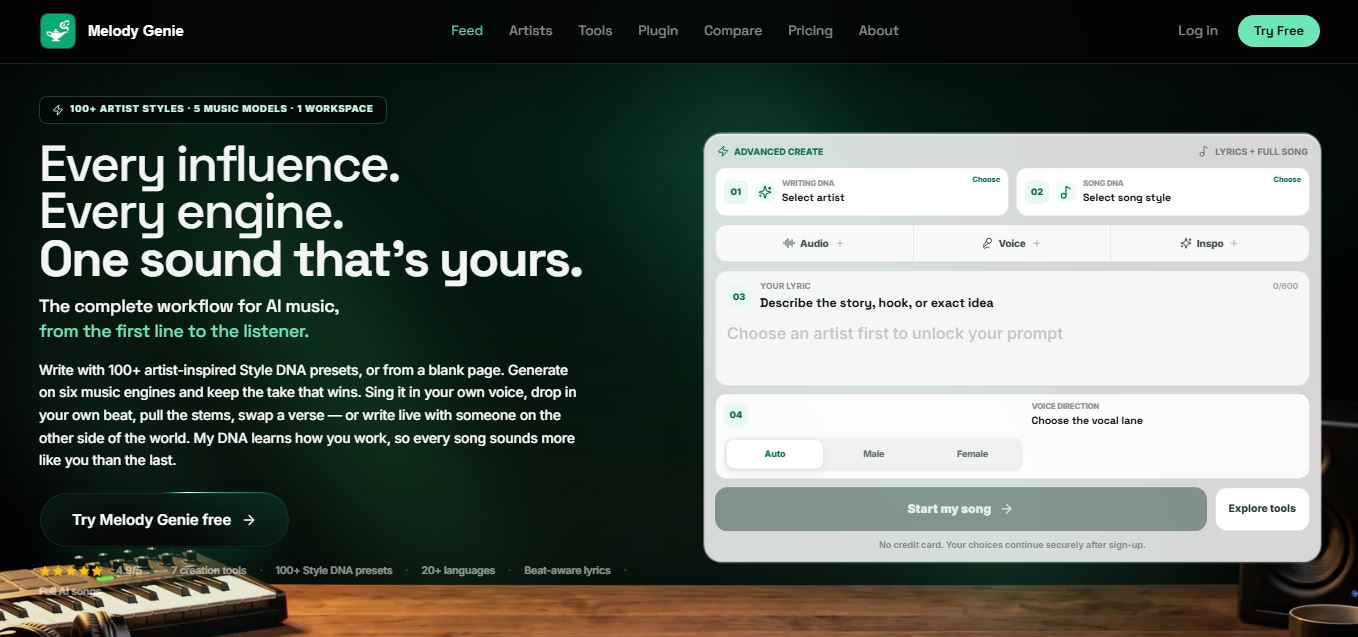
Melody Genie
MelodyGenie is an AI-powered music generator that creates original songs from simple text prompts. Users can choose styles, moods, and genres, then instantly generate melodies and full tracks, making it easy for creators, marketers, and hobbyists to produce custom music without musical expertise.
Freemium
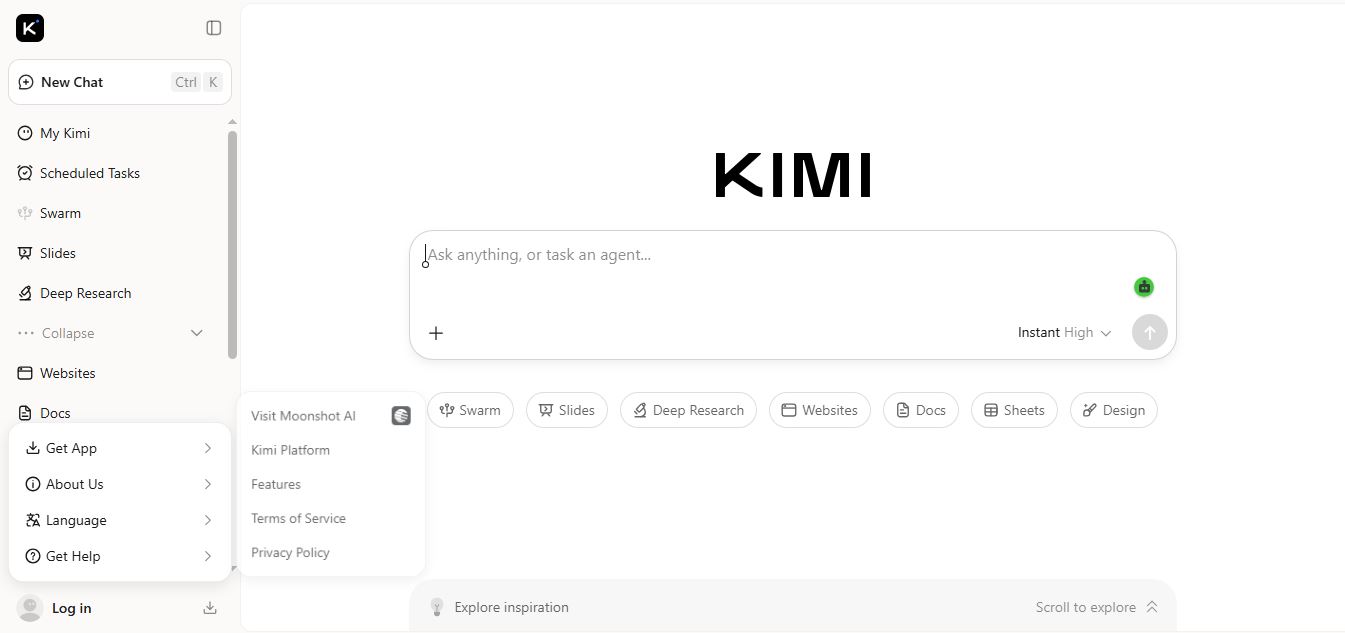
Kimi AI
Kimi AI is an advanced AI assistant developed by Moonshot AI that helps you chat, research, write, code, and automate tasks in one place. It supports web search, file analysis, and multimodal inputs, and can even run autonomous “agent” workflows to complete complex tasks end-to-end.
Freemium

Fashion Diffusion AI
Fashion Diffusion is an AI-powered fashion design platform that helps brands and designers create clothing designs, virtual try-ons, AI models, product photos, and marketing visuals faster and cost-effectively.
Paid
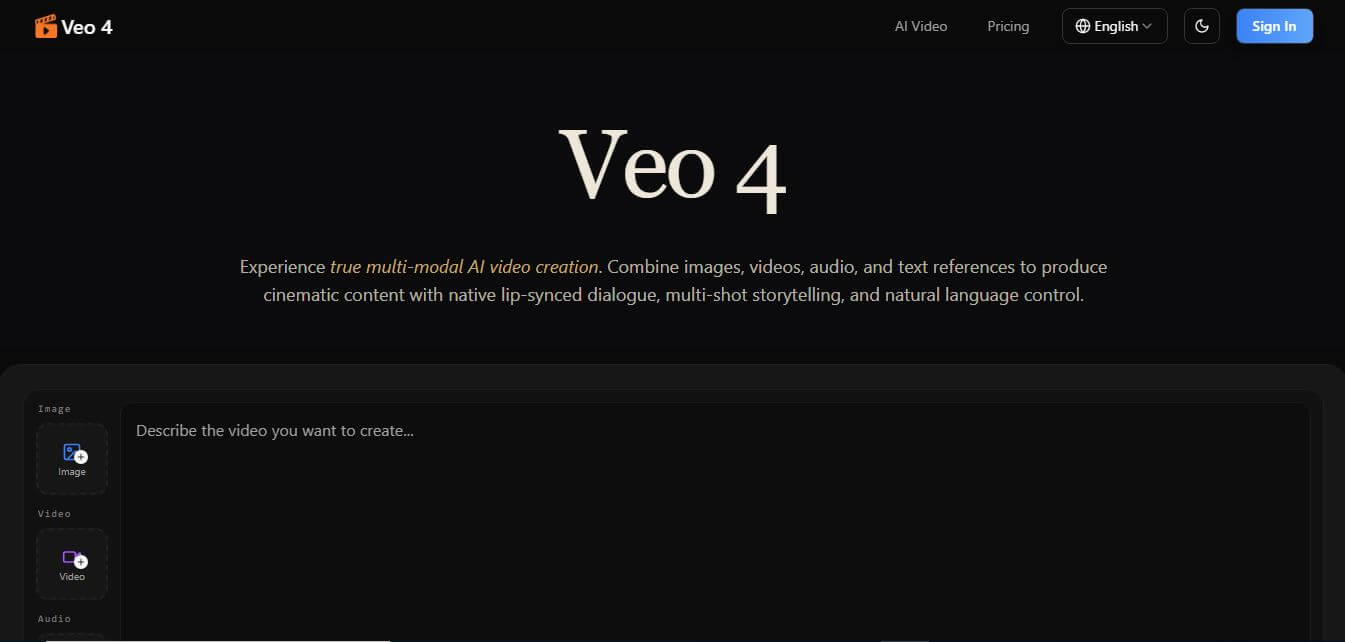
Veo 4
Veo 4 AI is an AI video creation platform that generates dramatic videos from text, images, audio, and video prompts using realistic motion and synchronized sound.
Paid
Alternatives
Alternatives to Muse Glimmer
The best Muse Glimmer alternatives include Qwen 3.6 27B, Gemma 4 31B, DeepSeek-R1, GLM-5.3, Claude 3.7 Sonnet, and Llama 3.3 70B.
Brand24
AI Agent
Brand24 (brand24.com) is an AI-powered media monitoring, social listening, and brand reputation management platform that enables marketing teams, PR agencies, and businesses to track online mentions, measure social sentiment, analyze audience reach, and monitor competitors across web and social channels.
BuzzSumo
AI Agent
BuzzSumo (buzzsumo.com) is a premier content intelligence, media monitoring, and influencer discovery platform designed for content marketers, digital agencies, PR professionals, and SEO strategists to analyze viral content trends, research journalists, and track brand coverage across web and social channels.
Rival IQ
AI Agent
Rival IQ (rivaliq.com) is a premier enterprise-grade competitive social media analytics, auditing, and benchmarking platform designed for digital marketing agencies, brand strategists, and enterprise marketing teams to analyze competitor performance, detect boosted posts, monitor social listening, and generate custom automated reports.
Keyhole
AI Agent
Keyhole (keyhole.co) is a real-time social media listening, hashtag tracking, competitor analysis, and influencer analytics platform designed for marketing agencies, enterprise brands, and PR teams to measure campaign reach, monitor brand sentiment, and optimize social strategies across major social networks.
Mention
AI Agent
Mention (mention.com) is an easy-to-use media monitoring, brand listening, and social media management platform that enables brands and agencies to track online mentions, analyze sentiment across web and social channels, schedule posts, and manage reputation in real time.
Talkwalker
AI Agent
Talkwalker (talkwalker.com) is a premier AI-powered enterprise social listening, consumer intelligence, and media monitoring platform that enables global brands and agencies to analyze social media, online news, broadcast media, and customer feedback across 187+ languages in real time.
Tailwind
AI Agent
Tailwind (tailwindapp.com) is an all-in-one social media scheduling, AI marketing, and visual design platform tailored for Pinterest, Instagram, and Facebook, offering smart visual planning, automated Ghostwriter AI copywriting, Pinterest Communities, and multi-channel publishing.
MeetEdgar
AI Agent
MeetEdgar (meetedgar.com) is an automated, category-based social media scheduling and content recycling platform designed for freelancers, small business owners, and digital marketers to organize updates into endless libraries, auto-generate post variations with AI, and keep feeds active on repeat.
Agorapulse
AI Agent
Agorapulse (agorapulse.com) is an enterprise-grade social media management, community engagement, and social ROI attribution platform designed for marketing agencies, mid-market businesses, and brands to streamline publishing, unify social inboxes, monitor conversations, and track revenue metrics across major social networks.