
What is Lily AI?
- Founders: Purva Gupta and Sowmiya Chocka Narayanan
- Launch: 2015
-
Use Cases:
- Product catalog enrichment
- On-site search and product discovery optimization
- SEO and advertising performance improvements
- Marketplace and multi-seller product normalization
-
Technology:
- Artificial intelligence and machine learning
- Natural language processing
- Visual AI and proprietary retail datasets
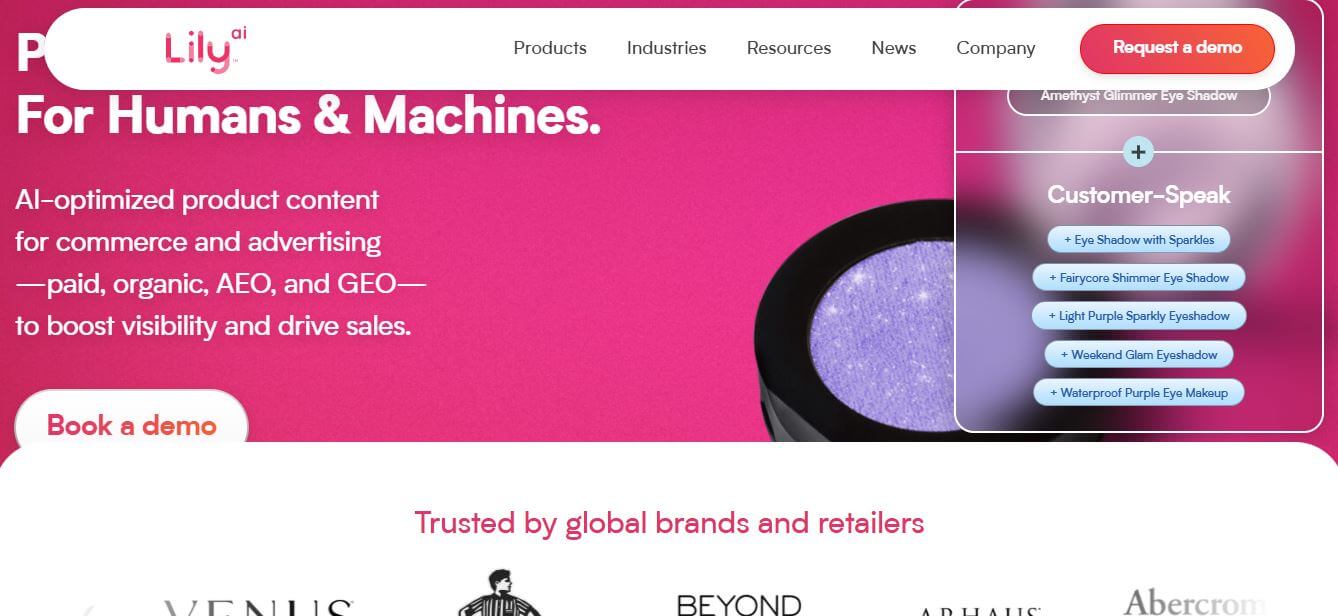
Lily AI is an AI-powered e-commerce platform that helps retailers connect the dots between how they describe products and how consumers search for them. By converting all merchant-centric product information into views and attributes that are friendly to shoppers, Lily AI enhances product visibility and relevance across digital platforms. It uses advanced artificial intelligence to upgrade product catalogs with detailed descriptors, enabling better on-site search, SEO, and merchandising. Retailers get improved discoverability, more engagement, and higher conversion rates, while shoppers receive a more intuitive and personalized shopping experience across categories and touchpoints.
Key Features
Lily AI key features are
- AI-enabled product attribute enhancement.
- Write the product description to attract customers.
- Improved customer-friendly onsite search and merchandising.
- The metadata and structured attributes have been enhanced for SEO purposes.
- Tagging based on trends, styles, and occasions.
- The catalog architecture is massively scalable to accommodate large inventories.
- Continuous learning and improving performance.
Pricing
- Free trial available
- Subscription-based pricing
- Custom plans offered
- Enterprise pricing available
Disclaimer: For the latest and most accurate pricing information, please visit the official Lily AI website.
Who's Using it?
A wide range of users and organizations are using Lily AI
- Bloomingdale’s
- Macy’s
- Gap
- thredUP
- Marks & Spencer
- J. Crew Group
- Bridge Furniture & Props
- Fabletics
Alternatives
Some Lily AI alternatives are
- PIMs powered by AI
- Search and merchandising engines are mainly for commerce.
- Catalog enrichment & optimization.
- Digital merchandising and analytics in retail
Conclusion
Lily AI liberates retailers from modernizing product content in style to be in line with consumer behavior, finding meaning in complex product data, and molding it into shopper-centric insights with optimized search performance and an improved customer experience that leads to real, measurable revenue growth. This application would be of enormous benefit to those brands with scalable e-commerce success plans.
People are also reading









 Verified