Epho
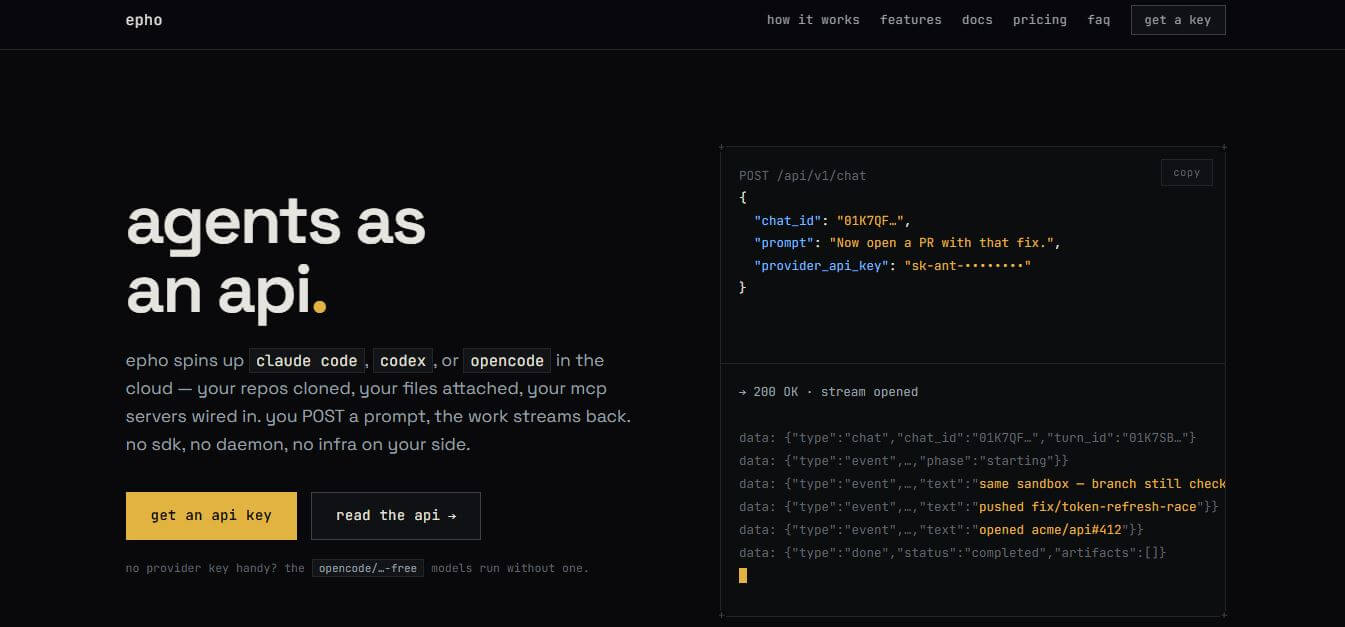
Epho (epho.io) is an AI agents-as-an-API platform that allows developers to run coding agents like Claude Code, Codex, and OpenCode in serverless cloud sandboxes via a single REST API request with streaming outputs, MCP support, and repository cloning.
What is Epho?
Epho (epho.io) is a cloud-based "agents-as-an-API" platform designed for software engineers, AI developers, and DevOps teams. It allows developers to run autonomous coding agents—including Claude Code, Codex, and OpenCode—in serverless cloud sandboxes via a single REST API endpoint. Featuring real-time Server-Sent Events (SSE) streaming, automatic repository cloning, Model Context Protocol (MCP) server integration, session persistence, and multi-provider failovers, Epho provides a turnkey backend for running coding agents in the cloud.
Epho provides a zero-setup REST API endpoint (
POST /api/v1/chat) that launches fully configured coding agent sandboxes in seconds. The platform supports multiple major coding agent harnesses (Claude Code, Codex, and OpenCode) with automatic provider failovers across underlying sandbox infrastructure. Supporting per-second billing starting at approximately $0.0000438 per second with a $10 initial trial credit, Epho enables developers to run autonomous code reviews, bug fixes, and data scripts in parallel without managing local background daemons or dedicated servers.
- Founder / Creator: Burak Karakan
- Launch Year: 2026
- Use Cases:
- Autonomous GitHub pull request reviews and automated code generation
- GitHub issue-to-PR automated conversion pipelines via async webhooks
- Interactive data-to-chart analysis agents with downloadable visual artifacts
- Slack and Discord developer bot agents with multi-turn conversation memory
- Technology:
- Serverless cloud sandbox provisioning with automatic provider failovers
- Turnkey execution harnesses for Claude Code, OpenAI Codex, and OpenCode
- Model Context Protocol (MCP) integration and Server-Sent Events (SSE) streaming
- Target Users:
- AI application developers and autonomous agent engineers
- DevOps engineers, CI/CD architects, and developer tooling specialists
- Software engineering leads and open-source project maintainers
- Tech startups building coding copilots and automated development products
- Acquisition: Operates as an independent developer infrastructure product

Key features of Epho
Epho's key features are
- Single-Endpoint REST API: Launch and orchestrate full AI coding agents via a single
POST /api/v1/chatrequest without installing SDKs or daemons. - Multi-Harness Support: Easily toggle between Claude Code, OpenAI Codex, and OpenCode within the same standardized API payload.
- Real-Time Event Streaming (SSE): Streams token outputs, tool invocations, terminal logs, and finished artifacts in real time over Server-Sent Events.
- Bring Your Own Key (BYOK): Pass your own Anthropic or OpenAI provider keys directly per request, keeping token billing tied directly to your provider accounts.
- Native Git & File Integration: Automatically clones repositories from GitHub, GitLab, or Bitbucket and mounts input files into the agent sandbox.
- Model Context Protocol (MCP) Support: Wire custom MCP servers and tools directly into the agent environment at startup.
- Session Persistence & Multi-Turn Chats: Maintain conversational state and file system context across multiple turns using persistent
chat_idparameters. - Multi-Provider Failover & Snapshots: Automatically captures session snapshots and redeploys onto fallback sandbox backends if an underlying node fails.
Epho Pricing
Epho operates on a pure compute-by-the-second infrastructure model alongside starter credits and free model tiers.
Free Starter Credit:
- $10 free compute credit upon sign-up and email verification
- Free model options available via OpenCode with zero provider API costs
Compute Usage Pricing:
- Default Instance: Approximately $0.0000438 per second (~$0.0026 per minute)
- Usage-based scaling based on vCPU and memory allocation
Model Token Costs (BYOK):
- Supply your own provider API keys (Anthropic / OpenAI) with zero token markup from Epho
Disclaimer: For the latest API documentation and instance pricing, please visit the official Epho website at epho.io.
Who is using Epho?
Epho is designed for a broad range of developers and engineering teams, including
- AI Engineers: Embedding autonomous code generation and refactoring features into SaaS products
- DevOps Teams: Running automated code review bots and automated issue-to-pull-request workflows
- Open-Source Maintainers: Automating issue triage, documentation updates, and automated dependency upgrades
- Data Teams: Using coding agents to ingest CSV/SQL data and generate dynamic charts as downloadable artifacts
- Bot Developers: Building Slack or Discord developer bots that execute multi-turn terminal commands in the cloud
Best Epho Alternatives
Some of the strongest Epho alternatives include
- E2B
- Daytona
- Modal
- OpenHands
- Aider
- Fly.io
Pros and Cons of Epho
Pros
- Eliminates the operational complexity of building and maintaining custom sandbox infrastructure
- Unified REST API runs Claude Code, Codex, and OpenCode with identical request structures
- Real-time SSE streaming delivers instant terminal logs and downloadable artifact links
- BYO key model ensures zero markup on LLM tokens and full control over provider billing
- Automatic multi-provider fallbacks prevent lost sessions if a cloud sandbox crashes
Cons
- Requires familiarity with REST APIs, JSON payloads, and developer integration workflows
- High-concurrency agent pipelines require monitoring infrastructure compute seconds
- Specific niche system runtimes (like legacy .NET) may require custom environment configuration
- Primarily built for programmatic API execution rather than a standalone visual consumer IDE
Why Choose Epho?
Epho is the ideal choice for developers and product teams who want to run autonomous coding agents in the cloud without building, securing, and maintaining custom sandbox infrastructure.
- Runs Claude Code, Codex, and OpenCode in the cloud with a single HTTP POST request
- Clones repositories, mounts files, and connects MCP servers automatically
- Streams real-time terminal output and delivers signed artifact download links
- Recovers automatically from sandbox failures with session state restoration
- Only charges for infrastructure runtime per second with zero markup on model tokens
Epho vs. Competitors
The main difference between Epho, E2B, Daytona, and OpenHands is that Epho provides pre-warmed, fully configured coding agent harnesses (Claude Code, Codex, OpenCode) through a single REST endpoint with built-in MCP integration, whereas E2B provides bare code-interpreter sandboxes requiring manual agent orchestration, Daytona focuses on developer workspace environments, and OpenHands is an open-source agent framework requiring self-hosting. Epho stands out for its turnkey "agents-as-an-API" delivery model.
| Feature / Tool | Epho (epho.io) | E2B | Daytona | OpenHands |
|---|---|---|---|---|
| Core Focus | Agents-as-an-API (Claude Code/Codex) | Code Interpreter Sandboxes | Standardized Dev Environments | Open-Source Agent Framework |
| Turnkey Agent Harnesses | Yes (Claude Code, Codex, OpenCode) | No (Bare Sandbox / Custom) | No (Workspace Focus) | Yes (Self-Hosted) |
| API Integration | Single REST Endpoint (/chat) | SDK / REST API | CLI & API | Web UI / Python API |
| Built-in MCP Server Wiring | Yes | Manual Setup | Manual Setup | Limited |
| Billing Model | Per-Second Infrastructure + BYOK | Usage / Compute Tiers | Self-Hosted / Cloud | Open Source / Cloud |
| Best For | Embedding Coding Agents into Apps | Python/JS Code Execution | Cloud Dev Workspaces | Open-Source Agent Research |
How do we rate Epho?
| Parameter | Rating (out of 5) |
|---|---|
| API Simplicity & Developer UX | 5.0 |
| Multi-Harness & Model Support | 4.9 |
| Sandbox Reliability & Failover | 4.9 |
| Real-Time Event & Artifact Streaming | 4.9 |
| Value for Money | 4.9 |
| Overall Score | 4.92 |
Epho Review
Epho delivers a vital infrastructure primitive for the emerging AI developer ecosystem. By recognizing that developers want to run coding agents without managing VMs, Docker daemons, or brittle harness integrations, it provides a clean, elegant API abstraction. The ability to pass a repository URL, a prompt, and MCP servers in a single JSON payload—and receive a live stream of terminal work—makes building autonomous coding workflows trivial. For software engineers, SaaS builders, and DevOps teams looking to harness the power of Claude Code and Codex in the cloud, Epho is an exceptional developer platform.
Conclusion
Epho is a powerful and modern developer tool that simplifies how AI coding agents are deployed and managed in the cloud. By turning complex agent setups into a simple API call, it removes the need for handling infrastructure, sandbox environments, and integrations manually. Its ability to run tools like Claude Code, Codex, and OpenCode in serverless environments makes it highly valuable for teams building automation, code generation, and AI-powered development workflows. While it offers strong flexibility and scalability, developers may still need to consider aspects like cost control, security, and production readiness. Epho represents a forward-thinking approach to “agents-as-an-API,” making advanced AI development faster, simpler, and more accessible.
FAQ
What is Epho and how can Epho help me?
Epho is a cloud-based AI infrastructure platform that lets you run coding agents like Claude Code, Codex, or OpenCode directly in the cloud. Epho helps developers automate coding tasks without setting up servers, environments, or complex integrations. Instead of managing infrastructure, you can simply send a request and get results streamed back in real time.
How does Epho actually work?
Epho works through a simple API. You send a prompt along with your repository or files, and Epho spins up a secure cloud sandbox, configures the AI agent, and executes the task. Epho then streams back the results, including code changes, logs, and outputs, making the whole process seamless and automated.
What makes Epho different from other AI coding tools?
Epho stands out because it focuses on “agents-as-an-API.” Instead of running tools locally or configuring environments manually, Epho abstracts everything into one API call. It handles sandbox setup, model integration, and event streaming, allowing developers to focus only on building features.
What kind of tasks can Epho perform?
Epho can handle tasks like code generation, bug fixing, pull request reviews, data analysis, and automation workflows. Since it connects directly to your repositories, Epho can read, modify, and test code just like a real developer working in a live environment.
Does Epho support multiple AI models?
Yes, Epho supports multiple AI coding agents such as Claude Code, OpenAI Codex, and OpenCode. This flexibility allows you to choose the best model for your use case without building separate integrations for each one.
How does pricing work in Epho?
Epho uses a usage-based pricing model, where you pay for the compute time used by the cloud sandbox. Costs are calculated per second of usage, and new users often receive free credits to test the platform before scaling.
Who should use Epho?
Epho is ideal for developers, AI engineers, startups, and teams building AI-powered products. It’s especially useful for anyone who wants to integrate coding agents into their apps without managing infrastructure.
User Reviews
No reviews yet for Epho.
Featured Tools
Featured AI tools from TechShark
Melody Genie
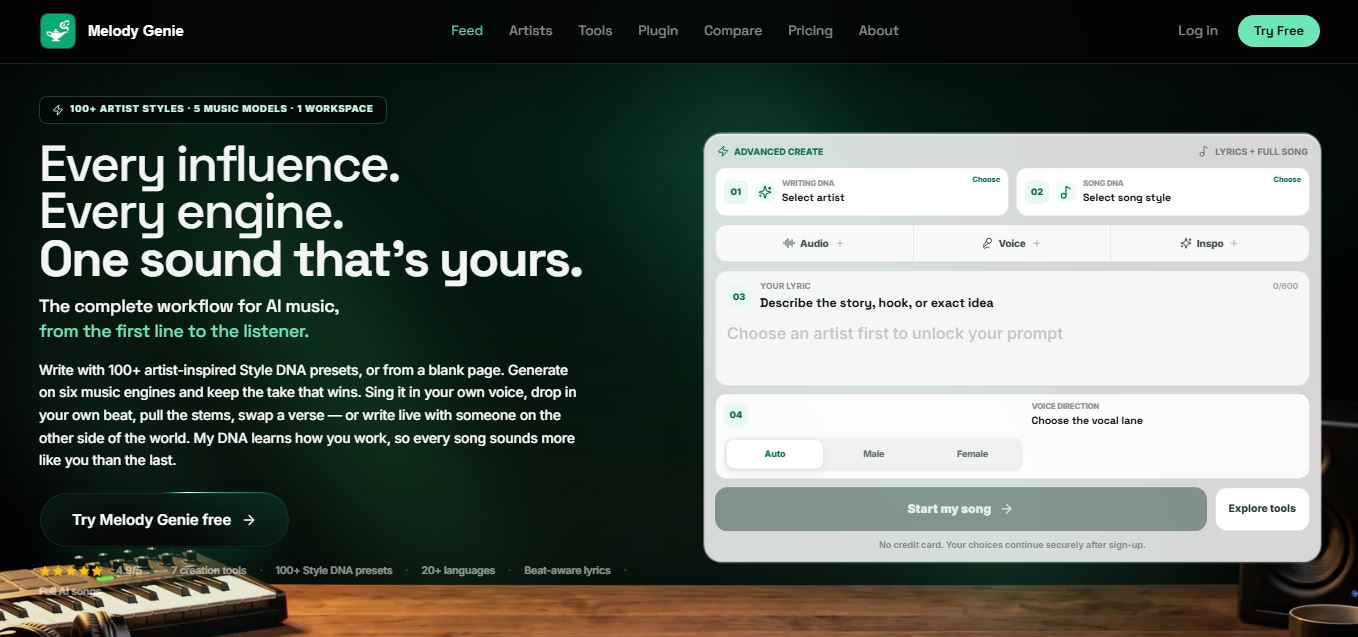
MelodyGenie is an AI-powered music generator that creates original songs from simple text prompts. Users can choose styles, moods, and genres, then instantly generate melodies and full tracks, making it easy for creators, marketers, and hobbyists to produce custom music without musical expertise.
Freemium
Kimi AI
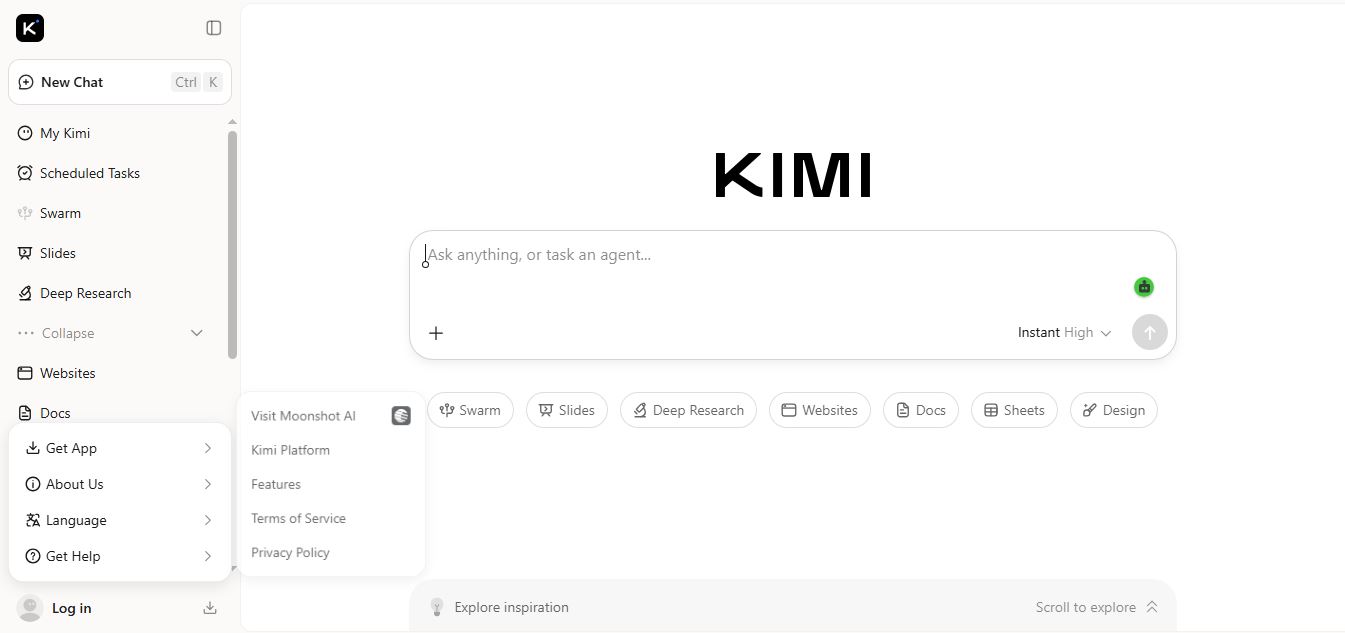
Kimi AI is an advanced AI assistant developed by Moonshot AI that helps you chat, research, write, code, and automate tasks in one place. It supports web search, file analysis, and multimodal inputs, and can even run autonomous “agent” workflows to complete complex tasks end-to-end.
Freemium
Fashion Diffusion AI
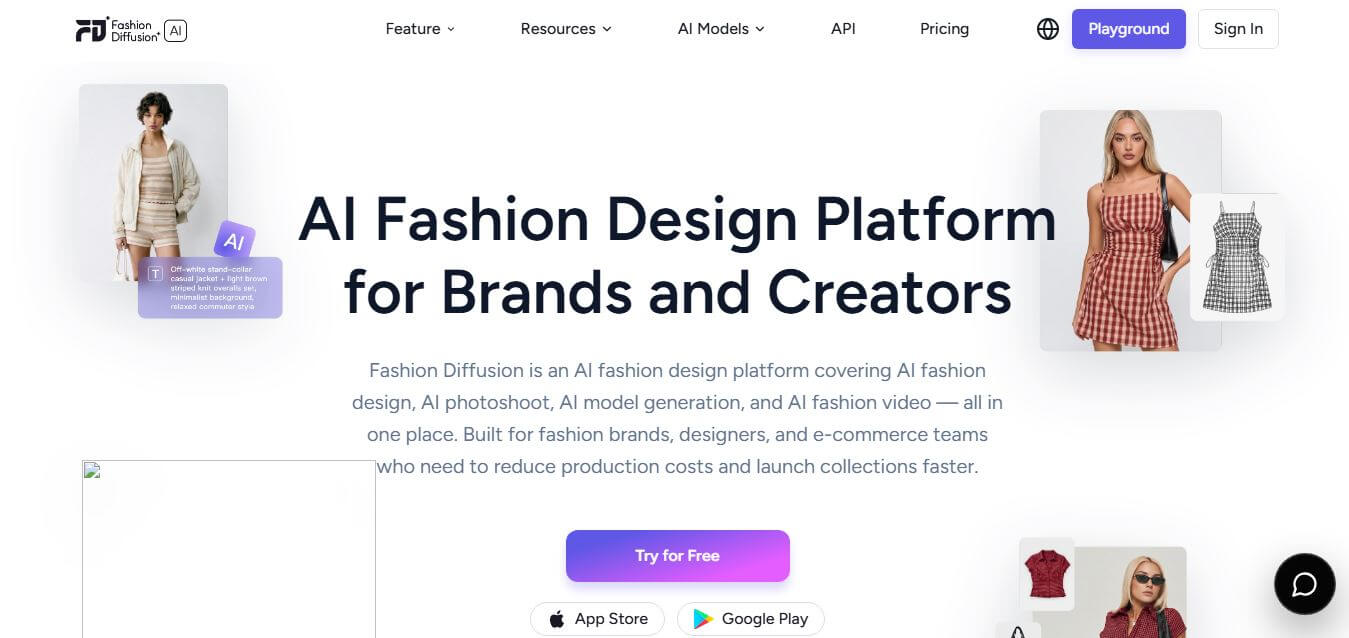
Fashion Diffusion is an AI-powered fashion design platform that helps brands and designers create clothing designs, virtual try-ons, AI models, product photos, and marketing visuals faster and cost-effectively.
Paid
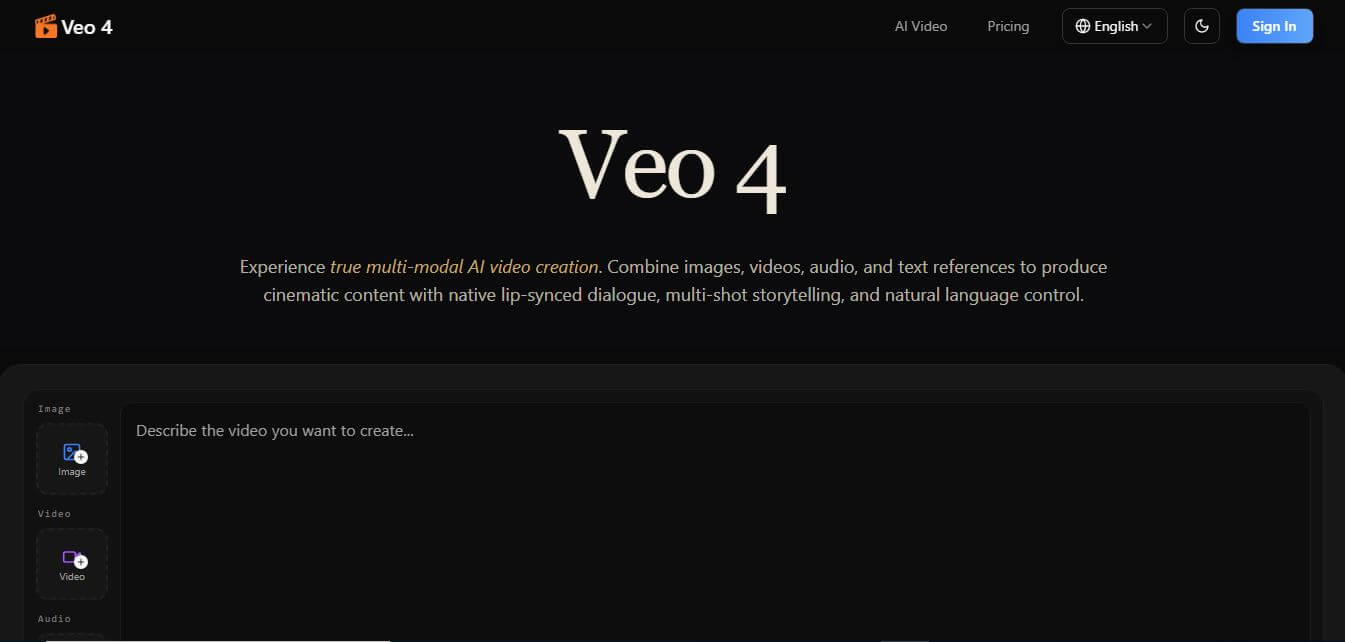
Veo 4
Veo 4 AI is an AI video creation platform that generates dramatic videos from text, images, audio, and video prompts using realistic motion and synchronized sound.
Paid
Alternatives
Alternatives to Epho
The best Epho alternatives include E2B, Daytona, Modal, OpenHands, Aider, and Fly.io. These platforms provide serverless execution sandboxes, cloud developer workspaces, and AI agent frameworks. While Epho specializes in turnkey "agents-as-an-API" for Claude Code, Codex, and OpenCode with zero sandbox configuration, alternatives like E2B focus on general-purpose Python code interpreter sandboxes, and Daytona provides persistent remote development environments. Choosing the ideal tool depends on whether you require a pre-configured coding agent API, raw compute sandboxes, or interactive developer IDE workspaces.
 4.9
4.9GitFluence
Code Assistant
GitFluence is an AI-powered Git command generator that helps developers turn plain-English instructions into exact Git commands. It eliminates the need to memorize syntax, speeds up version control workflows, and lets users quickly copy accurate commands for tasks like branching, merging, and fixing commits.
 4.9
4.9Kiro
Vibe Coding
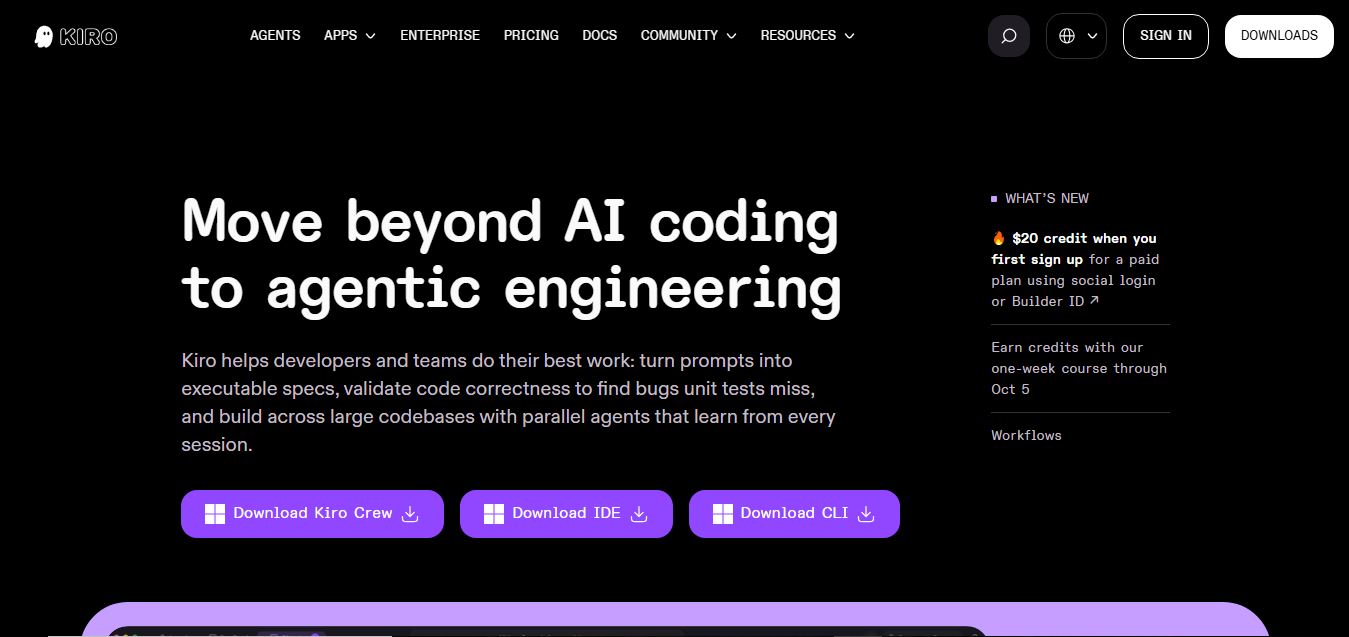
Kiro is an AI-powered developer platform that helps teams plan, build, and ship software using autonomous agents. It turns prompts into structured specs, writes and tests code, and automates workflows across IDE, CLI, and cloud, enabling faster, reliable development from prototype to production.
 4.8
4.8Emergent
Vibe Coding
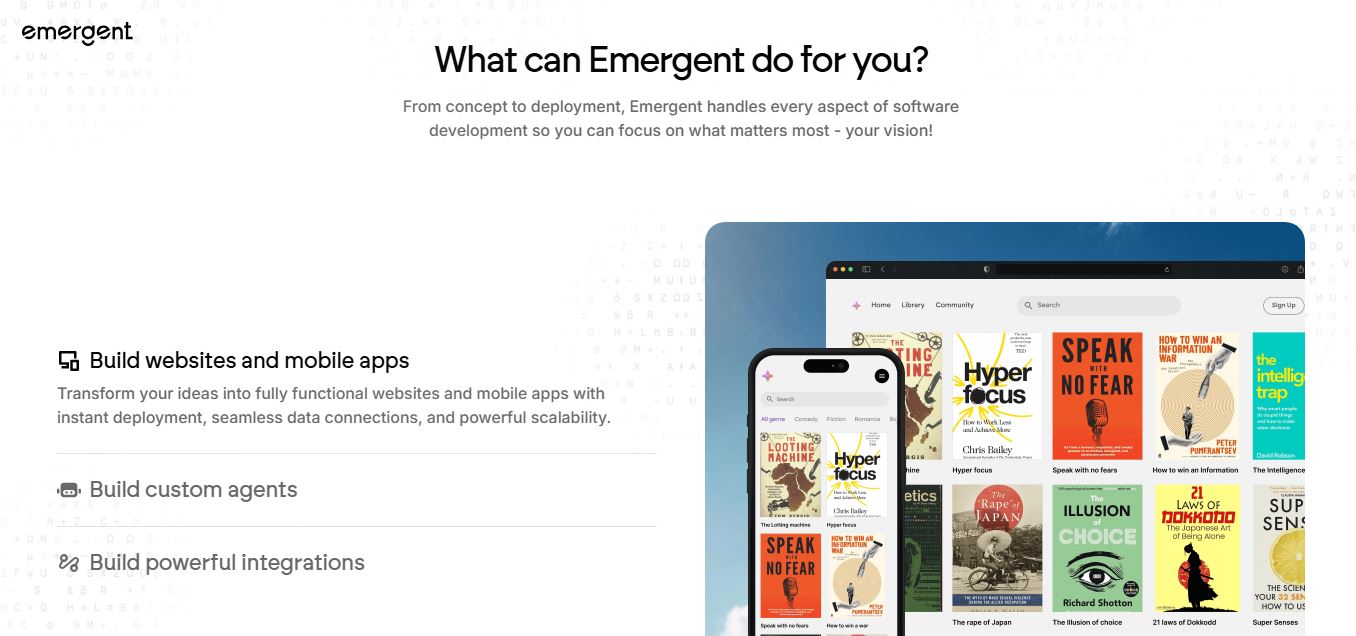
Emergent is an AI-powered app builder that lets users create full-stack web and mobile applications by simply describing their idea. It uses autonomous agents to plan, code, test, and deploy apps, handling everything from backend to hosting without requiring traditional programming skills.
 4.7
4.7Amazon Q Developer
Code Assistant
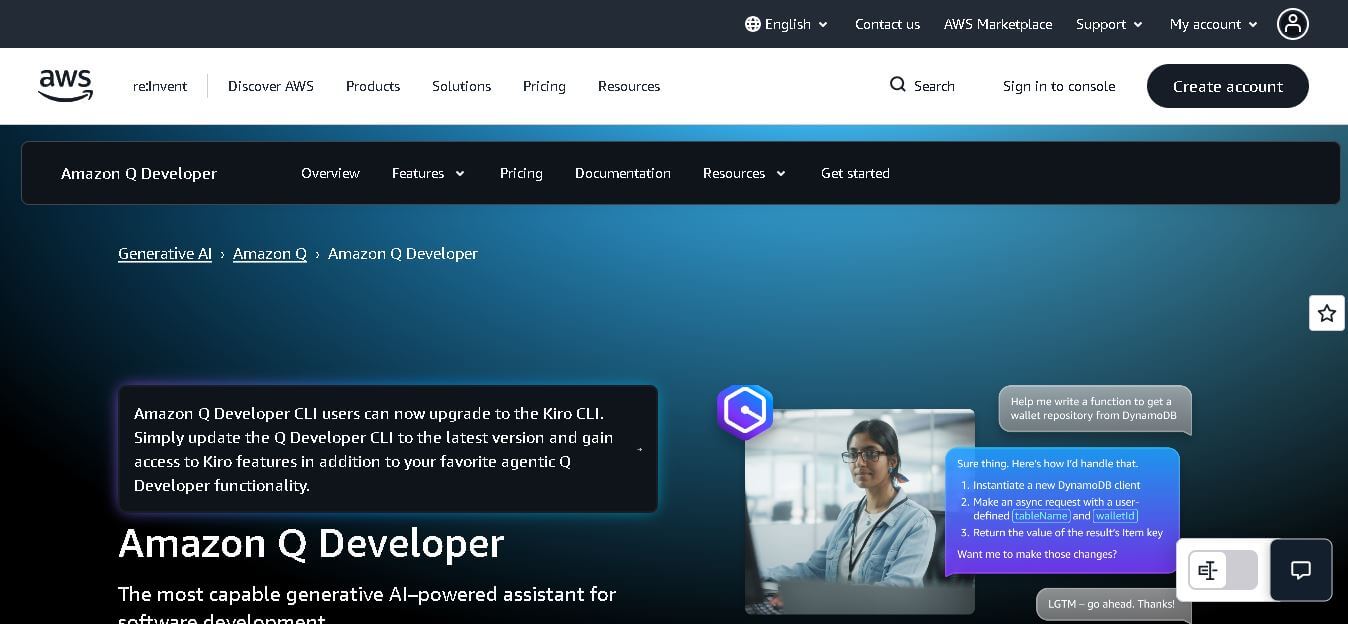
Amazon Q Developer helps developers write, explain, test, refactor, secure, and troubleshoot code while working with AWS services. It provides conversational assistance, inline suggestions, agentic coding, and cloud guidance across supported IDEs, command-line environments, and AWS interfaces. Its goal is to reduce repetitive work and help teams move from ideas to deployable software.
 4.9
4.9GitLab
Code Assistant
GitLab is a DevOps platform that provides a complete suite for planning, coding, testing, and deploying software in one place. It combines version control, CI/CD, security, and collaboration tools, helping teams streamline development workflows and deliver software faster and more efficiently.
 4.9
4.9CodeRabbit
Code Assistant
CodeRabbit is an AI-powered code review assistant that helps developers catch bugs, improve code quality, and speed up pull requests. It analyzes code changes in real time, provides actionable feedback, and integrates with Git workflows to make reviews faster and more efficient.
 4.9
4.9Sourcery
Code Assistant
Sourcery is an AI-powered code refactoring tool that helps developers automatically improve Python code quality. It analyzes code, suggests cleaner and more efficient alternatives, and applies refactors instantly, making code more readable, maintainable, and aligned with best practices.
Tenki Cloud
Code Assistant
Tenki Cloud is a high-performance, cost-efficient cloud infrastructure platform offering disposable sandboxes for AI agents, self-hosted GitHub Actions runners, and automated AI code review.
Chessnut
Code Assistant
Chessnut is an innovative chess technology company specializing in smart electronic chessboards, AI-powered coaching tools, and seamless hybrid online/offline gameplay solutions.