
Unitree R1
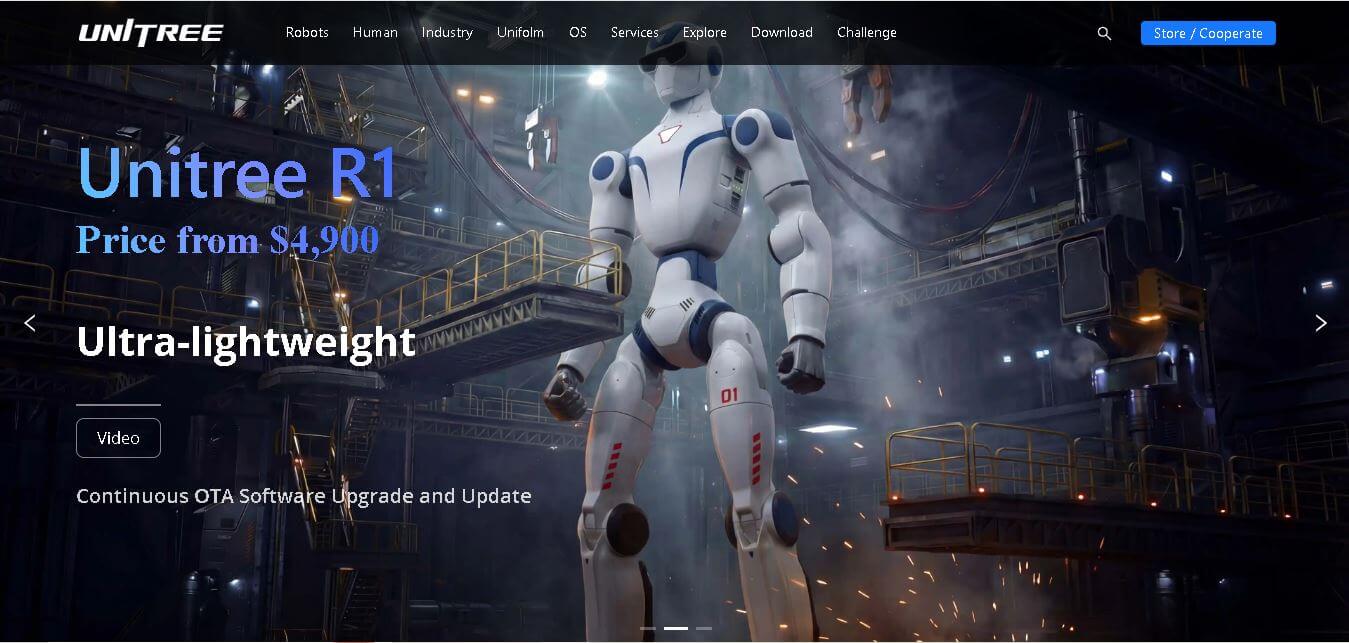
Unitree R1 is a lightweight humanoid robot built for movement, interaction, robotics research, education, and secondary development. With 26 degrees of freedom, binocular vision, voice capabilities, open control interfaces, and an approximately 1-hour battery life, R1 provides a compact platform for exploring humanoid robotics and real-world AI applications.
What is Unitree R1?
Unitree R1 is a compact humanoid robot designed for agile movement, multimodal interaction, robotics development, and real-world experimentation. It stands up to 123 cm tall and weighs about 29 kg in the standard R1 configuration. The robot combines 26 degrees of freedom, a 2-DOF head, binocular vision, microphone and speaker systems, Wi-Fi 6, Bluetooth 5.2, and an 8-core processor. Unitree also provides open interfaces for joints and sensors, supporting algorithm development and integration with simulation platforms.
Unitree R1 is a lightweight humanoid robot with a starting price of $4,900 for R1 AIR, while the standard R1 is listed at $5,900, excluding tax and shipping. It measures 1230 × 357 × 190 mm and weighs about 29 kg. The standard model provides 26 degrees of freedom, including 5 per arm, 6 per leg, 2 at the waist, and 2 at the head. It includes an 8-core processor, a 4-microphone array, a binocular camera, Wi-Fi 6, Bluetooth 5.2, a lithium battery, approximately 1-hour battery life, and OTA updates.
- Platform Role: Ultra-Lightweight Bipedal Humanoid Robot, AI Research Platform & Educational Robotics Developer Kit
- Developer & Organization: Unitree Robotics (Hangzhou, China)
- Cross-Platform Access: Open C++/Python/ROS 2 SDKs, Wi-Fi 6, Bluetooth 5.2, dedicated mobile app controller, and simulation interfaces
Use Cases:
- Developing bipedal locomotion algorithms, balance recovery controllers, and gait trajectory planning in academic research labs
- Training visual-language-action (VLA) AI manipulation models using integrated binocular depth cameras and optional dexterous hands
- Executing interactive customer service, showroom demonstrations, and educational workshops with integrated multimodal voice AI
- Deploying compact, low-weight humanoids into environments requiring floor-safe, human-scale interaction without heavy safety rigging
Technology:
- Up to 26 degrees of freedom (DOF) on the base body (6 per leg, 5 per arm, 2-DOF waist, and 2-DOF head), expandable to 40 DOF with force-controlled dexterous hands
- Low-inertia PMSM joint motors coupled with precision dual/single joint encoders and internal hollow-wiring joint architecture
- Embedded Large Multimodal Model (LMM) engine powered by an 8-core CPU or optional 100 TOPS AI computing docking station
- Integrated perception suite featuring stereo binocular depth cameras, a 4-microphone array, built-in speaker output, and quick-release smart battery architecture
Target Users:
- Universities, robotics research institutes, and AI labs focusing on reinforcement learning and bipedal control
- STEM educators and technology institutions teaching advanced robotics and ROS 2 software integration
- Commercial showrooms, event organizers, and exhibition venues requiring dynamic, interactive humanoid displays
- Robotics hobbyists and developers seeking an affordable entry point into full-body humanoid hardware
Acquisition: Manufactured and distributed globally by Unitree Robotics (unitree.com)

What are the key features of Unitree R1?
Unitree R1's key platform features are
- Ultra-Lightweight Bipedal Frame: Compact ~25–29 kg body weight and ~121–123 cm stature engineered for safe human-robot coexistence.
- Full-Body Articulation: Up to 26 core degrees of freedom, including articulated 2-DOF head and 2-DOF waist joints for expanded reach and field of view.
- Multimodal Voice & Vision AI: Integrated Large Multimodal Model (LMM) backed by a 4-mic array and binocular stereo depth camera.
- Modular Dexterous End-Effectors: Compatible with simple grippers, tendon-cable hands, or advanced force-controlled dexterous hands (e.g., Dex3-1 with haptic feedback).
- Open Developer Interface: Complete low-level and high-level SDK access with real-time simulation support for Python, C++, and ROS 2.
- Quick-Release Smart Battery: Swappable power modules offering ~1 hour of continuous operational runtime per charge.
How much does Unitree R1 cost?
The Unitree R1 is priced as one of the most affordable commercial bipedal humanoids on the market, with baseline direct consumer models starting at sub-$5,000 USD and advanced research configurations scaling upwards.
Consumer & Base Tiers:
- R1 Air / Basic Consumer Tier (From ~$4,900 - $15,950): Entry-level closed or basic configurations featuring 20–24 DOF, standard 8-core compute, and basic end-effectors.
Developer & Research Tiers:
- R1 Edu Standard / Pro ($23,000 - $32,900): Unlocks 26–40 DOF full-body articulation, 100 TOPS AI computing docking station, secondary SDK development access, and advanced tactile/dexterous hands.
Disclaimer: Prices vary based on compute modules (TOPS), dexterous hand selection (tactile vs. standard), shipping region, and official distributor support tiers.
Who should use Unitree R1?
Unitree R1 is designed for researchers, developers, and technology enthusiasts, including
- Academic Robotics Labs: Research groups seeking an accessible bipedal hardware platform for reinforcement learning experiments.
- Commercial & Event Exhibitors: Organizations needing a compact, eye-catching humanoid for customer greetings, trade shows, and public engagement.
- AI & Computer Vision Developers: Teams building embodied AI models that require joint control, depth sensing, and microphone input in one package.
What are the best alternatives to Unitree R1?
Some of the strongest Unitree R1 alternatives include
- Unitree G1
- Unitree H2
- Fourier Intelligence GR-1 / GR-2
- Booster Robotics T1
- Agibot Expedition A1
- Robosense / UBTECH Walker Series
What are the pros and cons of Unitree R1?
What are the pros of Unitree R1?
- Extremely competitive entry pricing making humanoid hardware accessible to smaller institutions
- Ultra-lightweight design (~25-29 kg) reduces risk during gait testing and balance failures
- Includes 2-DOF waist and 2-DOF head articulation for enhanced posture control and scanning
- Comprehensive SDK support with open control interfaces and major simulation environment support
What are the cons of Unitree R1?
- Lower maximum payload capacity (~2 kg arm load) compared to larger industrial humanoids
- Battery runtime limited to approximately 1 hour per charge during continuous operation
- Requires technical expertise in robotics and ROS 2 to fully utilize advanced EDU development features
Why should you choose Unitree R1?
Developing bipedal robotics algorithms traditionally required massive capital expenditure and heavy, potentially dangerous hardware setups. Unitree R1 solves this challenge by delivering a lightweight, stable, and articulated humanoid body at a fraction of standard industry costs. With integrated multimodal AI sensors, agile joint control, and open developer access, the R1 provides an ideal, low-risk platform to accelerate real-world AI and bipedal research.
How does Unitree R1 compare to competitors?
The primary distinction between Unitree R1, Unitree G1, Unitree H1/H2, and Fourier GR-1 lies in scale, joint torque capacity, and target deployment environment. While the Unitree G1 and H1 offer higher power density for dynamic acrobatics and heavy-duty research, the R1 prioritizes extreme affordability, low mass, and compact educational utility.
| Feature / Platform | Unitree R1 | Unitree G1 | Unitree H1 / H2 | Fourier GR-1 |
|---|---|---|---|---|
| Target Purpose | Entry Humanoid & Compact EDU AI Research | Reference Academic Biped & Dynamic Manipulation | Full-Size Flagship Industrial Humanoid | Medical & General Purpose Biped Platform |
| Height & Weight | 121–123 cm | ~25–29 kg | 132 cm | ~35 kg | 180 cm | ~47–50 kg | 165 cm | ~55 kg |
| Core Degrees of Freedom | 26 DOF (Up to 40 with hands) | 23 DOF (Up to 41 with hands) | 20–34 DOF (model dependent) | 40+ DOF |
| Arm Payload Capacity | ~2 kg | ~3 kg | ~10–15 kg | ~10 kg |
| Best For | Budget-conscious labs, educators, and showroom interaction | Advanced bipedal research labs requiring high joint torque | Heavy-duty research and industrial human-scale tasks | Rehabilitation, healthcare, and assistance research |
How do we rate Unitree R1?
| Parameter | Rating (out of 5) |
|---|---|
| Affordability & Market Value | 5.0 |
| Mechanical Hardware & Weight Efficiency | 4.8 |
| Multimodal AI & Perception Integration | 4.7 |
| Developer SDK & Simulation Compatibility | 4.8 |
| Payload & Battery Runtime | 4.3 |
| Overall Score | 4.72 |
What is our review and verdict on Unitree R1?
The Unitree R1 is a significant advancement for the humanoid robotics industry. By lowering the financial and physical barriers to owning a bipedal robot, Unitree enables a much wider audience of researchers and developers to build embodied AI software. Its compact frame, articulated waist and head, and open SDK make it an outstanding choice for learning, prototyping, and demonstration.
Conclusion
Unitree R1 brings humanoid robotics into a compact and relatively accessible form factor, combining 26 degrees of freedom, multimodal sensing, onboard computing, wireless connectivity, and open development interfaces. Its approximately 29 kg design and 123 cm height make it suitable for robotics experimentation, education, research, and physical AI development. With R1 AIR starting at $4,900 and the standard R1 listed at $5,900, Unitree offers multiple configurations for different development requirements.
FAQ
What is Unitree R1 used for?
Unitree R1 is designed for humanoid robotics experimentation, education, research, algorithm development, and interactive applications. Its open interfaces allow developers to work with joints and sensors, while its movement capabilities support physical robotics experiments. Unitree also positions R1 as a platform where algorithms can move from simulation environments into physical-world applications.
How much does Unitree R1 cost?
Unitree currently lists R1 AIR at $4,900 and the standard R1 at $5,900, with tax and shipping excluded. The R1 EDU version requires users to contact sales for pricing. Actual costs can therefore depend on the selected configuration, accessories, shipping, taxes, and applicable regional purchasing arrangements.
How many degrees of freedom does Unitree R1 have?
The standard Unitree R1 has 26 degrees of freedom. These include 6 degrees for each leg, 5 for each arm, 2 for the waist, and 2 for the head. R1 AIR has 20 degrees of freedom, while R1 EDU supports between 26 and 40 degrees depending on its configuration and optional components.
How tall and heavy is Unitree R1?
Unitree R1 measures approximately 1230 mm in height, 357 mm in width, and 190 mm in thickness when standing. The standard R1 weighs about 29 kg with its battery installed. R1 AIR is lighter at approximately 27 kg, while R1 EDU is listed at about 29 kg.
Does Unitree R1 support voice interaction?
Yes, the Unitree R1 includes a 4-microphone array and speaker system for audio interaction. Unitree also states that R1 integrates a large multimodal model for voice and images. This combination provides a foundation for developing interactive robotic applications involving speech, visual perception, and physical movement.
What camera does Unitree R1 use?
The standard Unitree R1 is equipped with a binocular camera, while the R1 AIR configuration uses a monocular camera. The binocular setup provides visual input for perception-related applications. Unitree also describes R1 as supporting multimodal capabilities involving voice and images, alongside open interfaces for sensors and robotics development.
User Reviews
No reviews yet for Unitree R1.
Featured Tools
Featured AI tools from TechShark

Melody Genie
MelodyGenie is an AI-powered music generator that creates original songs from simple text prompts. Users can choose styles, moods, and genres, then instantly generate melodies and full tracks, making it easy for creators, marketers, and hobbyists to produce custom music without musical expertise.
Freemium
Kimi AI
Kimi AI is an advanced AI assistant developed by Moonshot AI that helps you chat, research, write, code, and automate tasks in one place. It supports web search, file analysis, and multimodal inputs, and can even run autonomous “agent” workflows to complete complex tasks end-to-end.
Freemium

Fashion Diffusion AI
Fashion Diffusion is an AI-powered fashion design platform that helps brands and designers create clothing designs, virtual try-ons, AI models, product photos, and marketing visuals faster and cost-effectively.
Paid
Veo 4
Veo 4 AI is an AI video creation platform that generates dramatic videos from text, images, audio, and video prompts using realistic motion and synchronized sound.
Paid
Alternatives
Alternatives to Unitree R1
The best Unitree R1 alternatives include the Unitree G1, Unitree H1/H2, Fourier GR-1, and Agibot Expedition A1. While the Unitree R1 offers an ultra-lightweight (~25-29 kg) and highly affordable entry point for bipedal AI research, alternatives like the Unitree G1 provide higher joint torque and payload capacity for more demanding locomotion and manipulation tasks.
 4.8
4.8AgXeed (AgBot Autonomous Farming Solutions)
Robots and Devices
AgXeed develops autonomous agricultural technology designed to make field operations more efficient, flexible, and soil-friendly. Its AgBots work with TraXwise software to plan, monitor, and document farming tasks. The ecosystem supports different agricultural applications while helping farmers address labor shortages, reduce soil impact, improve productivity, and gain greater operational control.
 4.7
4.7Synchron (Stentrode BCI Platform)
Robots and Devices
Synchron develops implantable brain-computer interface technology intended to help people with paralysis communicate and interact with digital devices using movement-related brain signals. Its Stentrode™ device is implanted through a blood vessel, avoiding open brain surgery. The technology is currently being evaluated in clinical trials and is not commercially approved.
 4.8
4.8Skild AI
Robots and Devices
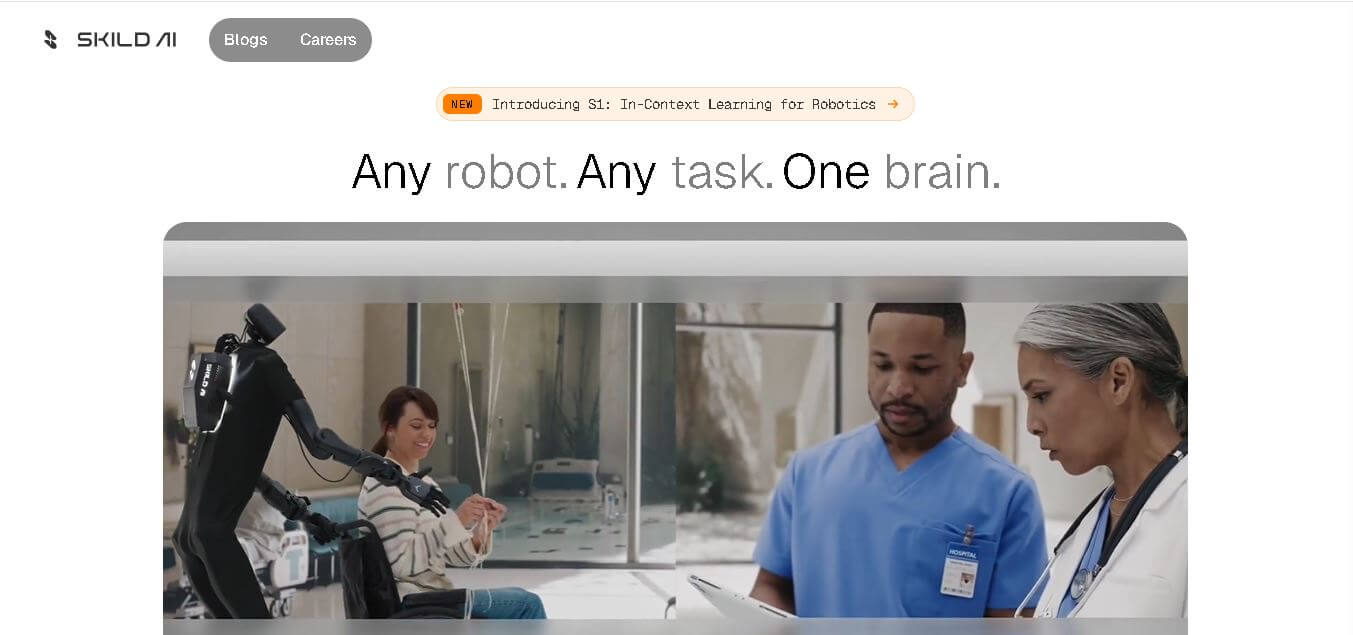
Skild AI develops general-purpose intelligence for robots operating in the physical world. Its Skild Brain is designed to work across different robot bodies and tasks, supporting applications such as inspection, mobile manipulation, autonomous packing, navigation, and dexterous activities. The company aims to make robotic intelligence more adaptable, scalable, and useful.