RemNote
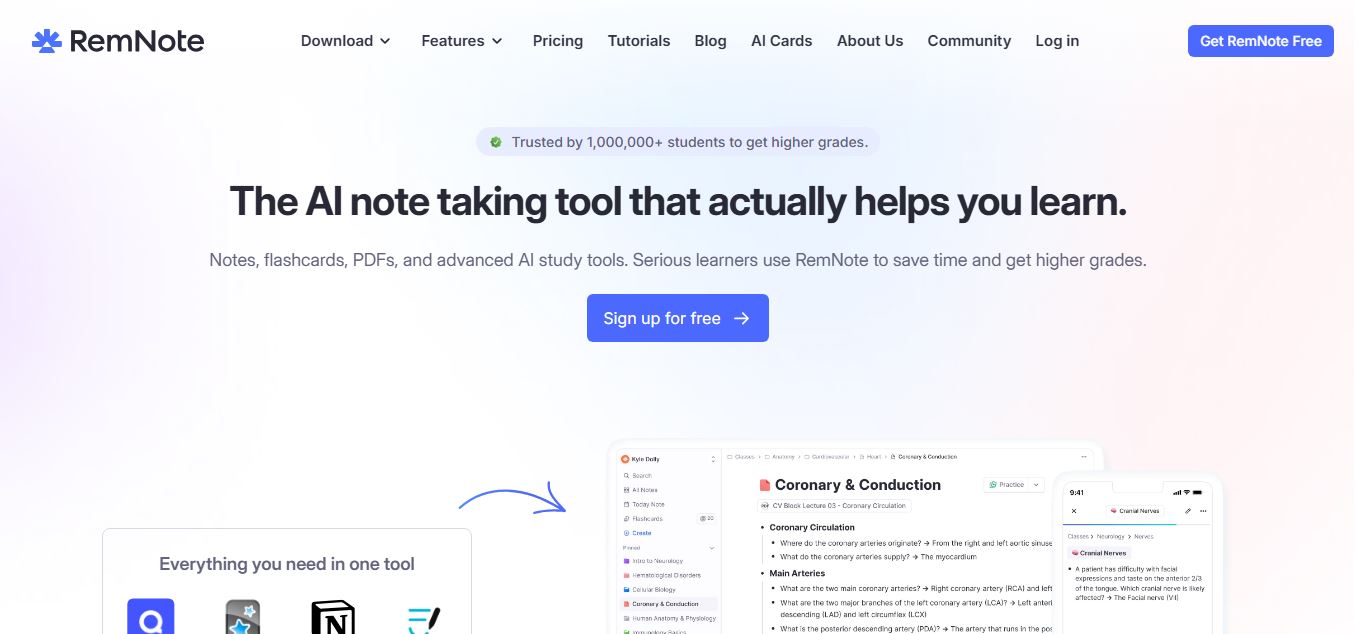
RemNote is an AI-powered study and note-taking platform that helps students turn notes, PDFs, and lectures into flashcards, quizzes, and summaries. It uses spaced repetition and an AI tutor to improve understanding, retention, and exam performance, combining learning, practice, and knowledge management in one system.
What is RemNote?
RemNote is an AI-powered note-taking and learning platform designed to help users retain information through spaced repetition and active recall. It combines notes, flashcards, and knowledge management into one system, allowing users to turn notes into flashcards automatically and review them over time for better memory retention. The platform also supports linking ideas, organizing knowledge hierarchically, and using AI tools to summarize, generate questions, and enhance study materials. It’s widely used by students and lifelong learners to study more efficiently and build long-term understanding.
Founded by MIT researchers Martin Schneider, Matthew Groh, and Moritz Wallawitsch, RemNote was developed to eliminate the friction between capturing knowledge and retaining it permanently. Backed by top-tier venture capital firms including General Catalyst and Soma Capital, RemNote serves over a million students, medical doctors, and knowledge workers worldwide. By integrating bi-directional concept linking, built-in PDF annotation with source-anchored flashcards, and an advanced spaced repetition algorithm, RemNote provides a complete learning operating system designed for long-term memory mastery.
- Founders / Leadership: Martin Schneider (Co-founder & CEO), Matthew Groh, and Moritz Wallawitsch
- Launch Year: 2020 (Expanded with PDF reader integrations, mobile apps, local-first offline storage, and modern spaced repetition engines through 2024–2026)
Use Cases:
- Studying for high-stakes examinations such as USMLE, MCAT, law bar exams, and university finals using automated active recall
- Reading academic papers and textbooks in PDF format while creating highlights linked directly to flashcards
- Building an interconnected "second brain" of academic research, book summaries, and concept maps via bi-directional linking
- Managing complex hierarchical outlines, lab protocols, and scientific notes with nested bullet structures
Technology:
- Hierarchical graph-based outline architecture treating every bullet and paragraph as an independent, referenceable entity ("Rem")
- Advanced spaced repetition scheduling engine supporting multiple algorithms, including customized Anki SM-2 and FSRS (Free Spaced Repetition Scheduler)
- Local-first data synchronization engine ensuring full offline functionality and end-to-end multi-device sync across desktop and mobile
Target Users:
- Medical students and healthcare professionals memorizing extensive pharmacological, anatomical, and clinical diagnostic data
- Undergraduate and postgraduate university students managing lecture notes and exam study schedules
- Academic researchers and graduate scholars annotating scientific literature and organizing literature reviews
- Content creators using writing tools to organize research databases, outline long-form manuscripts, and retain foundational industry knowledge
Corporate Entity: Operates as RemNote, Inc. (Cambridge, MA, USA & Global)

Key features of RemNote
RemNote's key features are
- Integrated Note-to-Flashcard Conversion: Type notes using simple keyboard shortcuts (like >> or ==) to turn concepts, definitions, and cloze deletions into flashcards without retyping.
- Built-in PDF & EPUB Reader: Highlight text and clip diagrams directly inside uploaded textbooks and papers, automatically generating flashcards linked back to the exact source page.
- Spaced Repetition System (SRS): Optimized practice queues powered by adaptive algorithms (including FSRS and SM-2) that surface flashcards just before you are about to forget them.
- Bi-Directional Linking & Concept References: Connect related thoughts and lecture topics using automatic backlinking and interactive knowledge graph views.
- Rich Card Types: Create basic front/back cards, multi-line concept lists, cloze deletions, diagram image occlusions, and table flashcards.
- Local-First & Full Offline Support: Keep complete ownership of your knowledge base with offline-capable desktop apps, local data folders, and optional cloud sync.
- Anki & Notion Import: Import existing Anki decks, Notion workspaces, Roam Research graphs, and Markdown files smoothly without losing card progress.
- Cross-Platform Mobile Apps: Study your daily flashcard queues and capture quick notes on the go across Windows, macOS, Linux, iOS, and Android.
RemNote Pricing
RemNote operates on a freemium model with a comprehensive free tier alongside premium subscription and lifetime purchase options.
Free Plan:
- $0 / Free forever
- Includes unlimited notes and flashcards, spaced repetition practice queues, basic PDF uploads (up to 3 files), cross-device sync, and community plugin access
RemNote Pro:
- $10.00 / month billed monthly (or $8.00 / month billed annually at $96.00/year; student discounts available from ~$6.00/month)
- Includes unlimited PDF and EPUB uploads and highlighting, advanced image occlusion, full-text PDF search, prioritized spaced repetition controls, offline backup export, and early feature access
RemNote Life:
- $399.00 one-time payment
- Grants permanent lifetime access to all Pro features with zero recurring subscription fees
Disclaimer: Prices are listed in USD. Educational verification discounts are offered to university and high school students. Visit remnote.com/pricing for active seasonal promotions and regional pricing.
Who is using RemNote?
RemNote is designed for academic scholars, medical students, and active learners, including
- Medical & Nursing Students: Memorizing complex pharmacology, anatomy, and pathology concepts using image occlusion and clinical case flashcards
- Law Students & Bar Applicants: Structuring statutes, legal precedents, and case briefs with nested hierarchical outlines and active recall practice
- STEM & Computer Science Students: Taking structured lecture notes containing code blocks, LaTeX mathematical equations, and algorithm workflows
- Academic Researchers: Annotating literature PDFs and synthesizing research notes into an interconnected personal knowledge graph
- Content Creators: Using writing tools to organize research databases, outline long-form manuscripts, and retain foundational industry knowledge
- Language Learners: Building custom vocabulary lists, grammar cloze cards, and audio pronunciation drills
Best RemNote Alternatives
Some of the strongest RemNote alternatives include
Pros and Cons of RemNote
Pros
- Completely eliminates the redundant effort of taking notes and separately writing flashcards in a secondary app
- Deep PDF reader integration allows direct highlighting and image occlusion without leaving the workspace
- Every flashcard links directly back to its original contextual note and PDF source page for instant review
- State-of-the-art spaced repetition algorithms (including FSRS support) maximize long-term memory retention
- Local-first data architecture provides privacy and seamless offline studying on desktop and mobile
Cons
- The hierarchical outline format and power-user keyboard shortcuts create an initial learning curve
- Free plan limits PDF uploads to 3 documents, requiring an upgrade to Pro for extensive textbook reading
- Mobile application experience, while steadily improving, is less fluid than the desktop application
- Highly complex graph databases with tens of thousands of Rems can occasionally experience minor syncing delays
Why Choose RemNote?
RemNote is the premier choice for students and researchers who want to combine structured note-taking with automated active recall, ensuring that the knowledge they capture is remembered permanently.
- Turn lecture notes and reading highlights into flashcards automatically while writing
- Annotate PDFs and textbooks with source-anchored flashcard references
- Retain critical information using scientific spaced repetition algorithms
- Connect concepts into an interconnected personal knowledge graph
- Trusted by over 1 million medical students, academics, and researchers worldwide
RemNote vs. Competitors
The main difference between RemNote, Anki, Obsidian, and Notion is that RemNote is purpose-built to merge hierarchical note-taking and spaced-repetition flashcard creation natively in one seamless workflow, whereas Anki is strictly a flashcard tool requiring separate note software, Obsidian focuses on markdown knowledge graphs requiring community plugins for flashcards, and Notion is a collaborative database workspace without native spaced repetition. RemNote stands out for its integrated PDF annotation flashcards, effortless card creation syntax, and dedicated learning focus.
| Feature / Tool | RemNote (remnote.com) | Anki | Obsidian | Notion |
|---|---|---|---|---|
| Core Focus | Note-Taking & Spaced Repetition Fusion | Standalone Spaced Repetition Flashcards | Networked Markdown Knowledge Base | Collaborative Docs & Project Databases |
| Native Flashcard Generation | Yes (Direct Inline Note Syntax) | Yes (Card Editor Interface) | Community Plugin Required | Third-Party Integration Required |
| PDF Annotation to Cards | Yes (Native Highlight-to-Card) | Add-on Dependent | PDF Viewer (No Direct Cards) | Basic File Attachment Only |
| Spaced Repetition Algorithm | SM-2 & FSRS Native Engines | SM-2 & FSRS Engines | Plugin Dependent | No Native SRS |
| Starting Paid Price | Free tier / Pro from $8.00/mo ($96/yr) | 100% Free (Paid iOS app $24.99) | Free for personal use / Sync $4/mo | Free tier / Plus $10.00/mo |
| Best For | Med Students, Academics & Active Recall | Hardcore Flashcard Drillers & Memorizers | Writers & Second Brain Knowledge Workers | Team Wikis, Project Management & Docs |
How do we rate RemNote?
| Parameter | Rating (out of 5) |
|---|---|
| Note-Taking & Flashcard Integration | 5.0 |
| PDF Reader & Source Annotation | 4.9 |
| Spaced Repetition Engine Quality | 4.9 |
| Knowledge Graph & Bi-directional Linking | 4.8 |
| Value for Money | 4.8 |
| Overall Score | 4.88 |
RemNote Review
RemNote represents an essential breakthrough in learning software by eliminating the wall between taking notes and studying them. For decades, learners have had to write notes in one application, manually copy definitions into Anki or Quizlet, and then struggle to recall the original context of each question. RemNote solves this fragmentation elegantly: by integrating card creation directly into hierarchical outlines and PDF reading, a single sentence or diagram can serve simultaneously as an informative note and an active study prompt. The ability to click directly from a challenging flashcard back to its exact location in a 600-page textbook saves countless hours of study time. While the outline structure requires an adjustment period, RemNote is an exceptional tool for anyone seeking mastery of complex academic subjects.
Conclusion
RemNote is an industry-leading knowledge management and spaced-repetition platform that redefines how students and researchers study, organize, and retain information. By uniting hierarchical notes, interactive flashcards, PDF annotation, and scientific spaced repetition into a cohesive local-first workspace, it provides an end-to-end learning environment. While casual users needing a simple collaborative document editor may prefer general-purpose tools like Notion, RemNote's focused learning architecture, memory algorithms, and source-anchored cards make it an indispensable platform for serious academic study.
FAQ
What is RemNote and how does it work?
RemNote is an all-in-one learning and knowledge management tool that combines note-taking, flashcards, and spaced repetition into a single system. It works by letting users take structured notes and instantly convert them into flashcards, which are then reviewed using spaced repetition to improve long-term memory retention. Instead of separating tools like Notion (notes) and Anki (flashcards), RemNote connects everything into one workflow.
What problems does RemNote solve?
RemNote solves the problem of fragmented study workflows and inefficient learning. Students and professionals often switch between multiple tools for notes, flashcards, and revision, which wastes time. RemNote integrates these processes, helping users capture knowledge, organize it, and retain it effectively using scientifically proven memory techniques like spaced repetition.
What features does RemNote offer?
RemNote offers features such as structured note-taking, flashcard creation, spaced repetition, PDF annotation, backlinks, templates, and knowledge graphs. It also includes AI-powered tools like automatic flashcard generation, summaries, quizzes, and an AI tutor, making it a complete study and productivity system.
How is RemNote different from Notion, Anki, or Obsidian?
RemNote stands out because it is built specifically for learning and memory retention, not just note-taking. Unlike Notion or Obsidian, which focus on organization and writing, RemNote integrates spaced repetition directly into notes. Compared to Anki, it offers a more modern interface and combines notes + flashcards in one place, eliminating the need for multiple tools.
Does RemNote use AI for studying?
Yes, RemNote includes AI-powered learning features such as generating flashcards from text, summarizing PDFs, creating quizzes, and providing an AI tutor for explanations. These features run on an AI credit system, where usage depends on your plan and resets monthly.
Is RemNote free to use?
Yes, RemNote offers a free plan with unlimited notes and flashcards, making it accessible for beginners. However, advanced features like AI tools, higher file limits, and deeper customization are available in paid plans.
How much does RemNote cost?
RemNote follows a freemium pricing model. The Pro plan starts at around $8/month, while the Pro + AI plan costs about $18/month, offering significantly more AI credits and advanced features. There is also a lifetime plan option for long-term users.
Who should use RemNote?
RemNote is ideal for students, competitive exam aspirants, researchers, and knowledge workers who need to learn and retain large amounts of information. It is especially useful for exam preparation (like medical, law, or government exams), language learning, and any scenario where long-term memory is critical.
User Reviews
No reviews yet for RemNote.
Featured Tools
Featured AI tools from TechShark
Melody Genie
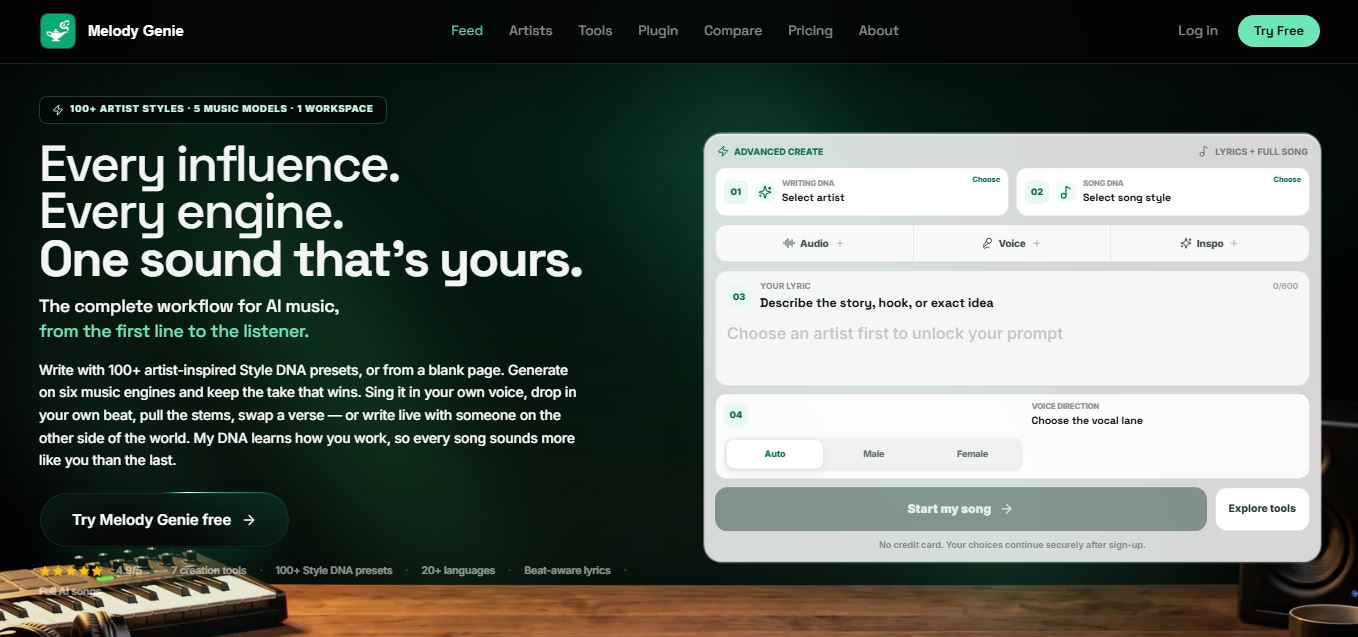
MelodyGenie is an AI-powered music generator that creates original songs from simple text prompts. Users can choose styles, moods, and genres, then instantly generate melodies and full tracks, making it easy for creators, marketers, and hobbyists to produce custom music without musical expertise.
Freemium
Kimi AI
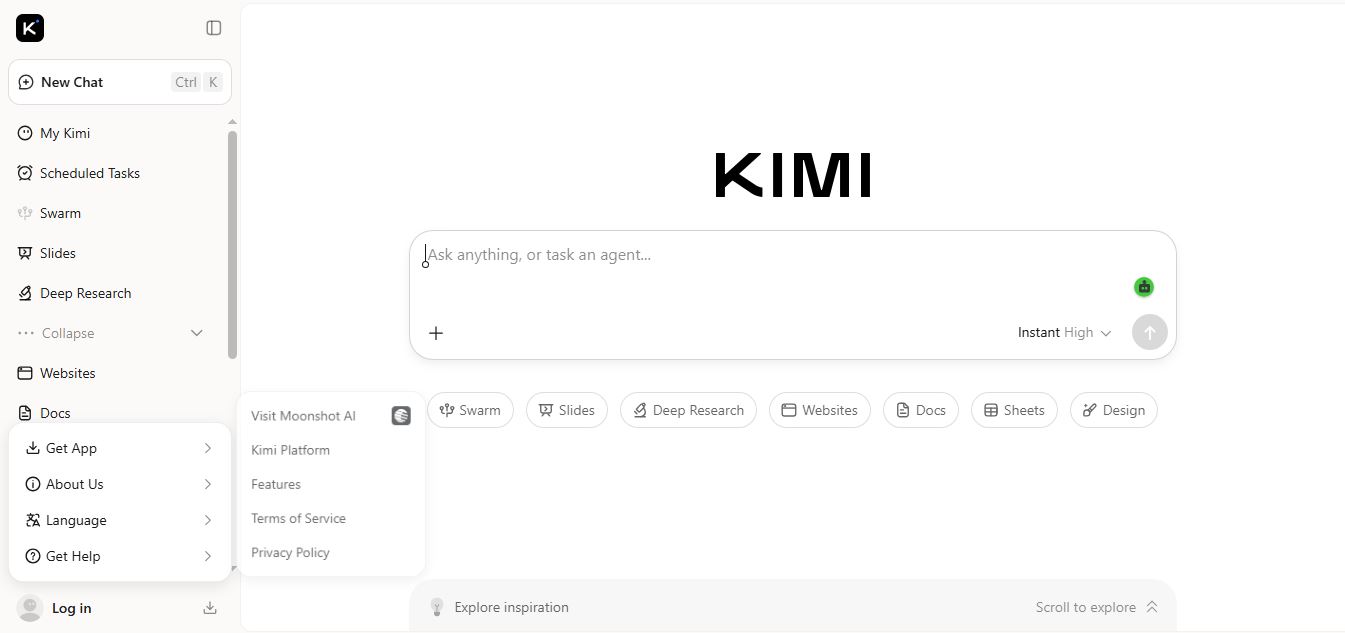
Kimi AI is an advanced AI assistant developed by Moonshot AI that helps you chat, research, write, code, and automate tasks in one place. It supports web search, file analysis, and multimodal inputs, and can even run autonomous “agent” workflows to complete complex tasks end-to-end.
Freemium

Fashion Diffusion AI
Fashion Diffusion is an AI-powered fashion design platform that helps brands and designers create clothing designs, virtual try-ons, AI models, product photos, and marketing visuals faster and cost-effectively.
Paid
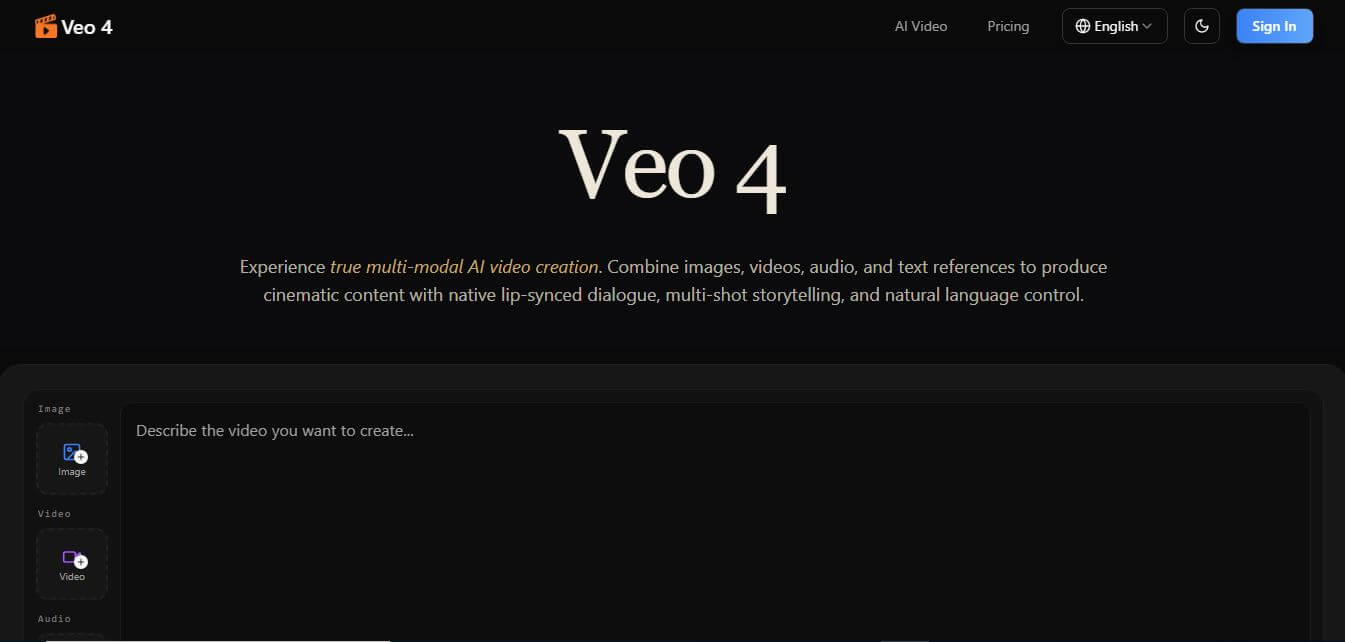
Veo 4
Veo 4 AI is an AI video creation platform that generates dramatic videos from text, images, audio, and video prompts using realistic motion and synchronized sound.
Paid
Alternatives
Alternatives to RemNote
The best RemNote alternatives include Anki, Obsidian, Scholarcy, Notion, Logseq, and Quizlet. These platforms provide note-taking, flashcard generation, and spaced repetition studying. While RemNote specializes in seamlessly merging hierarchical outlines, PDF highlighting, and automatic flashcard generation powered by modern spaced repetition algorithms (such as FSRS and SM-2), alternatives like Anki focus purely on standalone flashcard drills, and Obsidian provides an open-ended markdown knowledge graph requiring community plugins for study queues. Choosing the right tool depends on whether you require an all-in-one note-to-flashcard study platform, dedicated flashcard drills, or a general-purpose knowledge base.