
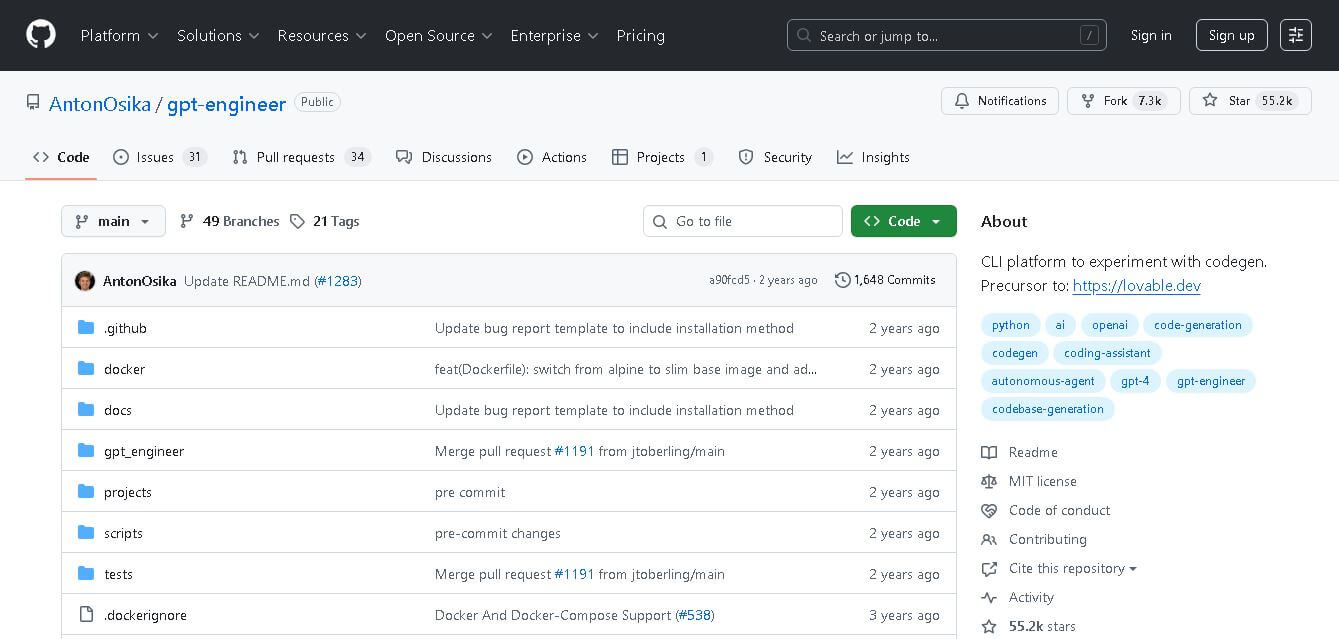
GPT Engineer?
- Founder: Anton Osika
- Launch: Launched in the summer of 2023 as an open-source GitHub project that attracted the attention of developers quickly.
Use Cases:
- Rapid prototyping for software applications
- Generates and/or improves existing codebases
- Teaching AI-assisted programming concepts
- Experimenting with modular AI workflows
Technology:
- Written in Python
- Uses OpenAI and similar large language models
- Modular pipelines are built to be customizable.
- Built for integrating (running) models in either the cloud or locally.
GPT Engineer is an AI-powered low-code/no-code platform that changes how we think about building software with just natural language. Just write out a few words describing an idea or application in standard English and have a fully working software package made for you a few minutes later. You’ll save untold hours of manual programming time simply by taking the words typed in and writing in code. It asks clarifying questions to refine your request, incorporates your feedback, and continuously improves the output. GPT Engineer is a command-line tool that is meant to work in a modular way, increase transparency, and allow for human supervision in the AI coding process. GPT Engineer was built for all developers, educators, and creators so anyone can realize the possibilities afforded through rapid exploration, testing, and development without needing to develop as much raw software engineering code and knowledge.
Key Features
GPT Engineer key features are
- Natural Language Code Generation: Translates written English prompts into usable software codebases.
- Interactive Clarification: Proactively asks follow-up questions to understand your project before writing the code.
- Full Project Scaffolding: Outputs complete file structures rather than separate snippets of code.
- Code Improvement Mode: Accepts existing projects and modifies them with AI guidance or enhancements.
- Customizable Pipelines: Allows users to add or swap steps in the software coding process.
- Persistent Execution: Saves state between runs—allows pausing and resuming on the tasks.
- Flexible Integration with Models: Works with other AI models (not just OpenAI's APIs).
- Open Source Community Help: It has contributors to help add features and documentation to the software.
Pricing
- Free open-source
- API usage based
- No subscription
- Self-hosted cost
Disclaimer: For the latest and most accurate pricing information, please visit the official GPT Engineer website.
Who is using it?
A wide range of users and organizations are using GPT Engineer
- Software Developers
- AI Engineers
- Startups
- Educators and Students
- Hobbyists
Alternatives
Some GPT Engineer alternatives are
- GitHub Copilot
- AutoGPT
- Devin AI
- Cursor AI
- Replit Ghostwriter
Conclusion
GPT Engineer is a sophisticated AI development assistant that turns ideas into usable codebases with minimal effort. Its modular structure and open source mean the developer has total control over customization and experimentation as desired. Whether you are a coder, educator, or technology hobbyist, GPT Engineer gives power to users to feel that they are a part of the future of AI software creation. It gives its user the ability to turn text-based imaginings into usable code, bridging the gap between what can be imagined and what is possible to implement.










 Verified