
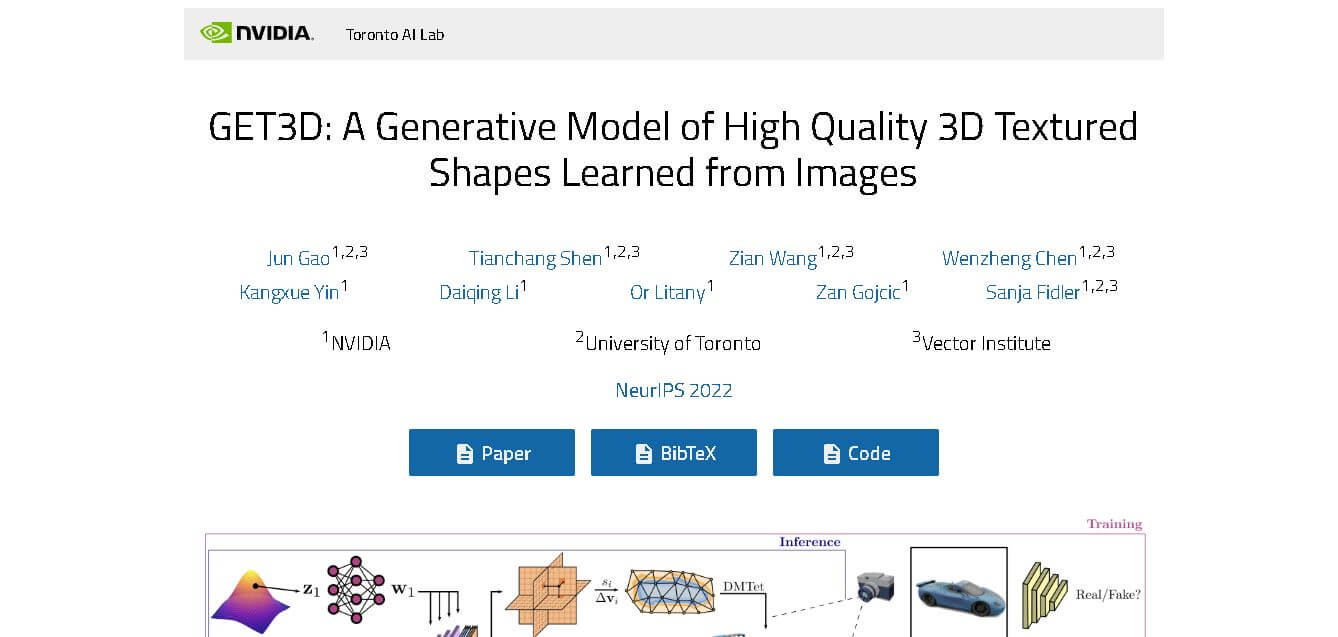
What is GET3D by Nvidia AI?
Founders/Launch
-
Developed by NVIDIA Research’s Toronto AI Lab.
-
Introduced in 2022 as part of NVIDIA’s ongoing research in generative AI for 3D modeling.
Use Cases
-
Creating large libraries of 3D assets for gaming and metaverse projects.
-
Generating textured meshes for AR/VR simulations and digital twins.
-
Supporting visual effects, 3D rendering, and AI-driven virtual environments.
Technology
-
Based on Generative Adversarial Networks (GANs).
-
Produces a 3D Signed Distance Function (SDF) and a texture field.
-
Uses separate latent codes for geometry and texture to ensure realism and diversity.
-
Supports interpolation between shapes for seamless design variations.
-
Extracts explicit meshes with detailed topology and textures ready for rendering.
GET3D is an AI-powered 3d platform that enables creators to automatically generate detailed, textured 3D meshes from 2D images. NVIDIA Toronto AI Lab developed the tool, revolutionizing the generation of 3D assets for games, simulations, and other virtual environments. GET3D removes the need to manually create models and uses a trained Generative Adversarial Network (GAN) to learn the shape and surface details of an object, enabling it to produce 3D assets like cars, chairs, animals, buildings, and more. The output mesh is compatible with all popular 3D software, and the tool allows developers, designers, and researchers to create 3D assets more efficiently and build for creators across numerous creative industries.
Key Features
GET3D key features are
- High-Quality Textured Meshes—Creates fully 3D models with realistic textures from basic 2D image input.
- Complex Geometry—Builds complex shapes and structures accurately.
- Texture and geometry separation—Control texture and geometry independently to allow flexibility in the style of the model or the texture/appearance.
- Latent space editing—smoothly traverse designs to create variations in your renderings.
- Production-ready assets—export models in standard 3D file formats for 3D renderers.
- Scalable generation—quickly generate a large number of trees, models, etc. for game and metaverse projects.
Pricing
- Free for research
- Academic access free
- Commercial licensing varies
Disclaimer: For the latest and most accurate pricing information, please visit the official GET3D website.
Who is using it?
A wide range of users and organizations are using GET3D
- AI and graphics researchers
- Game developers
- VR/AR designers
- Animation and film artists
- Architectural and product visualization teams
- Tool developers
Alternatives
Some GET3D alternatives are
- Point-E by OpenAI
- Luma AI
- Masterpiece Studio
- DreamFusion (Google Research)
- Kaedim
Conclusion
GET3D is a significant advance in generative AI for use in 3D modeling. You can take 2D images of something and convert them to high-quality, textured 3D meshes while saving users from otherwise tedious manual modeling. GET3D is capable of creating assets that are detailed, textured, rich in geometry, and appropriate for video gaming, animation, or constructing virtual worlds. As an open research project by NVIDIA, GET3D is combining artificial intelligence with the 3D design process in a way that can lessen the workload of creators and producers to help them create detailed, diverse, and expansive digital worlds.









 Verified