10 Best AI Content Detectors Tools 2026 (Tested & Ranked)
Looking for the best AI content detector? Compare 10 AI detectors in 2026 by pricing, features, accuracy, free plans, languages, and use cases.
Explore moreThe best AI content detector depends on your specific use case. Originality.ai is designed strongly around SEO and publishing workflows, GPTZero and Turnitin are widely oriented toward education, Copyleaks combines AI and plagiarism detection with multilingual capabilities, and QuillBot provides a free AI detection option alongside a broader writing toolkit.
AI-written content is now deeply embedded in the modern internet. A large-scale study analyzing nearly one million web pages found that 74.2% of newly published pages contain some level of AI-generated content. However, only 2.5% are fully AI-generated, while the vast majority are a blend of human and AI writing. This hybrid approach is exactly what makes AI detection so challenging in 2026—and why choosing the right AI content detector, AI writing checker, or ChatGPT detector is more important than ever.
Whether you're a professor aiming to grade fairly, a content manager reviewing freelance work, or a publisher safeguarding your site's credibility with Google, the tool you choose has real consequences. A false positive can damage a student’s reputation, while missed AI content can weaken trust in your brand. That’s why it’s critical to rely on tools that balance accuracy with fairness.
So, how can you actually tell if content is AI-generated?
This is where AI content detectors come in. These tools analyze writing patterns and estimate whether AI created or significantly assisted a piece of text. Modern detectors evaluate factors like predictability, sentence variation, repetition, and linguistic structure. However, it’s important to understand one key limitation: AI detection tools do not provide definitive proof of authorship. Their results are probabilistic and can vary depending on content length, editing level, language, and topic.
In this guide, we’ll break down the 10 best AI content detectors in 2026, including their real-world accuracy, pricing, key features, strengths, limitations, and ideal use cases—so you can choose the right tool with confidence.
Key Takeaways - AI Content Detector
- AI detectors estimate whether content resembles AI-generated writing; they don't definitively prove who wrote it.
- Free AI detectors are available, but they often impose word, character, or scan limits.
- Some platforms combine AI detection with plagiarism checking.
- Enterprise tools may offer APIs, team management, LMS integrations, and bulk scanning.
- Multilingual support varies considerably between providers.
- AI detection can become more difficult when generated content is substantially edited or paraphrased.
- For high-stakes decisions, detector results should be combined with human review and additional evidence.
- Pricing can change, so check the provider's current pricing page before purchasing.
AI Content Detector Comparison at a Glance
| Tool | Best For | Free Option | Starting Paid Price | AI Detection | Plagiarism | API | Image Detection |
|---|---|---|---|---|---|---|---|
| Originality.ai | SEO & publishers | Yes | $14.95/mo | ✓ | ✓ | ✓ | — |
| GPTZero | Education | Yes | Paid plans | ✓ | ✓ | ✓ | ✓ |
| Copyleaks | Enterprise | Yes/limited | $16.99/mo | ✓ | ✓ | ✓ | ✓ |
| Winston AI | Publishers | Trial | $18/mo | ✓ | ✓ | — | ✓ |
| Turnitin | Universities | No | Custom | ✓ | ✓ | — | — |
| QuillBot | Writers | Yes | $8.33/mo annually | ✓ | ✓ | — | ✓ |
| Sapling | Businesses | Yes | $25/mo | ✓ | — | ✓ | — |
| Quetext | Students & writers | Yes | $14.99/mo | ✓ | ✓ | ✓ | — |
| Pangram | Verification | Yes | $20/mo | ✓ | ✓ | ✓ | ✓ |
| ZeroGPT | Quick checks | Yes | Varies | ✓ | — | — | — |
What Is an AI Content Detector?
An AI content detector is a tool that analyzes text to determine whether it was written by a human or generated by artificial intelligence. It uses machine learning models, linguistic patterns, and statistical signals to identify characteristics typical of AI-written content, such as predictability, uniform tone, and repetition. These tools are widely used by educators, publishers, and businesses to verify content authenticity, maintain originality, and ensure transparency in digital communication.
Key Points:
- Detects AI-generated vs human-written text
- Uses NLP, machine learning, and pattern analysis
- Evaluates tone, structure, and predictability
- Helps prevent plagiarism and content misuse
- Used in education, SEO, publishing, and compliance
Why AI Content Detection Matters More in 2026
Three years ago, "AI detector" was a niche search term used mostly by university professors. Today it's a mainstream need across at least four very different groups:
- Educators trying to preserve academic integrity as AI adoption among students keeps climbing, even as faculty guidance struggles to keep pace—a 2025 global survey by the Digital Education Council found four out of five faculty members say their institution's AI guidelines for teaching aren't comprehensive.
- Publishers and SEO teams who need to know whether freelance or in-house writers are submitting AI-generated drafts, both for quality control and because search engines increasingly reward genuinely helpful, human-vetted content.
- Trust & safety teams at platforms trying to moderate synthetic spam, fake reviews, and coordinated bot activity at scale.
- Everyday writers and students who want to self-check a draft before submitting it, especially after using AI tools for brainstorming or editing.
The problem all four groups share: AI-generated text is no longer easy to spot by eye. Modern models write with natural rhythm, varied sentence length, and personal-sounding phrasing—which means the humans doing the judging need software that can catch statistical patterns invisible to casual reading.
10 Best AI Detectors in 2026
1. Originality.ai
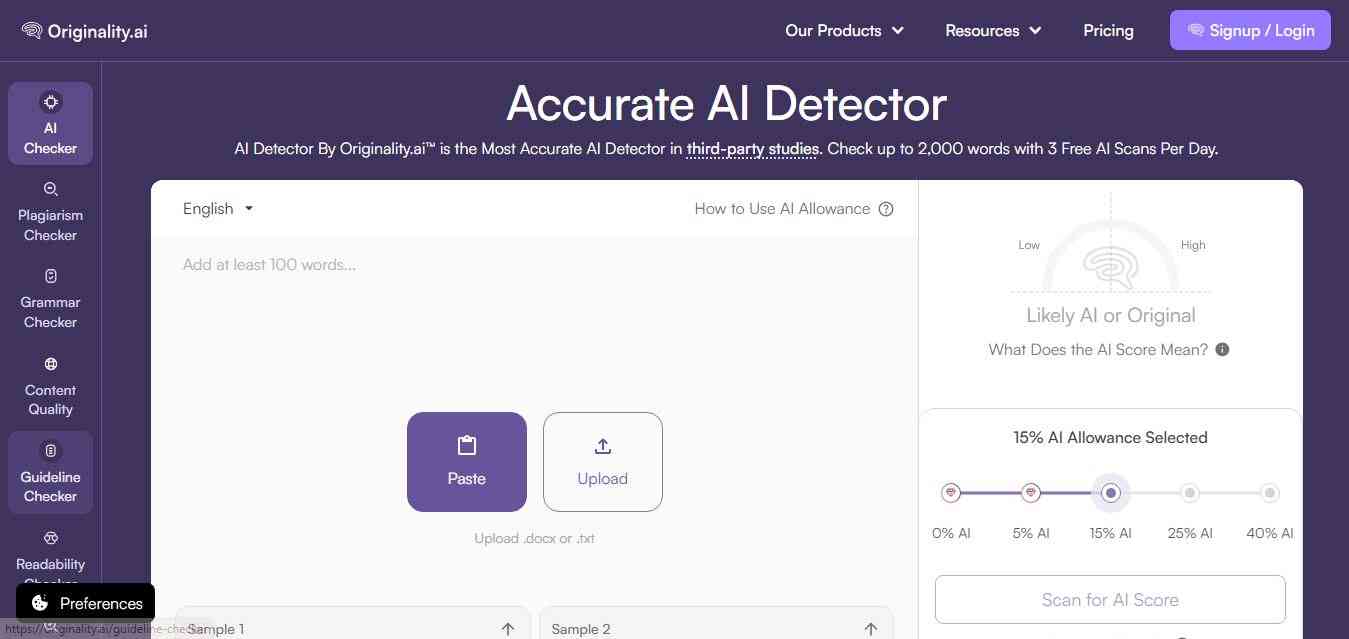
Originality.ai is designed specifically around content authenticity and publishing workflows. It combines AI detection, plagiarism checking, readability analysis, website scanning, team management, and API access. Its current Pro plan is listed at $14.95 per month when billed monthly, or $12.95 per month with annual billing, and includes 2,000 credits per month, with one credit representing 100 words. Enterprise pricing is also available. The platform supports document uploads, website scans, team collaboration, and a Chrome extension, making it particularly useful for agencies handling large volumes of content.
Best for: SEO professionals, publishers, agencies, and content teams
Key features:
- AI content detection
- Plagiarism detection
- Full website scanning
- Readability analysis
- Team management
- API access
- Document uploads
- Chrome extension
- Google Docs workflow support
Pricing
- Basic: Free; 3 scans per day and up to 2,000 words per scan
- Pro: $14.95/month monthly or $12.95/month with annual billing
- Enterprise: $179/month monthly or $136.58/month with annual billing
Pros:
- High accuracy on AI + paraphrased content
- Built for SEO teams & publishers
- Includes plagiarism + fact-checking features
- Team collaboration & API access
Cons:
- Paid tool (credit-based pricing)
- Can get expensive at scale
- Not beginner-friendly for casual users
Best use case: SEO agencies, publishers, affiliate websites, editorial teams, and businesses reviewing large amounts of AI-assisted content.
Why consider Originality.ai?
Originality.ai is particularly useful when AI detection is only one part of the editorial process. SEO agencies can use the same platform for AI detection, plagiarism checking, readability analysis, website scans, and content quality control.
2. GPTZero
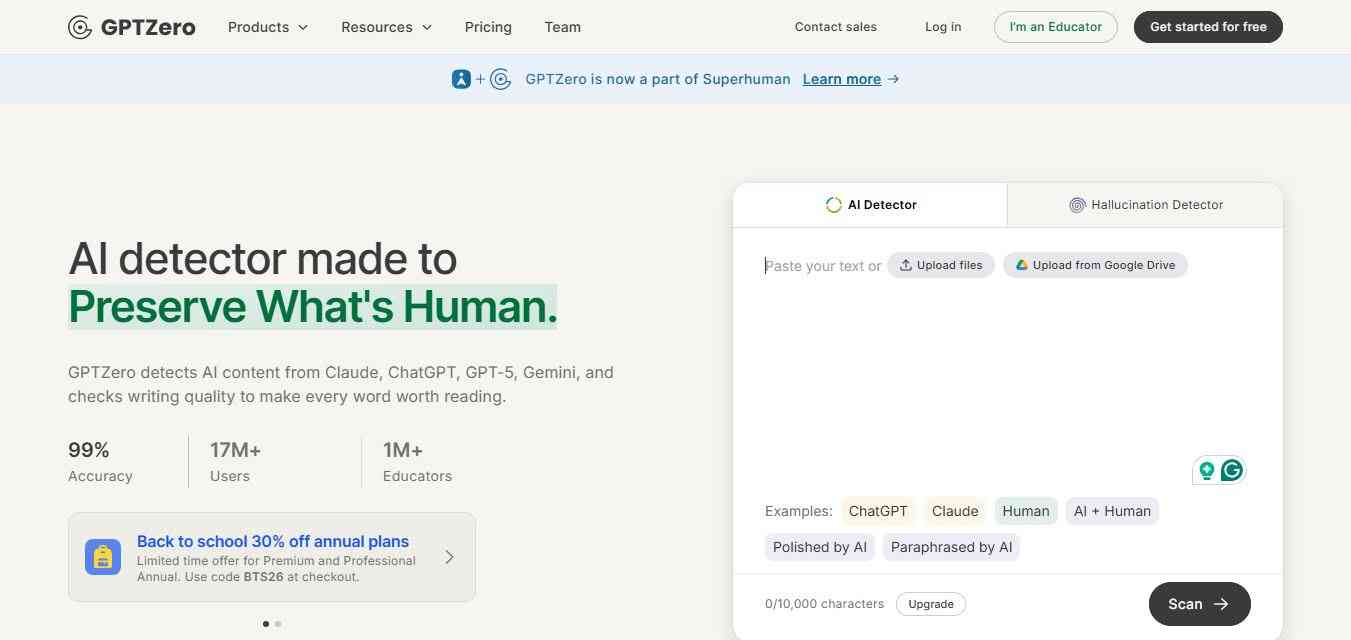
GPTZero is one of the most recognizable AI writing detection platforms and has developed a strong focus on education. It analyzes text for signals associated with AI-generated writing and provides reporting designed to help users investigate potentially AI-generated passages. GPTZero also offers features such as plagiarism checking, authorship and writing replay, grammar assistance, browser extensions, and an AI detection API. Its current product lineup includes both general and education-oriented plans.
Best for: Students, teachers, educators, and academic workflows
Key features:
- AI writing detection
- Sentence-level analysis
- Education workflows
- Plagiarism checking
- Writing replay
- Authorship analysis
- Browser extension
- API access
- Grammar tools
Pricing
- Free: Available
- Professional: Paid plans available; pricing varies according to plan and billing configuration
- Team/Enterprise: Custom organizational options
- API: Available for developers
Pros:
- Strong free plan (good for students)
- Easy to use with simple reports
- Good accuracy on raw AI content
- Widely used in education
Cons:
- Accuracy drops on edited/paraphrased text
- Moderate false positives
- Limited advanced features
Best use case: Teachers, students, academic institutions, and anyone who wants an AI writing checker with education-focused functionality.
Why consider GPTZero?
GPTZero is particularly relevant for educational environments because it goes beyond simply generating an AI percentage. Authorship and writing-history features can provide additional context when educators need to understand how a document was produced.
3. Copyleaks
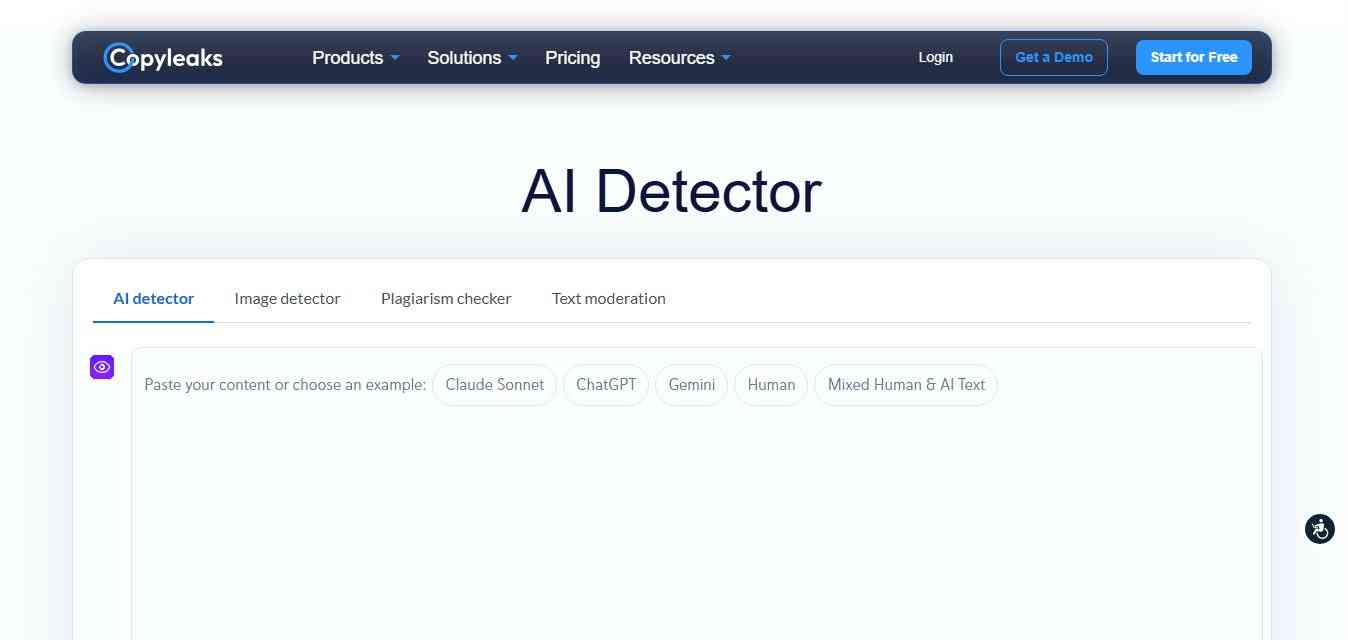
Copyleaks combines AI detection and plagiarism detection in a single platform. Its current pricing page lists the Personal plan at $16.99 per month when billed monthly or $13.99 per month with annual billing. The personal plan includes AI detection in 30+ languages, plagiarism detection in 100+ languages, browser extensions, Google Docs integration, multiple-file scanning, and AI image detection. The Pro plan adds team functionality and increased usage. Enterprise and education customers can request customized plans with additional integrations and API functionality.
Best for: Enterprises, schools, multilingual teams, and plagiarism checking
Key features:
- AI-generated content detection
- Plagiarism detection
- 30+ AI detection languages
- 100+ plagiarism languages
- AI image detection
- Cross-language plagiarism detection
- Browser extensions
- Google Docs integration
- Bulk file scanning
- Enterprise integrations
Pricing
- Personal: $16.99/month monthly or $13.99/month annually
- Pro: $99.99/month monthly or $74.99/month annually
- Enterprise: Custom pricing
- Education: Custom pricing based on institution size and requirements
Pros:
- Supports 30+ languages
- Low false-positive rate (one of the best)
- Enterprise & LMS integrations
- Good for business workflows
Cons:
- Interface can feel complex
- Paid plans required for full features
- Detection weak on heavily edited AI
Best use case: Organizations that need both AI detection and plagiarism checking, particularly multilingual businesses and educational institutions.
Why consider Copyleaks?
Copyleaks stands out for organizations that need AI detection and plagiarism detection together, especially when content is produced in multiple languages. Its enterprise and education plans also support LMS integrations, API functionality, analytics, and more advanced administrative controls.
4. Winston AI
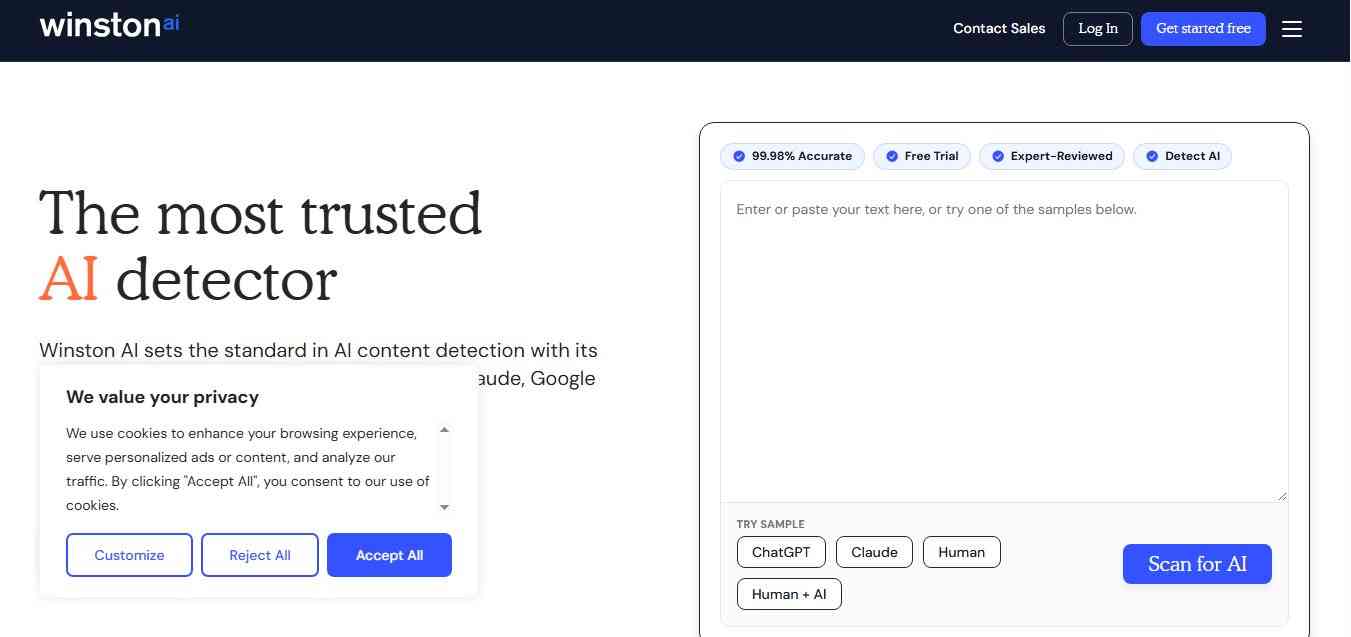
Winston AI goes beyond traditional text detection by offering AI detection for written content, as well as AI image and deepfake detection. The platform supports document scanning, OCR for images and handwriting, plagiarism detection, writing feedback, and downloadable PDF reports. Its current pricing page lists a free 14-day trial with 2,000 credits. Paid plans start at $18 per month, or an effective $10 per month when billed annually, for the Essential plan. Higher tiers increase monthly credits and team functionality.
Best for: Publishers, educators, content teams, and multimodal content verification
Key features:
- AI text detection
- AI image detection
- Deepfake detection
- OCR
- Plagiarism checking
- PDF reports
- Document scanning
- Writing feedback
- Team functionality
Pricing
- Free trial: $0 for 14 days; 2,000 credits
- Essential: $18/month or $120/year
- Advanced: $29/month or $192/year
- Elite: $49/month or $312/year
Monthly credit limits
- Essential: 100,000 credits
- Advanced: 200,000 credits
- Elite: 500,000 credits
Pros:
- High claimed accuracy
- Detailed sentence-level analysis
- Detects AI images as well
- Good for professionals & publishers
Cons:
- Claims not always independently verified
- Paid tool with limited free usage
- Less reliable on humanized content
Best use case: Publishers and organizations that want to examine both AI-generated text and synthetic visual content.
Why consider Winston AI?
Winston AI is useful for organizations that want to examine more than written content. Its combination of AI text detection, AI image detection, plagiarism checking, OCR, and writing feedback makes it suitable for broader content verification workflows.
5. Turnitin
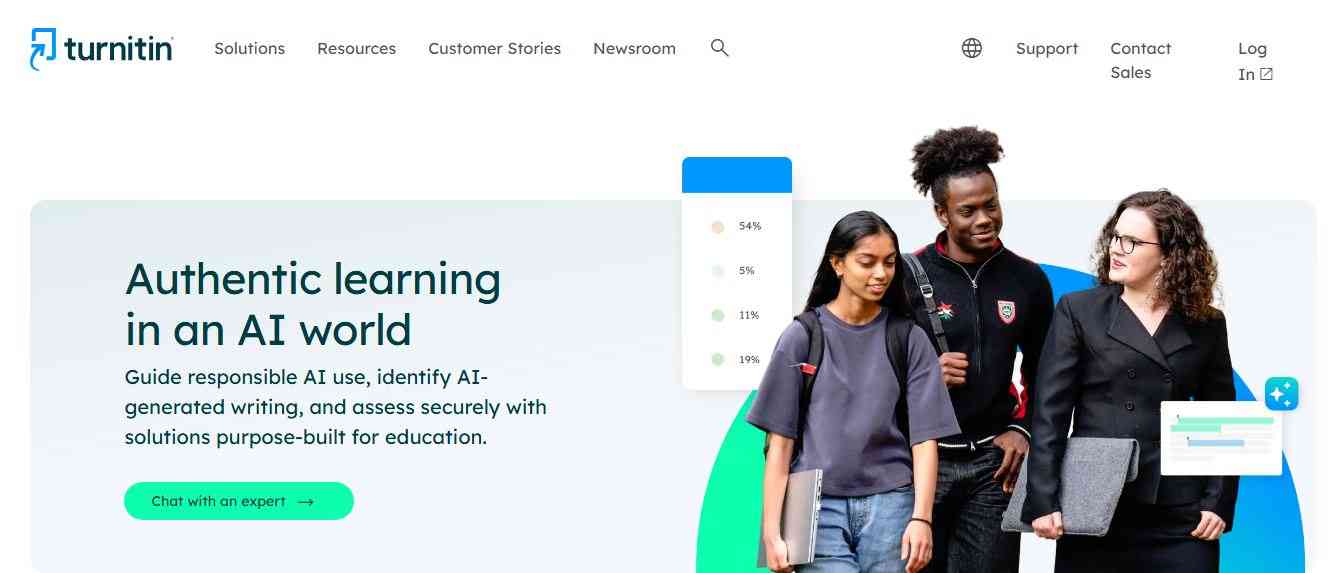
Turnitin is primarily an institutional academic integrity platform rather than a consumer AI checker. Its AI writing detection functionality is integrated into academic workflows, where it can be used alongside plagiarism and similarity checking. Turnitin continues to update its AI writing detection model; its 2026 release notes document updates designed to improve recall while maintaining a low false-positive rate. Turnitin also introduced more granular categories for certain AI-paraphrased content and limited how low AI scores appear in reports to reduce potential false-positive interpretation.
Best for: Universities, colleges, schools, and academic institutions
Key features:
- AI writing detection
- Similarity checking
- Academic integrity workflows
- LMS integration
- AI-paraphrasing detection categories
- Institutional reporting
- Submission management
- Educator-focused workflows
Pricing
- Individual: No direct Turnitin subscription for Feedback Studio/Similarity
- Schools and universities: Custom institutional pricing
- Turnitin Clarity: Additional license cost where applicable
Pros:
- Industry standard in universities
- Very high accuracy on raw AI text (~96%)
- Strong plagiarism detection database
- Integrated into academic systems
Cons:
- Not available to individuals
- Can flag human writing (false positives)
- Works best only in academic environments
Best use case: Universities, colleges, schools, educators, and institutions already using Turnitin for academic integrity.
Why consider Turnitin?
For institutions already using Turnitin, the major advantage is workflow integration. Educators can access AI-writing indicators alongside existing academic-integrity and similarity reports rather than maintaining a separate consumer AI detector.
6. QuillBot AI Detector
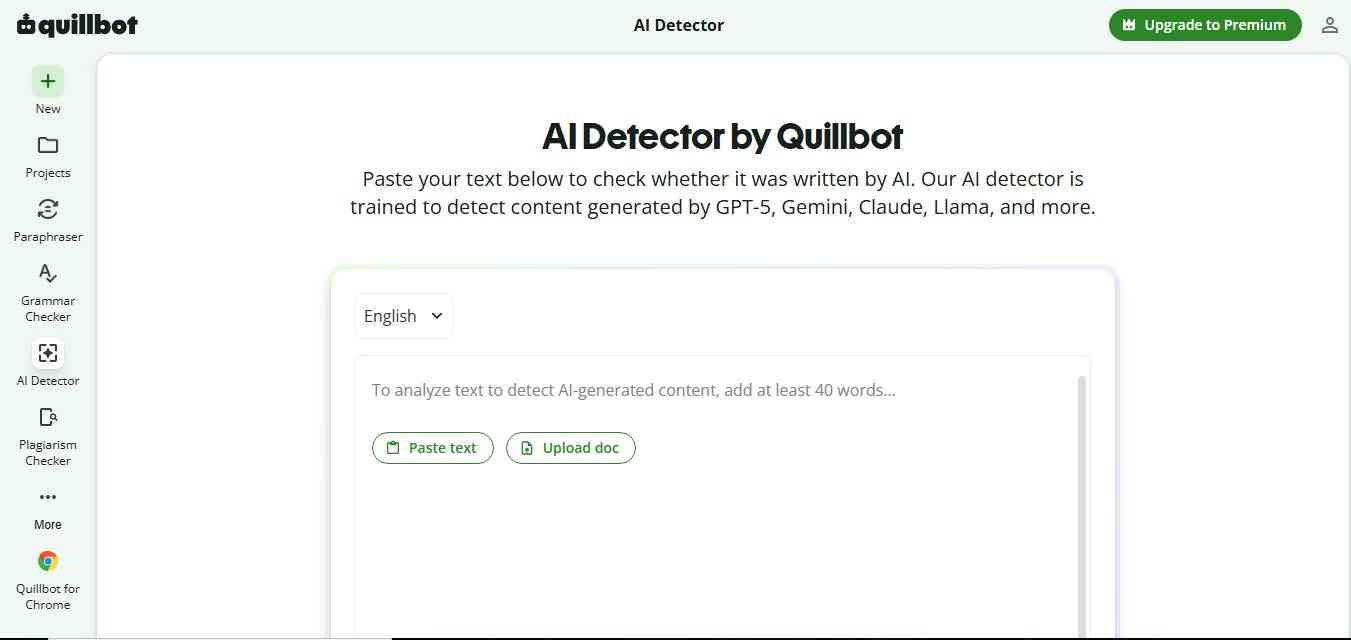
QuillBot's AI Detector is attractive for users who want a straightforward AI writing checker without paying specifically for detection. Quillbot says its detector analyzes characteristics such as predictability, repetition, sentence variation, and structural patterns, then provides a score estimating the likelihood that text was AI-generated. The free version currently supports up to 1,200 words per scan and up to six scans per day, while Premium removes the word limit and provides unlimited detection scans. Quillbot also provides explanatory feedback about flagged sections.
Best for: Students, writers, freelancers, and casual AI checks
Key features:
- Free AI detection
- AI-generated content analysis
- Sentence-level explanations
- AI-assisted writing analysis
- Grammar tools
- Paraphrasing
- Plagiarism checking
- Downloadable reports
- AI image detection
Pricing
- Free: $0; AI detector available
- Premium: $8.33/month when billed annually
- Team: Custom/team pricing
AI detector difference between free and premium
The detection itself is available free. According to QuillBot's current help documentation, free users can upload one file at a time, while premium users can upload up to 20 files simultaneously.
Pros:
- Free and easy to use
- Integrated with paraphrasing tools
- Good for quick checks
Cons:
- Lower accuracy compared to top tools
- Not reliable for serious validation
- Limited reporting features
Why consider QuillBot?
Quillbot is particularly useful if you don't want a standalone AI detector. You can check AI content and then use the same platform for grammar improvement, paraphrasing, summarization, plagiarism checking, and other writing tasks.
7. Sapling AI Detector
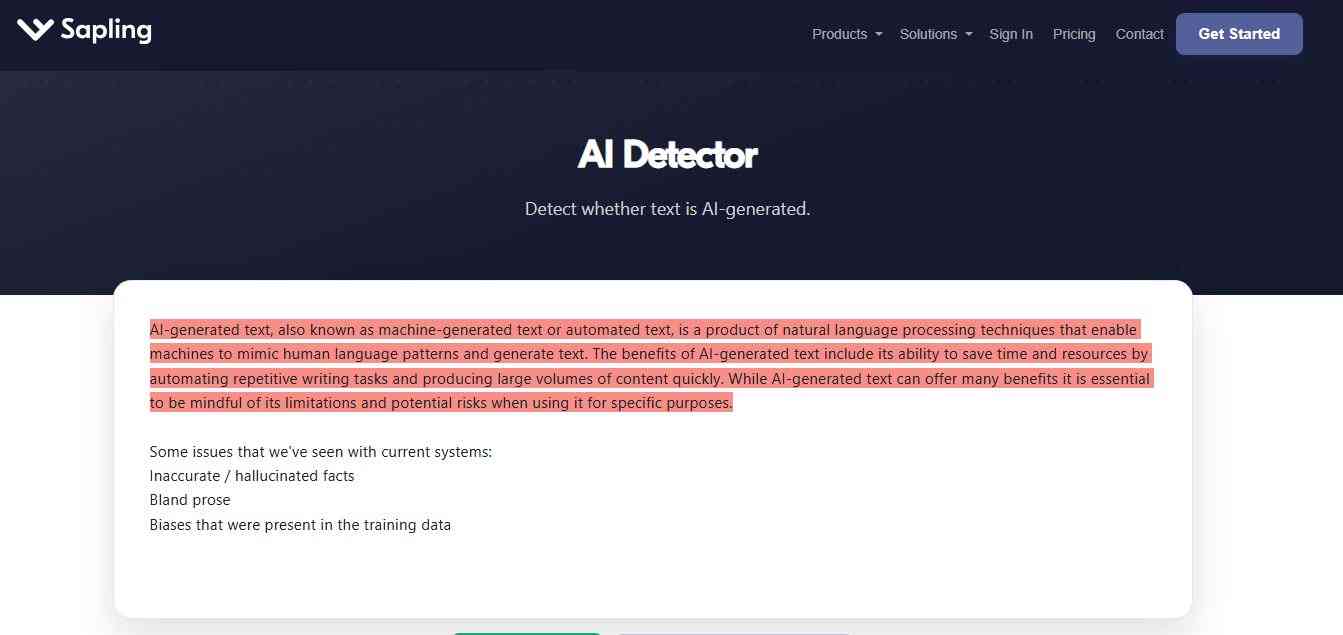
Sapling takes a slightly different approach by combining AI detection with a broader business writing platform. Its free plan includes AI detector checks for up to 2,000 characters each. The Pro plan costs $25 per month and increases the detector limit to 100,000 characters per check. Sapling also offers a usage-based AI Detector API, which developers can integrate into their applications. Its documentation currently lists API pricing starting at $0.005 per 1,000 characters, with lower rates at higher volumes. Sapling explicitly notes that AI detectors can generate both false positives and false negatives. Sapling combines AI detection with business writing assistance. Its free plan provides AI detector checks of up to 2,000 characters per check, while the Pro plan increases the limit to100,000 characters per check. Sapling's current Pro plan costs $25/month, while its developer API uses metered pricing. Enterprise plans start at 10 seats, priced at $15 per seat per month.
Best for: Businesses, developers, customer-support teams, and API users
Key features
- AI content detection
- AI detector API
- Writing assistance
- Grammar suggestions
- Advanced writing suggestions
- Rephrase tools
- Browser extensions
- Google Docs integration
- Microsoft Word integration
- Outlook integration
- AI detection batch files
- Enterprise administration
- Team analytics
- SSO/SCIM
- Custom integrations
- Self-hosting options
- API access
Pricing
- Free: $0/month; 2,000 characters per AI detection check
- Pro: $25/month; up to 100,000 characters per check
- API: Usage-based pricing with a $5 minimum
- Enterprise: Starts at $15/seat/month for 10 seats
Pros:
- Strong API & developer integration
- Free basic version available
- Useful for business communication tools
Cons:
- Lower accuracy (~85%)
- Struggles with modern AI models
- Limited detailed insights
Why consider Sapling?
Sapling makes particular sense for companies and developers that want AI detection inside an existing business communication or software workflow. Its API allows developers to build AI detection into their own applications.
8. Quetext AI Detector
Quetext combines AI detection with plagiarism checking and writing tools. Its free plan provides AI detection and plagiarism checking with limited word allowances. Paid individual plans add larger monthly limits, bulk uploads, AI humanization, summarization, grammar checking, citation functionality, and API access. Quetext's pricing structure is particularly relevant for users who don't want to maintain separate subscriptions for an AI detector and plagiarism checker. Its professional plans can also scale by monthly word volume, making the platform suitable for larger teams and organizations.
Best for: Students, writers, educators, and content teams
Key features:
- AI content detection
- Plagiarism checking
- Sentence-level analysis
- AI summarizer
- AI humanizer
- Citation tools
- Grammar checking
- Bulk uploads
- API access
Pricing
- Free: $0/month; AI detector and plagiarism checker up to 1,000 words
- Essential: From $14.99/month; 100,000 words/month
- Professional: From $29.98/month; 200,000 words/month
Pros:
- All-in-one tool (AI detection + plagiarism + grammar)
- High accuracy on raw AI text
- User-friendly interface
Cons:
- Limited free plan (word cap)
- Paid plan needed for bulk scanning
- Slight drop in accuracy on edited content
Best use case: Writers and students who want AI detection and plagiarism checking in one platform.
Why consider Quetext?
Quetext is useful for users who want AI detection and plagiarism checking in one subscription. Its free plan also makes it easy for students and writers to test the platform before paying.
9. Pangram
Pangram is an AI detection platform that places significant emphasis on explaining detection results rather than simply presenting a single percentage. Its free plan currently allows up to 2,000 words per day and includes AI assistance detection, interpretability features, file upload, OCR, browser extensions, Google Docs integration, image detection, and support for more than 20 languages. The individual plan is priced at $20 per month for up to 300,000 words, while the professional plan supports up to 1.5 million words for $65 per month.
Best for: Content verification, publishers, researchers, and users concerned about interpretability
Key features:
- AI text detection
- AI assistance detection
- Interpretability reports
- 20+ languages
- AI image detection
- OCR
- Browser extension
- Google Docs integration
- Plagiarism detection
Pricing
- Free: $0; 2,000 words/day
- Individual: $20/month; 300,000 words/month
- Professional: $65/month; 1.5 million words/month
- Team: $20/seat/month
- Developer API: Usage-based
- Enterprise: Custom pricing
- Education: Custom institutional licensing
Pros:
- Very low false-positive rate (best in studies)
- Strong independent research backing
- Reliable for high-stakes use
Cons:
- Newer tool (less adoption)
- Limited awareness vs competitors
- Feature ecosystem still growing
Best use case: Organizations that want more context around why text may have been flagged, rather than relying exclusively on a single AI percentage.
Why consider Pangram?
Pangram is particularly interesting for teams that want interpretability rather than just a single AI score. Higher plans also introduce plagiarism detection, image detection, API usage, and large monthly word allowances.
10. ZeroGPT
ZeroGPT is designed as an accessible AI content checker for people who want to quickly analyze text for possible AI generation. The platform is commonly used for checking content associated with tools such as ChatGPT and other generative AI systems. Its main appeal is simplicity: users can paste text and receive a detection result without needing a complicated enterprise workflow. Like other AI detectors, ZeroGPT should be treated as a screening tool rather than definitive proof of authorship, especially when the content has been heavily edited or paraphrased.
Best for: Quick checks, students, and users looking for a simple AI detector
Key features:
- AI content detection
- ChatGPT detection
- Simple text scanning
- Quick results
- Free checking options
- Paid usage options
- Content analysis
- Accessible interface
Pricing
- Free: AI detection is available
- Paid: Premium features and usage options may be available depending on the current plan
Editorial note: Because current official pricing could not be independently verified during this update, don't publish a specific ZeroGPT monthly price without checking its live pricing page immediately before publication.
Pros:
- Free and fast to use
- No login required
- Good for quick checks
Cons:
- Lowest accuracy among top tools
- High false-positive rate (~14%)
- Not reliable for professional use
Best use case: Quick, preliminary AI content checks when you don't need an advanced enterprise workflow.
Why consider ZeroGPT?
ZeroGPT can be useful when you need a quick preliminary AI-content check without setting up a more advanced publishing, education, or enterprise workflow.
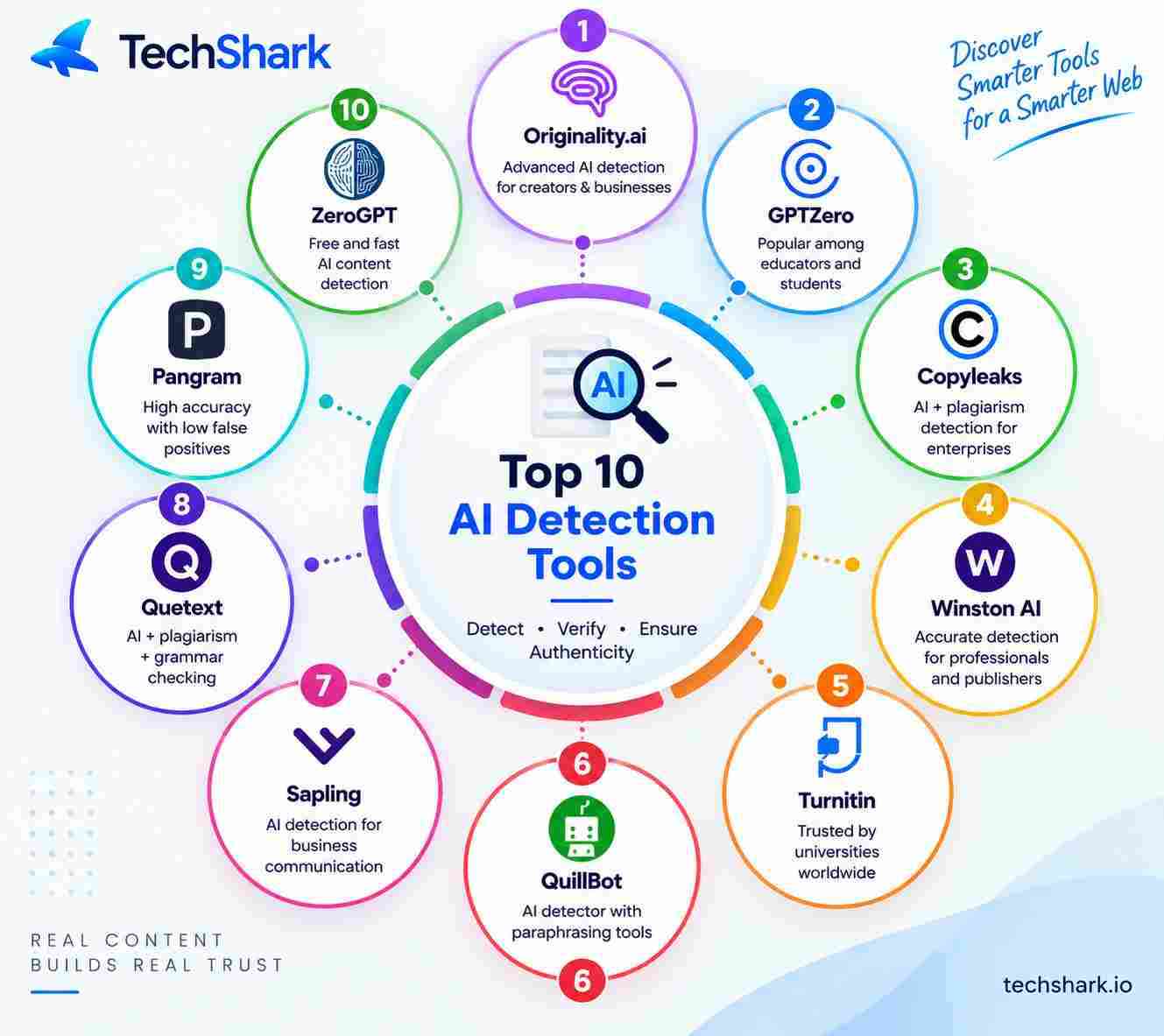
Which AI Content Detector Has the Most Useful Features?
The answer depends on what you need.
- For SEO agencies: Look for tools that combine AI detection with plagiarism, readability, website scanning, team collaboration, and API functionality. Originality.ai is designed around this type of publishing workflow.
- For students: A free tool such as Quillbot can be convenient, while GPTZero provides education-oriented detection and authorship features.
- For universities: Turnitin is designed around institutional academic-integrity workflows and integrates AI writing detection with its existing academic ecosystem.
- For multilingual content: Copyleaks is particularly notable because it currently advertises AI detection in 30+ languages and plagiarism detection in 100+ languages.
- For developers: Sapling, GPTZero, Originality.ai, Copyleaks, and Pangram all provide API-oriented options, although pricing and integration models differ.
- For AI image and text detection: Copyleaks, Winston AI, and Pangram now offer AI-image detection alongside text-focused capabilities.
Key Facts About AI Content Detection in 2026
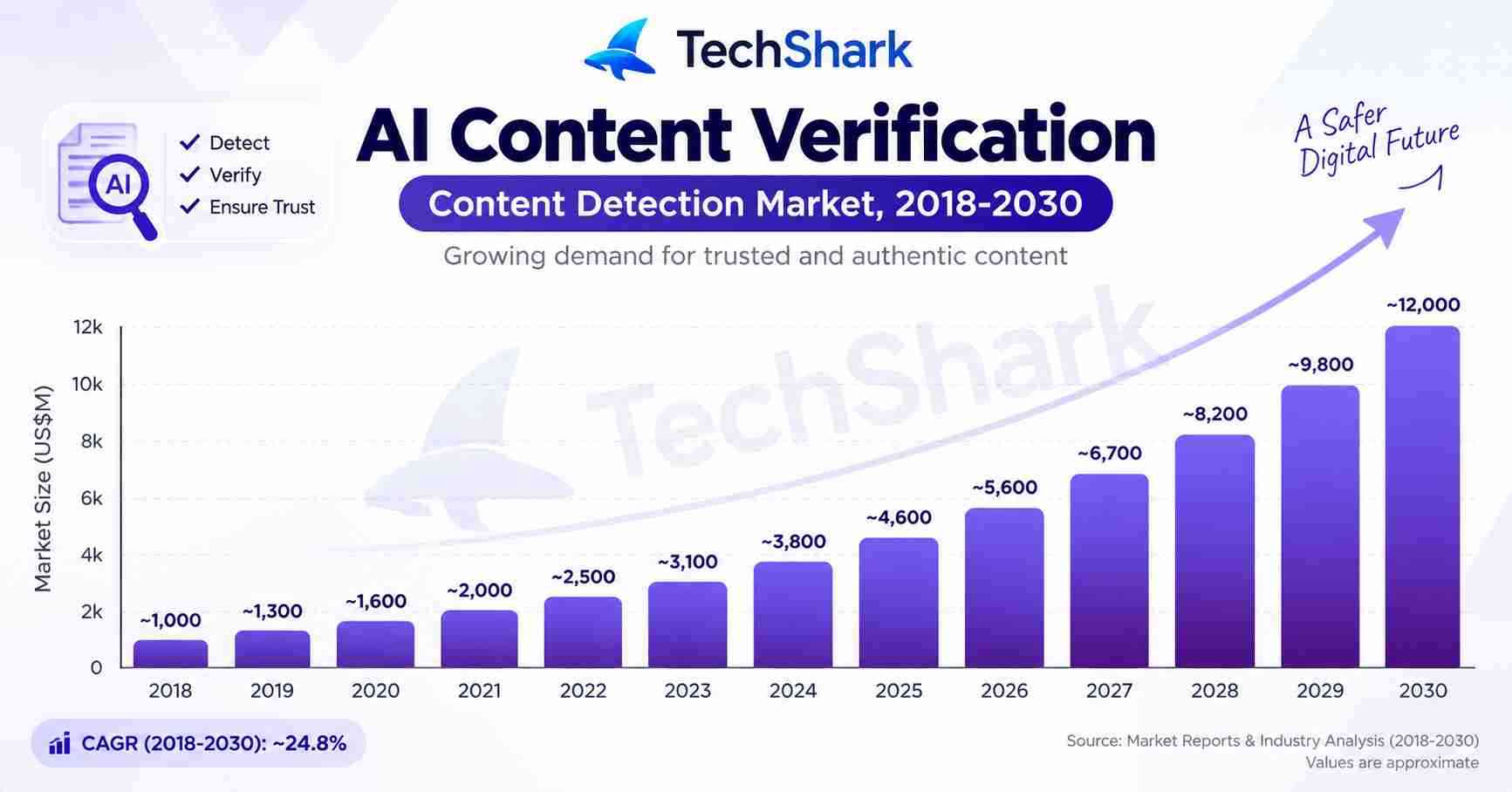
The growth of AI-assisted writing explains why AI detection tools have become increasingly important.
According to an Ahrefs survey of 879 marketers published in 2025, 87% of respondents said they use AI to help create content. The same research found that marketers using AI publish more content, demonstrating how quickly AI has become embedded in modern content workflows.
AI adoption is also spreading beyond marketing. Reuters reported in September 2026 that 44% of U.S. workplaces were using artificial intelligence as of May 2026. These numbers help explain the growing demand for AI content checkers across marketing, education, publishing, recruiting, and business communication.
Can AI Detectors Really Detect ChatGPT Content?
Yes, but not perfectly.
AI detectors generally estimate the probability that text resembles AI-generated writing. They don't have a magical database containing every sentence ever produced by ChatGPT.
Modern AI detection systems may analyze signals including:
Key features:
- AI content detection
- ChatGPT detection
- Simple text scanning
- Quick results
- Free checking options
- Paid usage options
- Content analysis
- Accessible interface
Pricing: Free option available, with paid plans for higher usage and additional functionality.
How Accurate Are AI Content Detectors?
This is one of the most misunderstood aspects of AI detection.
Many AI detector companies publish very high accuracy figures, but you should interpret these numbers carefully because performance depends on the test dataset and conditions.
A 2026 independent retail test of eight detectors found that the tools were generally effective at identifying raw, unedited AI text but performed substantially worse on edited AI text. In that test, detection of edited AI content fell into a much lower range than detection of raw AI output. The test also found false positives among human-written samples. Because this was one specific test corpus rather than a universal benchmark, its results should not be generalized to every type of content.
Why accuracy changes
AI detection performance can vary according to:
Why accuracy changes
AI detection performance can vary according to:
- Text length
- Writing style
- Subject matter
- Language
- AI model used
- Human editing
- Paraphrasing
- Translation
- Grammar correction
- Amount of AI assistance
- Detector model and training data
For that reason, "99% accurate" does not mean an AI detector will correctly identify 99% of every document you submit.
What Is the Difference Between an AI Detector and a Plagiarism Checker?
An AI detector estimates whether writing resembles AI-generated content. A plagiarism checker searches for similarities between your content and existing sources.
These are two different checks.
For example, someone could write an entirely original article with ChatGPT. It may have no plagiarism, but an AI detector could identify patterns associated with AI-generated writing. Conversely, someone could copy a paragraph from a website manually. It might be human-written, but a plagiarism checker could identify the copied material. For professional publishing, using both types of tools can provide a broader originality review.
Why Do AI Detectors Sometimes Flag Human Writing?
False positives happen.
Human writing can sometimes resemble AI-generated text because it may be:
- Highly structured
- Formal
- Grammatically consistent
- Repetitive
- Short
- Generic
- Written in a predictable style
- Produced by a non-native English speaker
- Academic or technical in nature
This is particularly important in education and professional settings.
A detector score should therefore not be used as the only evidence when making consequential decisions about a student, employee, writer, or applicant.
Instead, combine detection results with:
- Draft history
- Document revision history
- Source citations
- Writing samples
- Author interviews
- Research notes
- Version history
- Human review
How to Choose the Best AI Content Detector?
Before subscribing to an AI detection tool, consider these factors.
1. Detection accuracy
Look beyond marketing claims and investigate independent testing where available. Ask whether the testing involved raw AI output, edited AI content, mixed human-AI writing, and human-written content.
2. False positives
This is arguably just as important as detection rate.
A detector that identifies AI content but frequently flags legitimate human writing may create serious workflow problems.
3. Supported languages
If your organization publishes internationally, check whether the detector supports your target languages.
Copyleaks, for example, currently advertises AI detection in 30+ languages and plagiarism detection in 100+ languages.
- Words
- Characters
- Credits
- Documents
- Monthly scans
- Users
5. Plagiarism detection
If you need both services, choosing an integrated platform such as Copyleaks, Originality.ai, or Quetext may simplify your workflow.
6. API access
Developers and SaaS companies should look for API support. Sapling, GPTZero, Originality.ai, and other platforms provide ways to integrate AI detection into software workflows.
7. Reporting
For educational, editorial, or compliance workflows, downloadable reports and detailed explanations can be more useful than a simple percentage.
8. Privacy
Never assume every AI detector treats submitted content the same way. Before uploading confidential manuscripts, unpublished research, client documents, or sensitive business information, review the provider's privacy and data-retention policies.
Best AI Detector by Use Case
Rather than asking which tool is universally "best," match the detector to your workflow.
| Use Case | Tools to Consider |
|---|---|
| SEO content | Originality.ai, Copyleaks, Quetext |
| Content agencies | Originality.ai, Copyleaks |
| Students | GPTZero, QuillBot, Quetext |
| Teachers | GPTZero, Turnitin |
| Universities | Turnitin, Copyleaks |
| Multilingual content | Copyleaks, Pangram |
| API integration | Sapling, GPTZero, Originality.ai |
| AI + plagiarism checking | Copyleaks, Originality.ai, Quetext |
| AI image + text detection | Winston AI, Copyleaks |
| Free AI checking | QuillBot, GPTZero, Pangram |
Do AI Detectors Affect SEO?
AI detection and SEO are related, but they aren't the same thing. Google's search systems evaluate content using many signals. An AI detector's score does not automatically determine whether a webpage will rank.
For SEO professionals, the more useful question is:
Does the content provide genuine value to the reader?
High-quality content should demonstrate:
- First-hand experience
- Original insights
- Accurate information
- Useful examples
- Clear explanations
- Relevant sources
- Strong topical coverage
- Good readability
- Appropriate internal linking
- Search intent alignment
AI can help accelerate content production, but simply passing an AI detector does not make an article useful or authoritative.
Conclusion
The best AI content detector depends on what you're trying to accomplish. If you manage an SEO agency or publishing operation, look for strong content workflows, team management, plagiarism checking, and website scanning. If you're an educator, prioritize academic integrations and responsible interpretation of detection results. If you're a developer, API access and predictable usage pricing may matter more than a consumer-friendly interface. The most important point is that AI detection is not the same as proving authorship.
Modern detectors can be useful screening tools, but no percentage should replace human judgment. The strongest content-authenticity workflow combines AI detection with plagiarism checking, source verification, writing history, editorial review, and an understanding of how the content was produced. As AI-assisted writing becomes more common, the goal shouldn't simply be to "beat" an AI detector. The goal should be to create content that is original, useful, accurate, trustworthy, and genuinely valuable to readers. For most businesses, the practical approach is to choose a detector based on its workflow fit rather than chasing a single advertised accuracy percentage.
People are also reading:
- AI Browser vs Traditional Browser
- AI Deepfake Tools
- AI Copilot vs AI Agent
- Top AI Trends
- Best AI Fitness Tools
- Best AI Music Tools
Frequently Asked Questions (FAQs)
Q: What Is an AI Content Detector?
An AI content detector is software that analyzes written text and estimates whether it was generated or assisted by an artificial intelligence system. These tools may examine linguistic patterns, predictability, sentence variation, vocabulary, structure, and other signals associated with machine-generated writing.
Q: How Do AI Content Detectors Work?
Most AI detectors use machine-learning models trained to identify patterns associated with AI-generated text. Depending on the platform, the analysis may consider sentence structure, word predictability, repetition, stylistic consistency, and other linguistic characteristics. The exact detection methodology differs from one provider to another, and many vendors do not publicly disclose all details of their proprietary models.
Q: What is the best AI content detector?
The best AI content detector depends on your use case. Originality.ai is built around publishing and content workflows, GPTZero and Turnitin focus strongly on education, Copyleaks combines AI and plagiarism detection with multilingual support, and QuillBot offers a convenient free AI detection option.
Q: Is there a 100% accurate AI detector?
No AI detector should be treated as universally 100% accurate. Detection performance varies based on the model, writing style, document length, language, and amount of editing.
Q: What is the best free AI content detector?
Several platforms provide free AI detection, including QuillBot, GPTZero, Pangram, and others. The most suitable option depends on your word limits, required features, and intended use.
Q: Can AI detectors detect ChatGPT?
Many AI detectors are designed to identify writing associated with ChatGPT and other large language models. However, detection performance can vary, particularly when AI-generated text has been substantially edited, translated, or paraphrased.
Q: Can AI detectors detect humanized AI content?
Detection of heavily edited or paraphrased AI content is generally more difficult. Independent testing has found substantial drops in detection performance on edited AI text compared with raw AI output.
Q: Are AI detectors accurate for academic papers?
They can provide useful signals, but an AI detector score should not be considered conclusive evidence by itself. Academic institutions should follow their own policies and consider additional evidence such as drafts, sources, revision history, and student discussion.
Q: What is the difference between an AI checker and an AI detector?
In practice, the terms are often used interchangeably. Both generally refer to software that analyzes writing and estimates whether it was generated or assisted by AI.
Q: Should writers use AI detectors before publishing?
They can be useful as one part of a quality-control process, particularly for agencies and publishers. However, writers should prioritize factual accuracy, originality, usefulness, proper sourcing, and editorial quality rather than trying to achieve a particular detector score.
Q: What Is the Best AI Detector for Students?
Students can consider tools such as GPTZero, Quillbot, and Quetext for personal checking. However, students should remember that an AI detector's result is not definitive evidence of authorship and should not be treated as a guarantee of how an institution will evaluate a submission.