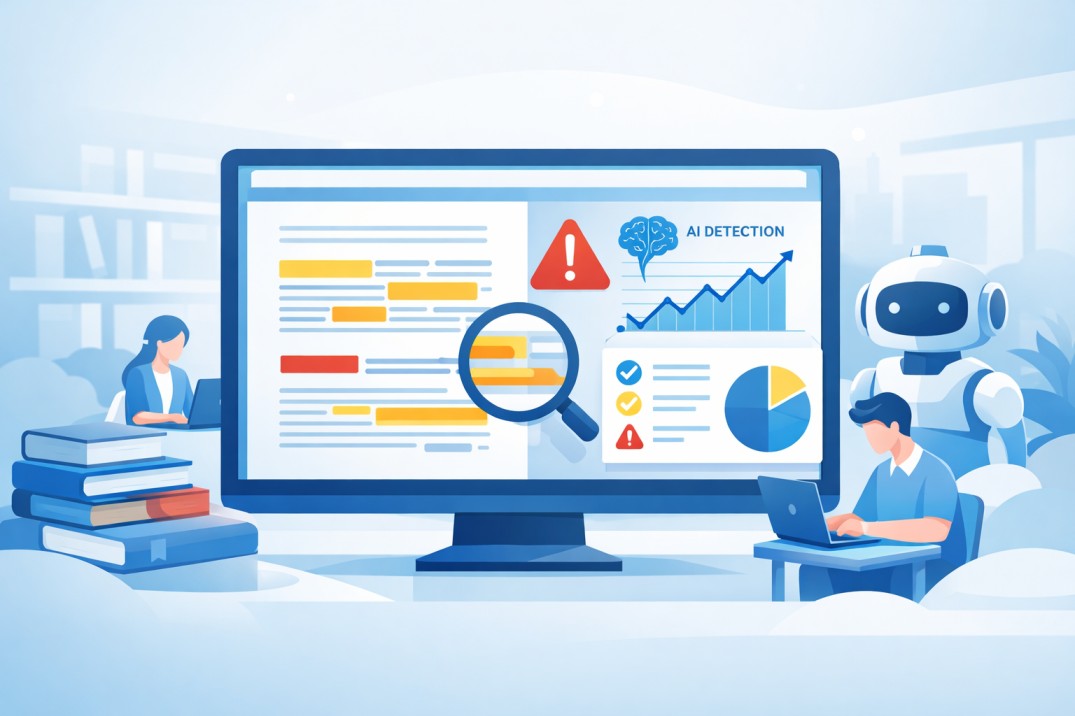
Artificial intelligence has rapidly transformed the education landscape. From research assistance to essay drafting, students now have access to powerful AI writing tools. While this technology can support learning, it also raises serious concerns around academic integrity. As a result, educators, institutions, and edtech platforms are increasingly relying on AI detectors to review student work and identify AI-generated content.
AI detectors for student work are designed to analyze text patterns, predict authorship, and estimate whether content is written by a human or generated by AI models such as ChatGPT, Gemini, or Claude. With schools and universities under pressure to maintain fairness and originality, choosing the right AI detector has become essential.
In this in-depth guide by Techshark.io, we review the 10 best AI detectors for reviewing student work in 2026. This article compares accuracy, features, pricing, and ideal use cases to help educators make informed decisions.
Comparison of the Best AI Detectors for Student Work
|
Tool Name |
Best For |
Accuracy Level |
Content Types |
Pricing |
Free Version |
|
Turnitin |
Universities |
Very High |
Essays, PDFs |
Paid |
No |
|
Schools & Teachers |
High |
Text |
Freemium |
Yes |
|
|
Accuracy-focused reviews |
Very High |
Long-form content |
Paid |
No |
|
|
Copyleaks |
Multilingual institutions |
High |
Text, Docs |
Freemium |
Yes |
|
Winston AI |
Essays & research papers |
High |
Academic writing |
Paid |
No |
|
Short assignments |
Medium–High |
Short text |
Free |
Yes |
|
|
Budget users |
Medium |
Text |
Free |
Yes |
|
|
Content at Scale Detector |
Long essays |
High |
Long content |
Free |
Yes |
|
Writer.com Detector |
Quick checks |
Medium |
Short text |
Free |
Yes |
|
Crossplag AI |
Academic integrity |
High |
Academic text |
Freemium |
Yes |
How We Selected the Best AI Detectors
To ensure accuracy and fairness, Techshark.io evaluated each AI detector using the following criteria:
- Detection accuracy and reliability
- False-positive rates
- Acceptance in academic institutions
- Ease of use for educators
- Data privacy and security standards
- Pricing and scalability for classrooms
Only tools that demonstrated consistent performance across multiple academic scenarios were included in this list.
1. Turnitin – Best for Academic Institutions
Turnitin is a comprehensive academic integrity platform trusted by universities worldwide for evaluating student submissions. Beyond traditional plagiarism checks, Turnitin’s AI detection system analyzes linguistic patterns, predictability, and writing structure to estimate the likelihood of AI-generated content. It is designed for large-scale academic use, making it ideal for institutions handling thousands of assignments each term. The platform integrates seamlessly with popular learning management systems, allowing educators to review student work within existing workflows. While it is not intended for individual users, Turnitin remains a gold standard for formal academic review and policy-driven assessment.
Key Features
- AI-generated content detection
- Advanced plagiarism analysis
- LMS integrations (Canvas, Moodle, Blackboard)
- Detailed originality reports
Pros
- Trusted by academic institutions globally
- High accuracy with low false positives
- Strong reporting and analytics
Cons
- Expensive for individuals
- No standalone student plans
Best For
Universities, colleges, and large educational institutions.
Pricing
Custom institutional pricing only.
2. GPTZero – Best for Teachers and Classrooms
GPTZero is an AI detector built specifically with educators in mind, focusing on classroom-friendly usability and transparency. It evaluates student writing using metrics such as perplexity and burstiness to determine whether text is likely written by a human or generated by AI tools like ChatGPT. GPTZero is especially useful for day-to-day classroom assignments, offering sentence-level analysis that helps teachers understand why content is flagged. With simple dashboards and document support, it balances accessibility with practical accuracy, making it a popular choice in schools and small institutions.
Key Features
- Sentence-level AI detection
- Educator dashboard
- Google Docs integration
- Batch file uploads
Pros
- Easy to use for teachers
- Free version available
- Clear AI probability scoring
Cons
- Less accurate for mixed human-AI content
- Limited advanced analytics
Best For
School teachers and small academic institutions.
Pricing
Freemium model with paid educator plans.
3. Originality.ai – Best for Detection Accuracy
Originality.ai is a high-precision AI detection tool designed for users who prioritize accuracy over simplicity. It is particularly effective for long-form academic writing, structured essays, and research-based assignments. The tool uses advanced language modeling to identify AI-generated patterns, even in partially edited content. Because of its detailed scoring and team-based access, Originality.ai is often used by institutions, publishers, and professional reviewers. Although it lacks a free plan, its reliability makes it a strong option for serious academic review workflows.
Key Features
- AI content detection
- Plagiarism checking
- Team-based access
- Chrome extension
Pros
- Very high accuracy
- Detailed scoring reports
- Suitable for large documents
Cons
- No free version
- Can flag heavily edited AI content
Best For
Institutions and professionals needing precision.
Pricing
Pay-as-you-go and subscription plans.
4. Copyleaks AI Detector – Best for Multilingual Content
Copyleaks AI Detector is designed for institutions that work with diverse, multilingual student populations. Supporting more than 30 languages, it enables educators to review AI-generated content across global classrooms. The platform combines AI detection with plagiarism analysis, offering a unified solution for academic integrity. Copyleaks is widely adopted by enterprises and educational organizations due to its security standards and scalable infrastructure. While accuracy may vary slightly by language, it remains one of the strongest options for international and multilingual academic environments.
Key Features
- Multilingual AI detection
- LMS integrations
- Plagiarism and AI checks combined
- API access
Pros
- Strong language support
- Enterprise-grade security
- Scalable for large institutions
Cons
- Interface can feel complex
- Accuracy varies by language
Best For
International schools and universities.
Pricing
Freemium with paid plans.
5. Winston AI – Best for Essays and Research Papers
Winston AI is tailored for detecting AI-generated academic essays and research papers with clarity and consistency. It focuses on probability-based scoring that helps educators understand the likelihood of AI involvement rather than issuing absolute judgments. The platform supports common academic file formats, making it suitable for higher education environments where formal submissions are standard. Winston AI’s clean interface and focused feature set make it appealing to professors and reviewers who want straightforward, document-based analysis without unnecessary complexity.
Key Features
- AI probability scoring
- Document upload support
- PDF and Word compatibility
Pros
- Clean and simple interface
- Accurate essay analysis
Cons
- No free tier
- Limited integrations
Best For
Professors and academic reviewers.
Pricing
Paid subscription only.
6. Sapling AI Detector – Best for Short Assignments
Sapling AI Detector is a lightweight tool optimized for analyzing short-form student content such as homework answers, discussion posts, and brief responses. Unlike enterprise platforms, Sapling emphasizes speed and simplicity, allowing educators to paste text and receive instant AI probability feedback. While it is not suitable for long essays or research papers, it performs well for quick checks in everyday classroom scenarios. Its free access and browser extension make it especially useful for teachers needing fast, informal verification.
Key Features
- Real-time AI detection
- Simple text input
- Chrome extension
Pros
- Completely free
- Fast and lightweight
Cons
- Not ideal for long essays
- Limited reporting
Best For
Short assignments and quick checks.
Pricing
Free.
7. ZeroGPT – Best Free AI Detector
ZeroGPT is one of the most widely used free AI detectors available to educators and students. It offers instant analysis without requiring account registration, making it highly accessible. The tool scans text for AI-generated patterns and highlights sentences that are likely produced by language models. While its accuracy does not match premium academic tools, ZeroGPT serves as a practical first-level screening option. It is best used as a supplementary tool rather than a final authority in academic evaluation.
Key Features
- AI content probability score
- Highlighted AI sentences
- Supports multiple AI models
Pros
- Free to use
- Easy interface
Cons
- Medium accuracy
- Higher false-positive rate
Best For
Budget-conscious users.
Pricing
Free.
8. Content at Scale AI Detector – Best for Long Essays
The Content at Scale AI Detector is built to handle large volumes of long-form text, making it suitable for reviewing lengthy essays, reports, and dissertations. It evaluates writing consistency and predictability across extended documents, which many lightweight detectors struggle with. The tool is freely accessible and does not require sign-up, lowering barriers for educators. Although its reporting features are limited, its ability to process long content efficiently makes it valuable for initial AI screening of substantial student submissions.
Key Features
- AI detection for long text
- Probability-based scoring
- No signup required
Pros
- Handles large documents well
- Free to use
Cons
- Limited reporting features
Best For
Long essays and dissertations.
Pricing
Free.
9. Writer.com AI Detector – Best for Quick Checks
Writer.com’s AI Detector is a simple, no-frills tool designed for fast content verification. It works best for short passages where educators need a quick indication of AI involvement. The detector provides an immediate probability score without complex reports or integrations. While it lacks the depth required for formal academic investigations, it is useful for rapid checks during grading or preliminary reviews. Its simplicity makes it accessible, but it should be paired with more robust tools for high-stakes decisions.
Key Features
- Simple text input
- Fast AI probability score
Pros
- Easy to use
- Free access
Cons
- Lower accuracy than premium tools
Best For
Quick content verification.
Pricing
Free.
10. Crossplag AI Detector – Best for Academic Integrity
Crossplag AI Detector is focused on preserving academic integrity by combining AI-generated content detection with plagiarism analysis. It is designed for academic and examination-focused environments where originality is critical. The platform provides structured reports suitable for institutional review and policy compliance. Crossplag is particularly useful for universities and examination boards seeking a balanced approach to AI detection and originality checking. While free usage is limited, its academic orientation makes it a reliable choice for formal assessment contexts.
Key Features
- AI and plagiarism detection
- Academic-focused reports
- API access
Pros
- Reliable for academic content
- Supports institutional use
Cons
- Limited free usage
Best For
Academic institutions and exam boards.
Pricing
Freemium model.
Who Should Use AI Detectors for Student Work?
AI detectors are useful for:
- School teachers
- University professors
- Online course creators
- Educational institutions
- EdTech platforms
They help maintain fairness, originality, and trust in academic evaluation.
Are AI Detectors 100% Accurate?
No AI detector is completely accurate. Most tools rely on probability-based models and may produce false positives or false negatives, especially with heavily edited or hybrid content. AI detectors should be used as supporting tools, not as the sole basis for academic penalties.
How to Choose the Right AI Detector
When selecting an AI detector, consider:
- Class size and submission volume
- Content length and format
- Budget constraints
- Language support
- Student privacy policies
Choosing the right tool ensures fair and effective evaluation.
Final Thoughts
AI detectors have become an essential part of modern education, helping institutions adapt to AI-driven learning environments. While no tool is perfect, the right AI detector can significantly support fair assessment and academic integrity.
To explore, compare, and review the latest AI detectors and other educational AI tools, visit Techshark.io and choose the solution that best fits your needs.
Frequently Asked Questions
1. Can AI detectors identify ChatGPT-written content?
Yes, most modern AI detectors can identify ChatGPT-generated text, but accuracy depends on editing level and writing style.
2. Are AI detectors safe for student privacy?
Reputable tools follow strict data privacy standards, but institutions should review policies carefully.
3. Is it ethical to use AI detectors in education?
Yes, when used transparently and responsibly as part of a fair assessment process.
4. Which AI detector is best for free use?
ZeroGPT and Sapling AI Detector are among the best free options.
5. Can students bypass AI detectors?
Advanced users may reduce detection probability, which is why human review remains essential.
People are also reading:
- Best AI Tools for Academic Research
- Best AI 3D Model Generator
- Best AI Tools for Startups
- Best AI Tools for Audio Editing
- Best AI Tools for Travel