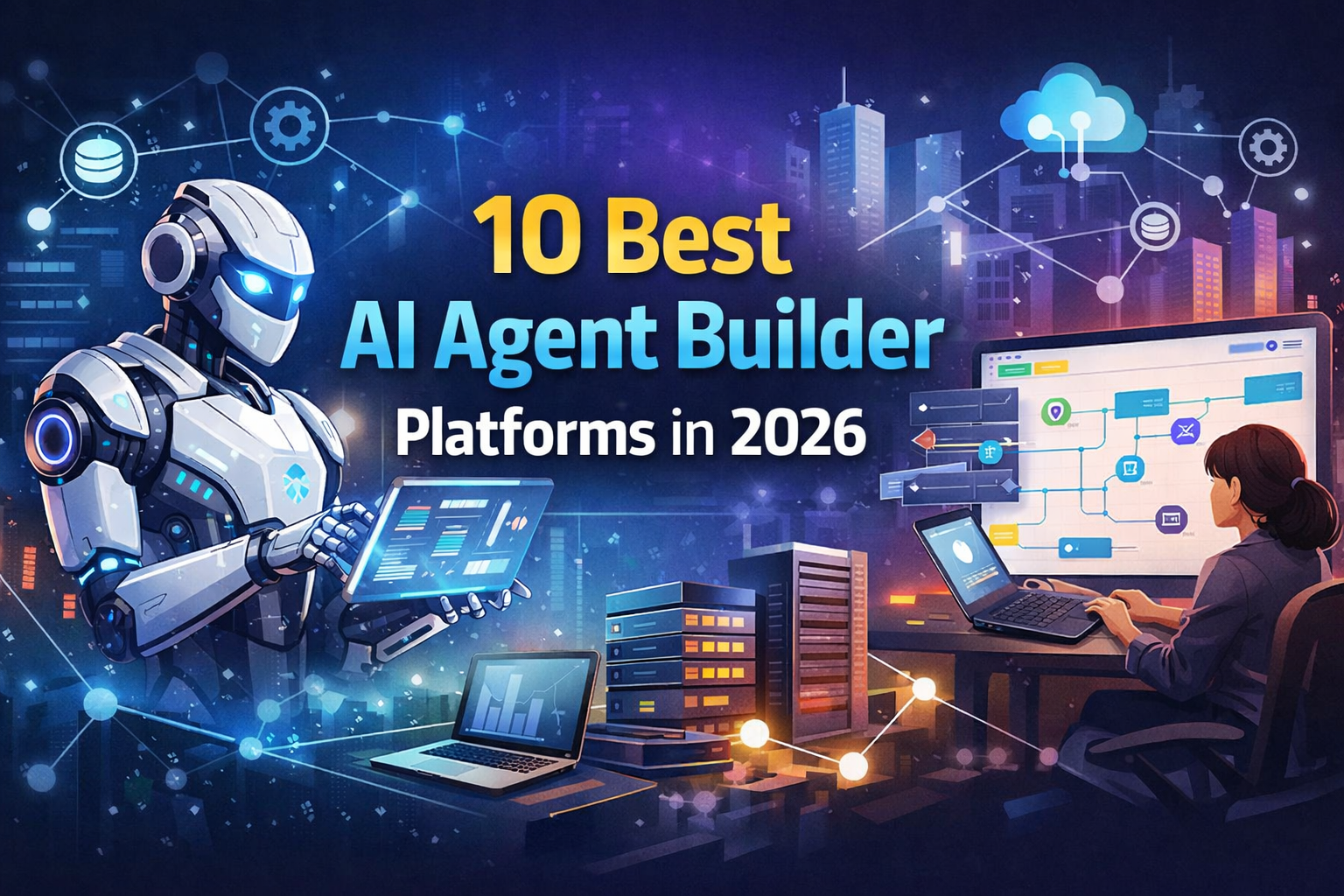
AI agent builder platforms have become one of the most important layers in the modern AI ecosystem. In 2026, businesses are no longer satisfied with simple chatbots that answer predefined questions. Instead, they demand autonomous AI agents that can plan tasks, reason through problems, interact with tools, retrieve knowledge, and collaborate with other agents in real time.
From automating customer support and internal operations to building AI software developers and research assistants, AI agents are transforming how work gets done. This has led to the rapid growth of AI agent builder platforms tools that make it possible to design, deploy, and manage intelligent agents without building everything from scratch.
In this guide by Techshark.io, we have curated and ranked the 10 best AI agent builder platforms based on usability, flexibility, scalability, and real-world adoption. This article is designed to help developers, enterprises, and no-code users choose the right AI agent platform for their specific needs.
What Is an AI Agent Builder Platform?
An AI agent builder platform is a framework or software solution that allows users to create autonomous AI agents capable of performing complex, multi-step tasks with minimal human intervention. These platforms combine large language models (LLMs) with workflows, memory systems, tool integrations, and decision-making logic.
Unlike traditional chatbots, AI agents can understand goals, break them into subtasks, decide which tools to use, retrieve relevant information, and continuously improve their outputs. Many modern platforms also support multi-agent systems, where multiple AI agents collaborate, delegate tasks, and verify each other’s work.
Common use cases include customer service automation, enterprise knowledge management, autonomous research, AI-driven software development, workflow orchestration, and data analysis.
All 10 AI Agent Builder Platforms
|
Platform |
Best For |
No-Code Support |
Multi-Agent Support |
RAG Support |
Pricing Model |
|
General-purpose AI |
No |
Yes |
Yes |
Subscription |
|
|
LangChain & CrewAI |
Developers |
No |
Yes |
Yes |
Free / Paid |
|
Microsoft AutoGen |
Collaboration |
No |
Yes |
Limited |
Free |
|
LlamaIndex |
Knowledge agents |
No |
Limited |
Yes |
Free / Enterprise |
|
Copilot Studio |
Enterprises |
Partial |
Limited |
Yes |
Subscription |
|
Vertex AI Agent Builder |
Scalable enterprise |
No |
Yes |
Yes |
Usage-based |
|
Kore.ai |
Conversational AI |
Partial |
Limited |
Yes |
Custom |
|
IBM watsonx.ai |
Regulated industries |
No |
Limited |
Yes |
Enterprise |
|
Dify |
No-code users |
Yes |
Limited |
Yes |
Free / Paid |
|
Flowise |
Visual workflows |
Partial |
Limited |
Yes |
Free / Paid |
1. ChatGPT Agent – Best Overall AI Agent Builder
ChatGPT Agent stands out as the most versatile and powerful AI agent builder platform available today. Built on OpenAI’s advanced reasoning models, it allows users to create agents that can plan tasks, reason through complex problems, use tools, and maintain long-term context across interactions. Unlike traditional prompt-based systems, ChatGPT Agent is designed to execute workflows autonomously rather than simply respond to questions.
One of the biggest advantages of ChatGPT Agent is its balance between power and usability. Users do not need deep technical expertise to deploy functional AI agents, yet the platform still delivers enterprise-grade reasoning and performance. It supports tool usage, browsing, memory, and action execution, making it suitable for a wide range of real-world use cases.
For teams looking to quickly deploy intelligent agents without managing infrastructure or complex frameworks, ChatGPT Agent is often the fastest and most reliable option.
- Best For: General-purpose automation, research, analytics, and business workflows
- Pricing: Included in paid ChatGPT plans
2. LangChain & CrewAI – Best for Developers and Multi-Agent Systems
LangChain and CrewAI are among the most popular open-source frameworks for building advanced AI agent systems. These platforms are designed primarily for developers who need fine-grained control over agent behavior, memory, tool usage, and inter-agent collaboration. Rather than offering a simple UI, LangChain and CrewAI provide modular building blocks that can be combined to create highly customized solutions.
CrewAI extends LangChain’s capabilities by introducing role-based multi-agent collaboration. This allows developers to assign specific responsibilities to different agents, such as planning, execution, validation, and reporting. Together, these frameworks enable the creation of sophisticated agent teams that can handle complex, real-world workflows.
Although the learning curve is higher compared to no-code platforms, LangChain and CrewAI remain the top choice for engineering teams building production-grade AI systems.
- Best For: Developers, startups, and AI engineering teams
- Pricing: Free (open-source), optional paid services
3. Microsoft AutoGen – Best for Collaborative AI Workflows
Microsoft AutoGen is a research-driven framework designed for building collaborative, conversational AI agents. It focuses on enabling multiple agents to communicate with each other, negotiate tasks, and collectively solve problems. AutoGen is particularly strong in scenarios where agents must reason together, verify outputs, and iterate toward better solutions.
AutoGen is model-agnostic, meaning it can work with different LLM providers depending on user requirements. While it does not offer a visual interface or no-code builder, its architecture makes it highly suitable for advanced experimentation and enterprise research projects.
For teams exploring autonomous collaboration between AI agents, AutoGen provides a solid and well-supported foundation.
- Best For: Research teams and advanced developers
- Pricing: Free and open-source
4. LlamaIndex – Best for RAG-Based AI Agents
LlamaIndex is a specialized AI agent framework focused on retrieval-augmented generation (RAG). It enables AI agents to retrieve information from private documents, databases, and knowledge bases before generating responses. This makes it particularly valuable for enterprises that rely on proprietary data.
Rather than acting as a full no-code builder, LlamaIndex integrates seamlessly with other agent frameworks like LangChain. It excels at creating context-aware agents that deliver accurate, grounded outputs instead of hallucinated responses.
LlamaIndex is widely adopted in enterprise environments where data accuracy and traceability are critical.
- Best For: Knowledge-driven and enterprise AI agents
- Pricing: Free with enterprise plans available
5. Microsoft Copilot Studio – Best Enterprise AI Agent Platform
Microsoft Copilot Studio is an enterprise-grade AI agent builder designed to integrate deeply with Microsoft’s ecosystem, including Teams, Office 365, and internal business systems. It allows organizations to build AI agents that automate workflows, assist employees, and interact securely with enterprise data.
The platform emphasizes governance, compliance, and scalability, making it suitable for large organizations with strict security requirements. While customization outside the Microsoft ecosystem is limited, Copilot Studio excels in enterprise productivity scenarios.
- Best For: Enterprises using Microsoft products
- Pricing: Subscription-based
6. Google Vertex AI Agent Builder – Best for Scalable Enterprise Deployment
Google Vertex AI Agent Builder is a managed platform designed for building and deploying AI agents at scale. It includes built-in support for retrieval-augmented generation, memory, monitoring, and governance. Vertex AI is optimized for organizations already invested in Google Cloud Platform.
The platform provides strong security controls and is capable of handling high-volume, production-grade workloads. However, it requires familiarity with Google Cloud services and comes with usage-based pricing.
- Best For: GCP-based enterprises
- Pricing: Usage-based
7. Kore.ai – Best Conversational AI for Enterprises
Kore.ai is a leading enterprise conversational AI platform focused on customer service, virtual assistants, and enterprise search. It enables organizations to deploy AI agents across multiple channels, including web, mobile, and messaging platforms.
Kore.ai is known for its stability, analytics, and enterprise support. While it is less flexible for experimental agent development, it remains a strong choice for organizations prioritizing reliability and scale.
- Best For: Customer support and enterprise automation
- Pricing: Custom enterprise pricing
8. IBM watsonx.ai – Best for Regulated Industries
IBM watsonx.ai is designed for organizations operating in regulated industries such as finance, healthcare, and government. The platform focuses on AI governance, transparency, and compliance while enabling the creation of intelligent AI agents.
It supports custom model development and secure deployment, making it suitable for organizations with strict regulatory requirements. However, it is generally more expensive and slower to innovate compared to startup-focused platforms.
- Best For: Regulated enterprises
- Pricing: Enterprise pricing
9. Dify – Best No-Code Open-Source AI Agent Builder
Dify is a no-code, open-source AI agent builder designed for startups, solopreneurs, and non-technical users. It offers a visual interface for building AI agents, managing prompts, and deploying APIs without writing code.
Dify strikes a balance between simplicity and flexibility, making it ideal for quick experimentation and MVP development. Its open-source nature also allows teams to self-host and customize the platform.
- Best For: No-code users and startups
- Pricing: Free with paid plans
10. Flowise – Best Visual AI Agent Builder
Flowise is a low-code, node-based AI agent builder that allows users to visually design workflows and connect AI components. Built on top of LangChain, it simplifies agent creation while retaining developer-friendly flexibility.
Flowise is especially popular among builders who want to prototype quickly without writing extensive code. While it lacks advanced enterprise features, it remains one of the most accessible visual AI agent tools.
- Best For: Low-code builders and prototyping
- Pricing: Free with optional paid hosting
How to Choose the Right AI Agent Builder Platform
- Choose Dify or Flowise if you want no-code or low-code simplicity
- Choose LangChain, CrewAI, or AutoGen for developer-driven projects
- Choose Copilot Studio or Vertex AI for enterprise-scale deployment
- Choose LlamaIndex for data-heavy and knowledge-based agents
How We Ranked the Best AI Agent Builder Platforms
To ensure accuracy and fairness, Techshark.io evaluated each platform using the following criteria:
- Ease of use and learning curve
- Customization and extensibility
- Multi-agent collaboration support
- Retrieval-Augmented Generation (RAG) capabilities
- Integrations and API availability
- Enterprise readiness, security, and governance
- Pricing transparency and scalability
- Community adoption and ecosystem strength
Final Verdict
AI agent builder platforms are redefining automation and intelligence in 2026. Whether you are a developer, enterprise, or no-code creator, the right platform can dramatically improve productivity and scalability.
Explore and compare the best AI agent builder platforms on Techshark.io to find the perfect solution for your needs.
Frequently Asked Questions
1. What is the best AI agent builder platform?
ChatGPT Agent is the best overall platform due to its reasoning capabilities, ease of use, and production readiness.
2. Are AI agent builders better than chatbots?
AI agent builders create autonomous systems that can plan, reason, and use tools, while chatbots mainly respond to prompts.
3. Which AI agent builder is best for beginners?
Dify and Flowise are best for beginners due to their visual and no-code interfaces.
4. Are there open-source AI agent builders?
Yes, LangChain, CrewAI, AutoGen, Dify, and Flowise are open-source.
5. Can AI agents work without human supervision?
AI agents can work autonomously, but human oversight is recommended for critical tasks.