What Is Stochastic Gradient Descent (SGD)?
Stochastic Gradient Descent (SGD) is an optimization algorithm used to train machine learning models by iteratively adjusting model parameters to reduce a loss function. Unlike batch gradient descent, which calculates the gradient using the entire training dataset for each update, traditional stochastic gradient descent updates the parameters using one randomly selected training example at a time. SGD is widely used in machine learning and deep learning because it can update model parameters without processing the entire dataset for every step. This makes it useful when training models on large datasets or when computational resources are limited.
For example, a machine learning model trained to predict house prices may initially produce inaccurate predictions. SGD calculates how the model's parameters contribute to prediction errors and adjusts those parameters to reduce the loss. Repeating this process helps the model learn patterns from the training data.
SGD helps a machine learning model learn by repeatedly adjusting its parameters to reduce prediction errors.
How Does Stochastic Gradient Descent Work?
The stochastic gradient descent algorithm typically follows these steps:
- Initialize model parameters: Assign initial values to the model's weights and biases.
- Select a training example: Randomly choose one example from the training dataset.
- Calculate the prediction: Use the current model parameters to generate a prediction.
- Compute the loss: Measure the difference between the prediction and the target value.
- Calculate the gradient: Determine how the loss changes with respect to each trainable parameter.
- Update the parameters: Adjust the parameters in the direction that reduces the loss, using a learning rate.
- Repeat the process: Continue updating the model using additional training examples until a stopping condition is reached.
The model may process the dataset multiple times. Each complete pass through the training dataset is called an epoch.
Stochastic Gradient Descent Formula
The parameter update rule for SGD is:
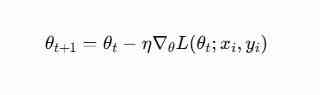
Where:
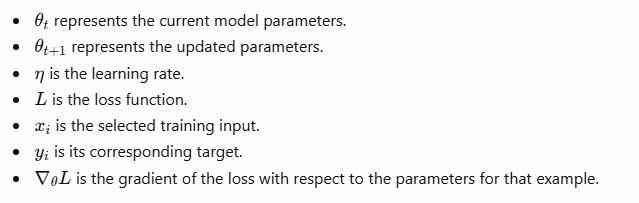
The learning rate determines the size of each update. A rate that is too high can cause unstable training, while one that is too low can make training unnecessarily slow.
What Is an Example of Stochastic Gradient Descent?
Imagine training a model to predict house prices using information such as property size, location, and number of bedrooms. Initially, the model's predictions may differ significantly from actual prices. SGD selects one house from the training dataset, calculates the prediction error, and updates the model parameters based on that example. The next update uses another randomly selected house. Over many updates, the model adjusts its parameters to reduce the overall prediction error. A single update may not improve performance across every house, because each update uses only one example. However, repeated updates can help the model converge toward parameters that perform well across the dataset.
What Are the Different Types of Gradient Descent?
|
Feature |
Batch gradient descent |
Stochastic gradient descent |
Mini-batch gradient descent |
|---|---|---|---|
|
Data per update |
Entire training dataset |
One training example |
A small batch of examples |
|
Computational cost per update |
Usually higher |
Usually lower |
Intermediate |
|
Update frequency |
Once per full gradient calculation |
After each selected example |
After each batch |
|
Gradient variability |
Lower for a fixed dataset and parameter setting |
Higher |
Intermediate |
|
Common application |
Smaller datasets and full-batch optimization |
Online or incremental learning settings |
Common deep learning training workflows |
Important distinction: In deep learning libraries, the term SGD is sometimes used for optimizers that update parameters using mini-batches rather than single examples. The exact behavior depends on the implementation.
What Are the Advantages of Stochastic Gradient Descent?
- Efficient updates: It can update parameters without calculating the gradient over the entire dataset each time.
- Lower memory requirements per update: Traditional SGD can process one training example at a time.
- Scalability: It is suitable for learning from large datasets.
- Online learning support: It can adapt to new examples incrementally in suitable learning systems.
- Useful optimization behavior: Gradient noise can sometimes help the optimization process move away from certain shallow or saddle-like regions, although this is not guaranteed.
- Broad applicability: SGD and its variants are used to train models for classification, regression, and deep learning tasks.
What Are the Limitations of Stochastic Gradient Descent?
- Noisy updates: Individual examples may produce gradients that differ substantially from the overall dataset gradient.
- Learning-rate sensitivity: Poor learning-rate choices can lead to slow progress or unstable updates.
- Fluctuating loss: The loss may rise temporarily even when training is generally improving.
- Hyperparameter tuning: Learning rates, schedules, and other settings may require experimentation.
- Convergence challenges: Performance depends on the loss function, model structure, data, and optimization settings.
Techniques such as learning-rate scheduling, momentum, gradient clipping, and mini-batch training can help address some of these limitations.
What Is the Difference Between SGD and Adam?
SGD and Adam are optimization algorithms used to train machine learning models. Standard SGD uses a learning rate and gradient information to update parameters, while Adam adapts parameter-specific step sizes using moving averages of gradients and squared gradients.
|
Feature |
SGD |
Adam |
|---|---|---|
|
Update mechanism |
Uses the gradient and learning rate |
Uses moving averages of gradients and squared gradients |
|
Learning-rate adaptation |
Usually uses a shared learning rate, potentially with a schedule |
Adapts effective step sizes for individual parameters |
|
Hyperparameters |
Learning rate; optional momentum and other settings |
Learning rate, beta parameters, and numerical stability settings |
|
Common strength |
Can work well with appropriate tuning and may generalize well in some settings |
Often provides convenient early optimization progress |
|
Common limitation |
May require careful learning-rate tuning |
May require more optimizer state and does not always generalize better |
Neither optimizer is universally superior. The best choice depends on the model, dataset, training objective, computational constraints, and evaluation results.
What Are the Applications of Stochastic Gradient Descent?
SGD and related optimization methods are used across a range of machine learning applications:
- Image classification: Training neural networks to identify objects and categories in images.
- Natural language processing: Optimizing models used for text classification, language modeling, and other language tasks.
- Recommendation systems: Learning parameters that estimate user preferences and item relevance.
- Predictive analytics: Training regression and classification models for forecasting and risk estimation.
- Deep learning: Updating neural network weights during model training.
- Online learning: Updating suitable models as new training examples become available.
The specific optimizer used depends on the learning task and the architecture being trained.