What Is Retrieval-Augmented Generation (RAG)?
Retrieval-augmented generation (RAG) is an AI technique that combines information retrieval with a generative AI model to produce responses informed by relevant external information. Instead of relying only on information learned during training, a RAG system retrieves relevant content from sources such as documents, databases, knowledge bases, or indexed web pages and supplies that information to a large language model (LLM) when generating an answer. RAG is commonly used to build AI assistants that answer questions about company documents, product manuals, customer support resources, research papers, and other specialized information.
For example, a business could create an AI assistant that answers employee questions using its internal HR policies. When an employee asks about annual leave, the system retrieves the relevant policy sections and supplies them to the LLM, which generates an answer based on that material. The main purpose of RAG is to make AI-generated answers more relevant to a specific knowledge source and help the system incorporate information that may not be available in the model's original training data.
RAG allows AI to retrieve relevant information before generating an answer.
RAG can improve factual grounding, but it does not guarantee accuracy. The retrieval system may miss relevant information, source documents may be outdated, and the LLM may still misinterpret or misrepresent the retrieved content.
How Does Retrieval-Augmented Generation Work?
A RAG system typically follows a pipeline that retrieves relevant information and passes it to a generative AI model.
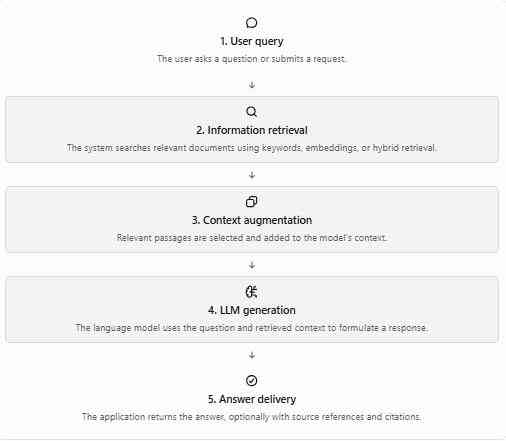
A production RAG application also needs a knowledge preparation process that happens before a user asks a question.
- Document ingestion: Collect information from PDFs, websites, databases, help centers, or other approved sources.
- Text extraction and chunking: Extract the content and divide it into smaller, manageable sections.
- Embedding generation: Convert supported text chunks into numerical representations called embeddings.
- Indexing: Store the chunks and their searchable representations in a retrieval system, often a vector database or search index.
- Retrieval and generation: When a question arrives, retrieve relevant chunks and provide them to the LLM.
These stages vary by implementation. Some systems use keyword search, hybrid search, reranking, metadata filters, or specialized database queries instead of relying exclusively on vector search.
What Are the Main Components of RAG Architecture?
A typical RAG architecture combines several components to retrieve useful information and generate responses.
|
Component |
Function |
Example |
|---|---|---|
|
Data source |
Provides the knowledge used by the system |
Product documentation or internal policies |
|
Document loader |
Imports content from supported sources |
PDF or website ingestion |
|
Text chunking |
Divides content into retrievable sections |
Splitting a manual into smaller passages |
|
Embedding model |
Converts text into numerical vectors |
Generating embeddings for document chunks |
|
Vector database or search index |
Stores searchable representations and document data |
Retrieving relevant policy sections |
|
Retriever |
Finds candidate passages for a query |
Searching for a refund policy |
|
Reranker |
Reorders candidate passages by relevance |
Prioritizing the most relevant policy section |
|
Large language model |
Generates an answer using the question and retrieved context |
Explaining the refund rules |
|
Evaluation and monitoring |
Measures retrieval quality, answer quality, and reliability |
Checking whether answers match source documents |
A vector database is common in RAG applications, but it is not mandatory. RAG can also use traditional search indexes, relational databases, knowledge graphs, or combinations of retrieval methods.
What Is an Example of Retrieval-Augmented Generation?
Consider an online software company that wants to build an AI-powered customer support assistant. A customer asks: “How can I reset my account password?” Without RAG, a general-purpose LLM might provide generic password-reset instructions that do not match the company's actual product.
With RAG, the application can:
- Search the company's official help center.
- Retrieve the relevant password-reset instructions.
- Supply the retrieved steps to the LLM.
- Generate a response based on the documentation.
- Include a link to the relevant help article when supported.
This approach helps the assistant provide answers tailored to the company's product rather than relying exclusively on general knowledge. Another example is an AI research assistant that retrieves relevant sections from uploaded reports before summarizing findings or answering questions. In both cases, answer quality depends on whether the correct information is retrieved and interpreted accurately.
What Are the Different Types of RAG?
RAG systems can be designed in different ways depending on the complexity of the task and the available data.
|
RAG approach |
Description |
Typical application |
|---|---|---|
|
Basic or naive RAG |
Retrieves relevant text chunks and supplies them directly to an LLM |
Simple document question answering |
|
Advanced RAG |
Improves retrieval using techniques such as query rewriting, metadata filtering, hybrid search, or reranking |
Enterprise knowledge assistants |
|
Hybrid RAG |
Combines keyword-based search with semantic retrieval |
Searching technical documentation |
|
Graph-based RAG |
Uses relationships in a knowledge graph alongside retrieval to support questions involving connected entities |
Research and relationship analysis |
|
Agentic RAG |
Uses an AI agent to plan or repeat retrieval steps, sometimes calling multiple tools |
Complex research and multi-source question answering |
|
Multimodal RAG |
Retrieves information from supported combinations of text, images, tables, audio, or other modalities |
Document and media search |
These categories are not mutually exclusive. For example, an advanced RAG system can combine hybrid retrieval, a knowledge graph, and agent-based orchestration.
What Are the Benefits of RAG in AI?
RAG helps developers build AI applications that use specific, external knowledge sources.
- Access to current information: Retrieve updated documents without necessarily retraining the underlying LLM.
- Domain-specific answers: Ground responses in company documentation, research collections, or specialized knowledge bases.
- Better traceability: Provide references to the retrieved sources so users can verify important claims.
- Reduced reliance on model memory: Supply relevant facts at response time rather than relying exclusively on what the model learned during training.
- Knowledge-base integration: Connect AI assistants to approved internal or external information sources.
- Flexible updates: Add, remove, or revise indexed documents without fine-tuning the LLM itself.
- Potentially fewer unsupported answers: Retrieved evidence can help ground generation, although hallucinations and retrieval errors remain possible.
The effectiveness of RAG depends on retrieval relevance, document quality, chunking, model capabilities, access controls, and evaluation. It should not be treated as an automatic solution to hallucinations or outdated information.
What Is the Difference Between RAG and Fine-Tuning?
RAG and fine-tuning are two different ways to adapt AI applications to specific requirements. RAG supplies relevant external information at inference time, whereas fine-tuning further trains a model using selected examples.
|
Feature |
Retrieval-Augmented Generation |
Fine-tuning |
|---|---|---|
|
Main purpose |
Provide relevant external knowledge. |
Adapt model behavior or task performance. |
|
How it works |
Retrieves information and adds it to the prompt context |
Updates model parameters through additional training |
|
Knowledge updates |
Update the underlying knowledge source or index. |
May require additional training to incorporate new examples |
|
Source citations |
Can provide citations based on retrieved documents |
Does not inherently provide citations |
|
Common use case |
Answering questions about current product documentation |
Adapting a model to a specialized format or task |
|
Data requirements |
A searchable, relevant knowledge source |
Suitable training examples and training infrastructure |
|
Can they be combined? |
Yes |
Yes |
Which is better? Choose RAG when an application needs to retrieve information from changing documents or a private knowledge base. Consider fine-tuning when you need to adapt the model's behavior, style, or performance on a specific task. Some applications benefit from using both.
What Are the Common Applications of RAG?
- Customer support: RAG-powered chatbots retrieve relevant help articles, troubleshooting steps, and product documentation to answer customer questions.
- Enterprise knowledge management: Organizations can build AI assistants that search internal policies, training materials, technical documents, and approved company resources.
- Research and education: RAG can retrieve passages from research papers, books, and educational resources to support document-based questions and summaries.
- Finance and compliance: Financial organizations can retrieve relevant policy documents, compliance guidance, and internal procedures to support research and employee workflows. Sensitive decisions still require appropriate verification and oversight.
- Software development: AI coding assistants can retrieve API documentation, codebase information, and internal engineering guidelines to answer technical questions.
- Marketing and content research: Marketing teams can use RAG to search approved brand guidelines, existing articles, product specifications, and research documents before generating content.
What Are the Limitations of RAG?
RAG can improve how AI applications use external information, but it introduces additional technical and operational challenges.
- Poor retrieval quality: The system may retrieve irrelevant passages or miss the information needed to answer a question.
- Incorrect source material: Outdated, contradictory, or inaccurate documents can lead to misleading answers.
- Hallucinations: An LLM may still make unsupported claims, even when relevant documents are available.
- Chunking challenges: Dividing documents into unsuitable sections can separate important context or reduce retrieval relevance.
- Latency and cost: Embedding, searching, reranking, and generating responses add processing overhead.
- Security and privacy: Sensitive documents require appropriate permissions, access controls, and data-handling safeguards.
- Prompt injection: Malicious instructions embedded in retrieved documents may influence a model if the application is not designed to handle untrusted content safely.
- Evaluation complexity: Developers must evaluate retrieval relevance separately from answer accuracy and source attribution.
To address these limitations, teams can use representative test queries, relevance metrics, reranking, access-control filters, source-grounded answer checks, and human review for high-impact decisions.
What Are Some Popular RAG Frameworks and Tools?
The following tools can help developers build retrieval-augmented generation applications.
- LangChain: A framework for building LLM applications, including retrieval pipelines, document processing, prompt templates, and tool integrations.
- LlamaIndex: Provides tools for connecting LLMs with external data, indexing documents, retrieving information, and building knowledge-intensive applications.
- Pinecone: A vector database platform used to store and retrieve vector representations for semantic search and AI retrieval workflows.
- Weaviate: A vector database that supports vector and hybrid search for applications that retrieve relevant information from indexed data.
These tools serve different roles: LangChain and LlamaIndex help orchestrate application workflows, while Pinecone and Weaviate provide retrieval and vector database capabilities. The best choice depends on the data sources, scale, security requirements, and existing technology stack.