Voyager
Voyager is an AI agent developed for Minecraft that autonomously explores, learns, and completes tasks without human intervention. It uses GPT-based reasoning to build skills over time, write code, and improve through experience, showcasing how AI can continuously learn and adapt in open-ended environments.
What is Voyager?
Voyager is an AI agent developed to play Minecraft autonomously by learning and improving over time. Instead of following fixed scripts, it uses a combination of large language models and reinforcement learning to write its own code, complete tasks, and explore the game world. It continuously stores and reuses skills, allowing it to progress further with each session, making it a strong example of how AI can learn complex behaviors in open-ended environments.
Voyager is an autonomous AI agent for Minecraft developed by NVIDIA Research in 2023, designed to learn and explore continuously without human intervention. It uses GPT-4 to generate and refine code, enabling it to acquire 100+ skills, complete long-horizon tasks, and build a reusable skill library over time. Voyager achieved up to 3.3× faster exploration progress than prior agents and can automatically correct errors, self-improve, and adapt strategies, making it a milestone toward general-purpose autonomous AI agents.
- Lead Research Institutions: NVIDIA, Caltech, UT Austin, Stanford University, UW
- Core Technology: GPT-4 Code Generation + Mineflayer API + Vector Skill Library
Use Cases:
- Advancing lifelong learning and open-ended exploration in embodied AI agents
- Benchmarking large language models on complex, multi-step interactive coding tasks
- Studying autonomous skill acquisition, self-verification, and code-based environment control
- Automated gameplay testing and reinforcement learning evaluation
Technology:
- Automatic Curriculum: GPT-4 generates tasks dynamically based on agent state and discovery history
- Skill Library: Vector database storing executable JavaScript functions for modular code reuse
- Iterative Prompting & Execution Feedback: Self-debugging loop using environmental error messages and visual feedback
Target Users:
- Embodied AI & Reinforcement Learning Researchers
- Large Language Model Code-Generation Engineers
- Game AI Developers & Academic Scholars
Acquisition: Open Source GitHub Repository (MIT License)
Key features of Voyager
Voyager's key features are
- Lifelong Autonomous Learning: Continuously explores and acquires new skills without human guidance or model weight updates.
- Code-Based Action Space: Writes and executes JavaScript code via Mineflayer instead of outputting raw keyboard/mouse motor control tokens.
- Composable Skill Library: Saves successful behaviors into a searchable vector database, reusing simpler functions to build complex multi-step actions.
- Self-Verification & Debugging: Automatically inspects execution errors and game feedback, iteratively fixing broken code until a task succeeds.
- Superior Tech Progression: Unlocks wooden tools 15.3x faster and discovers 3.3x more unique items compared to prior state-of-the-art LLM agents.
Voyager Pricing
Voyager is an open-source research project hosted on GitHub under an MIT license.
Access Model:
- $0 – Free open-source software (OSS)
- Requires a user-provided OpenAI API key with GPT-4 access for code generation
Disclaimer: Voyager requires active API access to OpenAI's GPT-4 models to function during local execution.
Who is using Voyager?
Voyager is designed for AI researchers and developers, including
- Embodied AI Researchers: Investigating open-ended exploration and long-horizon planning
- LLM Code Agents Developers: Exploring tool use, code execution loops, and vector memory libraries
- Game AI Engineers: Studying autonomous NPC behavior and procedural task generation
Best Voyager Alternatives
Some of the strongest Voyager research alternatives include
- OpenAI Video Pre-Training (VPT)
- Dreamer 4 (Google DeepMind)
- MineDojo Foundation Models
- DEPS (Description-Explanation-Planning-Selection) Agent
Pros and Cons of Voyager
Pros
- Drastically faster tech-tree progression and item discovery than behavioral cloning agents
- A highly modular skill library allows zero-shot generalization to newly initialized worlds
- Self-correcting code execution loop minimizes human debugging intervention
Cons
- Relies heavily on paid external LLM API calls (GPT-4) for continuous prompt generation
- Requires local setup combining Python environments, Node.js, and Minecraft server instances
- Execution speed bounded by API response latencies during code generation loops
Why Choose Voyager?
Voyager redefines how software agents interact with virtual environments. By shifting from low-level pixel processing to high-level programmatic code generation via LLMs, it achieves unprecedented open-ended learning efficiency in complex video game worlds like Minecraft.
- Leverage GPT-4 as an autonomous programmer and problem solver
- Build reusable skill databases that generalize across unseen worlds
- Explore cutting-edge embodied lifelong learning frameworks
Voyager vs. Competitors
The main difference between Voyager and OpenAI's VPT is that VPT relies on massive behavioral cloning over human video datasets, whereas Voyager uses GPT-4 code generation and an iterative skill library to actively plan and execute actions programmatically.
| Feature / Model | Voyager | OpenAI VPT | Dreamer 4 | Genie |
|---|---|---|---|---|
| Core Mechanism | GPT-4 Code Generation (JavaScript) | Behavioral Cloning from Video | Transformer World Model RL | Latent Action Video Diffusion |
| Action Space | High-level Executable Code API | Low-level Keyboard/Mouse | Continuous Vector Actions | |
| Lifelong Learning | Yes (Vector Skill Library) | No (Fixed Policy Weights) | Yes (Imagination RL) | |
| Human Supervision | Zero (Fully Autonomous) | High (Massive Video Datasets) | Offline Dataset Records |
How do we rate Voyager?
| Parameter | Rating (out of 5) |
|---|---|
| Architectural Innovation | 4.9 |
| Exploration & Generalization | 4.8 |
| Skill Library Reuse | 5.0 |
| Ease of Setup & API Cost | 4.2 |
| Overall Score | 4.72 |
Voyager Review
Voyager is a landmark achievement in embodied AI, proving that large language models can act effectively as autonomous programmers in complex 3D virtual environments. By combining automatic curriculums, executable skill libraries, and self-verification feedback loops, it sets a new standard for open-ended learning agents.
Conclusion
Voyager demonstrates how AI agents can learn and improve over time by exploring environments, completing tasks, and building reusable skills. Instead of following fixed instructions, it adapts through experience and stores knowledge for future use. This makes it a strong example of continuous learning in action. Overall, Voyager highlights the potential of autonomous AI, showing how systems can evolve, become more capable, and handle increasingly complex challenges independently.
FAQ
What is Voyager?
Voyager is an AI-powered Minecraft agent that explores the game, learns skills, and completes tasks without constant human guidance.
How does Voyager work?
Voyager uses GPT-4, an automatic curriculum, iterative prompting, and a growing skill library to learn from Minecraft feedback and improve its actions.
Can Voyager learn Minecraft skills?
Yes. It can learn skills such as collecting resources, crafting items, exploring areas, and progressing through Minecraft’s technology tree.
What AI model does Voyager use?
The original Voyager implementation uses OpenAI’s GPT-4 through API calls. It generates programs and improves them using feedback instead of fine-tuning the model.
Can Voyager remember learned skills?
Yes. Voyager stores learned behaviors in an expandable skill library. These skills can later be retrieved, combined, and reused for new Minecraft tasks.
Is Voyager open source?
Yes. The Voyager code is publicly available on GitHub under the MIT License, allowing developers and researchers to study and experiment with the project.
Is Voyager free to use?
The source code is open source, but running Voyager requires Minecraft, the required software setup, and an OpenAI API key, so using the complete system may involve additional costs.
User Reviews
No reviews yet for Voyager.
Featured Tools
Featured AI tools from TechShark
Melody Genie
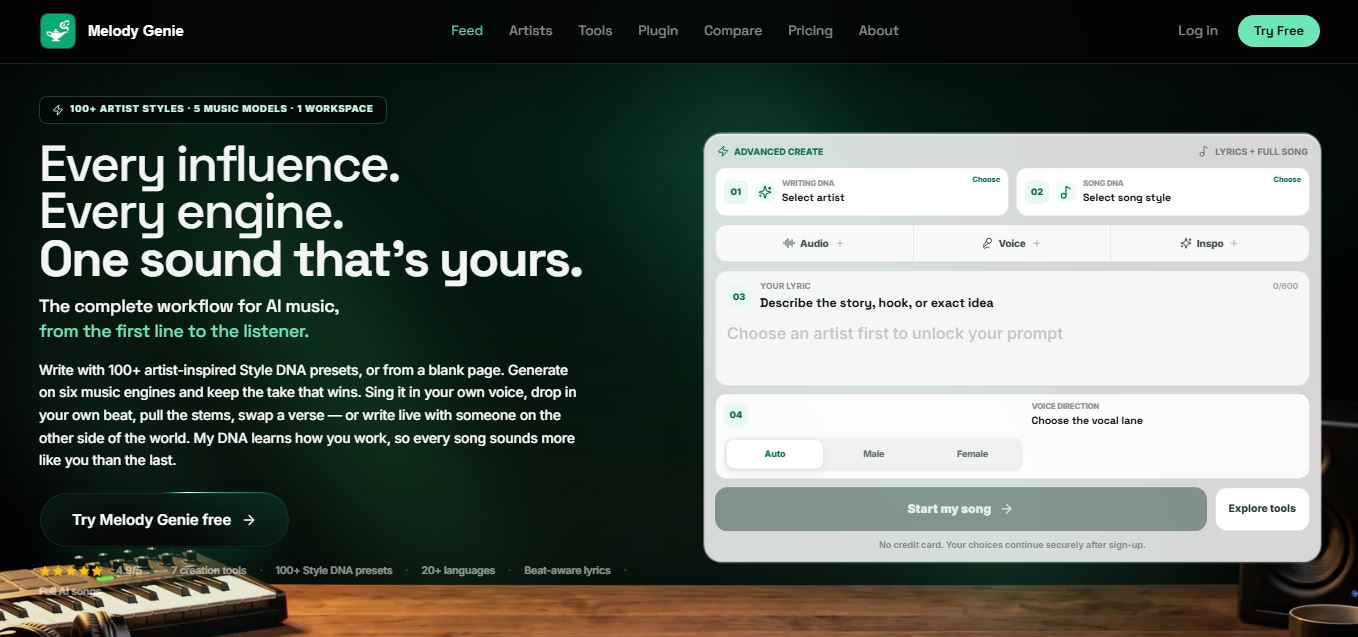
MelodyGenie is an AI-powered music generator that creates original songs from simple text prompts. Users can choose styles, moods, and genres, then instantly generate melodies and full tracks, making it easy for creators, marketers, and hobbyists to produce custom music without musical expertise.
Freemium
Kimi AI
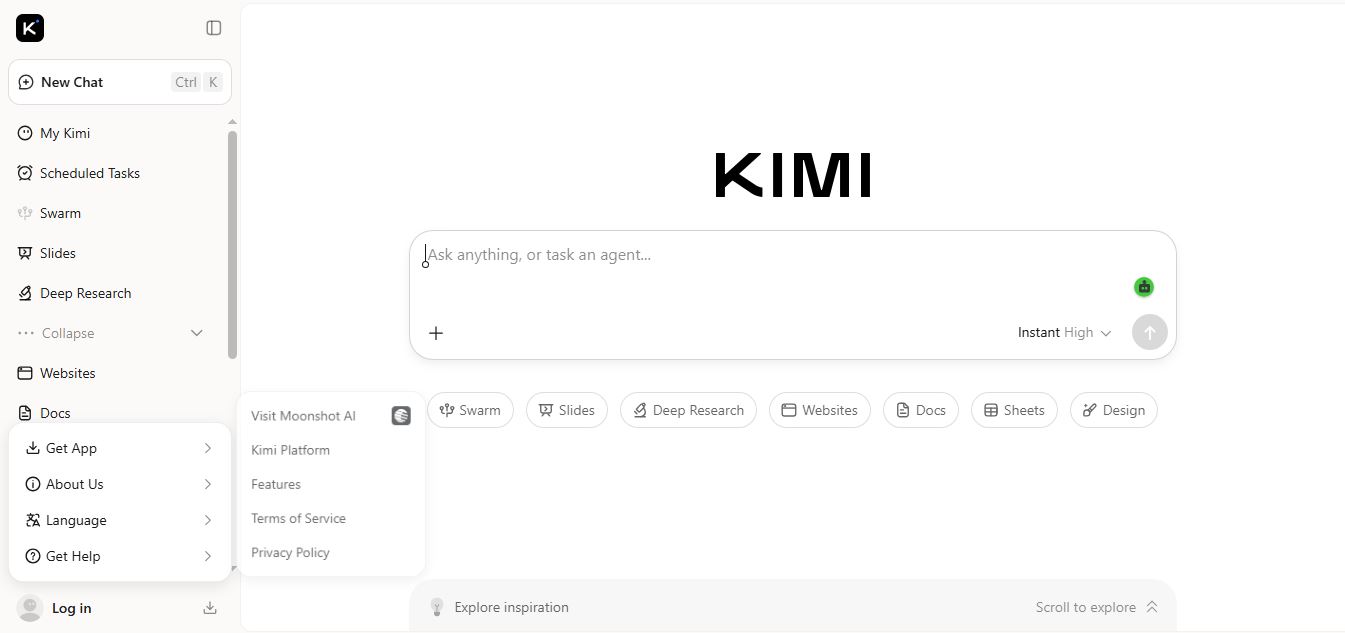
Kimi AI is an advanced AI assistant developed by Moonshot AI that helps you chat, research, write, code, and automate tasks in one place. It supports web search, file analysis, and multimodal inputs, and can even run autonomous “agent” workflows to complete complex tasks end-to-end.
Freemium

Fashion Diffusion AI
Fashion Diffusion is an AI-powered fashion design platform that helps brands and designers create clothing designs, virtual try-ons, AI models, product photos, and marketing visuals faster and cost-effectively.
Paid
Veo 4
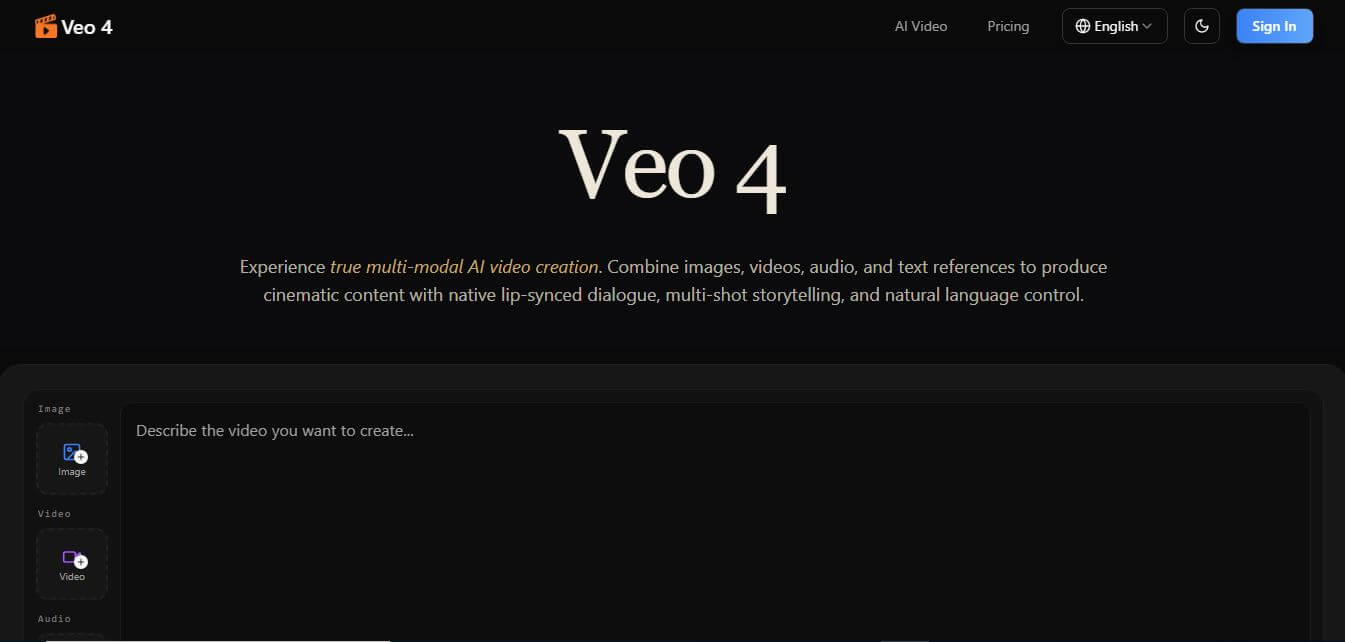
Veo 4 AI is an AI video creation platform that generates dramatic videos from text, images, audio, and video prompts using realistic motion and synchronized sound.
Paid
Alternatives
Alternatives to Voyager
The best Voyager alternatives include AutoGPT, BabyAGI, and AgentGPT. While Voyager focuses on an AI agent that autonomously plays Minecraft, learns skills, writes code, and improves over time using reinforcement learning and memory, alternatives like AutoGPT and AgentGPT specialize in general-purpose autonomous agents that can perform tasks, automate workflows, and execute goals across domains. These tools are better suited for users who want broader automation, flexibility, and real-world task execution beyond game-based AI experimentation.
 4.8
4.8MGAI (Message Game AI)
Gaming
MGAI is an AI wingman for online dating conversations, helping users create better messages, ask engaging questions, develop date ideas, and move conversations forward. Created by dating expert Ice White, it also provides access to The Message Game book, Tinder Profile Checklist, community support, and live coaching through its membership.
AI or Human
Gaming
AI or Human is an interactive browser game that challenges you to identify whether images or text were created by AI or humans. You make your choice for each example, review your performance, and learn why recognizing synthetic media can be difficult. It works without requiring users to upload their own files or use technical detection software for everyday users.
LitRPG Adventures
Gaming
LitRPG Adventures is an AI-powered platform that helps gamers, writers, and creators generate detailed RPG content like character backstories, quests, and worlds. It offers multiple generators and a large content library, making it easy to build immersive tabletop or fantasy stories quickly.
SportBot AI
Gaming
SportBot AI is an advanced AI-powered sports analytics and value-detection platform designed to help sports enthusiasts and bettors understand probabilities, risk, and market inefficiencies. Rather than offering guaranteed tips, it aggregates real-time data across soccer, basketball, American football, hockey, and tennis, using machine learning algorithms to scan bookmaker odds and uncover statistical edges.
Noctie AI
Gaming
Noctie AI is an advanced, human-like AI chess trainer and virtual sparring partner designed to help players of all skill levels improve. Unlike traditional chess engines (such as Stockfish) that rely on brute-force calculation, Noctie is trained on over a billion human games to emulate human intuition, opening choices, and natural mistakes from beginner to super-GM level (~2800 Elo). It features real-time color-coded move evaluations, custom opening practice, and personalized puzzle generation based on your mistakes.
 4.7
4.7Hexagram
Gaming
Hexagram is an interactive development studio and technology platform that leverages artificial intelligence and cloud services to build dynamic, ever-evolving virtual worlds and cross-platform entertainment experiences. Known for pioneering immersive narrative campaigns, augmented reality (AR) activations, and responsive AI characters for major global brands.
RoFT
AI-Detection
RoFT (Real or Fake Text) is an interactive, gamified research project and web application that challenges users to test their ability to distinguish between human-written text and machine-generated content. Featuring diverse content categories like short stories, news articles, recipes, and speeches, the platform focuses on 'Boundary Detection' to help users identify the exact moment an artificial intelligence takes over writing.
AuxWorld
Gaming
AuxWorld is a prompt-to-world generative AI platform developed by Auxuman Inc. that allows users to create, explore, and remix fully interactive 3D multiplayer universes from simple text descriptions in under 30 seconds. Featuring drop-in multiplayer support, custom physics, procedural soundtracks, and a remix economy akin to GitHub forks, it enables anyone to build and share playable virtual spaces.
AI Game Master
Gaming
AI Game Master is an immersive, AI-powered text adventure and Dungeon RPG platform inspired by Dungeons & Dragons. Utilizing advanced generative language models, it acts as an infinite, dynamic Dungeon Master that reacts in real time to player choices, weaving branching storylines, combat encounters, and open-ended fantasy worlds entirely through text.