TRELLIS.2
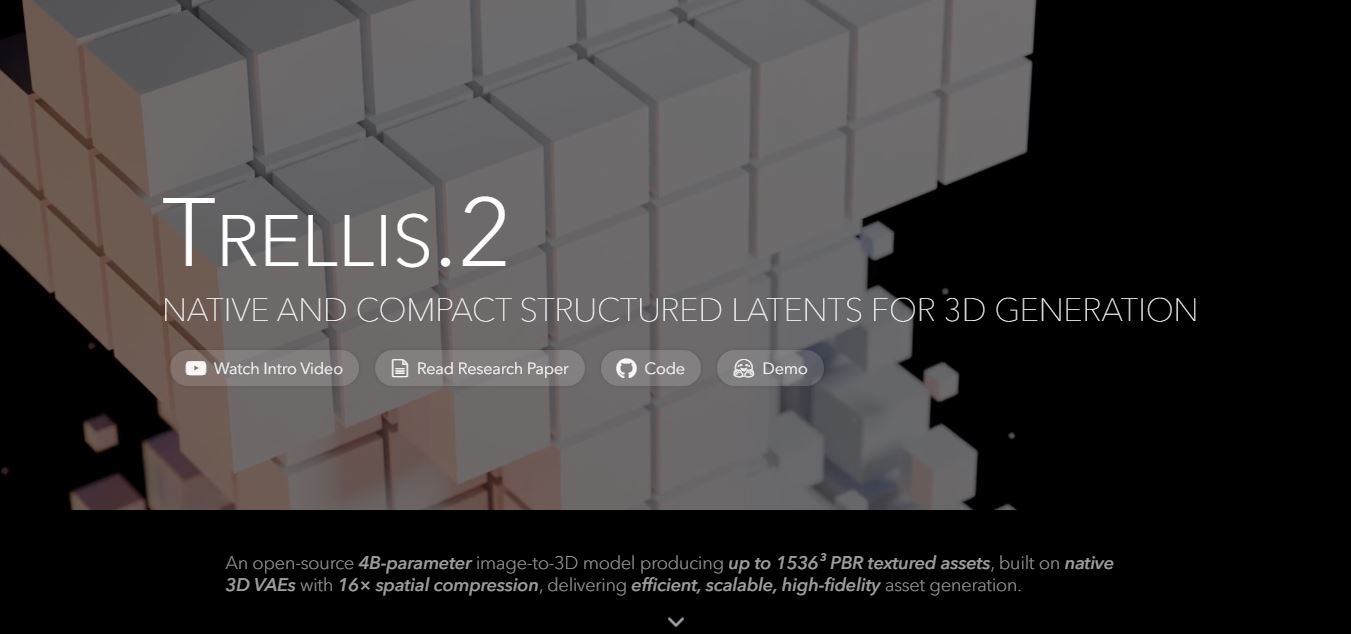
TRELLIS.2 is Microsoft’s open-source AI model for turning images into detailed 3D assets with realistic materials, complex geometry and high-resolution output.
What is TRELLIS.2 AI?
TRELLIS.2 is an open-source image-to-3D generative system made by Microsoft Research and some collaborators. It relies on a huge 4-billion-parameter setup, and somehow it can take just one picture and turn it into high-detail 3D objects with careful geometry and materials that look physically right for the lighting. It can spit out results at resolutions as high as 1536³ , and it also deals with tricky shapes, like open surfaces, non-manifold geometry, and even internal structures. What’s intriguing is the way it’s built, because its main bits mix O-Voxel, which is a field-free sparse voxel format, with a Sparse Compression 3D VAE that performs 16× spatial downsampling. Thus overall, TRELLIS.2 is mainly put forward as a research-oriented effort, focused on advanced 3D creation rather than a consumer pipeline.
TRELLIS.2 contains 4 billion parameters and can generate 3D assets at 512³, 1024³, and 1536³ resolutions. According to Microsoft, generation takes approximately 3 seconds at 512³, 17 seconds at 1024³, and 60 seconds at 1536³ on an NVIDIA H100 GPU. Its Sparse Compression VAE uses 16× spatial downsampling and generates about 9,600 latent tokens for a 1024³ asset. The model supports Base Color, Metallic, Roughness, and Alpha attributes for PBR rendering.
- Founder: TRELLIS.2 does not have a single founder. It was created by a research team involving Microsoft Research, Microsoft AI, Tsinghua University, and USTC. The listed authors include Jianfeng Xiang, Xiaoxue Chen, Sicheng Xu, Ruicheng Wang, Zelong Lv, Yu Deng, Hongyuan Zhu, Yue Dong, Hao Zhao, Nicholas Jing Yuan, and Jiaolong Yang.
- Launch date: The TRELLIS.2 technical report and project materials identify the work as a 2025 research project. The project website carries a copyright notice from 2025 and cites the technical report from the same year.
- Use cases: Image-to-3D asset generation, 3D reconstruction, game asset creation, virtual environments, AR and VR development, product visualization, 3D design research, and experimentation with generative 3D workflows.
- Technology: O-Voxel, Sparse Compression 3D VAE, structured latent representations, vanilla DiTs, sparse voxel processing, and PBR material modeling.
- Target users: 3D researchers, AI researchers, developers, technical artists, game developers, computer vision professionals, and advanced creators interested in local 3D generation.
- Acquisition: TRELLIS.2 was not acquired from another company. It is a Microsoft research project developed by Microsoft Research and collaborating academic researchers.

TRELLIS.2 Key Features
TRELLIS.2 key features are
- High-Fidelity Image-to-3D Generation: TRELLIS.2 converts a single image into a detailed 3D asset while attempting to preserve important geometry, appearance, and visual characteristics from the reference image.
- 4 Billion Parameters: The 4B-parameter model provides substantial capacity for generating high-resolution 3D geometry and materials.
- Up to 1536³ Resolution: TRELLIS.2 supports 512³, 1024³, and 1536³ generation settings, giving developers flexibility between speed and output detail.
- O-Voxel Representation: O-Voxel is a field-free sparse voxel structure designed to represent geometry and appearance together while supporting complex topologies.
- Arbitrary Topology: The model can represent open surfaces, non-manifold structures, and enclosed internal geometry, which are difficult for conventional implicit surface representations.
- PBR Material Support: TRELLIS.2 models Base Color, Metallic, Roughness, and Alpha attributes, enabling generated assets to support physically based rendering and relighting.
- Sparse Compression VAE: Its 3D VAE provides 16× spatial downsampling and creates a compact latent representation for efficient generative modeling.
- Fast Generation: Microsoft reports approximately 3 seconds at 512³, 17 seconds at 1024³, and 60 seconds at 1536³ on an NVIDIA H100 GPU.
- GLB Export: The provided workflow supports converting generated assets into GLB format, making the output practical for downstream 3D workflows.
- Minimal Post-Processing: Microsoft describes its asset conversion process as rendering-free and optimization-free, with mesh-to-O-Voxel conversion taking less than 10 seconds on a single CPU and O-Voxel-to-mesh conversion taking less than 100 milliseconds with CUDA acceleration.
TRELLIS.2 Pricing
TRELLIS.2 offers various pricing plans
| Plan | Price | Details |
|---|---|---|
| TRELLIS.2 | Free | Open-source research project |
| API | Not available | No official paid API plan listed |
| Local GPU | Variable | Depends on your hardware |
| Cloud GPU | Variable | Depends on provider and GPU usage |
| Commercial use | Not specified | Official project page restricts materials to academic and research purposes |
Disclaimer: For the latest and most accurate pricing information, please visit the official Astria TRELLIS.2 website.
Who is Using TRELLIS.2?
A diverse range of users and organizations utilize TRELLIS.2
- AI researchers studying generative 3D models
- Computer vision researchers
- 3D graphics researchers
- Game developers experimenting with automated asset generation
- Technical artists
- 3D developers
- AR and VR developers
- Universities and research laboratories
- Developers building image-to-3D applications
- Open-source AI communities
What Are the Best TRELLIS.2 Alternatives?
TRELLIS.2 Alternatives are
- Hunyuan3D 2.1
- Meshy
- Tripo
- Hyper3D Rodin
Pros and Cons
Pros
- High-quality image-to-3D generation
- 4B-parameter architecture
- Supports resolutions up to 1536³
- Handles complex and arbitrary topology
- Supports PBR material attributes
- Uses a compact 3D latent representation
- Open-source code and model availability
- Supports GLB asset export
- Fast inference on high-end NVIDIA hardware
- Strong choice for research and experimentation
Cons
- Primarily designed as a research project
- Local deployment requires significant technical knowledge
- High-end GPU hardware may be necessary for practical performance
- The 4B model can be demanding to run
- Generated geometry may still require professional cleanup depending on the application
- Single-image reconstruction cannot know hidden geometry with certainty
- Commercial users need to carefully review Microsoft's usage disclaimer and applicable licenses
Why Choose TRELLIS.2?
TRELLIS.2 is particularly compelling because it approaches 3D generation differently from many image-to-3D systems. Instead of treating geometry and appearance as separate problems, its O-Voxel representation is designed to encode both within a structured sparse representation.
- Choose TRELLIS.2 for research: Its architecture exposes compelling technologies for researchers working on generative 3D.
- Choose TRELLIS.2 for high-resolution assets: The model supports generation up to 1536³.
- Choose TRELLIS.2 for complex geometry: O-Voxel is designed to handle open surfaces, non-manifold geometry, and internal structures.
- Choose TRELLIS.2 for PBR workflows: Base Color, Metallic, Roughness, and Alpha attributes are supported.
- Choose TRELLIS.2 for open-source experimentation: The repository and pretrained model are publicly available.
- Choose TRELLIS.2 for local workflows: Developers can run the model within their own technical environment rather than relying exclusively on a hosted interface.
TRELLIS.2 vs. Competitors
The main difference between TRELLIS.2, Hunyuan3D 2.1, Meshy, Tripo, and Rodin is that TRELLIS.2 emphasizes open research, structured 3D representations, arbitrary topology, and high-resolution PBR asset generation. Hunyuan3D 2.1 also targets open-source PBR generation, while Meshy, Tripo, and Rodin focus more strongly on accessible product experiences, commercial workflows, and creator-friendly tooling. The best choice therefore depends on whether research flexibility or production convenience matters most.
| Tool | Main Focus | Image to 3D | PBR Materials | Open Source | Best For |
|---|---|---|---|---|---|
| TRELLIS.2 | Research-grade image-to-3D | Yes | Yes | Yes | Researchers and developers |
| Hunyuan3D 2.1 | High-fidelity 3D and PBR | Yes | Yes | Yes | Open-source 3D development |
| Meshy | AI 3D creation platform | Yes | Yes | No | Creators and game developers |
| Tripo | AI 3D generation platform | Yes | Yes | No | Fast creator workflows |
| Rodin | Production-oriented 3D generation | Yes | Yes | No | Professional 3D production |
Hunyuan3D 2.1 offers a particularly close open-source comparison because it also combines image-to-3D generation with PBR materials. Meshy, Tripo, and Rodin are more accessible hosted platforms, with pricing, user interfaces, and production features designed for creators and teams.
How Do We Rate TRELLIS.2?
| Rating Category | Score Out of 5 |
|---|---|
| Creative Accuracy | 4.5 |
| User Experience | 3.5 |
| Tools and Capabilities | 4.7 |
| Speed and Efficiency | 4.5 |
| Creative Freedom | 4.6 |
| Trust and Transparency | 4.3 |
| Help and Community | 4.0 |
| Value for Money | 4.8 |
| Ecosystem Fit | 4.2 |
| Overall Score | 4.4 |
These ratings reflect TRELLIS.2 as a technical 3D generation project rather than as a polished consumer SaaS product. Its technical capabilities are a major strength, while setup complexity and hardware requirements reduce its accessibility for beginners.
TRELLIS.2 Review
TRELLIS.2 is one of the more technically ambitious open-source approaches to image-to-3D generation. Its most significant advantage is not simply that it creates 3D models from images, but that it attempts to represent complicated geometry and rich material information in a compact, structured latent space. The support for arbitrary topology is especially notable. Traditional 3D representations can struggle with open surfaces, non-manifold geometry, and internal structures, while TRELLIS.2 explicitly targets these cases. Its PBR support also makes the output more useful for realistic rendering. The main limitation is accessibility. TRELLIS.2 is much more suitable for developers and researchers than casual users. Installation, GPU requirements, model management, and post-processing require technical knowledge. Overall, TRELLIS.2 is an excellent choice for people who want to explore the technical frontier of open image-to-3D generation, but users looking for a simple browser-based workflow may consider Meshy, Tripo, or Rodin easier to use.
Conclusion
TRELLIS.2 combines a bunch of things at once, like high-resolution image-to-3D creation, arbitrary topology handling, smaller 3D latent representations, and PBR material modeling, in one research-focused system. The 4B-parameter model, plus the ability to work at resolutions as high as 1536³, makes it feel like a pretty impressive option for more advanced 3D research and development. Still, because the setup is pretty technical, it is not the most straightforward pick for beginners, you know. For developers and researchers who care about open-source generative 3D tech, TRELLIS.2 provides a strong base to test ideas on and keep iterating on later.
FAQ
What is TRELLIS.2?
TRELLIS.2 is an open-source 4B-parameter image-to-3D model developed by researchers from Microsoft Research and academic institutions.
What can TRELLIS.2 do?
TRELLIS.2 can generate 3D assets from images and supports detailed geometry, PBR materials, and high-resolution outputs.
Is TRELLIS.2 free?
The project is presented as an open-source research project, but users may still need computing resources to run it.
What is the maximum TRELLIS.2 resolution?
TRELLIS.2 supports generation at a maximum resolution of 1536³.
Does TRELLIS.2 generate textures?
Yes. It can model surface attributes, including base color, roughness, metallic, and opacity for PBR rendering.
User Reviews
No reviews yet for TRELLIS.2.
Featured Tools
Featured AI tools from TechShark

Melody Genie
MelodyGenie is an AI-powered music generator that creates original songs from simple text prompts. Users can choose styles, moods, and genres, then instantly generate melodies and full tracks, making it easy for creators, marketers, and hobbyists to produce custom music without musical expertise.
Freemium
Kimi AI
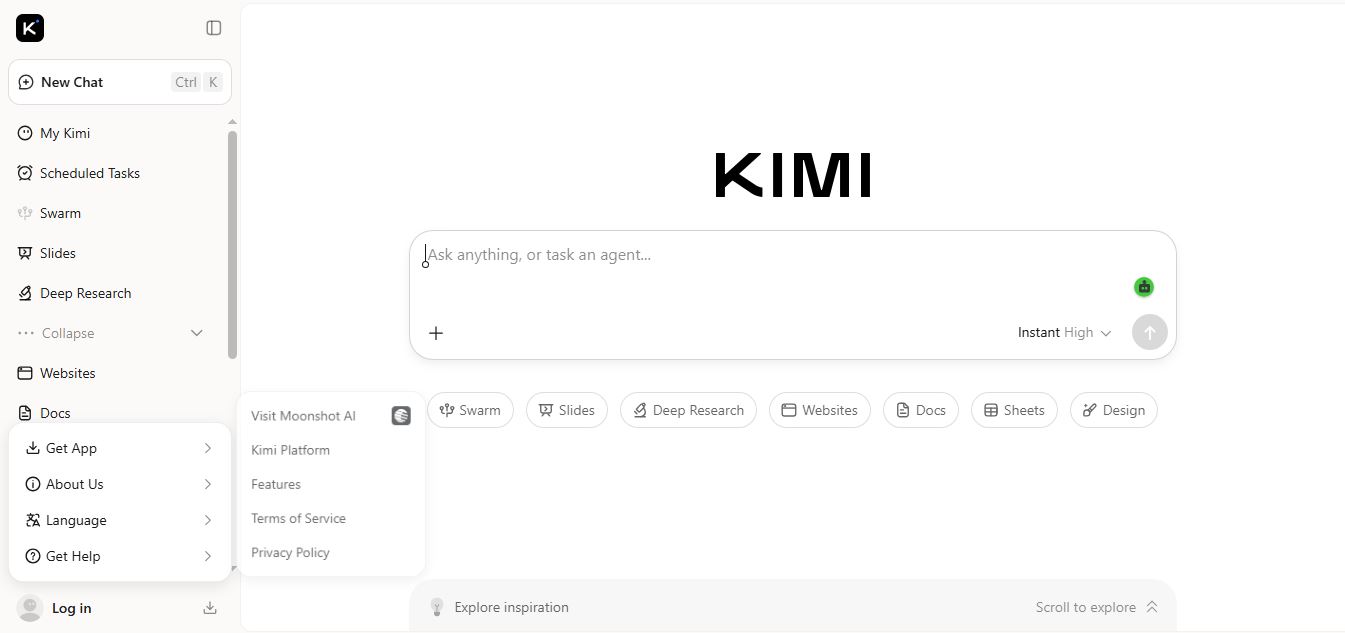
Kimi AI is an advanced AI assistant developed by Moonshot AI that helps you chat, research, write, code, and automate tasks in one place. It supports web search, file analysis, and multimodal inputs, and can even run autonomous “agent” workflows to complete complex tasks end-to-end.
Freemium

Fashion Diffusion AI
Fashion Diffusion is an AI-powered fashion design platform that helps brands and designers create clothing designs, virtual try-ons, AI models, product photos, and marketing visuals faster and cost-effectively.
Paid
Veo 4
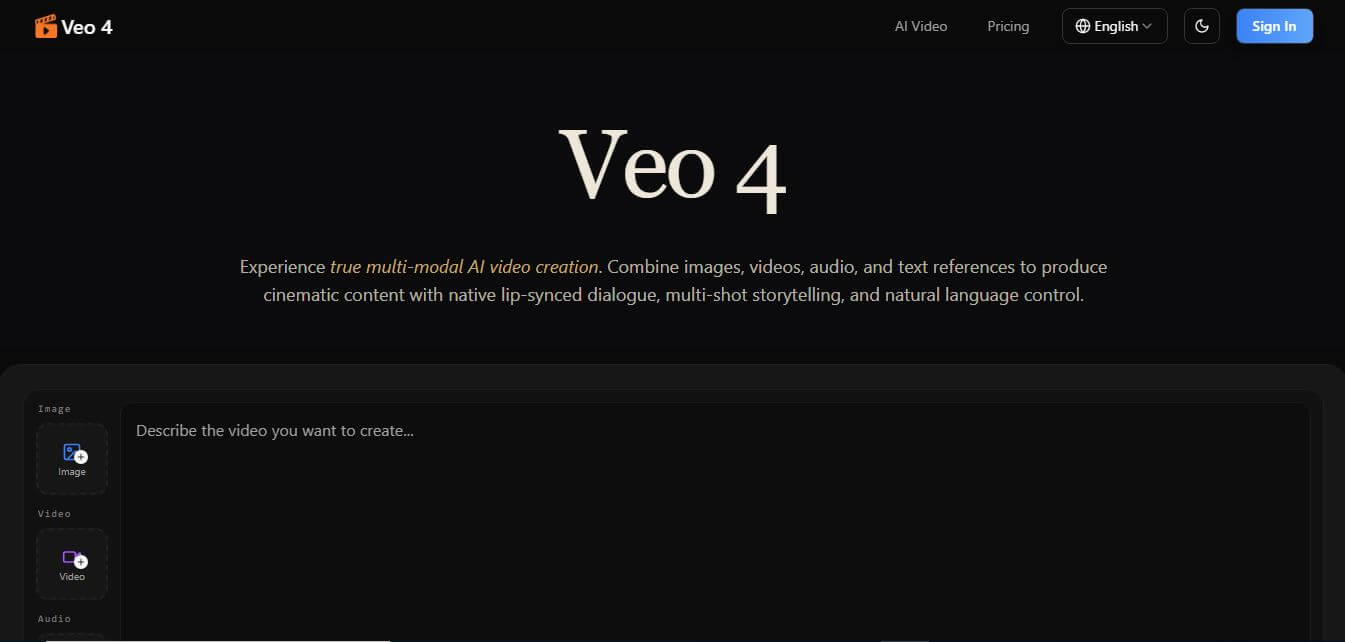
Veo 4 AI is an AI video creation platform that generates dramatic videos from text, images, audio, and video prompts using realistic motion and synchronized sound.
Paid