What Is a Utility-Based Agent?
A utility-based agent is an AI agent that evaluates possible outcomes using a utility function and selects actions that provide the greatest expected benefit according to its preferences. Unlike a simple reflex agent, which responds to the current situation using predefined rules, a utility-based agent compares potential outcomes. It can consider factors such as cost, speed, safety, convenience, and risk when deciding what to do.
For example, a navigation system may identify several routes to a destination. The shortest route may have heavy traffic, while another route may be safer and more reliable. A utility-based agent can compare travel time, traffic conditions, distance, and other factors to choose the route with the highest overall utility.
A utility-based agent chooses the action that offers the most desirable outcome based on its preferences.
How Does a Utility-Based Agent Work?
A utility-based agent typically perceives its environment, evaluates possible actions, estimates their outcomes, and chooses an action based on the utility of those outcomes.
Step 1: Perceive the environment
The agent collects information through sensors, user inputs, databases, APIs, or other sources.
Step 2: Identify possible actions
It determines which actions are available and considers the potential consequences of each option.
Step 3: Calculate utility
A utility function assigns a value to each possible outcome based on the agent's objectives and preferences.
Step 4: Compare alternatives
The agent compares the utility of possible actions. If outcomes are uncertain, it may calculate expected utility using their probabilities.
Step 5: Select and execute an action
The agent chooses an action with the highest expected utility among the available alternatives and observes the resulting state.
What Is a Utility Function in AI?
A utility function is a mathematical function that assigns a numerical value to an outcome, representing how desirable that outcome is for an agent. Utility values allow an AI system to compare different options when several factors influence a decision. Higher values generally represent more preferred outcomes under the defined utility model.
A simplified utility function can be expressed as:
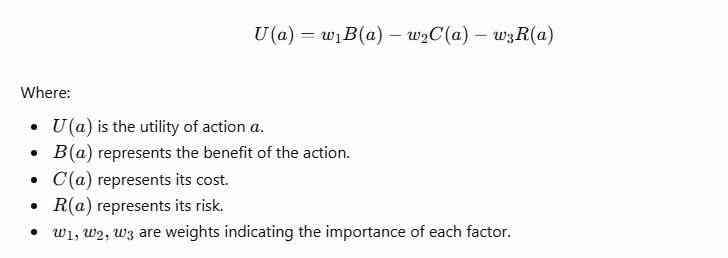
This is an illustrative model, not a universal utility formula. Real systems may use more factors, nonlinear functions, learned preferences, or probabilistic models.
Example of a Utility Function
Suppose a delivery agent compares three routes. For illustration, assume the utility score incorporates travel time, cost, and safety.
|
Route |
Travel time |
Cost |
Safety score |
Utility score |
|---|---|---|---|---|
|
Route A |
30 minutes |
₹100 |
6/10 |
55 |
|
Route B |
35 minutes |
₹80 |
9/10 |
78 |
|
Route C |
25 minutes |
₹150 |
7/10 |
52 |
These scores are hypothetical and assume a predefined scoring system. Under this utility model, Route B is preferred despite taking longer than Route C because its overall combination of cost and safety receives a higher score. The example illustrates an important point: the best action depends on how the agent values competing objectives, not simply on which option is fastest or cheapest.
Expected Utility and Decision-Making Under Uncertainty
In real-world environments, an AI agent may not know exactly what will happen after taking an action. Expected utility helps it compare actions when outcomes have different probabilities.
The expected utility of an action can be expressed as:
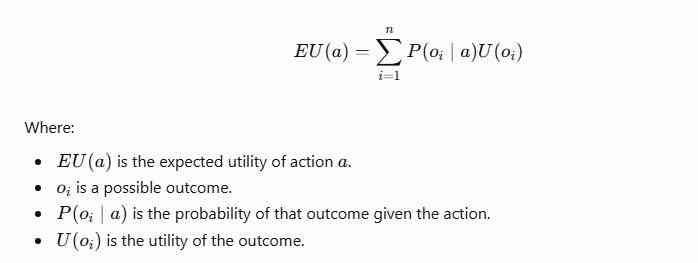
For example, a delivery agent may compare a fast route with a higher probability of traffic delays against a longer route with more predictable travel times. It can estimate the expected utility of both routes and select the option that best meets its objectives. Expected utility is especially useful in uncertain environments, but its quality depends on the accuracy of the probabilities, utility estimates, and assumptions used.
Characteristics of a Utility-Based Agent
Utility-based agents have several important characteristics:
- Outcome evaluation: They evaluate how desirable possible outcomes are.
- Preference-based decisions: Their decisions reflect a defined utility model.
- Alternative comparison: They compare multiple available actions instead of relying only on fixed rules.
- Support for multiple objectives: They can balance factors such as time, cost, safety, and performance.
- Uncertainty handling: They can use expected utility when outcomes are probabilistic.
- Adaptive decision-making: They can change their selected action when the environment or available information changes.
- Rational action selection: Under an appropriate model, they aim to select actions that maximize expected utility.
A utility-based agent is not automatically capable of learning or adapting its utility function. Learning depends on whether the system includes additional learning mechanisms.
Types and Approaches to Utility-Based Agents
Utility-based agents are often distinguished by how they evaluate outcomes and handle uncertainty.
|
Approach |
Description |
Example |
|---|---|---|
|
Deterministic utility-based agent |
Evaluates outcomes with known or assumed consequences |
Selecting the least costly route when travel times are known |
|
Expected-utility agent |
Compares actions using probabilities and expected outcomes |
Choosing a route under uncertain traffic conditions |
|
Multi-objective utility agent |
Combines multiple objectives into an overall utility score |
Balancing cost, speed, and safety |
|
Learning-based utility agent |
Learns or updates its decision model or preferences using data or feedback |
Improving recommendations based on user interactions |
These are useful conceptual categories rather than a universally standardized taxonomy. A real agent may combine several approaches.
Utility-Based Agent vs. Goal-Based Agent
Both utility-based and goal-based agents make decisions based on desired outcomes, but they evaluate outcomes differently.
|
Factor |
Utility-Based Agent |
Goal-Based Agent |
|---|---|---|
|
Main objective |
Maximize utility or preference value |
Achieve a specified goal |
|
Evaluation |
Scores outcomes according to desirability |
Determines whether actions help reach the goal |
|
Trade-offs |
Can compare different levels of benefit and cost |
May treat all goal-achieving outcomes as acceptable |
|
Multiple outcomes |
Can rank outcomes by preference |
Focuses on satisfying the goal conditions |
|
Uncertainty |
Can maximize expected utility |
Can plan toward a goal under uncertainty |
|
Example |
Selects a route balancing time, cost, and safety |
Selects a route that reaches a destination |
Key difference: A goal-based agent asks whether an action helps achieve a goal, while a utility-based agent also evaluates how desirable the resulting outcome is.
Utility-Based Agent vs. Other Intelligent Agents
|
Agent type |
How it makes decisions |
Example |
|---|---|---|
|
Simple reflex agent |
Uses condition-action rules based on current percepts |
A thermostat turns heating on when temperature falls below a threshold |
|
Model-based reflex agent |
Uses an internal model to track aspects of the environment |
A robot tracks obstacles it cannot currently see |
|
Goal-based agent |
Selects actions to achieve a goal |
A pathfinding agent navigates to a destination |
|
Utility-based agent |
Compares outcomes using utility values |
A navigation agent balances travel time, cost, and safety |
|
Learning agent |
Improves its behavior using experience or feedback |
A recommendation system learns from user interactions |
These categories describe different decision-making capabilities. They are not always mutually exclusive: a learning agent can also be utility-based, goal-based, or model-based.
Real-World Applications of Utility-Based Agents
- Autonomous Vehicles: Self-driving systems must balance safety, travel efficiency, passenger comfort, traffic conditions, and legal requirements when evaluating possible actions. Utility-like objective functions can help compare candidate behaviors, alongside hard safety constraints.
- Navigation Systems: Route-planning systems can rank alternatives based on estimated arrival time, distance, tolls, traffic, and user preferences.
- Recommendation Systems: Recommendation agents can rank products, videos, or articles based on relevance, user preferences, price, and other objectives.
- Robotics and Automation: Robots can evaluate actions according to task completion, energy consumption, movement time, and obstacle avoidance to select suitable behaviors.
- Financial Decision Support: Decision-support agents can compare potential strategies based on expected returns, costs, and risk preferences. Financial applications require suitable risk controls and should not rely solely on a simplified utility score.
- Smart Energy Management: Intelligent systems can balance electricity costs, energy demand, comfort, and equipment constraints when managing heating, cooling, or energy storage.
Benefits of Utility-Based Agents
Utility-based agents provide several advantages for complex AI decision-making.
- Better trade-off management: They can balance competing factors instead of optimizing only one metric.
- Flexible decision-making: They can select different actions as circumstances and preferences change.
- Support for uncertainty: Expected utility allows agents to compare actions with probabilistic outcomes.
- Preference-aware behavior: Utility functions can represent user or organizational priorities.
- Improved resource allocation: Agents can compare costs and benefits when allocating time, energy, or computing resources.
- Measurable decisions: Utility scores make it easier to compare alternatives under a consistent evaluation model.
- Broader applicability: The approach is useful in robotics, planning, recommendation, logistics, and decision-support applications.
Challenges and Limitations of Utility-Based Agents
Although utility-based agents are useful, their performance depends on the quality of the utility model and the information available.
- Designing the Utility Function: It can be difficult to convert real-world preferences into accurate numerical scores. A poorly designed utility function may cause the agent to favor undesirable outcomes.
- Conflicting Objectives: Some objectives compete with each other. For example, a route that minimizes time may increase cost or risk. Choosing appropriate weights and constraints can be challenging.
- Uncertain or Incomplete Information: An agent may not know the true probabilities of possible outcomes. Incorrect estimates can result in poor decisions even when the expected-utility calculation is mathematically correct.
- Computational Complexity: Evaluating many possible actions and future outcomes can be computationally expensive, particularly in large or dynamic environments.
- Changing Preferences: User preferences and operating conditions may change over time. A fixed utility function may not continue to reflect the intended priorities.
- Bias and Unintended Behavior: If the utility function rewards the wrong metric, an agent may optimize that metric in ways that conflict with the broader objective. For example, maximizing speed without adequate safety constraints could lead to dangerous choices.
- Safety and Ethical Constraints: Not every important requirement should be represented as a trade-off. Real-world systems often need hard constraints, safety checks, human oversight, and regulatory compliance in addition to utility maximization.
Best Practices for Designing a Utility-Based Agent
To develop a reliable utility-based agent:
- Define the objective clearly. Identify the outcomes the agent should prefer and the constraints it must respect.
- Choose meaningful utility factors. Include relevant factors such as cost, time, quality, risk, and user preferences.
- Set and validate weights. Use data, domain expertise, or stakeholder feedback to determine how factors should be weighted.
- Model uncertainty carefully. Use realistic probabilities when calculating expected utility.
- Add safety constraints. Prevent unacceptable actions instead of assuming a low utility score will always be sufficient.
- Test multiple scenarios. Evaluate behavior under normal conditions, unusual situations, and conflicting objectives.
- Monitor decisions. Check whether actual outcomes align with the intended goals and preferences.
- Update the model when necessary. Revise utility functions or estimates when user needs, operating conditions, or evidence changes.