What is Analytical AI?
Analytical AI is a type of artificial intelligence that uses huge amounts of organized and unstructured data to identify patterns, generate insights, make predictions, and propose actions. Unlike generative AI, which develops fresh content, analytical AI focuses solely on understanding and interpreting existing data.
Every business, hospital, bank, and government institution generates a huge amount of data. The issue has never been a lack of knowledge; it has always been a failure to take in it quickly enough to act on it. Analytical AI is the solution to that challenge.
Analytical AI is fundamentally defined as AI systems that evaluate data, find patterns, and transform results into actionable insights. These systems don't produce text or images. They do not engage in talks. They analyze past events, determine their causes, predict future events, and sometimes suggest actions.
According to a 2024 McKinsey Global Survey, organizations that embed Analytical AI into core business processes report up to 20% improvements in decision-making speed and significant reductions in forecasting errors. The global AI analytics market alone is projected to reach $119 billion by 2030, growing at a compound annual rate of over 26%.
The global AI analytics market, valued at approximately $14 billion in 2023, is on a trajectory to reach $119 billion by 2030 — a compound annual growth rate of around 26.4%. That figure reflects how central data-driven decision-making has become to modern business strategy and how rapidly organizations are replacing traditional reporting tools with AI-powered analytical systems. In practice, the impact is already visible. A 2024 Deloitte study found that companies using Analytical AI for supply chain management reduced forecasting errors by an average of 30 to 50%.
In financial services, AI-powered fraud detection systems now catch approximately 95% of fraudulent transactions before they complete—compared to around 60% for rule-based systems. Healthcare providers using predictive analytics have reduced unplanned hospital readmissions by up to 20% by identifying at-risk patients before discharge. Perhaps most telling is the competitive picture: McKinsey estimates that data-driven organizations are 23 times more likely to acquire new customers and 6 times more.
How Does Analytics AI Work?
Analytical AI works by moving data through a structured pipeline — from raw input to meaningful output. The process generally follows four stages.
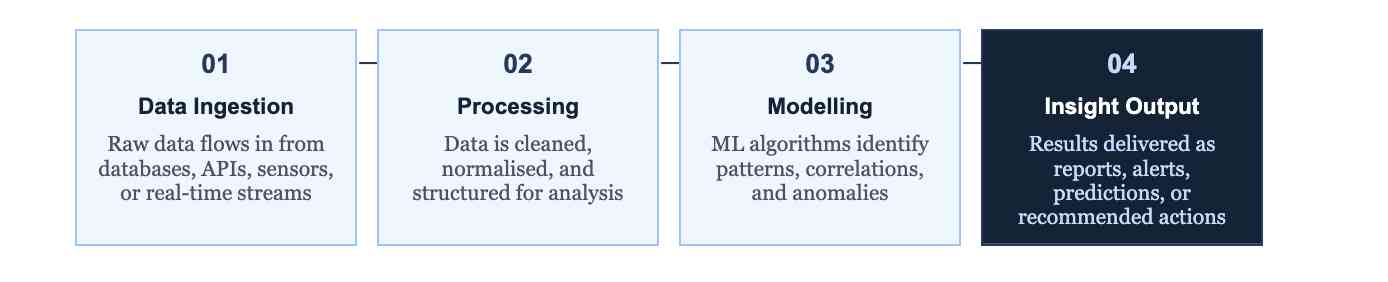
The machine learning layer is where the real intelligence sits. Depending on the task, an Analytical AI system might use regression models to forecast sales, clustering algorithms to segment customers, anomaly detection to flag unusual activity, or natural language processing to extract meaning from unstructured text like reviews or support tickets. The output is always the same goal: turning raw data into something a human or system can act on.
Why is Analytics AI Important?
Data is only valuable if you understand it. Most companies have massive datasets that they struggle to analyze, let alone understand. Analytical AI changes that equation. It transforms data from a storage burden to a strategic asset capable of being queried, processed, and acted upon at a tempo and scale that no human analytic team could do alone.
| Use Case | Description |
|---|---|
| Smarter business decisions | Leaders no longer rely on gut feel or stale quarterly reports. Analytical AI delivers real-time, data-backed insights on demand — reducing costly guesswork at every level. |
| Early warning systems | From detecting financial fraud to spotting early signs of equipment failure, Analytical AI flags issues before they escalate—often saving millions in reactive costs. |
| Personalisation at scale | Retailers, streaming platforms, and healthcare providers use Analytical AI to tailor experiences for millions of users simultaneously—something impossible through manual analysis. |
Type of Analytics AI
Analytical AI is not a single technique — it is a spectrum of capabilities, each answering a different question about data.
| Type | What It Does | Real-World Example |
|---|---|---|
| Descriptive AI | Answers: what happened? Summarises historical data to show trends, patterns, and performance over time. | Monthly sales dashboards, web traffic reports |
| Diagnostic AI | Answers: why did it happen? Drills into data to identify root causes behind observed trends or anomalies. | Churn analysis, quality failure root-cause tools |
| Predictive AI | Answers: what is likely to happen? Uses statistical models and ML to forecast future outcomes based on historical patterns. | Demand forecasting, credit risk scoring, churn prediction |
| Prescriptive AI | Answers: what should we do? Recommends specific actions to achieve the best outcomes beyond prediction. | Supply chain optimisation, treatment recommendation engines |
| Cognitive Analytics | Combines NLP and ML to extract insights from unstructured data like text, audio, and images that traditional tools cannot process. | Sentiment analysis, contract review, support ticket triage |
| Real-time Analytics | Processes and analyses data streams as they arrive, enabling instant decisions without waiting for batch processing. | Fraud detection, algorithmic trading, live inventory management |